

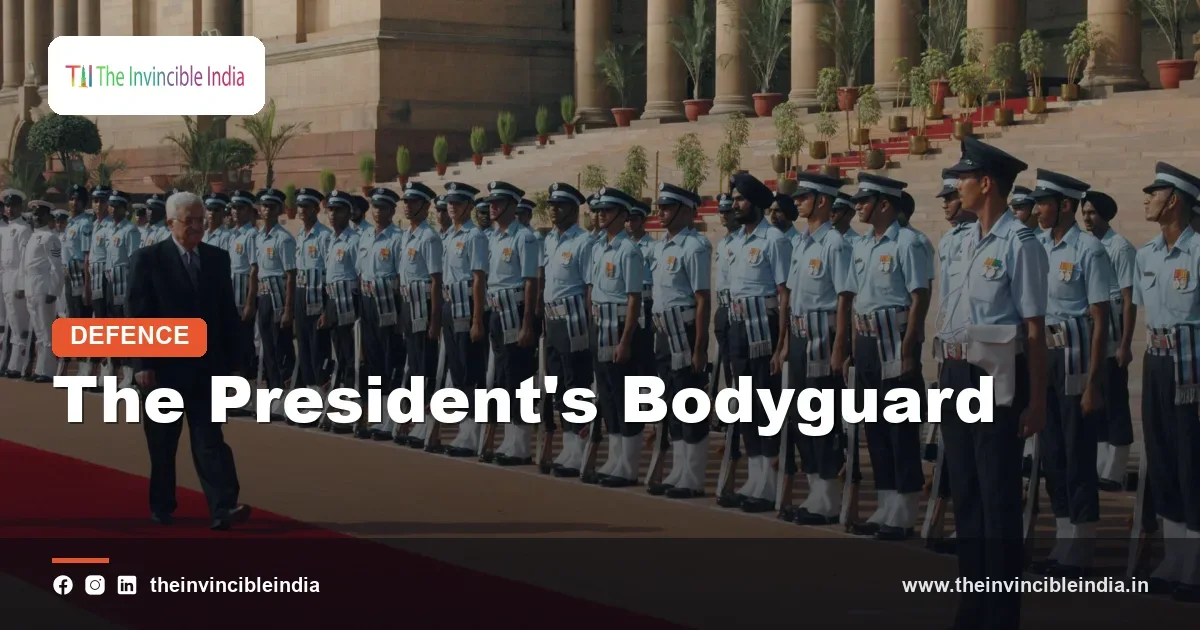
The President’s Bodyguard (PBG) is the senior-most regiment of the Indian Army, a household cavalry unit of roughly 160 personnel raised in 1773 that escorts the President of India on ceremonial occasions while also maintaining a full operational role as trained paratroopers. The regiment began as the Governor-General’s Bodyguard under the East India Company and has served the head of state, under different names, for well over two centuries.
The President’s Bodyguard is best known to the public for its red-and-gold ceremonial uniforms, its lances and its horses on Republic Day, but it is a regular unit of the Armoured Corps whose troopers are expected to be soldiers first. This explainer sets out the history, composition, duties, selection and traditions of the regiment; last reviewed on 8 October 2026.
| Quick Facts: President’s Bodyguard of India | |
|---|---|
| Official name | President’s Bodyguard (PBG) |
| Raised | 1773, at Banaras (Varanasi), as the Troop of Bodyguards of the Governor of Bengal |
| Founder | Warren Hastings, Governor of Bengal and later the first Governor-General |
| Present name since | 1950, when India became a republic |
| Type | Household cavalry regiment, part of the Armoured Corps of the Indian Army |
| Strength | About 160 officers and troopers |
| Seniority | Senior-most regiment of the Indian Army |
| Base | Delhi, in the Rashtrapati Bhavan area |
| Serves | The President of India, the Supreme Commander of the armed forces under Article 53 |
Key Takeaways
- The President’s Bodyguard was raised in 1773 and is the senior-most regiment of the Indian Army.
- The President’s Bodyguard began as a troop of about 50 men raised at Banaras by Warren Hastings, the Governor of Bengal, to guard the Governor.
- The regiment has about 160 members and combines a ceremonial role as the President’s escort with an operational role as parachute-trained soldiers.
- The President’s Bodyguard was known as the Governor-General’s Bodyguard and then the Viceroy’s Bodyguard before taking its present name in 1950.
- Recruitment to the President’s Bodyguard has traditionally been from Sikhs, Jats and Rajputs, and its troopers must meet exacting height and fitness standards.
- The President’s Bodyguard escorts the President at the Republic Day parade, at state ceremonies and at swearing-in occasions at Rashtrapati Bhavan.
What is the President’s Bodyguard of India?
The President’s Bodyguard of India is a mounted regiment of the Indian Army whose primary duty is to serve as the personal escort and ceremonial guard of the President of India. The President is the Supreme Commander of the armed forces under Article 53 of the Constitution, and the Bodyguard is the unit that stands closest to the head of state at ceremonies.
The regiment is administratively part of the Armoured Corps, the arm of the Army that traditionally descends from the cavalry. It is among the few units of the Army that still maintains a regular mounted establishment of horses, and it is generally regarded as the oldest unit of its kind in the country.
Despite its ceremonial prominence, the Bodyguard is a combat unit. Its members belong to the Indian Army, hold the same ranks and follow the same discipline as soldiers of other regiments, and are expected to be fully trained for operational tasks.
When and how was the President’s Bodyguard raised?
The President’s Bodyguard was raised in 1773 by Warren Hastings, then Governor of Bengal, as a small mounted troop to protect the Governor, and it is therefore older than the Indian Army in its modern form. The original troop was a few dozen men, commonly stated as 50, recruited from among horsemen and based initially at Banaras.
The unit grew over time and was renamed several times as the office it served changed in title. The sequence of names tells the story of Indian constitutional history in miniature.
Timeline of the regiment
| Period | Name or event |
|---|---|
| 1773 | Troop of Bodyguards raised at Banaras for the Governor of Bengal |
| Late 18th and 19th century | Serves as the Governor-General’s Bodyguard and takes part in several campaigns of the East India Company |
| 1858 onward | Serves the Viceroy of India after the Crown takes over from the East India Company |
| 1947 | Independence and Partition; the unit’s assets and personnel are divided between India and Pakistan |
| 1947 to 1950 | Serves the Governor-General of India |
| 1950 | Becomes the President’s Bodyguard when India becomes a republic |
During the 19th century the regiment saw active service in the East India Company’s campaigns and earned battle honours. In the twentieth century, it was mainly a ceremonial unit, though its soldiers continued to be fully trained for field duties.
What happened to the Bodyguard at Partition?
At Partition in 1947, the Governor-General’s Bodyguard was divided between India and Pakistan, with each country receiving a portion of the personnel and equipment. The regiment’s silver ceremonial coach is widely reported to have been allotted to India after the two commanding officers settled the question with the toss of a coin.
The Indian share of the unit consisted largely of its Sikh and Rajput and Jat squadrons, which formed the core of the Bodyguard that continues today. The Pakistani share became the equivalent unit serving that country’s head of state.
After Independence, the Bodyguard continued to serve the Governor-General, Lord Mountbatten and then C. Rajagopalachari, and in 1950 it was re-designated as the President’s Bodyguard when Dr Rajendra Prasad became the first President of India.
What are the roles of the President’s Bodyguard?
The President’s Bodyguard has a dual role: a ceremonial role as the mounted escort and guard of honour for the President of India, and an operational role as a trained fighting unit of the Army. The Army regards both as equally important, and the troopers are chosen and trained with both in mind.
Ceremonial role
The Bodyguard’s ceremonial duties form the basis of its public identity. It escorts the President on occasions such as the Republic Day parade on Kartavya Path in New Delhi, the formal welcome given to visiting heads of state at the forecourt of Rashtrapati Bhavan, the President’s swearing-in and the Beating Retreat ceremony. Troopers also mount guard at Rashtrapati Bhavan on ceremonial occasions.
On Republic Day, the President travels with the Bodyguard’s mounted escort. The use of a horse-drawn carriage for the President’s journey to the parade was discontinued for some decades and was revived in 2014, giving the regiment a visible role in the parade once more.
Operational role
The operational role means that the regiment’s soldiers are trained as paratroopers and, alongside this, receive training in tank-related skills linked to the Armoured Corps and other military tasks. They have also been selected for qualifications connected with Army aviation and other specialised duties. This ensures that the unit is not just a showpiece but a body of soldiers who can be deployed in the field if required.
The Bodyguard has contributed personnel to operational tasks, and its soldiers have served in the field. As a small regiment, it supports operations with detachments, not as a complete unit.
How big is the President’s Bodyguard and how is it organised?
The President’s Bodyguard has a strength of about 160 officers and men, making it one of the smallest regiments in the Indian Army. It is commanded by a Colonel-rank officer, usually an officer from the Armoured Corps, and is organised in a way that reflects both its mounted and its operational function.
The regiment’s mounted element is the part seen in public. Its members are divided into squadrons or troops for the purpose of ceremonial duties, and the bulk of the men are drawn from the three traditional classes from which the regiment recruits. A farrier, saddlers, grooms and a veterinary team support the troopers by looking after the horses.
The regiment also has a band element, and the trumpeters of the Bodyguard are an important part of its ceremonial turnout. The regiment’s headquarters is located in Delhi, near Rashtrapati Bhavan, where its stables and barracks are situated.
Who can join the President’s Bodyguard and how are troopers selected?
Troopers of the President’s Bodyguard are traditionally recruited from Sikhs, Jats (Hindu Jats and Jat Sikhs) and Rajputs, and they are selected through a rigorous process that stresses height, physique and fitness. The regiment has historically followed a class-based recruitment practice similar to other old cavalry regiments of the Army, and this pattern continues to define its composition.
Selection for the regiment is notable for the physical requirements. Troopers have to be tall and well-built enough to look uniform when riding in formation, and they must also pass the Army’s usual medical, physical and educational tests. After joining, they receive Armoured Corps training, riding instruction and a parachute course.
Because the troopers must serve in the ceremonial and the operational roles, selection is competitive and the soldiers who join are normally expected to remain in the regiment for much of their career. The officers, by contrast, are posted from the wider Armoured Corps.
What are the horses, lances and uniforms of the President’s Bodyguard?
The President’s Bodyguard rides horses and carries lances as part of a full-dress ceremonial kit, and its uniform is a red tunic with gold braid, white breeches, high boots and a turban with a distinctive crest. The turban and tunic are among the most easily recognised ceremonial dress items in the country.
- Horses: The regiment maintains a stable of carefully selected horses, which are trained to stay calm amid crowds, bands and flypasts. They are mostly well-built animals of the larger riding breeds, and they are matched in appearance for the parade.
- Lances: Each mounted trooper carries a lance with a small pennant, a weapon that is a link to the regiment’s cavalry heritage.
- Sword: Troopers also carry a sabre as part of full dress.
- Uniform: The red and gold full-dress uniform is worn only on ceremonial occasions, while the regiment’s troopers wear standard Army combat dress during operational training.
The horses of the Bodyguard are looked after to a very high standard, and caring for them is a daily responsibility of the troopers. Horse and rider train together for months before major events such as Republic Day.
Why is the President’s Bodyguard considered the senior-most regiment?
The President’s Bodyguard is considered the senior-most regiment of the Indian Army because it was raised in 1773, earlier than any other unit now on the Army’s rolls, and because it is positioned first in the order of precedence among regiments. On parade, the Bodyguard takes the right of the line, an honour that reflects both its age and its closeness to the head of state.
Seniority in the Army has practical meaning on ceremonial occasions, since it decides the order in which units march and take their places. It also carries symbolic weight, because the regiment serves the person who sits at the top of the constitutional hierarchy.
The title reflects continuity: the Bodyguard has served successive heads of state, from Governors to Governors-General and Viceroys, and finally to Presidents, without a break in its identity.
What traditions does the President’s Bodyguard follow?
The traditions of the President’s Bodyguard draw on its cavalry origins and include formal ceremonial drills, the maintenance of regimental colours and customs, and an emphasis on loyalty and discipline. Many of these traditions have been carried over from the days of the Governor-General’s Bodyguard and are passed on through the regiment’s training.
The regiment’s identity is also expressed through regimental events and customs that mark its long history, and it is regularly called upon to provide the guard of honour at Rashtrapati Bhavan.
The cavalry spirit is reflected in daily life as well. Troopers take pride in their horsemanship, in the turn-out of the horse and the rider and in the precision of their movements in formation.
Bottom Line
The President’s Bodyguard is the Indian Army’s senior-most regiment, a small mounted unit of about 160 that has guarded the head of state since 1773. It combines a ceremonial role that is visible every Republic Day with an operational role as trained paratroopers, and that dual identity is what makes it unusual.
Frequently Asked Questions
What is the President’s Bodyguard?
The President’s Bodyguard is the senior-most regiment of the Indian Army and serves as the mounted escort of the President of India. It was raised in 1773 and has about 160 members. It is part of the Armoured Corps and is based in Delhi.
When was the President’s Bodyguard raised?
The President’s Bodyguard was raised in 1773 by Warren Hastings, the Governor of Bengal, at Banaras. It began as a troop of about 50 horsemen. It later served as the Governor-General’s Bodyguard, the Viceroy’s Bodyguard and, since 1950, the President’s Bodyguard.
What does the President’s Bodyguard do?
The President’s Bodyguard escorts the President on ceremonial occasions such as the Republic Day parade, and it provides guards of honour at Rashtrapati Bhavan. It also has an operational role, as its troopers are trained paratroopers. The regiment therefore serves as both a ceremonial and a fighting unit.
Who is recruited into the President’s Bodyguard?
Troopers are traditionally recruited from Sikhs, Jats and Rajputs and must meet strict standards of height, physique and fitness. They undergo Armoured Corps training, riding instruction and a parachute course. Officers are posted from the wider Armoured Corps.
How many members does the President’s Bodyguard have?
The President’s Bodyguard has about 160 officers and troopers, which makes it one of the smallest regiments in the Indian Army. Its small size reflects its specialised role as a household cavalry unit. Its mounted troopers are supported by grooms, farriers and a band.
Why is the President’s Bodyguard called the senior-most regiment?
The President’s Bodyguard is called the senior-most regiment because it was raised in 1773, before any other unit on the Army’s rolls, and ranks first in precedence. On parade it takes the right of the line. It has served each successive head of state since the days of the Governor of Bengal.
{“@context”:”https://schema.org”,”@graph”:[{“@type”:”FAQPage”,”mainEntity”:[{“@type”:”Question”,”name”:”What is the President’s Bodyguard?”,”acceptedAnswer”:{“@type”:”Answer”,”text”:”The President’s Bodyguard is the senior-most regiment of the Indian Army and serves as the mounted escort of the President of India. It was raised in 1773 and has about 160 members. It is part of the Armoured Corps and is based in Delhi.”}},{“@type”:”Question”,”name”:”When was the President’s Bodyguard raised?”,”acceptedAnswer”:{“@type”:”Answer”,”text”:”The President’s Bodyguard was raised in 1773 by Warren Hastings, the Governor of Bengal, at Banaras. It began as a troop of about 50 horsemen. It later served as the Governor-General’s Bodyguard, the Viceroy’s Bodyguard and, since 1950, the President’s Bodyguard.”}},{“@type”:”Question”,”name”:”What does the President’s Bodyguard do?”,”acceptedAnswer”:{“@type”:”Answer”,”text”:”The President’s Bodyguard escorts the President on ceremonial occasions such as the Republic Day parade, and it provides guards of honour at Rashtrapati Bhavan. It also has an operational role, as its troopers are trained paratroopers. The regiment therefore serves as both a ceremonial and a fighting unit.”}},{“@type”:”Question”,”name”:”Who is recruited into the President’s Bodyguard?”,”acceptedAnswer”:{“@type”:”Answer”,”text”:”Troopers are traditionally recruited from Sikhs, Jats and Rajputs and must meet strict standards of height, physique and fitness. They undergo Armoured Corps training, riding instruction and a parachute course. Officers are posted from the wider Armoured Corps.”}},{“@type”:”Question”,”name”:”How many members does the President’s Bodyguard have?”,”acceptedAnswer”:{“@type”:”Answer”,”text”:”The President’s Bodyguard has about 160 officers and troopers, which makes it one of the smallest regiments in the Indian Army. Its small size reflects its specialised role as a household cavalry unit. Its mounted troopers are supported by grooms, farriers and a band.”}},{“@type”:”Question”,”name”:”Why is the President’s Bodyguard called the senior-most regiment?”,”acceptedAnswer”:{“@type”:”Answer”,”text”:”The President’s Bodyguard is called the senior-most regiment because it was raised in 1773, before any other unit on the Army’s rolls, and ranks first in precedence. On parade it takes the right of the line. It has served each successive head of state since the days of the Governor of Bengal.”}}]}]}


