

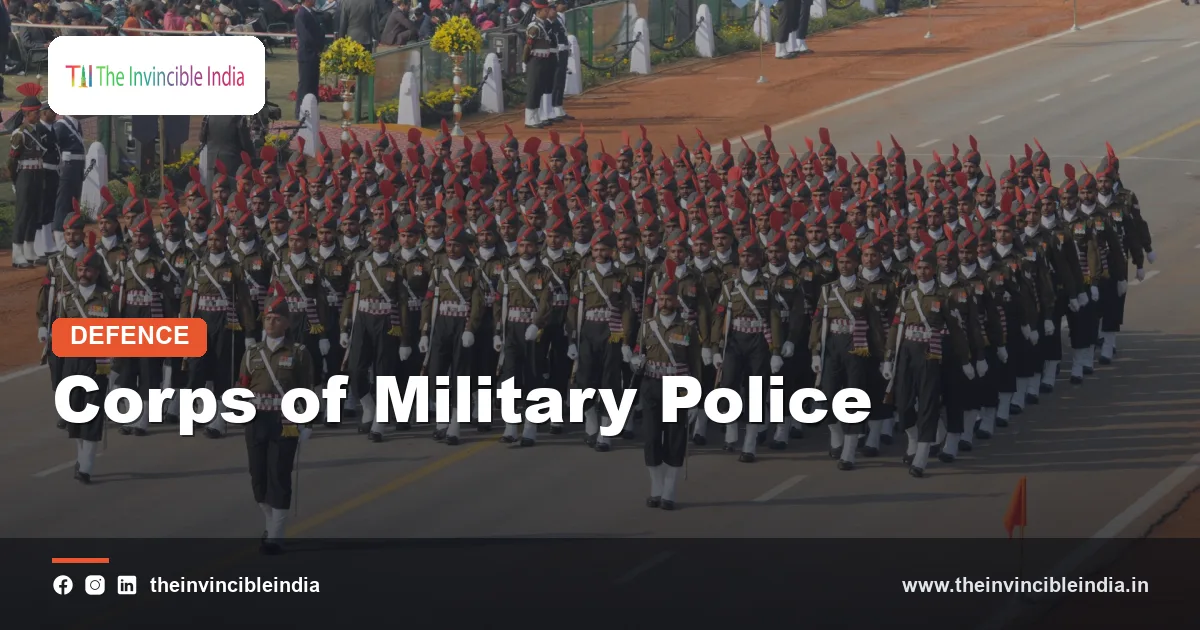
The Corps of Military Police (CMP) is the Indian Army’s own police force, responsible for maintaining discipline, enforcing law and order among military personnel, regulating traffic and movement, and handling prisoners of war. Military police units work within the Army’s chain of command and under the Army Act, 1950, which means they police soldiers rather than the civilian public.
The Corps of Military Police is a combat service support arm whose members are easily recognised by their distinctive headgear and duty armbands at checkpoints, ceremonial events and traffic posts. In recent years the Corps has also drawn national attention for inducting women as soldiers, a landmark step that opened general-duty soldier ranks in the Army to women.
Quick Facts
| Item | Corps of Military Police (CMP) |
|---|---|
| Parent force | Indian Army |
| Category | Combat service support arm (provost and military police) |
| Legal basis | Army Act, 1950 and Army Rules, 1954, along with Army Headquarters orders |
| Lineage | Descends from provost establishments of the colonial armies; organised as a separate corps in the twentieth century |
| Core functions | Discipline and law and order, traffic control, route management, prisoners of war, security duties, investigation of service offences |
| Training establishment | CMP Centre and School, Bengaluru (Karnataka) |
| Heritage identity | Associated with the Battle of Assaye (1803) |
| Notable recent milestone | Induction of women soldiers into the Corps, with the first batch training in Bengaluru from 2021 |
Key Takeaways
- The Corps of Military Police is the Indian Army’s military police, responsible for policing service personnel and maintaining discipline within the Army.
- The Corps of Military Police works under the Army Act, 1950, and does not exercise general policing powers over the civilian population.
- Core tasks of the Corps of Military Police include traffic control, movement and route management, security duties, and the custody of prisoners of war and stragglers.
- The CMP Centre and School in Bengaluru is the training home of the Corps of Military Police.
- The Corps of Military Police is associated with the heritage of Assaye, a 1803 battle of the Second Anglo-Maratha War, as part of its corps identity.
- The Indian Army began inducting women as soldiers into the Corps of Military Police in 2021, a widely reported first for general-duty soldier ranks in the Army.
What is the Corps of Military Police?
The Corps of Military Police is the arm of the Indian Army that performs police duties within the Army, enforcing military discipline, regulating movement and protecting military property and personnel. It is staffed by officers, junior commissioned officers and soldiers who are selected for integrity, physical fitness and judgement and trained in policing skills.
In the Army’s structure, the CMP is a support arm, alongside the Army Service Corps, Army Ordnance Corps, Corps of EME and others. Its authority comes from military law and orders, and it works under the supervision of the Provost Marshal at Army Headquarters and subordinate provost staff in commands and formations. Unlike the civil police, military police generally deal with offences by persons subject to the Army Act, though they cooperate closely with state police in areas where soldiers and civilians interact.
What are the main functions of the Corps of Military Police?
The main functions of the Corps of Military Police are maintaining discipline and law and order among troops, controlling traffic and movement, handling prisoners, and providing security. These duties are carried out in peacetime stations, cantonments and in the field during operations.
Discipline and law and order
- Patrolling military areas, cantonments and railway stations and bus stands used by troops.
- Checking the conduct and dress of personnel on duty and on leave in public places.
- Apprehending soldiers who commit offences, absent themselves without leave or break rules.
- Assisting commanding officers and investigating authorities in service-related inquiries.
Traffic and route control
- Directing traffic at junctions, bridges and defiles used by military columns.
- Marking and signing routes and enforcing speed, spacing and order of march.
- Establishing traffic control posts and holding areas during large troop movements.
Security and escort duties
- Guarding key military installations, headquarters and ceremonial events.
- Providing security and close protection to senior military dignitaries and visiting officials as ordered.
- Escorting convoys and prisoners.
Prisoners and stragglers
- Collecting, guarding and evacuating prisoners of war.
- Rounding up stragglers, meaning soldiers separated from their units during or after an action.
- Managing military detention arrangements in accordance with law.
How does the Corps of Military Police differ from civil police?
The Corps of Military Police differs from civil police because it is part of the armed forces, works under military law and mainly polices service personnel, whereas civil police are state agencies enforcing the general criminal law on the public. The two work together when incidents involve both soldiers and civilians.
| Feature | Corps of Military Police | Civil police |
|---|---|---|
| Parent organisation | Indian Army | State governments (and Union Territory administrations) |
| Main law | Army Act, 1950 and Army Rules | Code of Criminal Procedure and Indian penal laws |
| Jurisdiction | Persons subject to military law and military areas | General public across the state |
| Typical duties | Discipline, traffic for military columns, prisoners of war, security of installations | Crime prevention, investigation, public order, traffic |
| Wartime role | Prisoner handling, route control, stragglers | Continues civil policing |
What is the history of military policing in India?
Military policing in India began with the provost systems of the East India Company’s armies and was organised into a dedicated Corps in the twentieth century. Armies of the period needed provost officers to deal with plunder, desertion and camp discipline, and these functions became more formal as the armies grew.
During the Second World War, the scale and variety of tasks grew: Indian divisions fought in North Africa, Italy and Burma, and large camps and lines of communication needed traffic control, security and prisoner handling. Military police units expanded in this period. After Independence in 1947, the Corps was retained as part of the Indian Army and its organisation was adapted to national needs, including the management of prisoners during later wars.
A well-known example of its wartime duty came after the 1971 war, when the Indian Army held more than ninety thousand Pakistani prisoners of war. Guarding, moving and administering such numbers in accordance with the Geneva Conventions required large-scale planning and a major contribution from military police and other units.
Why is the Corps of Military Police associated with Assaye?
The Corps of Military Police is associated with Assaye because it adopted the memory of the Battle of Assaye, fought in September 1803, as part of its heritage and identity. Assaye was one of the major engagements of the Second Anglo-Maratha War, where a British-led force under Arthur Wellesley, later the Duke of Wellington, defeated a larger Maratha army.
Many Indian Army units trace traditions to colonial-era battles in which their ancestor formations took part, and these traditions are passed down through battle honours, mess customs and commemorations. For the CMP, the name Assaye serves as a link to the lineage of provost and policing duties in the old armies and stands as a symbol of the Corps’ pride in service. As with other corps, the heritage is commemorated through its centre, museum and ceremonies, and it is used to build esprit de corps among military police personnel.
How do military police control traffic and movement?
Military police control traffic and movement by planning routes, setting up traffic control posts and directing columns so that large numbers of vehicles can move safely and on time. Orderly movement is essential during exercises and operations, because congestion on a single road can delay an entire formation and expose it to danger.
Main tasks in movement control include:
- Route reconnaissance and marking: Selecting and signing routes, with clear signs and guides at junctions.
- Traffic control posts: Manned points where military police regulate flow, check movement orders and pass information.
- Convoy regulation: Maintaining vehicle spacing, halts and order of march.
- Diversions and priorities: Giving priority to ambulances, command vehicles and urgent loads.
- Coordination with civil authorities: Working with the state police and highway authorities when columns use public roads.
How does the Corps of Military Police handle prisoners of war?
The Corps of Military Police handles prisoners of war by taking custody of them near the point of capture, escorting them to collection points and guarding them under the rules of the Geneva Conventions. Armies are required to treat prisoners humanely, protect them from violence and provide food, shelter and medical care.
The process generally moves in stages:
- Prisoners are secured and searched at or near the point of capture.
- They are moved to forward collection points and then to rear camps under escort.
- Intelligence personnel may question them in accordance with law, while military police maintain security and order.
- Camps are administered with attention to welfare, records and eventual repatriation after hostilities.
The Corps also handles stragglers, who may be disoriented or separated from their units, and ensures they are returned to the correct formation.
Why did the Indian Army induct women into the Corps of Military Police?
The Indian Army inducted women into the Corps of Military Police to widen the role of women in the armed forces and to enable women soldiers to take part in policing tasks, including those involving women civilians and personnel. The decision was announced in 2019, and the first batch of women soldiers began training in 2021 at the CMP Centre and School in Bengaluru.
Before this, women were commissioned as officers in several arms and services, but the ranks below officer level had remained largely closed to them in the Army, apart from medical and nursing roles. The induction in the CMP opened soldier-level service in a combat support arm. The intended plan was to induct women in annual batches and increase their share in the Corps gradually over time.
The move was seen as significant for several reasons:
- It created a pathway for women to serve as soldiers, not only as officers.
- It provided the Army with personnel to handle checks, searches and other tasks involving women.
- It reflected a broader trend of expanding women’s roles in the Indian armed forces.
How are military police trained and organised?
Military police are trained at the CMP Centre and School in Bengaluru and organised into units attached to commands, corps and divisions, with provost staff at higher headquarters. Training covers law, powers of arrest, traffic and escort procedures, security techniques, and basic soldiering.
The organisation typically includes:
- Provost Marshal and staff: Senior officers who advise commanders on discipline, security and movement control.
- Military police companies and detachments: Units providing local policing and traffic control for a formation or station.
- Specialist teams: Personnel for investigation, security and ceremonial duties.
- Training staff: Instructors at the centre and school who teach policing and drill.
Selection and training emphasise integrity, fairness and firmness, because military police regularly deal with their fellow soldiers and must maintain trust.
Bottom Line
The Corps of Military Police keeps the Indian Army orderly, mobile and secure by enforcing discipline, managing traffic and holding prisoners lawfully. Its heritage symbol of Assaye and the recent induction of women soldiers show a Corps that values both tradition and change, and its quiet work underpins many of the Army’s activities.
Frequently Asked Questions
What does the Corps of Military Police do in the Indian Army?
The Corps of Military Police acts as the Army’s police force, maintaining discipline and law and order among troops. It also controls traffic and movement, handles prisoners of war and stragglers, and provides security duties. Its powers come from the Army Act, 1950 and military orders.
Can military police arrest civilians?
The Corps of Military Police is mainly responsible for persons subject to military law and for military areas, not for the general public. In cases involving civilians, military police normally cooperate with and hand over matters to the civil police. Their specific powers depend on law and on the circumstances.
Where are military police trained?
Military police are trained at the CMP Centre and School in Bengaluru, Karnataka. The institution provides recruit training and courses in policing, law, traffic control and security. It is also where the first batch of women soldiers for the Corps began training.
What is the connection between the Corps of Military Police and Assaye?
The Corps of Military Police is associated with the heritage of the Battle of Assaye, fought in 1803 during the Second Anglo-Maratha War. The name forms part of the Corps’ identity and traditions. It links the Corps to the long lineage of provost and policing duties in the Army.
When did women join the Corps of Military Police?
Women were announced as soldiers in the Corps of Military Police in 2019, and the first batch began training in 2021 in Bengaluru. This was widely reported as the first induction of women into general-duty soldier ranks of the Army. The plan was to expand their numbers in annual batches.
How does the Corps handle prisoners of war?
The Corps of Military Police takes custody of prisoners of war, escorts them to collection points and guards them in camps under the Geneva Conventions. Prisoners must be treated humanely and given food, shelter and medical care. The Corps also helps maintain records and security until prisoners are repatriated.
{“@context”:”https://schema.org”,”@graph”:[{“@type”:”FAQPage”,”mainEntity”:[{“@type”:”Question”,”name”:”What does the Corps of Military Police do in the Indian Army?”,”acceptedAnswer”:{“@type”:”Answer”,”text”:”The Corps of Military Police acts as the Army’s police force, maintaining discipline and law and order among troops. It also controls traffic and movement, handles prisoners of war and stragglers, and provides security duties. Its powers come from the Army Act, 1950 and military orders.”}},{“@type”:”Question”,”name”:”Can military police arrest civilians?”,”acceptedAnswer”:{“@type”:”Answer”,”text”:”The Corps of Military Police is mainly responsible for persons subject to military law and for military areas, not for the general public. In cases involving civilians, military police normally cooperate with and hand over matters to the civil police. Their specific powers depend on law and on the circumstances.”}},{“@type”:”Question”,”name”:”Where are military police trained?”,”acceptedAnswer”:{“@type”:”Answer”,”text”:”Military police are trained at the CMP Centre and School in Bengaluru, Karnataka. The institution provides recruit training and courses in policing, law, traffic control and security. It is also where the first batch of women soldiers for the Corps began training.”}},{“@type”:”Question”,”name”:”What is the connection between the Corps of Military Police and Assaye?”,”acceptedAnswer”:{“@type”:”Answer”,”text”:”The Corps of Military Police is associated with the heritage of the Battle of Assaye, fought in 1803 during the Second Anglo-Maratha War. The name forms part of the Corps’ identity and traditions. It links the Corps to the long lineage of provost and policing duties in the Army.”}},{“@type”:”Question”,”name”:”When did women join the Corps of Military Police?”,”acceptedAnswer”:{“@type”:”Answer”,”text”:”Women were announced as soldiers in the Corps of Military Police in 2019, and the first batch began training in 2021 in Bengaluru. This was widely reported as the first induction of women into general-duty soldier ranks of the Army. The plan was to expand their numbers in annual batches.”}},{“@type”:”Question”,”name”:”How does the Corps handle prisoners of war?”,”acceptedAnswer”:{“@type”:”Answer”,”text”:”The Corps of Military Police takes custody of prisoners of war, escorts them to collection points and guards them in camps under the Geneva Conventions. Prisoners must be treated humanely and given food, shelter and medical care. The Corps also helps maintain records and security until prisoners are repatriated.”}}]}]}


