

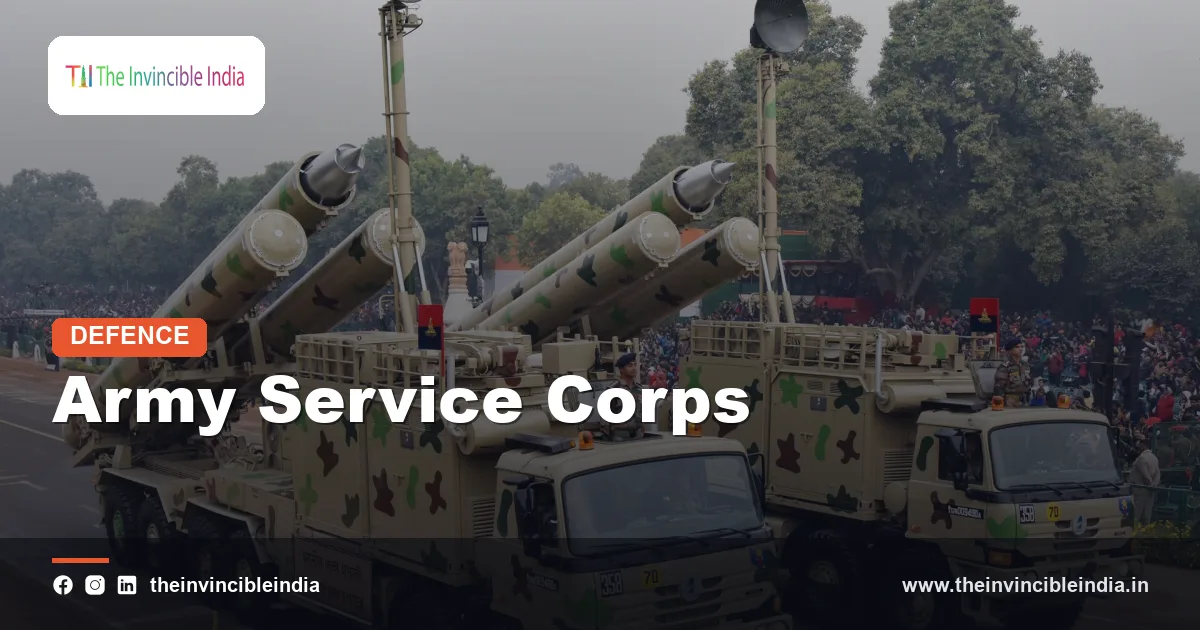
The Army Service Corps (ASC) is the logistics arm of the Indian Army that supplies food, fuel and other essentials to troops and provides the transport, by road, by air and by animal, that keeps them moving. As a combat service support arm, the Army Service Corps does not usually fight on the front line, but no formation can sustain operations without the rations, petrol, oil and lubricants (POL) and vehicles the Corps delivers.
The Corps has a lineage reaching back to the supply and transport services of the colonial armies and has served in two World Wars and every major operation since Independence. It is known for working in the toughest terrain, from deserts to glaciers, and for running some of the last animal transport units in the Indian military.
Quick Facts
| Item | Army Service Corps (ASC) |
|---|---|
| Parent force | Indian Army |
| Category | Combat service support arm (logistics) |
| Origins | Supply and transport services of the East India Company armies, formalised in the early twentieth century as the Indian Army Service Corps |
| Core functions | Supplies (rations, POL, fresh food), transport, air dispatch, and related support |
| Transport types | Mechanical transport, animal transport (mules and ponies), and air dispatch |
| Training establishment | ASC Centre and College, Bengaluru (Karnataka) |
| Staff supervision | Directorate of Supplies and Transport at Army Headquarters, under the Quartermaster General’s Branch |
| Associated corps | Army Ordnance Corps (stores and ammunition), Corps of Electronics and Mechanical Engineers (repair), Army Medical Corps |
Key Takeaways
- The Army Service Corps is the Indian Army’s main supply and transport arm, responsible for rations, fuel, and the vehicles and animals that carry them.
- The Army Service Corps is a combat service support arm, which means it supports fighting arms such as the Infantry, Armoured Corps and Regiment of Artillery rather than engaging the enemy directly.
- The Corps operates mechanical transport companies, animal transport units with mules and ponies, and air dispatch units that drop supplies by parachute.
- The Army Service Corps traces its heritage to the supply and transport services of the colonial armies and became the Indian Army Service Corps in the early twentieth century.
- The ASC Centre and College in Bengaluru trains the Corps’ officers, junior commissioned officers and soldiers in supply, transport and allied skills.
- The Army Service Corps is vital in high-altitude and remote areas, where supplies often reach forward posts by mule, porter, helicopter or airdrop when roads are unavailable.
What is the Army Service Corps?
The Army Service Corps is the arm of the Indian Army that procures, stores, transports and issues the supplies that troops need to live and fight, particularly food, fuel and general transport. It is staffed by officers, junior commissioned officers and other ranks who are trained as logisticians, drivers, handlers and dispatchers.
In Army doctrine, logistics is organised by function. Ammunition, equipment and general stores are handled by the Army Ordnance Corps, vehicle and equipment repair by the Corps of Electronics and Mechanical Engineers (EME), and medical care by the Army Medical Corps. The Army Service Corps handles the portion of the chain concerned with supplies such as rations and POL and with the transport that moves goods, personnel and sometimes equipment. Together, these arms and services form the administrative backbone that allows commanders to plan operations.
What does the Army Service Corps do?
The Army Service Corps supplies food and fuel to troops and operates the transport used to move people and material between rear bases and forward areas. These duties are often summarised as “supply” and “transport”, though the Corps performs several related tasks.
Supply
- Procurement, storage, and issue of rations, including fresh and preserved food, to troops in peacetime locations and in the field.
- Management of petrol, oil and lubricants (POL) for vehicles, generators, aircraft support at forward locations and other equipment.
- Operation of supply depots and field supply points that are set up close to formations during operations.
- Management of bulk items like firewood, kerosene, winter clothing support items and other general supplies as assigned.
Transport
- Mechanical transport companies carrying stores, rations, fuel and troops over long distances.
- Animal transport units using mules and ponies in mountain and roadless terrain.
- Specialised transport for bulk liquids such as water and POL.
- Movement of troops and baggage during relocation and exercises.
Other services
- Air dispatch, which packs and drops supplies from aircraft to troops who cannot be reached by road.
- Training and manpower support to the wider Army logistic system.
- Assistance to civil authorities during floods, earthquakes and other emergencies by moving relief material and personnel.
How did the Army Service Corps originate?
The Army Service Corps originated in the supply and transport arrangements that the East India Company’s armies built in the eighteenth and nineteenth centuries, and the Indian version took shape as the Indian Army Service Corps in the early twentieth century. Colonial campaigns across the subcontinent, Afghanistan and Burma required organised commissariat and transport services, often relying on bullock carts, camels, mules and porters.
Over time, the supply and transport functions were consolidated. After the reforms of the Indian Army in the early twentieth century, a corps dedicated to supply and transport was formed, and it became known as the Indian Army Service Corps, later using a “Royal” prefix in the 1930s. After Independence in 1947, the “Royal” prefix was dropped and the organisation continued as the Army Service Corps of the Indian Army.
What is the history of the Army Service Corps in wartime?
The Army Service Corps has supported Indian troops in every major conflict since its formation, from the First World War to the post-Independence operations. Its history is largely the story of keeping armies supplied under difficult conditions.
| Period | Theatre or event | Role of supply and transport services |
|---|---|---|
| First World War (1914-18) | Mesopotamia, Egypt, East Africa, France | Mule and motor transport, river transport and supply for Indian expeditionary forces |
| Second World War (1939-45) | North Africa, Italy, Burma | Large-scale mechanised transport, mule companies and supply by road, river and air |
| 1947-48 | Jammu and Kashmir operations | Supply to forward posts in mountain terrain, including by animal transport and air support |
| 1962, 1965 and 1971 | Conflicts on the northern and western borders | Logistics for large formations, with road, rail-head and animal transport links |
| 1984 onwards | Siachen and other high-altitude areas | Sustaining posts at extreme altitude through mules, porters, helicopters and airdrop support |
| 1999 | Kargil sector | Supply of forward troops over rugged terrain under operational conditions |
Much of this history is a matter of logistics rather than battlefield glory, but military planners have long said that campaigns are won or lost by supply. The Burma campaign of the Second World War, where airdrops and mule transport supported troops in jungle and hills, is often cited as a classic example of the importance of logistics.
How does the Army Service Corps support troops in high altitude areas?
The Army Service Corps supports troops at high altitude by combining mule and pony transport, vehicle convoys up to the end of the road, and air delivery by helicopter and airdrop. Posts on mountains and glaciers can be reachable only by foot or by air, so the Corps plans its supply chain in stages.
A common pattern is a chain with several links:
- Bulk stores are moved by road from depots to a road-head using mechanical transport.
- From the road-head, animal transport units or porters carry loads along mountain tracks to forward locations.
- Where tracks are unusable, helicopters or fixed-wing aircraft deliver supplies, and air dispatch crews prepare and drop loads.
- Special high-altitude rations, fuel and clothing support help troops survive extreme cold and low oxygen.
Logistics at altitude is difficult because weather can cut access for days, fuel freezes, and every item must be carefully planned. The Army Service Corps maintains reserve stocks in advance, especially before winter closes passes, to ensure troops are not left without supplies.
What are the animal transport units of the Army Service Corps?
The animal transport units of the Army Service Corps are companies that use mules and ponies to carry loads where vehicles cannot go, particularly in the Himalayan and other mountain regions. These units are among the few formal animal transport organisations still used by modern armies.
Mules are well suited to mountain tracks because they are sure-footed and can carry heavy loads over steep ground. An animal transport company includes handlers, who care for the animals, and veterinary and remount support from related services. The animals are trained, fed and sheltered in dedicated lines, and the units move with the troops they serve.
Although technology has increased the use of helicopters and roads, animal transport still plays a role in remote areas, since it is reliable, relatively quiet and independent of fuel. The tradition of animal transport is one of the distinctive features of the Corps and links it directly to its colonial-era origins.
What is air dispatch in the Army Service Corps?
Air dispatch is the Army Service Corps function of preparing supplies and delivering them from aircraft to troops on the ground by parachute or free drop. Air dispatch units are trained to pack loads, rig them with parachutes or drop systems, load them aboard aircraft and release them over designated drop zones.
The work is carried out jointly with the Indian Air Force, which provides the aircraft and aircrew, while the Army Service Corps provides the loading and dispatch expertise. Air dispatch is valuable in cut-off areas, during natural disasters and in operations where road access is blocked. Typical items include food, fuel, medicines, clothing and certain equipment. The personnel are trained at facilities that specialise in airborne and air-delivery skills, and the function sits alongside the airborne and parachute training traditions of the Army.
How is the Army Service Corps organised and trained?
The Army Service Corps is organised into companies and units that serve at different levels, from brigades to corps, and its personnel are trained at the ASC Centre and College in Bengaluru. Units are attached to formations in the field, so that each division and brigade has its own supply and transport support.
Key features of the organisation include:
- Supply units: Field supply depots and supply companies that stock and issue rations and POL.
- Transport units: General transport companies, tipper and tanker units, and specialised carriers.
- Animal transport units: Mule and pony companies for mountain formations.
- Air dispatch units: Companies trained for air delivery of supplies.
- Training institutions: The ASC Centre and College trains officers and soldiers in logistics, mechanical transport, driving and allied trades.
Direction of the Corps’ policies sits with the Quartermaster General’s Branch at Army Headquarters, which oversees supplies and transport across the Army, working with other logistic services and the Ministry of Defence.
What is the identity and tradition of the Army Service Corps?
The identity of the Army Service Corps rests on a service ethos: it exists to sustain others, and its members often take pride in being the force behind the fighting force. Like other corps, it has its own cap badge, insignia, centre, museum and traditions, and it takes part in Army ceremonials and sports.
The Corps draws its personnel from across India and from many communities, since supply and transport are trades rather than region-based fighting traditions. The Corps also offers technical career paths, such as driving, catering, logistics management and air dispatch. Members of the Corps have received gallantry and distinguished service awards over the decades, reflecting that logistics units have served in danger zones and under fire.
In civil life, the Corps is also associated with its disaster-relief work, adventure activities and sports, which add to its public reputation beyond the traditional supply role.
How is the Army Service Corps changing with technology?
The Army Service Corps is adopting modern logistics practices such as digital inventory systems, improved vehicles and better cold-weather rations, while retaining traditional capabilities such as animal transport. Army logistics, in general, has moved toward better tracking, standardised packaging and closer cooperation with the other services.
Common themes in the modernisation of military logistics include:
- Computerised stock management to reduce wastage and shortages.
- Better vehicles and fuel handling to improve reliability.
- Improved ration packs, including lighter and more nutritious options for high-altitude and field use.
- Use of commercial and civil transport where appropriate, in coordination with government systems.
- Joint logistics planning with the Indian Air Force, Indian Navy and other agencies.
The Corps’ core mission, however, remains constant: to ensure that the Indian Army is fed, fuelled and mobile wherever it is required.
Bottom Line
The Army Service Corps is the quiet foundation of the Indian Army’s strength, converting national resources into food, fuel and movement at the point of need. Its mix of trucks, mules and aerial delivery reflects a long history and a practical response to India’s varied terrain, and the Corps will remain central to the Army’s ability to operate anywhere.
Frequently Asked Questions
What is the role of the Army Service Corps in the Indian Army?
The Army Service Corps provides supplies and transport to the Indian Army. It handles rations, petrol, oil and lubricants, and runs mechanical, animal and air-dispatch transport. As a combat service support arm, it enables the fighting arms to operate by keeping them fed and mobile.
Where is the Army Service Corps Centre and College located?
The ASC Centre and College is located in Bengaluru, Karnataka. It is the main training establishment of the Army Service Corps and trains officers, junior commissioned officers and soldiers in supply, transport and related trades. The city is also home to the Corps’ museum and heritage collection.
Does the Army Service Corps still use mules?
Yes, the Army Service Corps maintains animal transport units that use mules and ponies in mountain and roadless terrain. Mules can carry loads along steep tracks where vehicles cannot go. These units are a distinctive and long-standing part of the Corps.
What is the difference between the Army Service Corps and the Army Ordnance Corps?
The Army Service Corps handles supplies such as rations and fuel and provides transport, whereas the Army Ordnance Corps manages ammunition, equipment and general stores. Both belong to the Army’s logistics system and work closely together. A third service, the Corps of EME, repairs and maintains vehicles and equipment.
What is air dispatch in the Army?
Air dispatch is the delivery of supplies from aircraft to troops on the ground, usually by parachute. Army Service Corps air dispatch personnel prepare and rig the loads and release them over drop zones, working with the Indian Air Force. It is used in remote, cut-off or disaster-hit areas.
Does the Army Service Corps take part in combat?
The Army Service Corps is not a fighting arm, but its units operate in or near combat zones and its personnel are trained to defend themselves and their convoys. Its members have received gallantry awards for service under fire. Its principal purpose remains the support of combat arms through supply and transport.
{“@context”:”https://schema.org”,”@graph”:[{“@type”:”FAQPage”,”mainEntity”:[{“@type”:”Question”,”name”:”What is the role of the Army Service Corps in the Indian Army?”,”acceptedAnswer”:{“@type”:”Answer”,”text”:”The Army Service Corps provides supplies and transport to the Indian Army. It handles rations, petrol, oil and lubricants, and runs mechanical, animal and air-dispatch transport. As a combat service support arm, it enables the fighting arms to operate by keeping them fed and mobile.”}},{“@type”:”Question”,”name”:”Where is the Army Service Corps Centre and College located?”,”acceptedAnswer”:{“@type”:”Answer”,”text”:”The ASC Centre and College is located in Bengaluru, Karnataka. It is the main training establishment of the Army Service Corps and trains officers, junior commissioned officers and soldiers in supply, transport and related trades. The city is also home to the Corps’ museum and heritage collection.”}},{“@type”:”Question”,”name”:”Does the Army Service Corps still use mules?”,”acceptedAnswer”:{“@type”:”Answer”,”text”:”Yes, the Army Service Corps maintains animal transport units that use mules and ponies in mountain and roadless terrain. Mules can carry loads along steep tracks where vehicles cannot go. These units are a distinctive and long-standing part of the Corps.”}},{“@type”:”Question”,”name”:”What is the difference between the Army Service Corps and the Army Ordnance Corps?”,”acceptedAnswer”:{“@type”:”Answer”,”text”:”The Army Service Corps handles supplies such as rations and fuel and provides transport, whereas the Army Ordnance Corps manages ammunition, equipment and general stores. Both belong to the Army’s logistics system and work closely together. A third service, the Corps of EME, repairs and maintains vehicles and equipment.”}},{“@type”:”Question”,”name”:”What is air dispatch in the Army?”,”acceptedAnswer”:{“@type”:”Answer”,”text”:”Air dispatch is the delivery of supplies from aircraft to troops on the ground, usually by parachute. Army Service Corps air dispatch personnel prepare and rig the loads and release them over drop zones, working with the Indian Air Force. It is used in remote, cut-off or disaster-hit areas.”}},{“@type”:”Question”,”name”:”Does the Army Service Corps take part in combat?”,”acceptedAnswer”:{“@type”:”Answer”,”text”:”The Army Service Corps is not a fighting arm, but its units operate in or near combat zones and its personnel are trained to defend themselves and their convoys. Its members have received gallantry awards for service under fire. Its principal purpose remains the support of combat arms through supply and transport.”}}]}]}


