

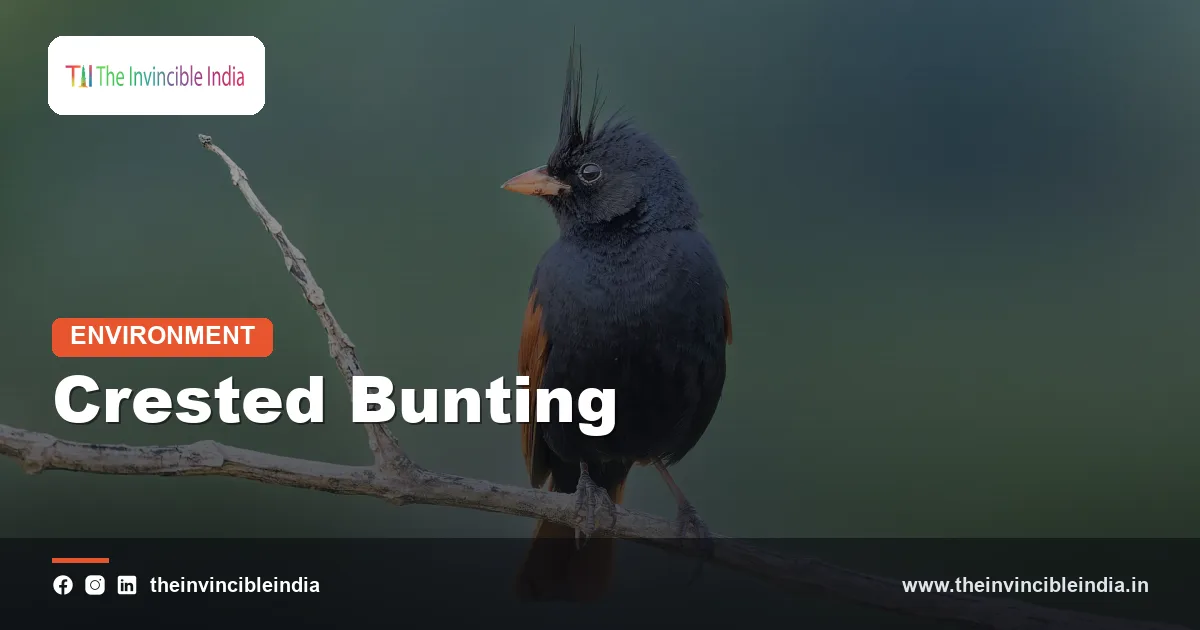
The crested bunting (Emberiza lathami) is a small seed-eating songbird of dry, rocky hill slopes in the Himalayan foothills and the hills of eastern and northeastern India, and it is the only Indian bunting in which the male wears a long, pointed, backward-swept crest on a glossy black body. Also written as Melophus lathami in older books, the crested bunting is resident in much of its range, perching on boulders, bushes and wires, and singing from open vantage points in the breeding season.
This explainer covers what the crested bunting is, how males and females differ, where in India it lives, what it eats, how it breeds, what its song sounds like, how it compares with other Indian buntings, and how secure its population is.
| Quick Fact | Detail |
|---|---|
| Common name | Crested bunting |
| Scientific name | Emberiza lathami (formerly Melophus lathami) |
| Family | Emberizidae (buntings) |
| Indian names | No single standard Hindi name is in wide use; the bird is known mainly by its English name among birdwatchers |
| Size | About 16 to 17 cm, with a long crest and a fairly long tail |
| Range and habitat | Himalayan foothills and outer ranges, the northeast, and hill country in parts of eastern and central India; dry rocky slopes, terraced fields and scrub |
| Diet | Grass and weed seeds, grain, plus insects fed to nestlings |
| Breeding season | Mainly spring to the monsoon months, with a cup nest hidden on the ground or in a bank |
| Conservation status | Least Concern (IUCN) |
Key Takeaways
- The crested bunting (Emberiza lathami) is a small songbird of the bunting family in which the male is glossy black with a long crest and chestnut wings and tail.
- A female crested bunting is brown and streaked with a short crest, but she shares the rich chestnut colour in the wings and tail that marks the male.
- Crested buntings live on dry, rocky or scrubby hill slopes and terraced fields, mainly in the Himalayan foothills, the northeast and parts of eastern India.
- The diet of the crested bunting is mostly grass seeds and grain picked from the ground, with insects added when chicks are being raised.
- Male crested buntings sing from exposed rocks, bushes and low trees, which makes the bird easy to find during the breeding season.
- The crested bunting is rated Least Concern globally because of its wide range, although its habitat can be lost to quarrying, burning and intensive farming.
What is a crested bunting?
A crested bunting is a small, stout-billed songbird belonging to the buntings, a family of mostly ground-feeding seed eaters that are close relatives of sparrows and finches in everyday appearance. Buntings have short, conical bills made for cracking seeds, and many of them sing from prominent perches.
For many decades the crested bunting was placed in a genus of its own, Melophus, and its name was written Melophus lathami. Later genetic studies showed that the species sits within the large genus Emberiza, and most modern lists now use Emberiza lathami. Both names still appear in field guides and websites, so either can be seen in older and newer sources.
The species name honours John Latham, an eighteenth-century English naturalist who described many Asian birds. The English name comes from the male's long crest, which is the most obvious feature of the bird.
How can you identify a crested bunting?
You can identify a crested bunting by a small, finch-sized bird with a long upswept crest, and, in the male, a black body with bright chestnut wings and tail. The crest is raised when the bird is excited or singing, and it can lie flat and become less noticeable when the bird is calm.
The male
The breeding male is glossy blue-black on the head, back and underparts. The wings and the tail are rich chestnut, which shows clearly in flight and when the wings are partly open. The bill is pale and the legs are brownish. In non-breeding plumage, the black can look slightly duller and scaled with brown edges.
The female and young
The female is olive-brown above and buff or pale below, with fine streaks on the breast and a shorter, less obvious crest. Her wings and tail still show a chestnut wash, which is the best clue to separate her from sparrows and pipits. Young birds resemble females, and young males gradually acquire their black plumage.
Voice
The song of the male is a short, simple, rather weak series of notes delivered repeatedly from a perch. The calls are soft, sharp chips and trills used to keep contact. The bird is not a powerful singer, but it makes up for this by singing persistently.
Where is the crested bunting found in India?
The crested bunting is found in India mainly along the Himalayan foothills and outer ranges from the western Himalaya eastward through the northeast, with additional populations in hilly areas of eastern and central India. Its overall range extends beyond India into Nepal, Bangladesh, Myanmar, southern China and parts of mainland Southeast Asia.
Within India it is best known from the lower Himalayan slopes in Himachal Pradesh, Uttarakhand, Sikkim, West Bengal, Assam and the other northeastern states, where it is commonly seen on dry hillsides. Scattered records come from hill country farther south, and some birds make short seasonal movements in response to weather and food.
The bird is chiefly resident, meaning that it stays in the same general area through the year. Local movements may occur from higher slopes to lower ground in winter, and some individuals wander outside the usual range, so unusual sightings are often reported to citizen-science platforms.
What habitat does the crested bunting prefer?
The crested bunting prefers dry, open, rocky or stony hill slopes with scattered bushes and grass, together with the edges of terraced fields and cultivation. It is a bird of drier, sunnier habitats, unlike many of the dense forest birds of the same hills.
- Rocky outcrops and boulder-strewn hillsides, where males use stones as song posts.
- Dry scrub and grassy slopes, which supply seeds and cover for nests.
- Terraced farmland, field margins and fallow land in the hills.
- Roadsides and cuttings, where the bird perches on rocks and wires.
- Open pine or sal woodland with grassy ground between the trees.
The bird commonly occurs from low foothills up to mid elevations, typically up to around 2,000 metres, though the precise upper limit varies between regions. It avoids dense, shaded forest and wet valley floors.
What does the crested bunting eat?
The crested bunting eats mainly seeds from grasses and weeds, along with small amounts of grain, and it adds insects to its diet during the breeding season. Seeds make up the bulk of the diet for most of the year, and they are picked up from the ground or from low plants.
The bird forages on the ground, hopping and walking between stones and tussocks. It often feeds in pairs or in small groups, and may join other seed eaters at good feeding spots. After the rains, seeding grasses on hill slopes offer abundant food.
When chicks hatch, the parents bring insects such as grasshoppers, caterpillars, beetles and spiders, since growing nestlings need protein. This seasonal shift between seeds and insects is typical of buntings and many other small seed-eating birds.
How does the crested bunting breed?
The crested bunting breeds mainly from spring through the monsoon months, building a cup nest on the ground or low in a bank, hidden under a rock, tuft of grass or bush. The exact timing depends on altitude and local weather, with higher sites starting later.
The nest is a neat cup of dry grass, roots and fine stems, lined with finer material such as hair or grass. The clutch is usually three or four eggs, and the eggs are pale with darker markings. The female does most of the incubation, though both parents feed the young after they hatch.
Because the nest is close to the ground, it is vulnerable to livestock, dogs, snakes and fires set to clear grass. Nests hidden in cover or in shelter under rocks have a better chance of success. Fledglings leave the nest before they can fly well, and the parents continue to feed them for a time.
Why do crested buntings sing from rocks and bushes?
Crested buntings sing from rocks, bushes and low trees because open perches let a male advertise his territory and attract a female across the hillside. A bird that sings from the top of a boulder can be heard and seen from a long distance in open country.
A singing male often raises his crest, and may flick his tail to show the chestnut patches. He tends to return to the same favoured perches again and again, which is why a birdwatcher who finds one song post can often return later and see the bird at the same spot.
Song is most frequent in the early morning and again in the late afternoon during the breeding season. Outside that season, the birds are quieter and may be seen feeding on the ground in small parties, so they are easier to miss.
How does the crested bunting differ from other Indian buntings?
The crested bunting differs from other Indian buntings mainly in its crest and the black plumage with chestnut wings and tail of the male, features that no other regular Indian bunting combines. India hosts a number of buntings, several of them winter visitors, and they can be hard to tell apart when they are in dull plumage.
| Bunting | Typical features | Usual status in India |
|---|---|---|
| Crested bunting (Emberiza lathami) | Long crest; black male with chestnut wings and tail; brown streaked female | Resident in hills and foothills |
| Black-headed bunting (Emberiza melanocephala) | Black head, chestnut back, yellow underparts | Winter visitor, mainly to the west and centre |
| Red-headed bunting (Emberiza bruniceps) | Chestnut head and yellow underparts in breeding males | Winter visitor to open farmland |
| Rock bunting (Emberiza cia) | Grey head with black stripes, chestnut belly | Breeds in the Himalaya, some move down in winter |
| Chestnut-eared bunting (Emberiza fucata) | Chestnut ear patch, streaked breast with a dark band | Winter visitor and local breeder in the Himalaya and northeast |
| White-capped bunting (Emberiza stewarti) | White crown and black throat in males | Himalayan breeder, winter in the north |
The crest alone is often enough to tell the crested bunting apart from its relatives. For females, the chestnut wing colour and short crest, together with the setting of a dry hillside, give the best clues.
Is the crested bunting a resident or a migrant?
The crested bunting is mainly a resident bird in India, though it makes short local movements between higher and lower ground depending on season and food. It is therefore not a long-distance migrant like the black-headed and red-headed buntings that arrive from the north-west each winter.
In some parts of the Himalayan foothills, birds move downhill in the coldest months and return upslope as the weather warms. In other areas, individuals are seen all year round at the same spots. Records of the species outside its usual range are generally regarded as wandering rather than regular migration.
Because the bird is not strongly migratory, local populations depend on the quality of hill habitat nearby. This makes the crested bunting a useful example of a species whose fortunes are closely tied to land use around where it lives.
How does the crested bunting behave through the day?
The crested bunting spends most of the day feeding quietly on the ground, with bursts of singing and perching at the start and end of the day. Birds are most active in the early morning and again in the late afternoon, and they tend to rest in shade during the hottest hours.
When feeding, a crested bunting walks or hops over open ground, pausing often to look around and to pick up seeds. It flies up to a low perch when disturbed, flicks its tail and shows the chestnut colour in its wings. The crest is lowered when the bird is relaxed and raised when it is alarmed, excited or singing.
Outside the breeding season, crested buntings are often seen in pairs or small family parties, and sometimes mix with other seed eaters such as sparrows, pipits and munias. They also come to drink at small streams and seepages on dry slopes, and they are known to take dust baths on bare patches of soil.
- Early morning: singing from rocks and active feeding.
- Midday: shade-seeking and resting in bushes.
- Late afternoon: second burst of feeding and song.
- Night: roosting in grass tufts, bushes or rock crevices.
Is the crested bunting threatened?
The crested bunting is not considered threatened and is listed as Least Concern by the International Union for Conservation of Nature (IUCN), mainly because its geographic range is very large and the species is fairly common in suitable habitat. In India, it is protected under the Wildlife (Protection) Act, 1972, like most wild native birds.
Even so, certain pressures affect it locally. Quarrying and road building remove the rocky slopes that it prefers, and repeated burning of grass can destroy nests and reduce seed supplies. The conversion of terraced hill farms to other uses or their abandonment may change the mix of open ground and scrub. Capture for the cage-bird trade has also been a concern for several small seed-eating birds in India, though it is illegal.
Careful management of grazing and fire, and the protection of natural rocky hillsides, help maintain the dry, open habitats on which the crested bunting depends. Observers can contribute by logging sightings so that changes in distribution can be tracked.
Bottom Line
The crested bunting is a handsome, hardy seed eater of dry Indian hillsides, easily recognised by the male's black plumage, chestnut wings and swept-back crest. It is resident and secure at the species level, but it relies on open, rocky, grassy habitats that need care.
Frequently Asked Questions
What is a crested bunting?
A crested bunting is a small songbird of the bunting family, scientifically named Emberiza lathami. The male is glossy black with a long crest and chestnut wings and tail. It lives on dry, rocky hill slopes in the Himalayan foothills and other parts of India.
Where can I see a crested bunting in India?
You can see a crested bunting on dry hill slopes, terraced fields and rocky roadsides in the Himalayan foothills and the northeast. It is also recorded from some hill areas of eastern and central India. Look for males singing from boulders, bushes and wires in the breeding season.
How do you tell a male crested bunting from a female?
A male crested bunting is glossy black with a long crest, while a female is brown and streaked with a short crest. Both sexes have chestnut wings and tail, which show well in flight. The male is the more striking bird, but the chestnut colour helps in identifying the female.
What does the crested bunting eat?
The crested bunting eats mostly seeds from grasses and weeds, along with some grain. It feeds on the ground in pairs or small groups. When it has chicks, it adds insects such as grasshoppers, caterpillars and beetles to the diet.
Does the crested bunting migrate?
The crested bunting is mainly a resident and does not make long migrations. Some birds move short distances between higher and lower slopes with the seasons. Birds seen far outside the normal range are usually wanderers.
Is the crested bunting an endangered bird?
No, the crested bunting is not endangered and is rated Least Concern by the IUCN. It has a wide range and is fairly common in suitable habitat. Local threats include quarrying, grass burning and loss of hill farmland.
{“@context”:”https://schema.org”,”@graph”:[{“@type”:”FAQPage”,”mainEntity”:[{“@type”:”Question”,”name”:”What is a crested bunting?”,”acceptedAnswer”:{“@type”:”Answer”,”text”:”A crested bunting is a small songbird of the bunting family, scientifically named Emberiza lathami. The male is glossy black with a long crest and chestnut wings and tail. It lives on dry, rocky hill slopes in the Himalayan foothills and other parts of India.”}},{“@type”:”Question”,”name”:”Where can I see a crested bunting in India?”,”acceptedAnswer”:{“@type”:”Answer”,”text”:”You can see a crested bunting on dry hill slopes, terraced fields and rocky roadsides in the Himalayan foothills and the northeast. It is also recorded from some hill areas of eastern and central India. Look for males singing from boulders, bushes and wires in the breeding season.”}},{“@type”:”Question”,”name”:”How do you tell a male crested bunting from a female?”,”acceptedAnswer”:{“@type”:”Answer”,”text”:”A male crested bunting is glossy black with a long crest, while a female is brown and streaked with a short crest. Both sexes have chestnut wings and tail, which show well in flight. The male is the more striking bird, but the chestnut colour helps in identifying the female.”}},{“@type”:”Question”,”name”:”What does the crested bunting eat?”,”acceptedAnswer”:{“@type”:”Answer”,”text”:”The crested bunting eats mostly seeds from grasses and weeds, along with some grain. It feeds on the ground in pairs or small groups. When it has chicks, it adds insects such as grasshoppers, caterpillars and beetles to the diet.”}},{“@type”:”Question”,”name”:”Does the crested bunting migrate?”,”acceptedAnswer”:{“@type”:”Answer”,”text”:”The crested bunting is mainly a resident and does not make long migrations. Some birds move short distances between higher and lower slopes with the seasons. Birds seen far outside the normal range are usually wanderers.”}},{“@type”:”Question”,”name”:”Is the crested bunting an endangered bird?”,”acceptedAnswer”:{“@type”:”Answer”,”text”:”No, the crested bunting is not endangered and is rated Least Concern by the IUCN. It has a wide range and is fairly common in suitable habitat. Local threats include quarrying, grass burning and loss of hill farmland.”}}]}]}


