

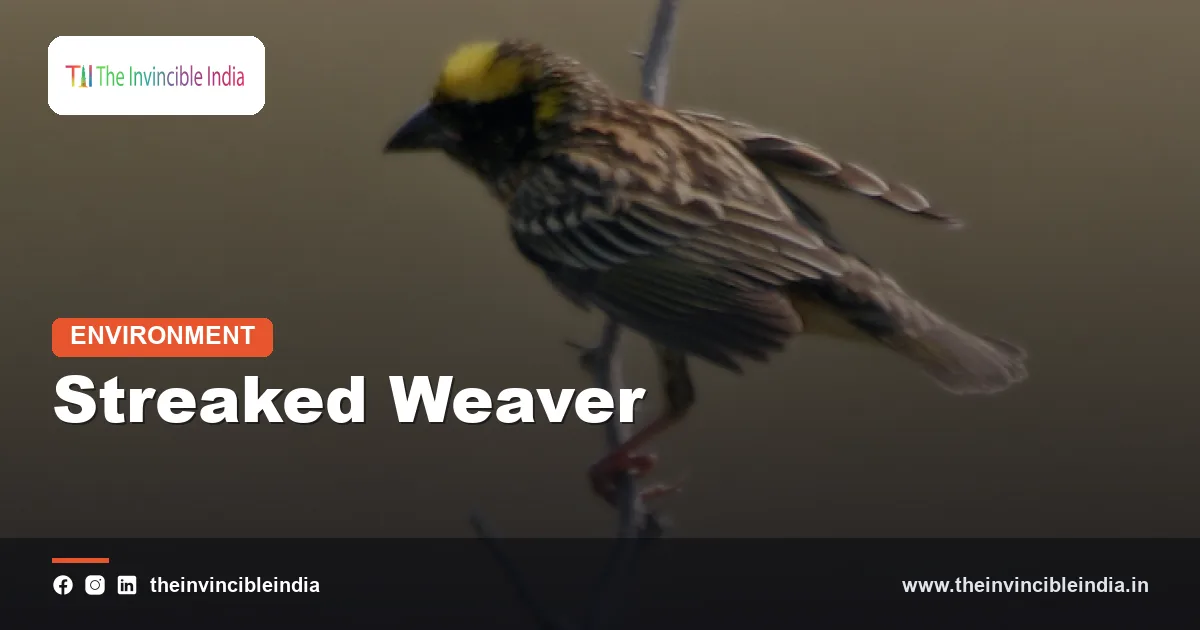
The streaked weaver (Ploceus manyar) is a sparrow-sized weaverbird of reed beds, marshes and tall wet grassland that stitches an enclosed, roofed nest of grass strips onto standing reeds, and it is easy to recognise by its heavily streaked breast and, in breeding males, a bright golden-yellow crown. Found across the plains of the Indian subcontinent and into Southeast Asia, the streaked weaver is one of several weavers in India, and it is the one most closely tied to wetland vegetation.
This explainer covers what the streaked weaver is, how to tell it from the baya weaver and other weavers, where it lives, what it eats, how and why it weaves its nest, how colonies are organised, and whether the species is at risk.
| Quick Fact | Detail |
|---|---|
| Common name | Streaked weaver |
| Scientific name | Ploceus manyar |
| Family | Ploceidae (weavers) |
| Indian names | Weavers are generally called baya in Hindi; the streaked weaver is mostly known by its English name among birdwatchers |
| Size | About 15 cm, similar to a house sparrow |
| Range and habitat | Plains of the Indian subcontinent and Southeast Asia; reed beds, marshes, tall grassland, sugarcane and paddy near water |
| Diet | Grass and rice seeds, grain, and insects fed to chicks |
| Breeding season | Mainly during and after the monsoon, in colonies over or beside water |
| Conservation status | Least Concern (IUCN) |
Key Takeaways
- The streaked weaver (Ploceus manyar) is a small weaverbird that builds a woven, enclosed grass nest attached to standing reeds and tall marsh plants.
- A breeding male streaked weaver has a golden-yellow crown, a dark face and a heavily streaked breast, while females and non-breeding males look like streaked brown sparrows.
- Streaked weavers live in wetlands, reed beds, tall grassland and irrigated farmland across the plains of India, usually close to water.
- The diet of the streaked weaver is mainly grass seed, rice and other grain, with insects supplied to the young in the nest.
- Male streaked weavers build the nests and may mate with more than one female, which is a system known as polygyny.
- The streaked weaver is rated Least Concern, but the draining of marshes and clearing of reed beds can remove its breeding sites locally.
What is a streaked weaver?
A streaked weaver is a small seed-eating songbird in the weaver family, Ploceidae, a group famous for building elaborate woven nests. Weavers are related to sparrows, and they share the stout, conical bill that is suited to crushing seeds and grain.
The scientific name Ploceus comes from a Greek word meaning weaver, while the species name manyar is of Javanese origin. The species is widespread in South and Southeast Asia, and the birds of the Indian subcontinent belong to a regional subspecies that differs only slightly from those farther east.
The family Ploceidae has well over a hundred species, most of them in Africa. In India there are only a few weavers, and all of them build hanging or reed-supported nests. Their nest-building skill is one of the most celebrated examples of bird craftsmanship in the country.
How can you identify a streaked weaver?
You can identify a streaked weaver by its heavily streaked breast and flanks, brown-streaked back and thick conical bill, together with the yellow cap of the breeding male. Because it is so streaky below, it differs from many other weavers whose underparts are plain.
Breeding male
The breeding male has a bright golden-yellow crown that contrasts with a blackish face and throat. The back is brown with dark streaks, and the breast and flanks are white or buff with bold dark streaks. The bill is black and thick, and the legs are pinkish.
Female and non-breeding male
The female is a sparrow-like bird with a brown streaked back, a pale buff eyebrow and a streaked breast. A non-breeding male looks very similar to the female, and the yellow cap is lost until the next breeding season. The bill in these plumages is horn coloured.
Voice
The streaked weaver is a noisy bird around the colony. It gives chattering calls, soft chirps and a wheezing, buzzing song, usually from a perch near the nest. Colonies can be quite loud in the breeding season.
Where is the streaked weaver found in India?
The streaked weaver is found in India across most of the plains, from the Indo-Gangetic region and the northeast to central and southern India, wherever wetlands and tall reeds are present. It is less common in the driest western regions and in hilly areas, and it is generally a low-altitude bird.
Outside India, the species ranges through Pakistan, Nepal, Bangladesh and Sri Lanka, and eastward through Myanmar, Thailand and Indochina to Java. The birds are mostly resident, though they move locally depending on water levels and food supply.
Good places to see the streaked weaver include large marshes, floodplains, reservoirs, and wetland sanctuaries across the country, where reed beds provide ideal nest sites. The bird can also appear in irrigated farmland and sugarcane fields near these wetlands.
What habitat does the streaked weaver prefer?
The streaked weaver prefers wet, tall vegetation, especially reed beds, cattail stands and flooded grassland. It needs tall, strong stems on which to attach its nest, and nearby open land for feeding.
- Reed beds along rivers, lakes and reservoirs.
- Freshwater marshes and swamps with dense grass.
- Tall, wet grassland on floodplains.
- Paddy fields and sugarcane in irrigated regions.
- Canal and pond edges lined with tall grasses.
The bird is much more strongly tied to wetlands than the baya weaver. If the reeds are cut or the water dries up, a colony usually moves elsewhere.
What does the streaked weaver eat?
The streaked weaver eats mainly seeds, including grass seed and cultivated grains such as rice, and it feeds insects to its chicks. Seeds are collected from the ground or taken directly from the seed heads of tall grasses and reeds.
Outside the breeding season the birds gather in flocks and feed together in open fields, stubble and marshy ground. Flocks may be mixed with other weavers or munias. When rice ripens, flocks can visit paddy, which is why weavers are sometimes regarded as minor crop pests, though their natural food is wild grass seed.
During breeding, adults catch caterpillars, grasshoppers, small flies and other insects. These are rich in protein and are essential for fast growth of the nestlings. Without enough insects, chicks may grow slowly or die, which links weaver success to the health of the whole wetland.
How does the streaked weaver build its nest?
The streaked weaver builds its nest by tearing long, thin strips from grass and reed leaves and then weaving and knotting them around living stems to form an enclosed chamber. The work is done mainly by the male, who uses his bill and feet as tools.
The nest is oval or pear-shaped, roofed, and has its entrance at the side or below, often with a short tube. It is anchored to several standing reeds, so that the nest sways in the wind but stays fixed. Many nests are built over water or over soft, wet ground, a position that reduces access for snakes, rodents and other land predators.
Stages of building
- The male attaches fibre strips to a fork of stems, forming a ring or loop.
- He builds a roofed chamber out from the ring, weaving strips in and out.
- He adds an entrance, often at the lower side.
- If a female accepts the nest, she lines the inside with soft grass and flower heads.
Rejected nests are frequently left incomplete or are dismantled, and the male builds again. A single male may construct several nests in one season.
How do streaked weaver colonies breed?
Streaked weavers breed in loose colonies, mainly during and just after the monsoon, with each male building one or more nests and attracting females. The monsoon period gives plentiful grass seed, insects and reed growth, so the timing matches food supply.
Males are often polygynous, meaning that one male can mate with several females in a season, each female occupying a separate nest. Males show off by fluttering their wings beside the nest and singing. A female who is interested inspects the nest and, if she accepts it, finishes the lining.
The female lays about two to four eggs, which are white or pale, and she incubates them herself. Both the female and, to a lesser extent, the male may feed the young. The young leave the nest after a few weeks and join flocks once they can fly.
How does the streaked weaver differ from other Indian weavers?
The streaked weaver differs from other Indian weavers mainly in its heavily streaked breast, its reed-bed habitat and its nest position on reeds rather than hanging from trees. Several weavers share parts of the same range, so they sometimes occur together at one wetland.
| Weaver | Typical features | Usual habitat and nest |
|---|---|---|
| Streaked weaver (Ploceus manyar) | Heavily streaked breast; yellow cap in breeding male | Reed beds and marshes; nest fixed to reeds |
| Baya weaver (Ploceus philippinus) | Plain buff underparts in female; yellow cap and dark mask in male | Open country and farmland; hanging nest with long tube on palm, babool or other trees |
| Black-breasted weaver (Ploceus benghalensis) | Black breast band in breeding male | Tall grass near water; nest on grass stems |
| Finn's weaver (Ploceus megarhynchus) | Large bill, yellow head and underparts in males | Tall grassland in the terai; threatened and localised |
| Asian golden weaver (Ploceus hypoxanthus) | Bright yellow, with black face mask in males | Reed beds and wet grassland, localised in India |
The heavily streaked breast is the best field mark. A female baya weaver has a plain, unstreaked buff breast, whereas a streaked weaver, in any plumage, shows clear dark streaks on the chest and flanks.
Why do weaverbirds weave nests?
Weaverbirds weave nests because a tightly woven, enclosed structure protects eggs and chicks from predators, rain and heat, and because a well-built nest helps a male attract a mate. A strong nest is a visible sign of the male's health and skill.
The hanging or reed-supported design makes it difficult for snakes, squirrels and monkeys to reach the eggs. Placing the nest over water adds another barrier. The roof sheds monsoon rain, and the narrow entrance keeps out larger birds.
Weaving is partly inherited and partly learnt. Young males tend to build clumsy nests at first, and their skill improves with practice. This makes weaver nests a favourite subject of behavioural research and photography.
What role does the streaked weaver play in a wetland?
The streaked weaver plays several roles in a wetland, acting as a seed eater, an insect eater, a source of prey for larger animals and an indicator of reed bed condition. A healthy colony usually means that the reed beds are intact and that the water level has stayed stable through the breeding season.
By eating grass seed, weavers take part in the movement and loss of wetland seeds, and by catching insects for their chicks, they help to regulate populations of caterpillars and grasshoppers that feed on marsh plants. In turn, their eggs, chicks and adults are eaten by snakes, harriers, owls, monitor lizards and other predators, which makes the weaver a link in the local food chain.
Old nests are often reused by other animals. Small spiders and insects shelter in them, and sparrows or munias may use abandoned nests. Because colonies are conspicuous and easy to count, they are a convenient way for local naturalists and conservation groups to follow the state of a marsh from year to year.
- Seed eater that feeds on grasses and cereals.
- Insect predator during the breeding season.
- Prey for snakes, raptors and other wetland predators.
- Provider of old nests that other small animals may use.
- Visible indicator of reed bed health and water stability.
Is the streaked weaver threatened?
The streaked weaver is not threatened globally and is rated Least Concern by the International Union for Conservation of Nature (IUCN), because it has a very large range and is common in many wetlands. In India, it is protected under the Wildlife (Protection) Act, 1972, as a native wild bird.
The main threats are local. Marshes are drained for farming and construction, reed beds are cut for thatch, fodder and paper-making, and wetlands are damaged by pollution and invasive plants. Burning of reeds in the breeding season can destroy whole colonies. Where water levels are poorly managed, nests may be flooded or left high and dry.
Conserving wetlands, leaving some reed beds uncut through the breeding season, and controlling pollution help the streaked weaver and many other marsh birds such as warblers, bitterns and herons.
Bottom Line
The streaked weaver is a compact, streaky marsh bird whose male builds neat woven nests on reeds and sings beside them to attract mates. It remains common in suitable wetlands, but it relies on reed beds and tall wet grass that need to be protected from drainage, burning and overcutting.
Frequently Asked Questions
What is a streaked weaver?
A streaked weaver is a small weaverbird, Ploceus manyar, that lives in reed beds, marshes and wet grassland. It has a heavily streaked breast and, in breeding males, a golden-yellow crown. It weaves an enclosed nest of grass strips on standing reeds.
How is a streaked weaver different from a baya weaver?
A streaked weaver has a streaked breast and builds its nest on reeds in wetlands, while a baya weaver has plain underparts in the female and builds long hanging nests on trees. The two species may share a wetland. The streaks on the chest are the quickest way to separate them.
Where does the streaked weaver build its nest?
The streaked weaver builds its nest on standing reeds and tall marsh plants, often over water or soft, wet ground. The nest is woven from grass strips and sways with the stems. Placing it over water helps protect it from snakes and other land predators.
What does the streaked weaver eat?
The streaked weaver eats mainly grass seeds and grains such as rice. During breeding, adults also catch insects to feed the chicks. Outside breeding it forages in flocks on fields, stubble and marshy ground.
Is the streaked weaver found all over India?
The streaked weaver is found across most of the plains of India, including the Gangetic plain, the northeast, and parts of central and southern India. It is local in dry western regions and is not usually a hill bird. It is always found near water and tall wet vegetation.
Is the streaked weaver an endangered bird?
No, the streaked weaver is not endangered and is listed as Least Concern by the IUCN. It has a wide range and is common in many wetlands. Local declines can occur where marshes are drained or reed beds are cleared.
{“@context”:”https://schema.org”,”@graph”:[{“@type”:”FAQPage”,”mainEntity”:[{“@type”:”Question”,”name”:”What is a streaked weaver?”,”acceptedAnswer”:{“@type”:”Answer”,”text”:”A streaked weaver is a small weaverbird, Ploceus manyar, that lives in reed beds, marshes and wet grassland. It has a heavily streaked breast and, in breeding males, a golden-yellow crown. It weaves an enclosed nest of grass strips on standing reeds.”}},{“@type”:”Question”,”name”:”How is a streaked weaver different from a baya weaver?”,”acceptedAnswer”:{“@type”:”Answer”,”text”:”A streaked weaver has a streaked breast and builds its nest on reeds in wetlands, while a baya weaver has plain underparts in the female and builds long hanging nests on trees. The two species may share a wetland. The streaks on the chest are the quickest way to separate them.”}},{“@type”:”Question”,”name”:”Where does the streaked weaver build its nest?”,”acceptedAnswer”:{“@type”:”Answer”,”text”:”The streaked weaver builds its nest on standing reeds and tall marsh plants, often over water or soft, wet ground. The nest is woven from grass strips and sways with the stems. Placing it over water helps protect it from snakes and other land predators.”}},{“@type”:”Question”,”name”:”What does the streaked weaver eat?”,”acceptedAnswer”:{“@type”:”Answer”,”text”:”The streaked weaver eats mainly grass seeds and grains such as rice. During breeding, adults also catch insects to feed the chicks. Outside breeding it forages in flocks on fields, stubble and marshy ground.”}},{“@type”:”Question”,”name”:”Is the streaked weaver found all over India?”,”acceptedAnswer”:{“@type”:”Answer”,”text”:”The streaked weaver is found across most of the plains of India, including the Gangetic plain, the northeast, and parts of central and southern India. It is local in dry western regions and is not usually a hill bird. It is always found near water and tall wet vegetation.”}},{“@type”:”Question”,”name”:”Is the streaked weaver an endangered bird?”,”acceptedAnswer”:{“@type”:”Answer”,”text”:”No, the streaked weaver is not endangered and is listed as Least Concern by the IUCN. It has a wide range and is common in many wetlands. Local declines can occur where marshes are drained or reed beds are cleared.”}}]}]}


