

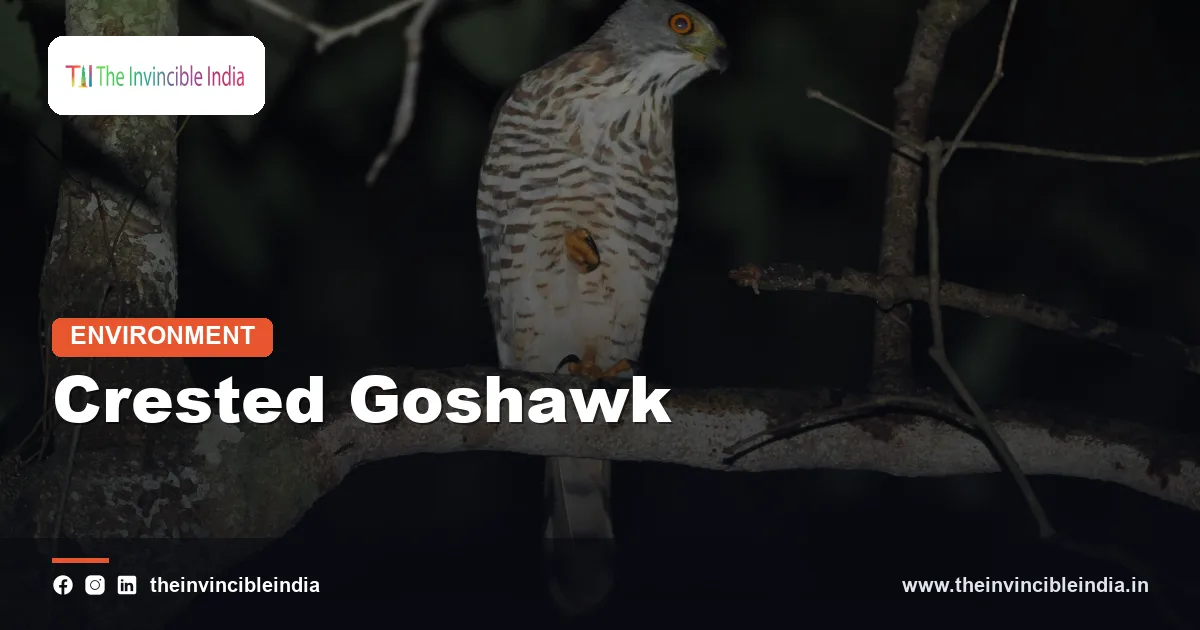
The crested goshawk (Accipiter trivirgatus) is a stocky, medium-sized forest hawk of South and South-East Asia, recognised by a short crest on the back of its head, and it ambushes birds, lizards and small mammals from hidden perches in wooded country. In India it is a resident of hill forests, foothills and well-wooded plains rather than open grassland.
The crested goshawk is secretive and often heard before it is seen, but its loud calls and its showy courtship flights, in which the white feathers under the tail are fluffed out like a powder puff, make it one of the more distinctive hawks of Indian woodland. This guide explains how to identify it, where it lives, what it eats, how it breeds, how it differs from similar hawks and what threatens it.
| Feature | Details |
|---|---|
| Common name | Crested goshawk |
| Scientific name | Accipiter trivirgatus |
| Family | Accipitridae (hawks, eagles, kites and harriers), order Accipitriformes |
| Size | About 30 to 46 cm long; wingspan roughly 65 to 90 cm; females noticeably larger than males |
| Range and habitat in India | Resident in forests and wooded country, including the Western Ghats, the Himalayan foothills, the north-east and some central and eastern forests |
| Diet | Lizards, small birds, rodents, squirrels, large insects, frogs and occasionally snakes |
| Breeding and movement | Resident and largely non-migratory; builds a stick nest high in a forest tree and displays by soaring and fluffing white undertail feathers |
| Conservation status | Least Concern (IUCN); protected under the Wildlife (Protection) Act, 1972 |
Key Takeaways
- The crested goshawk (Accipiter trivirgatus) is a forest hawk with a short crest, short rounded wings and a long tail, adapted for fast manoeuvres among trees.
- Adult crested goshawks have a dark brown to grey back, a dark central throat stripe, streaked breast and barred belly, and a pale, fluffy undertail visible in display.
- The crested goshawk feeds mainly on lizards, small birds and rodents, which it catches by ambush from a perch or by a short, fast dash through the trees.
- In India the crested goshawk is a resident species of the Western Ghats, Himalayan foothills, north-east and other forested regions, rather than a migrant.
- Male and female crested goshawks perform a soaring display in which the white undertail coverts are spread out, usually early in the breeding season over the forest canopy.
- The IUCN lists the crested goshawk as Least Concern, although it depends on tree cover and is vulnerable to forest clearance in many parts of its range.
What Is the Crested Goshawk?
The crested goshawk is a medium-sized bird of prey in the family Accipitridae, known scientifically as Accipiter trivirgatus, and it belongs to the genus Accipiter, the “bird hawks” that also includes the shikra, the besra and the northern goshawk. These hawks share short, broad wings and long tails, which let them twist and turn among branches in pursuit of prey.
Within the genus, the crested goshawk is a relatively large and heavy-set species in the tropics. It occurs from India, Nepal and Sri Lanka across mainland South-East Asia to the Greater Sunda islands and the Philippines. Several subspecies are recognised across this vast range, with some regional differences in size and plumage.
The name “goshawk” originally meant “goose hawk” in Old English, since the bird was used in falconry. The crested goshawk is not, however, a significant quarry bird in Indian falconry and is better known to naturalists and forest walkers.
How Can You Identify a Crested Goshawk?
A crested goshawk can be identified by its short, pointed crest, dark brown upperparts, a bold black line down the white throat, a heavily streaked breast, a barred belly and a long tail with several dark bands. The eyes are yellow to orange, and the bird has a fierce, intent look.
Adult plumage
Adults are dark brown to greyish above, with a slightly paler head. The throat is white with a vertical dark stripe, and the breast has bold brown streaks, changing to rufous or brown bars on the belly and flanks. The undertail coverts are pure white and fluffy, and are a good field mark when a bird is perched or in display.
Juveniles
Young birds are browner above, with pale edges to the feathers, and their underparts are creamy with dark spots or teardrop marks rather than the bars seen in adults. The crest is shorter, and the eyes are paler, often yellowish or whitish.
Voice
The crested goshawk is a noisy bird in the breeding season. Its call is a loud, high, repeated whistle or shriek, often written as “ki-wik, ki-wik” or similar. Its voice carries far through forest and is often the first clue to the bird’s presence.
Where Does the Crested Goshawk Live in India?
The crested goshawk lives in India in forests and well-wooded country, including the Western Ghats, the foothills of the Himalaya, the north-eastern hills and some parts of central and eastern India. It prefers evergreen, semi-evergreen and moist deciduous forest, plantations with large trees and forest edges.
Habitat features that matter to the species include:
- Mature trees: tall, dense trees provide both nest sites and hidden perches.
- Clearings and streams: edges, glades and watercourses offer open lanes for hunting.
- Mixed forest and plantations: the bird is sometimes seen in tea, coffee or rubber estates if tall shade trees remain.
- Hill and lowland forest: in India it occurs from low-lying forest up to moderate altitudes, usually below the highest mountain zones.
Subspecies in the Indian region include birds of the Himalayan foothills and north-east, a form associated with the Western Ghats and a distinct form in Sri Lanka. Details of their ranges are still debated, so many field guides treat the species broadly as a resident of wooded tropical and subtropical Asia.
What Does the Crested Goshawk Eat?
The crested goshawk eats mainly lizards, small birds and rodents, with squirrels, frogs, large insects and occasionally snakes making up the rest of its diet. It is an opportunistic hunter, taking whatever prey it can surprise in the forest.
| Prey group | Examples | Capture method |
|---|---|---|
| Reptiles | Garden lizards, forest lizards, small snakes | Pounced on from a perch or snatched from branches |
| Birds | Babblers, bulbuls, doves, small woodpeckers, nestlings | Short surprise chase through the trees |
| Mammals | Rats, mice, squirrels and young bats | Ambush hunting and low pursuit |
| Amphibians and insects | Frogs, large beetles, cicadas, crickets | Opportunistic capture on the ground or branches |
The relative importance of each prey type changes with place and season. In some areas lizards form a large share of the diet, while in others small birds and squirrels are more significant. Large female crested goshawks can handle larger prey than the smaller males.
How Does the Crested Goshawk Hunt?
The crested goshawk hunts mostly by ambush: it sits motionless on a shaded perch inside or at the edge of the forest, watches for movement and then makes a short, fast attack. Its short, rounded wings and long tail give it the manoeuvrability needed to weave between branches.
- Still-hunting: the hawk perches in cover for long spells, scanning the ground and branches.
- Surprise dash: it accelerates from a perch to seize prey before it can react.
- Edge patrol: the bird sometimes flies low along forest edges, roads and streams to flush animals.
- Ground and branch searching: it will also descend to the ground or walk along branches to catch lizards.
Unlike open-country raptors, the crested goshawk rarely soars while hunting. Soaring is mostly reserved for display flights above the canopy, which are the best chance for observers to see the bird clearly.
How Does the Crested Goshawk Breed?
The crested goshawk breeds in the forest, building a platform nest of sticks high in a tree, and the pair announces its territory with a conspicuous soaring display in which the white undertail feathers are spread. Breeding usually takes place in the drier part of the year in India, though timing varies with region.
Key points of its breeding cycle include:
- Display flight: a pair circles above the canopy, with the male performing a roller-coaster dive and climb, and the white undertail coverts fluffed out.
- Nest: a platform of twigs lined with leaves, placed high in a large tree, usually well hidden among foliage.
- Clutch: typically two eggs, sometimes three, which are pale and may carry a few light markings.
- Chick care: the female incubates and broods, and the male brings food, passing it to her near the nest.
Nests can be difficult to find because the birds are secretive near the nest and avoid exposed flights close to it. Disturbance and tree felling are important threats at this stage.
How Is the Crested Goshawk Different from Other Hawks?
The crested goshawk differs from other Indian hawks in its larger size, crest, bold throat stripe and white fluffy undertail, which set it apart from the smaller shikra, besra and Eurasian sparrowhawk. Hawks of this genus can be hard to separate, so combining several features is the safest approach.
| Species | Approximate length | Main field marks | Typical habitat |
|---|---|---|---|
| Crested goshawk | 30 to 46 cm | Short crest, dark throat stripe, streaked breast, barred belly, white fluffy undertail | Forest and wooded foothills |
| Shikra | 30 to 36 cm | Pale grey back, fine barring below, no crest, red eyes in adults | Open woodland, gardens, villages |
| Besra | 29 to 36 cm | Dark upper side, bold mesial stripe, rufous barred belly | Hill forest |
| Northern goshawk | 48 to 62 cm | Much larger, pale eyebrow, no crest | Temperate Himalayan forest, rare |
| Oriental honey buzzard | 55 to 65 cm | Crested look but small head, longer wings, different shape | Forest and woodland |
The oriental honey buzzard is sometimes confused with the crested goshawk because it also has a slight crest, but it has a smaller, more pigeon-like head and spends more time in soaring flight. The shikra is a bird of towns, farms and thin woodland, and lacks a crest.
Why Does the Crested Goshawk Matter?
The crested goshawk matters because it is a forest predator that helps control populations of lizards, small birds and rodents, and its presence suggests that mature tree cover and prey animals remain in an area. Predators like this form one link in the food web of Indian woodlands.
- As a mid-sized forest raptor, it keeps numbers of small vertebrates in check.
- Its need for tall trees makes it a useful indicator of forest quality.
- Its loud calls and display flights add to the experience of birdwatchers in protected areas.
- Its reliance on large trees means conserving it also conserves the other birds and mammals that live in the same canopy.
Is the Crested Goshawk Threatened?
No, the crested goshawk is classed as Least Concern by the IUCN because it has a large range and a presumed large population, but it is exposed to local threats, mainly from forest loss. The species is secretive, so population estimates are rough.
- Deforestation: clearing for agriculture, mining, plantations and settlements removes both hunting and nesting habitat.
- Fragmentation: small, isolated patches of forest may not support breeding pairs.
- Persecution: some raptors are shot or trapped, often because they take poultry or are mistaken for other hawks.
- Pesticides and disturbance: chemical use and human activity near nests can lower breeding success.
Within India the species is protected under the Wildlife (Protection) Act, 1972. It occurs in many national parks and sanctuaries, where tree cover is maintained.
How Can You Spot a Crested Goshawk?
You can spot a crested goshawk by walking quietly along forest edges, trails and streams in the early morning, listening for its loud calls and looking for soaring pairs above the canopy on sunny mornings. Patience is essential, because the bird spends much of its time hidden.
- Visit protected forests in the Western Ghats, the Himalayan foothills or the north-east.
- Scan the canopy from clearings and forest roads at dawn, when pairs often display.
- Listen for repeated high-pitched calls, then follow the sound.
- Look for the white undertail “powder puff” and the dark throat stripe.
- Use binoculars and avoid approaching nesting trees closely.
Bottom Line
The crested goshawk is a stocky, crested forest hawk of India that hunts lizards, birds and rodents by ambush and shows off with a soaring display and fluffed white undertail. It is globally secure but depends on mature forest, so its future in India is tied to the protection of wooded habitats.
Frequently Asked Questions
Where is the crested goshawk found in India?
The crested goshawk is found in forests and wooded country, including the Western Ghats, Himalayan foothills and the north-east. It is a resident bird that does not migrate. It prefers tall trees, forest edges and stream sides.
What does a crested goshawk eat?
A crested goshawk eats mainly lizards, small birds, rodents and squirrels. It also takes frogs, large insects and occasionally small snakes. It usually ambushes prey from a hidden perch.
How can you identify a crested goshawk?
A crested goshawk can be identified by its short crest, dark throat stripe, streaked breast and barred belly. It also has a long banded tail and yellow to orange eyes. Pairs show a fluffy white undertail during display flights.
Is the crested goshawk the same as the shikra?
No, the crested goshawk is a different species from the shikra. It is larger and stockier, has a crest and a dark throat stripe, and lives mainly in forest. The shikra is a smaller, paler hawk found in open woodland, gardens and farmland.
Is the crested goshawk endangered?
No, the crested goshawk is rated Least Concern by the IUCN. It has a very large range across South and South-East Asia. It can still be affected locally by deforestation and disturbance.
How many eggs does a crested goshawk lay?
A crested goshawk typically lays two eggs, and sometimes three. The female incubates them while the male brings food. The nest is a stick platform built high in a forest tree.
{“@context”:”https://schema.org”,”@graph”:[{“@type”:”FAQPage”,”mainEntity”:[{“@type”:”Question”,”name”:”Where is the crested goshawk found in India?”,”acceptedAnswer”:{“@type”:”Answer”,”text”:”The crested goshawk is found in forests and wooded country, including the Western Ghats, Himalayan foothills and the north-east. It is a resident bird that does not migrate. It prefers tall trees, forest edges and stream sides.”}},{“@type”:”Question”,”name”:”What does a crested goshawk eat?”,”acceptedAnswer”:{“@type”:”Answer”,”text”:”A crested goshawk eats mainly lizards, small birds, rodents and squirrels. It also takes frogs, large insects and occasionally small snakes. It usually ambushes prey from a hidden perch.”}},{“@type”:”Question”,”name”:”How can you identify a crested goshawk?”,”acceptedAnswer”:{“@type”:”Answer”,”text”:”A crested goshawk can be identified by its short crest, dark throat stripe, streaked breast and barred belly. It also has a long banded tail and yellow to orange eyes. Pairs show a fluffy white undertail during display flights.”}},{“@type”:”Question”,”name”:”Is the crested goshawk the same as the shikra?”,”acceptedAnswer”:{“@type”:”Answer”,”text”:”No, the crested goshawk is a different species from the shikra. It is larger and stockier, has a crest and a dark throat stripe, and lives mainly in forest. The shikra is a smaller, paler hawk found in open woodland, gardens and farmland.”}},{“@type”:”Question”,”name”:”Is the crested goshawk endangered?”,”acceptedAnswer”:{“@type”:”Answer”,”text”:”No, the crested goshawk is rated Least Concern by the IUCN. It has a very large range across South and South-East Asia. It can still be affected locally by deforestation and disturbance.”}},{“@type”:”Question”,”name”:”How many eggs does a crested goshawk lay?”,”acceptedAnswer”:{“@type”:”Answer”,”text”:”A crested goshawk typically lays two eggs, and sometimes three. The female incubates them while the male brings food. The nest is a stick platform built high in a forest tree.”}}]}]}


