

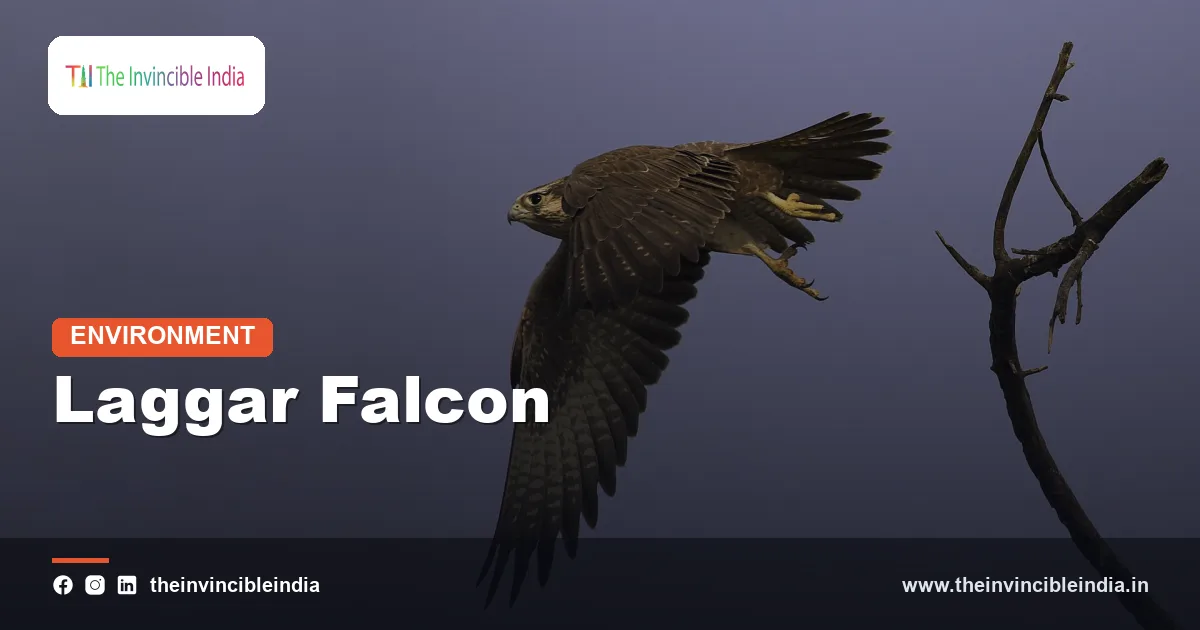
The laggar falcon (Falco jugger) is a medium-sized, brown-backed falcon that lives all year round in the dry open country, farmland, ravines and semi-desert of the Indian subcontinent, hunting birds, rodents and lizards in fast, low pursuit flights. It is one of the few falcons that actually breeds in India rather than visiting in winter, and it was once a familiar sight on telegraph wires and roadside trees across the northern plains.
Today the laggar falcon is far less common than it used to be, and it is listed as Near Threatened by the International Union for Conservation of Nature (IUCN). This guide explains how to recognise the bird, where it lives, what it eats, how it breeds, why its numbers have fallen and how it differs from other Indian falcons such as the peregrine and the common kestrel.
| Feature | Details |
|---|---|
| Common name | Laggar falcon (also written laggar; sometimes called the jugger falcon) |
| Scientific name | Falco jugger |
| Family | Falconidae (falcons and caracaras), order Falconiformes |
| Size | About 40 to 46 cm long; wingspan roughly 85 to 100 cm; females are larger than males |
| Range and habitat in India | Resident across much of the subcontinent in dry open plains, cultivation, scrub, semi-desert and ravines; scarce in dense forest and high mountains |
| Diet | Small and medium birds, rodents, lizards and large insects |
| Breeding and movement | Resident and largely non-migratory; uses old stick nests of other large birds, with eggs laid mainly in the cooler months and early summer |
| Conservation status | Near Threatened (IUCN); protected under the Wildlife (Protection) Act, 1972 |
Key Takeaways
- The laggar falcon (Falco jugger) is a resident Indian falcon that breeds on the subcontinent and does not undertake long migrations.
- Adult laggar falcons have a brownish-grey back, a rufous or chestnut crown, a dark moustache stripe and a pale underside streaked with dark marks.
- The laggar falcon hunts mostly birds and rodents, often working as a pair to flush and chase prey over open ground.
- Laggar falcons do not build their own nests; they take over old stick nests made by crows, kites, vultures or other large birds.
- The IUCN lists the laggar falcon as Near Threatened because its population has declined, with trapping, pesticides and loss of open habitat among the suspected causes.
- The laggar falcon is larger and broader than a kestrel and less boldly marked than a peregrine, which helps separate the three in the field.
What Is a Laggar Falcon?
A laggar falcon is a resident bird of prey in the family Falconidae, described scientifically as Falco jugger, and it is native mainly to India, Pakistan, Nepal and Bangladesh. The word “laggar” comes from the local names used by bird catchers and falconers in northern India, and the species is sometimes written as “jugger” in older books.
Taxonomically, the laggar falcon belongs to the group of large falcons known as hierofalcons. Its closest relatives are thought to include the lanner falcon of Africa and southern Europe and the saker falcon of Central Asia. These birds share a bulky build, broad wings and a tendency to hunt close to the ground rather than diving from great heights like the peregrine.
The bird is a typical falcon in structure. It has long pointed wings, a fairly long tail, a hooked beak with a toothlike notch (the tomial tooth) used to break the neck of prey, and powerful feet with sharp talons. Like most birds of prey, females are noticeably bigger than males, a pattern called reverse sexual dimorphism.
How Can You Identify a Laggar Falcon?
A laggar falcon can be identified by its brown upperparts, pale streaked underparts, chestnut-tinged head and thin dark moustache, combined with a compact, powerful falcon shape. Birds at rest often perch upright and still on an exposed branch, pole or electric pylon, scanning the ground below.
Adult plumage
Adults have a dull brown to greyish-brown back and wings with faint paler barring. The crown is usually rufous or buff, contrasting with a dark patch behind the eye and a narrow moustachial stripe. The underparts are whitish to buff with dark streaks on the breast and flanks, and the thighs are dark, giving a slightly dark-bottomed look. The tail is brownish with narrow paler bars and a pale tip.
Young birds
Juvenile laggar falcons are darker overall, with more heavily streaked underparts and a less distinct pattern on the head. The streaking is dense and the bird can look quite dark brown from below. This stage is often the source of confusion with other large falcons.
In flight
In flight the laggar falcon appears broad-winged for a falcon, with a fairly long tail and steady, strong wingbeats. It often flies low over fields or follows ridgelines and ravines, then accelerates in a short, flat dash to catch prey. It does not usually soar as high as eagles and buzzards, although pairs may circle on warm air in the late morning.
Where Does the Laggar Falcon Live in India?
The laggar falcon lives across the drier plains and plateaus of India, preferring open country with scattered trees, farmland, scrub, ravines and the edges of villages and towns. It is found in many northern and central states, and in parts of the Deccan, but it avoids thick evergreen forest and the higher Himalaya.
Several features of the landscape matter to the species:
- Open ground: short crops, grazing land and stubble fields let the falcon spot and chase prey over long distances.
- Tall perches: trees, power lines, poles and rocky outcrops provide look-out posts.
- Nesting trees: large, isolated trees such as acacia, neem, eucalyptus and banyan hold the old stick nests the falcon prefers.
- Ravines and river banks: eroded cliffs and ravines give additional hunting lanes and nest sites.
Outside India, the laggar falcon ranges through Pakistan, Nepal and Bangladesh, and it has occasionally been reported from neighbouring regions such as parts of Afghanistan and Myanmar. Inside India, bird surveys in recent decades have reported it from rural and semi-urban habitats, including areas close to towns where open land remains.
What Does the Laggar Falcon Eat?
The laggar falcon eats mainly small and medium-sized birds, supplemented by rodents, lizards and large insects. It is an opportunistic predator, which means it takes whatever suitable prey is most available in the area it patrols.
| Prey group | Examples | How it is usually caught |
|---|---|---|
| Birds | Doves, pigeons, mynas, larks, bee-eaters, parakeets, smaller shorebirds | Fast, low chase and a strike from above or behind |
| Mammals | Mice, rats, gerbils, young squirrels, occasionally bats at dusk | Short swoop from a perch or low flight |
| Reptiles | Lizards such as agamids and skinks | Pounced on from a perch |
| Insects | Large beetles, grasshoppers, termite alates | Caught in the air or on the ground |
Pairs of laggar falcons are known to hunt cooperatively. One bird may flush prey while its partner waits to intercept, and a pair can pursue a pigeon flock by taking turns. This teamwork is one reason the species has long interested falconers, although it is generally considered less swift than a peregrine.
How Does the Laggar Falcon Hunt?
The laggar falcon hunts by a mix of perch-and-pounce ambushes and flat, fast chases, using speed and surprise rather than the high-altitude stoop for which the peregrine is known. It often sits quietly for long periods, then launches in a rapid flight along a hedge or field edge to catch birds off guard.
The hunting methods fall into a few types:
- Perch hunting: the falcon watches from a pole or branch and drops onto prey on the ground.
- Contour hunting: the bird flies low along field margins, ravine walls or tree lines, using cover to surprise prey.
- Tail-chase: the falcon follows a fleeing bird, matches its twists and takes it in the air.
- Cooperative hunting: a mated pair splits roles, one flushing and one intercepting.
After a kill the laggar falcon usually carries food to a favourite plucking post, removes feathers and eats the meat, leaving small piles of feathers that observers sometimes use to find territories.
How Does the Laggar Falcon Breed?
The laggar falcon breeds on the subcontinent, laying its eggs in an old stick nest of another large bird, mostly in the cooler months and early summer. Pairs hold territories and are often seen together near the same trees from year to year.
The key features of its breeding cycle include:
- Nest site: abandoned nests of crows, kites, vultures or other raptors on tall trees, and occasionally on cliffs, pylons or buildings.
- Clutch: typically three to four eggs, which are creamy with reddish-brown blotches.
- Incubation: carried out mainly by the female, while the male brings food.
- Chicks: fed by both parents and leave the nest after several weeks, though they continue to depend on adults for some time afterwards.
Because the laggar falcon needs existing nests, it depends on other birds. A drop in numbers of crows, kites or vultures, or the cutting of large trees, can reduce nest sites even where hunting ground remains.
Why Is the Laggar Falcon Declining?
The laggar falcon is declining because of a combination of trapping, pesticide contamination, loss of open habitat and a shrinking supply of safe nesting trees, according to bird experts who have reviewed the species. The IUCN classifies it as Near Threatened, meaning it is close to qualifying for a higher threat category.
Suspected causes
- Capture for falconry: falcons have been trapped for sport and for sale, and the laggar is one of the species caught on the subcontinent.
- Pesticides: chemicals can build up in prey birds and rodents, harming raptors that feed on them.
- Habitat change: grassland, scrub and open farmland have been converted to dense crops, plantations, roads and construction.
- Loss of nest trees: old trees are cut, and the large birds whose nests the falcon reuses have themselves declined in some regions.
- Collisions and persecution: some birds are hurt by power lines, vehicles or illegal shooting.
Trapping and trade in wild raptors are illegal in India under the Wildlife (Protection) Act, 1972, but enforcement is difficult because the birds are small, mobile and easy to hide.
How Is the Laggar Falcon Different from Other Falcons?
The laggar falcon differs from other Indian falcons mainly in size, build and colour pattern: it is bigger and bulkier than a kestrel, more brown and less contrasted than a peregrine, and generally lacks the strong black head hood of that species. Comparing a few features side by side makes identification easier.
| Species | Approximate length | Main field marks | Status in India |
|---|---|---|---|
| Laggar falcon | 40 to 46 cm | Brown back, rufous crown, thin moustache, streaked pale underparts | Resident |
| Peregrine falcon | 34 to 50 cm | Slate-grey back, bold black hood and moustache, barred underparts | Resident and winter visitor |
| Common kestrel | 30 to 38 cm | Rufous back with spots, hovers in place, slim build | Winter visitor and local resident |
| Saker falcon | 45 to 57 cm | Large, brown, pale head, less contrast | Winter visitor |
| Eurasian hobby | 30 to 36 cm | Slim, swift-like wings, dark moustache, rufous trousers | Passage migrant and winter visitor |
The laggar falcon is often mistaken for a young peregrine or a saker, and the confusion is understandable. A useful rule is to look at the head and back: a resident falcon with a brown back and chestnut-washed crown on open farmland is a strong candidate for a laggar.
Why Does the Laggar Falcon Matter?
The laggar falcon matters because it is a top predator of open country that helps regulate populations of rodents and birds, and its decline can signal broader problems in farmland ecosystems. Raptors respond quickly to changes in food supply, pesticide use and habitat, so they are often used as indicator species in conservation planning.
Several points make the species useful to follow:
- It is one of a small number of breeding falcons in India, so its decline cannot be blamed on events elsewhere along migration routes.
- It lives close to people, so it is exposed to the effects of pesticides, trapping and land change.
- It shares habitat with other open-country birds, such as larks, pipits and partridges, so protecting it can help other wildlife.
Citizen science platforms and regional bird surveys now collect sightings, and these records help researchers see where the species is still present and where it has disappeared.
How Can People Help the Laggar Falcon?
People can help the laggar falcon by protecting old nesting trees, reducing harmful pesticides, preserving patches of open scrub and grassland, reporting trapping and recording sightings for bird surveys. Even small steps on farms and village common land can make a difference to a species that relies on ordinary countryside.
- Keep large old trees standing on field boundaries, roadsides and village commons.
- Use integrated pest management and avoid the most persistent poisons, especially rodenticides that can pass up the food chain.
- Leave some margins and uncultivated patches that support rodents, insects and small birds.
- Report suspected trapping or sale of wild falcons to the local forest department.
- Photograph and upload sightings to open bird databases so the species can be monitored.
Bottom Line
The laggar falcon is a sturdy, resident Indian falcon of open country that breeds on the subcontinent, hunts birds and rodents, and nests in the abandoned nests of other large birds. Its Near Threatened status reflects falling numbers linked to trapping, pesticides and habitat loss, and its fate depends on the survival of ordinary farmland, scrub and old trees.
Frequently Asked Questions
Is the laggar falcon found only in India?
No, the laggar falcon is found across the Indian subcontinent and not only in India. Its range includes Pakistan, Nepal and Bangladesh, and stray birds have been reported from neighbouring countries. India holds much of its global population.
Is the laggar falcon endangered?
The laggar falcon is not classed as endangered, but it is listed as Near Threatened by the IUCN. This means its population has declined and could move into a higher threat category if the pressures continue. Trapping, pesticides and habitat loss are the main concerns.
What does a laggar falcon eat?
A laggar falcon eats mainly birds such as doves, pigeons, mynas and larks. It also takes rodents, lizards and large insects when they are available. Pairs sometimes hunt together to flush and catch prey.
How can you tell a laggar falcon from a peregrine falcon?
A laggar falcon has a brown back and a chestnut or buff crown, while a peregrine has a slate-grey back and a bold black hood. The laggar also has a thinner moustache and a more broad-winged, bulky look. The peregrine is better known for high-speed dives from great height.
Does the laggar falcon migrate?
No, the laggar falcon is mostly a resident bird that stays in the same region through the year. Individuals may wander locally in search of food, especially in the dry season. It does not make the long seasonal journeys of species such as the Amur falcon.
Is it legal to keep or trap a laggar falcon in India?
No, trapping, keeping or trading wild falcons is illegal in India under the Wildlife (Protection) Act, 1972. The law protects birds of prey and provides for penalties for hunting and trade. Anyone who sees a captive wild raptor should inform the local forest authorities.
{“@context”:”https://schema.org”,”@graph”:[{“@type”:”FAQPage”,”mainEntity”:[{“@type”:”Question”,”name”:”Is the laggar falcon found only in India?”,”acceptedAnswer”:{“@type”:”Answer”,”text”:”No, the laggar falcon is found across the Indian subcontinent and not only in India. Its range includes Pakistan, Nepal and Bangladesh, and stray birds have been reported from neighbouring countries. India holds much of its global population.”}},{“@type”:”Question”,”name”:”Is the laggar falcon endangered?”,”acceptedAnswer”:{“@type”:”Answer”,”text”:”The laggar falcon is not classed as endangered, but it is listed as Near Threatened by the IUCN. This means its population has declined and could move into a higher threat category if the pressures continue. Trapping, pesticides and habitat loss are the main concerns.”}},{“@type”:”Question”,”name”:”What does a laggar falcon eat?”,”acceptedAnswer”:{“@type”:”Answer”,”text”:”A laggar falcon eats mainly birds such as doves, pigeons, mynas and larks. It also takes rodents, lizards and large insects when they are available. Pairs sometimes hunt together to flush and catch prey.”}},{“@type”:”Question”,”name”:”How can you tell a laggar falcon from a peregrine falcon?”,”acceptedAnswer”:{“@type”:”Answer”,”text”:”A laggar falcon has a brown back and a chestnut or buff crown, while a peregrine has a slate-grey back and a bold black hood. The laggar also has a thinner moustache and a more broad-winged, bulky look. The peregrine is better known for high-speed dives from great height.”}},{“@type”:”Question”,”name”:”Does the laggar falcon migrate?”,”acceptedAnswer”:{“@type”:”Answer”,”text”:”No, the laggar falcon is mostly a resident bird that stays in the same region through the year. Individuals may wander locally in search of food, especially in the dry season. It does not make the long seasonal journeys of species such as the Amur falcon.”}},{“@type”:”Question”,”name”:”Is it legal to keep or trap a laggar falcon in India?”,”acceptedAnswer”:{“@type”:”Answer”,”text”:”No, trapping, keeping or trading wild falcons is illegal in India under the Wildlife (Protection) Act, 1972. The law protects birds of prey and provides for penalties for hunting and trade. Anyone who sees a captive wild raptor should inform the local forest authorities.”}}]}]}


