

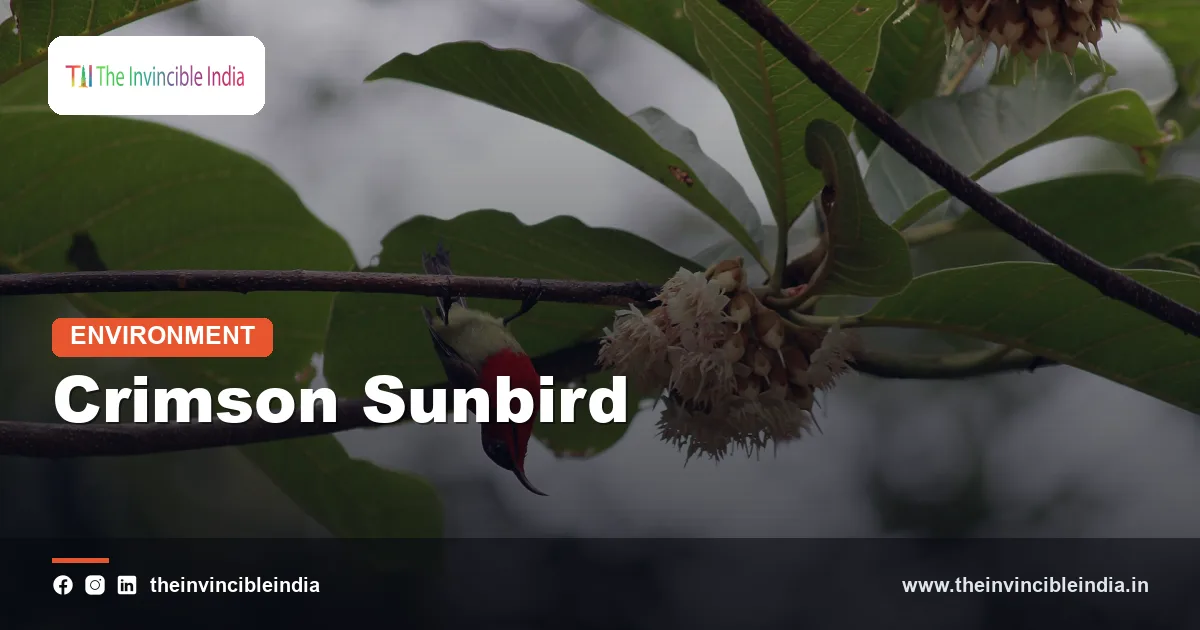
The crimson sunbird is a tiny, nectar-feeding songbird whose male glitters in crimson, glossy green and olive, living in forests, forest edges and gardens in the humid parts of India and across South and South-East Asia. With a slender curved bill and a brush-tipped tongue, it drinks nectar from flowers and takes small insects and spiders to feed its young.
The crimson sunbird (Aethopyga siparaja) is one of the most colourful small birds of the Indian region, often compared with the hummingbirds of the Americas. The comparison is only a surface one, because the two groups are unrelated and have evolved the same lifestyle on different continents.
Quick Facts
| Attribute | Detail |
|---|---|
| Common name | Crimson sunbird (Hindi-language texts often use the general name shakar khora for sunbirds) |
| Scientific name | Aethopyga siparaja |
| Family | Nectariniidae (sunbirds), order Passeriformes |
| Size | About 10 to 12 cm long; males slightly longer because of an extended tail |
| Key features | Male with crimson back and breast, glossy green crown and tail, olive-grey belly; female plain olive; slender curved bill |
| Range and habitat | Humid forests, forest edges, plantations and gardens, mainly in the Himalayan foothills, north-east India and other humid wooded hill tracts, extending into South-East Asia |
| Diet | Flower nectar, plus small insects and spiders |
| Breeding | Hanging, pouch-like nest of cobweb, moss and plant down with a side entrance; usually two eggs; mainly spring to early summer |
| Conservation status | Least Concern on the IUCN Red List |
Key Takeaways
- The crimson sunbird, Aethopyga siparaja, is a tiny nectar-feeding bird of the family Nectariniidae found in forests and gardens in India and South-East Asia.
- The male crimson sunbird has a crimson back and breast with a glossy green crown and tail, while the female is plain olive and yellowish.
- The crimson sunbird drinks nectar with a slender curved bill and a tubular, brush-tipped tongue, and it pollinates flowers as it feeds.
- Sunbirds, including the crimson sunbird, are unrelated to the hummingbirds of the Americas, though they look and behave similarly.
- The female crimson sunbird builds a hanging, pouch-shaped nest of cobweb, moss and plant down, with an entrance on the side.
- The IUCN lists the crimson sunbird as Least Concern, but loss of flowering trees and forest can reduce local numbers.
What is the crimson sunbird?
The crimson sunbird is a very small perching bird in the sunbird family that feeds mainly on flower nectar. It is a passerine, which means it belongs to the large order of perching birds that includes crows, sparrows and thrushes, and not to a special nectar-feeding order.
The family Nectariniidae contains the sunbirds and spiderhunters of Africa, Asia and Australasia. Sunbirds are small, energetic and often brilliantly coloured, with long, thin, down-curved bills. The crimson sunbird is among the most vividly coloured members of the group in the Indian region and is a favourite of photographers.
The genus Aethopyga contains a number of brightly coloured Asian sunbirds, several of which, such as the fire-tailed sunbird and Mrs Gould’s sunbird, also occur in the Indian Himalaya. Members of the genus are mostly forest and forest-edge birds.
What does the crimson sunbird look like?
The male crimson sunbird has a crimson back and breast, a glossy green crown and tail, and a greyish-olive belly, while the female is a plain olive-green above and dull yellowish below. The male’s colours flash in strong sunlight because the feathers are partly iridescent, which means their colour comes from the structure of the feather as well as from pigment.
The bill is slender, sharp and curved downward, matched to the shape of many tubular flowers. The tail of the male is slightly longer than that of the female, with extended central feathers. The female lacks the red and the shine, which makes her harder to spot among leaves.
Does the male change colour through the year?
Some sunbirds, such as the purple sunbird, moult into a dull “eclipse” plumage outside the breeding season, which looks like the female’s colouring. In the crimson sunbird the male generally keeps most of his bright colour, though colour intensity can vary with age, wear and season. The details differ between populations and are not fully standardised in the literature.
How is it different from other Indian sunbirds?
The crimson sunbird is separated from other sunbirds by the male’s red back and breast. The table below lists several sunbirds that people often compare.
| Sunbird | Male colour | Typical habitat in India |
|---|---|---|
| Crimson sunbird | Crimson back and breast; green crown and tail | Humid forests, forest edges, gardens |
| Purple sunbird | Glossy purple-black, with a metallic sheen | Gardens, scrub, cultivation |
| Loten’s sunbird | Dark purple above, maroon breast band, long bill | Peninsular gardens and scrub |
| Purple-rumped sunbird | Maroon throat, purple rump, yellow belly | Forest edge and gardens |
| Fire-tailed sunbird | Red and scarlet with a yellow rump | Himalayan forests |
Where does the crimson sunbird live in India?
The crimson sunbird lives mainly in the humid forests and wooded country of the Himalayan foothills and north-eastern India, and it extends through South-East Asia as far as Indonesia and the Philippines. It also occurs in gardens and plantations where flowering trees are plentiful.
Western Ghats birds that look similar are treated by some authorities as a separate species, Vigors’s sunbird, so the exact range depends on which classification is followed. This is a good reminder that bird taxonomy is regularly revised as new evidence appears.
The species prefers moist, flowering country with a mix of tall trees and shrubs. It is found in the canopy and understorey of forest, along forest tracks and in tea and coffee estates, as well as in gardens adjoining forest. In the hills it may move up and down slopes following flowering seasons.
What does the crimson sunbird eat?
The crimson sunbird eats flower nectar as its main food, supplemented by small insects and spiders, which are especially important when it is feeding young. Nectar provides the sugars needed to power a small, active bird, while insects supply protein.
Trees and shrubs that attract it include the silk cotton tree (Bombax ceiba), coral trees (Erythrina species), hibiscus, bottlebrush, mistletoes and many forest climbers. Many of these plants produce tubular, red or orange flowers rich in nectar. The bird also visits garden plants such as canna and salvia.
The bird feeds by perching on a twig near the flower, inserting the bill and drawing nectar up with its tubular tongue. It sometimes hovers briefly in front of a flower, though it usually clings or perches, unlike a hummingbird, which hovers for long periods.
How does the sunbird’s tongue work?
The sunbird’s tongue is long, tubular and split near the tip into brush-like fringes. It sweeps nectar into the tube by capillary action. Observers have also seen sunbirds make a small slit at the base of a flower to take nectar, a habit called nectar robbing, which avoids pollination.
Is the crimson sunbird related to a hummingbird?
No, the crimson sunbird is not related to hummingbirds, and the two groups look alike because of convergent evolution. Sunbirds live in Africa, Asia and Australasia, while hummingbirds live only in the Americas, and each group evolved separately to exploit nectar-rich flowers.
The main differences lie in the way they feed and fly. Hummingbirds can hover for long periods with extremely rapid wingbeats, whereas sunbirds mostly perch while feeding and hover only briefly. Sunbirds are songbirds, belonging to the order Passeriformes, whereas hummingbirds belong to a different order.
- Distribution: sunbirds in the Old World, hummingbirds in the New World.
- Feeding: sunbirds perch more; hummingbirds hover longer.
- Order: sunbirds are passerines; hummingbirds are not.
- Bill: both have long thin bills, a case of similar solutions to a similar problem.
How does the crimson sunbird build its nest?
The female crimson sunbird builds a small, hanging, pear-shaped nest of cobweb, moss, lichen, plant down and fine fibres, with an entrance on the side near the top. The nest is suspended from a twig or leaf tip and is often camouflaged with bits of bark or litter.
The female does most or all of the building, gathering strands of spider silk to bind the materials together. Some nests carry a small porch or hood over the entrance that keeps out rain. The shape and the soft, sticky silk make a flexible and well-hidden structure.
The female usually lays two eggs, which are pale and finely marked. She incubates them herself, while the male defends the territory and feeds nearby. Both parents may feed the young with insects and spiders, and nestlings fledge after about two weeks or more.
The breeding season varies with region and the flowering of local trees, but it often falls in spring and early summer. Sunbirds sometimes raise more than one brood when conditions are favourable.
Why are sunbirds important for pollination?
Sunbirds are important for pollination because they carry pollen on their bills and feathers from flower to flower as they feed. Many tropical plants have evolved bright red or orange tubular flowers that suit sunbirds, and these plants depend on birds to set seed.
When a crimson sunbird probes a flower, pollen brushes onto its forehead or bill and is deposited on the next flower. Trees such as the silk cotton and coral tree, which bloom when leafless, often rely on sunbirds, bulbuls and other birds to move pollen. In this way a small bird helps maintain the forest canopy.
Sunbirds also feed their chicks on insects and spiders, which makes them a minor control on small garden pests. In many parts of India, farmers and gardeners welcome their visits.
What does the crimson sunbird sound like?
The crimson sunbird has a sharp, high-pitched call, usually a series of short “tsit” or “chip” notes, and the male also sings a quick, tinkling twittering song. The calls are often the first sign that a sunbird is nearby, because the bird is small and hides in foliage.
Males sing from exposed perches during the breeding season and chase rivals through the trees. The song is made of thin, rapid notes and is not loud, but it carries across a garden or forest clearing in the early morning.
Both sexes flick their wings and tail as they move, and they are quick to dart away if disturbed. Patient observers often find the birds by watching a flowering tree and waiting for movement.
Is the crimson sunbird threatened, and how can you attract it?
The crimson sunbird is not globally threatened and is listed as Least Concern by the IUCN, but it depends on flowering trees and forest cover. Habitat loss, clearing of forest and the removal of flowering garden plants can reduce local numbers.
Gardeners can attract sunbirds by planting native flowering shrubs and trees that bloom in different seasons, offering a steady nectar supply. Avoiding pesticides keeps insects and spiders available for feeding chicks. Leaving fine cobwebs and soft plant down undisturbed gives females nest material.
- Plant hibiscus, bottlebrush, canna, coral tree and similar nectar-rich species.
- Keep a mix of tall trees and low shrubs for perching and shelter.
- Avoid insecticides and chemical sprays around flowering plants.
- Do not use sugar-water feeders unless they are cleaned regularly, because spoilage can harm birds.
- Keep cats away from nesting areas.
In India, most native wild birds are covered by the Wildlife (Protection) Act, 1972, which discourages capturing or harming them.
Bottom Line
The crimson sunbird is a small, glittering pollinator whose life is tied to nectar-rich flowers and forest cover. Spotting the male’s crimson breast among blossoms is one of the quiet pleasures of Indian birdwatching, and a garden full of flowering plants is the simplest way to support it.
Frequently Asked Questions
What is the crimson sunbird?
The crimson sunbird (Aethopyga siparaja) is a tiny nectar-feeding songbird of the family Nectariniidae. The male has a crimson back and breast with a glossy green crown and tail, while the female is plain olive. It lives in forests and gardens in India and South-East Asia.
What does the crimson sunbird eat?
The crimson sunbird eats mainly flower nectar, using a slender curved bill and a brush-tipped tongue. It also catches small insects and spiders, which are especially important food for its chicks. It visits flowers such as silk cotton, coral tree, hibiscus and bottlebrush.
Is a sunbird the same as a hummingbird?
No, a sunbird is not a hummingbird. Sunbirds live in the Old World and are songbirds that usually perch while feeding, whereas hummingbirds live only in the Americas and hover for long periods. The similarity between them is the result of convergent evolution.
How can you tell a male crimson sunbird from a female?
The male crimson sunbird is brightly coloured, with a crimson back and breast and a glossy green crown and tail. The female is dull olive above and pale yellowish below, with no red or shine. The male also has a slightly longer tail than the female.
How does the crimson sunbird make its nest?
The female crimson sunbird builds a hanging, pouch-shaped nest from cobweb, moss, lichen and plant down, with a side entrance near the top. She usually lays two eggs and incubates them herself. The nest is often decorated with bits of bark or leaf to blend in.
Is the crimson sunbird endangered?
No, the crimson sunbird is classed as Least Concern by the IUCN because it has a wide range and a stable overall population. Local numbers can fall if forests are cleared or flowering trees and shrubs are removed from gardens and plantations.
{“@context”:”https://schema.org”,”@graph”:[{“@type”:”FAQPage”,”mainEntity”:[{“@type”:”Question”,”name”:”What is the crimson sunbird?”,”acceptedAnswer”:{“@type”:”Answer”,”text”:”The crimson sunbird (Aethopyga siparaja) is a tiny nectar-feeding songbird of the family Nectariniidae. The male has a crimson back and breast with a glossy green crown and tail, while the female is plain olive. It lives in forests and gardens in India and South-East Asia.”}},{“@type”:”Question”,”name”:”What does the crimson sunbird eat?”,”acceptedAnswer”:{“@type”:”Answer”,”text”:”The crimson sunbird eats mainly flower nectar, using a slender curved bill and a brush-tipped tongue. It also catches small insects and spiders, which are especially important food for its chicks. It visits flowers such as silk cotton, coral tree, hibiscus and bottlebrush.”}},{“@type”:”Question”,”name”:”Is a sunbird the same as a hummingbird?”,”acceptedAnswer”:{“@type”:”Answer”,”text”:”No, a sunbird is not a hummingbird. Sunbirds live in the Old World and are songbirds that usually perch while feeding, whereas hummingbirds live only in the Americas and hover for long periods. The similarity between them is the result of convergent evolution.”}},{“@type”:”Question”,”name”:”How can you tell a male crimson sunbird from a female?”,”acceptedAnswer”:{“@type”:”Answer”,”text”:”The male crimson sunbird is brightly coloured, with a crimson back and breast and a glossy green crown and tail. The female is dull olive above and pale yellowish below, with no red or shine. The male also has a slightly longer tail than the female.”}},{“@type”:”Question”,”name”:”How does the crimson sunbird make its nest?”,”acceptedAnswer”:{“@type”:”Answer”,”text”:”The female crimson sunbird builds a hanging, pouch-shaped nest from cobweb, moss, lichen and plant down, with a side entrance near the top. She usually lays two eggs and incubates them herself. The nest is often decorated with bits of bark or leaf to blend in.”}},{“@type”:”Question”,”name”:”Is the crimson sunbird endangered?”,”acceptedAnswer”:{“@type”:”Answer”,”text”:”No, the crimson sunbird is classed as Least Concern by the IUCN because it has a wide range and a stable overall population. Local numbers can fall if forests are cleared or flowering trees and shrubs are removed from gardens and plantations.”}}]}]}


