

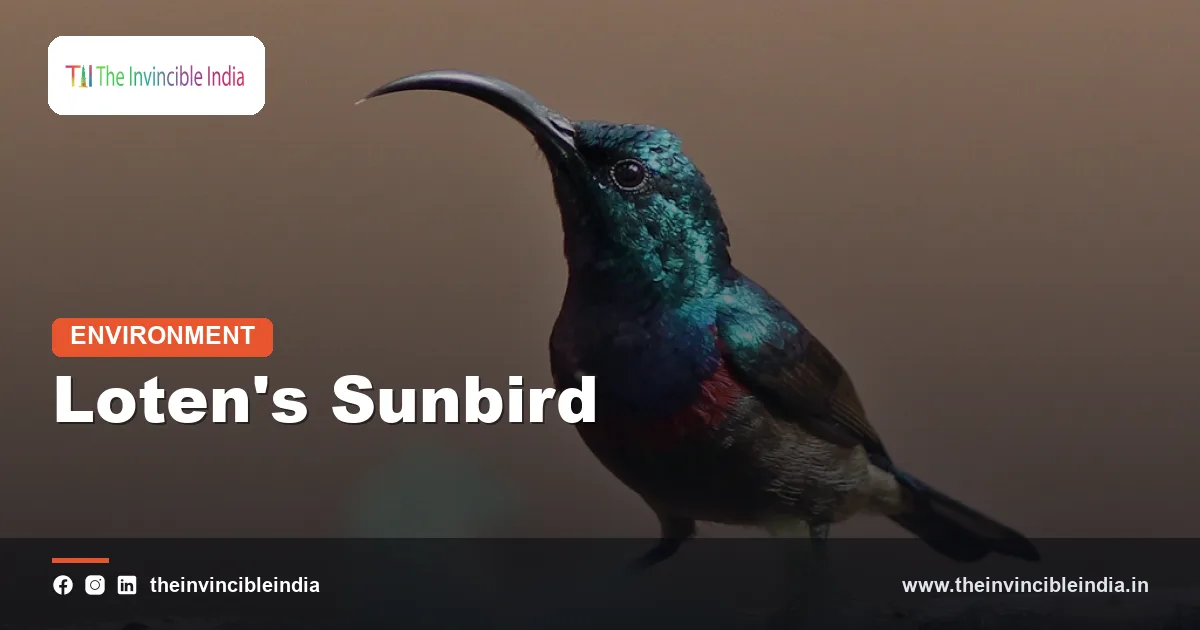
Loten’s sunbird (Cinnyris lotenius) is a small, long-billed nectar-feeding bird of the sunbird family that lives in the gardens, scrub, plantations and light forests of peninsular India and Sri Lanka. The male is a glossy dark bird with a purple-blue sheen and a broad maroon breast band, and it carries one of the longest, most strongly curved bills of any Indian sunbird. Because it often shows up on flowering shrubs in ordinary gardens, Loten’s sunbird is one of the easiest of the larger sunbirds to watch closely in southern India.
The species was named in honour of Johan Gideon Loten, a Dutch governor of Ceylon in the 1750s who supported the study of the island’s natural history. Today Loten’s sunbird is treated as a bird of Least Concern, a hardy resident that tolerates human-modified land as long as flowering plants and a little cover remain. This article explains its identification, range, diet, nesting, behaviour and ecological role.
Quick Facts
| Common name | Loten’s sunbird (also called the long-billed sunbird in older books) |
|---|---|
| Scientific name | Cinnyris lotenius (formerly placed in the genus Nectarinia) |
| Family | Nectariniidae (sunbirds and spiderhunters) |
| Size | About 12 to 14 cm, including a long, down-curved bill |
| Range | Peninsular India, mainly the south and the Western Ghats region, and Sri Lanka |
| Habitat | Gardens, scrub, coconut groves, light deciduous forest and forest edges |
| Diet | Flower nectar, small insects and spiders |
| Breeding | Pear-shaped hanging nest built by the female, usually two eggs; timing varies by region, often in the dry season into early monsoon |
| Conservation status | Least Concern (IUCN) |
Key Takeaways
- Loten’s sunbird is a sunbird of peninsular India and Sri Lanka, scientifically named Cinnyris lotenius.
- The male Loten’s sunbird shows a glossy purple-blue head and back and a broad maroon band across the breast, which separates it from other Indian sunbirds.
- Loten’s sunbird has a very long, strongly curved bill that suits it to drinking nectar from deep, tubular flowers.
- Loten’s sunbird feeds mainly on nectar but also catches small insects and spiders, which it needs to feed its chicks.
- The female Loten’s sunbird builds a pear-shaped, hanging nest of fine fibres and cobweb with a hooded side entrance, and usually lays two eggs.
- Loten’s sunbird is classed as Least Concern, and it persists in gardens and plantations wherever nectar-rich flowers are available.
What is Loten’s sunbird?
Loten’s sunbird is a member of the Nectariniidae, the family of Old World nectar-feeding birds known as sunbirds, and it is a resident species of peninsular India and Sri Lanka. It is not a hummingbird, although the two groups look alike and live similar lives. Hummingbirds belong to the Americas, while sunbirds live in Africa, southern Asia and Australasia, and the resemblance is a classic case of convergent evolution, where unrelated birds develop similar bodies because they exploit the same food.
The scientific name Cinnyris lotenius was published in the eighteenth century in the Linnaean system, and the bird was long listed as Nectarinia lotenia in Indian field guides. The common name honours Johan Gideon Loten (1710-1789), a Dutch colonial official who served as governor of Ceylon and sponsored careful drawings of the island’s wildlife. Some older Indian sources use the name long-billed sunbird or maroon-breasted sunbird, which describe two of its most obvious features.
India has roughly a dozen or more sunbirds and spiderhunters, from the common purple sunbird of city gardens to the fire-tailed and Mrs Gould’s sunbirds of the Himalaya. Loten’s sunbird occupies the southern and peninsular part of that picture. It is a bird of dry and moist deciduous country, coastal belts and plantations rather than the high mountains.
How can you identify Loten’s sunbird?
You can identify Loten’s sunbird by its unusually long, sharply down-curved bill and, in the male, by the combination of glossy dark upperparts and a broad maroon breast band. The bird is small, only about 12 to 14 cm long, and it moves restlessly through flowering branches, so a good view of the bill shape is often the quickest clue.
The male
The male has a metallic purple-blue sheen on the crown, back and throat that can look black in poor light. Across the breast runs a wide maroon or chestnut-maroon band, and the lower belly is dusky olive-grey. Small yellow tufts sit at the sides of the breast near the bend of the wing and can be displayed during courtship or aggression. The long bill is black and curved like a tiny sickle.
The female and young birds
The female is plain: olive-grey above and dull yellowish below, with the same long, curved bill. She lacks the metallic gloss and the maroon band. Young birds look like the female, and young males slowly gain dark feathers on the throat and breast as they mature.
Voice
The call is a sharp, repeated chip or chweet, and the song is a quick series of thin, high notes delivered from the top of a bush or tree. The song is mainly used by males to defend a territory during the breeding season.
Where is Loten’s sunbird found in India?
Loten’s sunbird is found mainly in peninsular India, with the greatest numbers in the south and along the Western Ghats region, and it also occurs in Sri Lanka. It is largely a lowland and foothill bird, found from the coast to moderate elevations, and it is replaced by other sunbirds in the Himalaya and the north-east.
Inside its range, the bird uses a wide set of habitats:
- Gardens and parks: flowering shrubs such as hibiscus, bottlebrush and canna attract it throughout the year.
- Scrub and thorn forest: it works through flowering bushes and mistletoe clumps in open, dry country.
- Coconut and fruit plantations: palms and orchard trees supply flowers and shaded nest sites.
- Light deciduous forest and forest edges: flowering trees such as coral tree (Erythrina) and silk cotton (Bombax) are favourite feeding spots.
- Coastal and mangrove margins: the bird visits flowering trees close to the shore.
The species is generally sedentary, meaning that individuals stay in the same area throughout the year. Local movements do occur when particular trees come into flower, and sunbirds can appear quickly at a flowering tree that was empty a week earlier.
What does Loten’s sunbird eat?
Loten’s sunbird eats mainly nectar from flowers, supplemented by small insects and spiders. Nectar is a rich energy source made mostly of sugar, and the bird’s metabolism is so fast that it must feed many times a day to stay fuelled. Insects and spiders supply the protein that nectar lacks, and adults rely on them especially when raising chicks.
The bird has a long, tube-like tongue that is split and fringed near the tip, which draws up nectar by capillary action rather than by simply lapping. Its long, curved bill matches the shape of many tubular flowers. When a flower is too deep or has a tough base, a sunbird sometimes pierces the base of the flower to get at the nectar, a habit known as nectar robbing.
Common sources of food include:
- Mistletoe flowers (Loranthaceae), which sunbirds often open and pollinate as they feed.
- Coral tree, silk cotton, Butea and other bird-pollinated trees that flower in the dry months.
- Garden plants such as hibiscus, bottlebrush, canna and bougainvillea.
- Small caterpillars, aphids, flies and spiders gleaned from leaves and bark, sometimes taken from webs.
Unlike hummingbirds, sunbirds usually perch while they feed, though they may hover for a moment to reach a flower. Watching a Loten’s sunbird clinging upside down to a flower spike is a common sight.
How does Loten’s sunbird breed and build its nest?
Loten’s sunbird breeds by building a pear-shaped, hanging nest that the female weaves from fine plant fibres, grass, plant down and cobweb, with a side entrance protected by a small hood or porch. The nest is usually slung from the outer twigs of a bush or tree at a modest height, though birds also use hanging wires, porches and shaded corners of buildings.
The female does most or all of the building and the incubating. The male guards the area, sings from a perch and chases rivals. The cobweb used as binding gives the nest strength and a slight stretch, and bits of lichen, dry leaves and plant debris are often added to the outside as camouflage.
Eggs and chicks
A clutch is typically two eggs, which are pale and finely marked. After hatching, the chicks are fed insects and nectar, and both parents bring food. The young leave the nest after about two weeks and remain dependent on their parents for a short time afterwards. In the south the breeding season often falls in the dry months leading into the early monsoon, but timing differs from one region to another and with local flowering.
How does Loten’s sunbird behave?
Loten’s sunbird is an active, territorial and usually solitary or paired bird, and it spends most of its day moving between flowering plants. Males defend patches of flowers by singing and chasing other sunbirds, and they readily attack their own reflection in a window or a car mirror during the breeding season.
Sunbirds spend part of their time preening and sunning on exposed twigs, which keeps the feathers in good condition and helps maintain the metallic gloss. In hot weather the birds are most active in the early morning and late afternoon. They often join mixed groups of small birds at a flowering tree, but they rarely form dense flocks of their own.
The birds are bold around people. They readily feed within a metre or two of a verandah and may visit balcony plants, which is why they are a favourite subject for garden birdwatchers and photographers.
How is Loten’s sunbird different from other Indian sunbirds?
Loten’s sunbird differs from other Indian sunbirds mainly in its longer, more curved bill and the male’s broad maroon breast band. The table below compares it with two sunbirds that live in the same gardens and are often confused with it.
| Feature | Loten’s sunbird | Purple sunbird | Purple-rumped sunbird |
|---|---|---|---|
| Scientific name | Cinnyris lotenius | Cinnyris asiaticus | Leptocoma zeylonica |
| Bill | Very long, strongly curved | Shorter, curved | Short, curved |
| Male breast | Broad maroon band over a dusky belly | Glossy purple-black, no band; dull eclipse plumage out of season | Maroon-brown back, purple rump and throat, yellow belly |
| Female | Olive-grey above, dull yellowish below | Olive above, pale yellowish below | Olive above, yellow belly, whitish throat |
| Typical habitat | Scrub, gardens, light forest | Gardens, scrub, farmland | Forest edges, wooded gardens |
The practical tip is to look first at the bill length and the breast. A long sickle-shaped bill with a maroon breast band on a dark male points to Loten’s sunbird.
Why does Loten’s sunbird matter to the ecosystem?
Loten’s sunbird matters because it works as a pollinator and as a controller of small insects in the gardens and scrub it visits. As the bird pushes its head into a flower to feed, pollen sticks to its bill and forehead and is carried to the next flower. This is especially important for bird-pollinated plants such as mistletoes and some tropical trees that depend on birds rather than bees.
Its role in insect control is smaller but real. Spiders and soft-bodied insects taken from foliage help limit populations of garden pests. The bird is also a useful indicator species: a thriving population of sunbirds suggests that a garden or patch of scrub still has a healthy mix of native flowering plants.
Is Loten’s sunbird threatened?
No, Loten’s sunbird is not threatened and is classed as Least Concern, because it is common across a wide range and adapts to gardens and plantations. The population is believed to be stable. Its main pressures are the removal of flowering trees, heavy pesticide use that reduces insect prey, and loss of nesting cover in tidy, over-pruned gardens.
Simple actions help the species. Gardeners can plant nectar-rich native and ornamental flowers, retain a few shrubs and hedges for nest sites, avoid spraying insecticides on flowering plants, and leave natural cobwebs and plant down where birds can collect them. Protecting old flowering trees along roads and in village commons also keeps food available in the dry season.
Where and when can you see Loten’s sunbird?
You can see Loten’s sunbird throughout the year in gardens, scrub and plantations of southern and peninsular India, most easily in the early morning and late afternoon when it feeds at flowering plants. The best strategy is to locate a flowering tree or shrub that is attracting insects and sunbirds, then wait quietly nearby.
Useful tips for watching the bird:
- Look for hibiscus, bottlebrush, coral tree and mistletoe clumps in flower, and scan them slowly.
- Listen for the sharp chip or chweet call, which often gives the bird away before it is seen.
- Use binoculars to check the bill length and the colour of the breast.
- Look for the small hanging nest in the dry season, but keep a respectful distance so that the parents are not disturbed.
Bottom Line
Loten’s sunbird is a small, long-billed nectar feeder of peninsular India and Sri Lanka, recognised by the male’s purple-blue gloss and maroon breast band. It is common, adaptable and ecologically useful as a pollinator, and gardens with flowering plants are among its best habitats.
Frequently Asked Questions
What is Loten’s sunbird?
Loten’s sunbird is a small nectar-feeding bird of peninsular India and Sri Lanka, scientifically named Cinnyris lotenius. The male is glossy purple-blue with a broad maroon breast band and a very long, curved bill. It belongs to the sunbird family, Nectariniidae.
Why is it called Loten’s sunbird?
The bird is named after Johan Gideon Loten, a Dutch governor of Ceylon in the 1750s who supported natural history work on the island. Older books also call it the long-billed sunbird or maroon-breasted sunbird, describing its bill and breast colour.
What does Loten’s sunbird eat?
Loten’s sunbird eats mainly flower nectar, together with small insects and spiders. Nectar provides energy, while the insects and spiders provide protein, especially for growing chicks. The bird uses its long, curved bill and brush-tipped tongue to reach nectar deep inside tubular flowers.
How is Loten’s sunbird different from the purple sunbird?
Loten’s sunbird has a longer, more strongly curved bill and a male with a broad maroon breast band, whereas the male purple sunbird is mostly glossy purple-black without a band. The purple sunbird also has a dull eclipse plumage out of the breeding season, and it is a widespread garden bird across much of India.
How does Loten’s sunbird build its nest?
The female builds a pear-shaped hanging nest from fine plant fibres, grass, plant down and cobweb, with a hooded entrance on the side. She hangs it from the outer twigs of a shrub or tree, and the clutch is usually two eggs. Both parents feed the chicks.
Is Loten’s sunbird endangered?
No, Loten’s sunbird is not endangered and is listed as Least Concern by the IUCN. It is a common resident that adapts well to gardens and plantations. Local declines are possible where flowering trees are removed or pesticides are overused.
{“@context”:”https://schema.org”,”@graph”:[{“@type”:”FAQPage”,”mainEntity”:[{“@type”:”Question”,”name”:”What is Loten’s sunbird?”,”acceptedAnswer”:{“@type”:”Answer”,”text”:”Loten’s sunbird is a small nectar-feeding bird of peninsular India and Sri Lanka, scientifically named Cinnyris lotenius. The male is glossy purple-blue with a broad maroon breast band and a very long, curved bill. It belongs to the sunbird family, Nectariniidae.”}},{“@type”:”Question”,”name”:”Why is it called Loten’s sunbird?”,”acceptedAnswer”:{“@type”:”Answer”,”text”:”The bird is named after Johan Gideon Loten, a Dutch governor of Ceylon in the 1750s who supported natural history work on the island. Older books also call it the long-billed sunbird or maroon-breasted sunbird, describing its bill and breast colour.”}},{“@type”:”Question”,”name”:”What does Loten’s sunbird eat?”,”acceptedAnswer”:{“@type”:”Answer”,”text”:”Loten’s sunbird eats mainly flower nectar, together with small insects and spiders. Nectar provides energy, while the insects and spiders provide protein, especially for growing chicks. The bird uses its long, curved bill and brush-tipped tongue to reach nectar deep inside tubular flowers.”}},{“@type”:”Question”,”name”:”How is Loten’s sunbird different from the purple sunbird?”,”acceptedAnswer”:{“@type”:”Answer”,”text”:”Loten’s sunbird has a longer, more strongly curved bill and a male with a broad maroon breast band, whereas the male purple sunbird is mostly glossy purple-black without a band. The purple sunbird also has a dull eclipse plumage out of the breeding season, and it is a widespread garden bird across much of India.”}},{“@type”:”Question”,”name”:”How does Loten’s sunbird build its nest?”,”acceptedAnswer”:{“@type”:”Answer”,”text”:”The female builds a pear-shaped hanging nest from fine plant fibres, grass, plant down and cobweb, with a hooded entrance on the side. She hangs it from the outer twigs of a shrub or tree, and the clutch is usually two eggs. Both parents feed the chicks.”}},{“@type”:”Question”,”name”:”Is Loten’s sunbird endangered?”,”acceptedAnswer”:{“@type”:”Answer”,”text”:”No, Loten’s sunbird is not endangered and is listed as Least Concern by the IUCN. It is a common resident that adapts well to gardens and plantations. Local declines are possible where flowering trees are removed or pesticides are overused.”}}]}]}


