

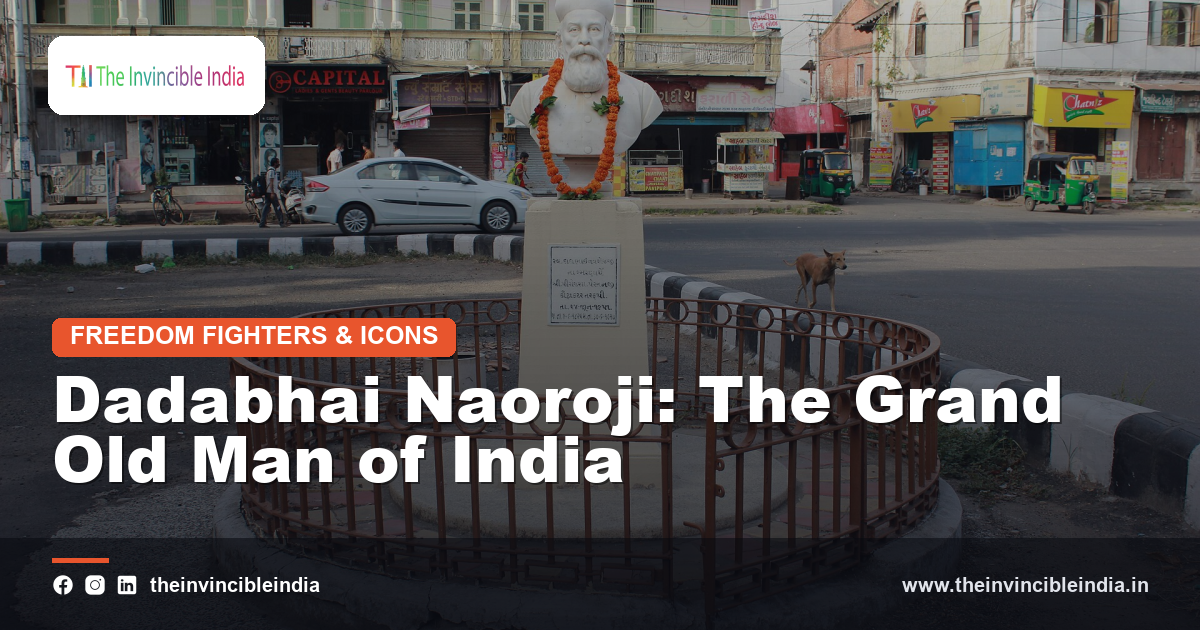
Dadabhai Naoroji occupies a place of singular honour among India’s freedom fighters, revered across generations as the Grand Old Man of India. A scholar, businessman and statesman, he devoted his long public life to awakening his countrymen to the economic injustices of colonial rule and to building the institutions through which India would eventually claim its freedom. His patient, reasoned scholarship, most famously his articulation of the drain theory, gave the early national movement its intellectual backbone, while his own example as the first Indian elected to the British Parliament proved that Indians could claim a voice at the very centre of imperial power. This guide traces the life, ideas and enduring legacy of Dadabhai Naoroji, mentor to a generation of leaders and one of the founding figures of modern Indian nationalism.
Quick Facts
| Detail | Information |
|---|---|
| Known as | The Grand Old Man of India |
| Born | 1825, in Bombay (present-day Mumbai) |
| Died | 1917 |
| Famous idea | The drain theory of Indias wealth under colonial rule |
| Notable work | “Poverty and Un-British Rule in India” |
| Distinction | First Indian elected to the British House of Commons |
The Grand Old Man of India
Dadabhai Naoroji is remembered with deep affection and respect as the Grand Old Man of India, a title bestowed on him in recognition of his decades of selfless public service and his role as a guiding elder of the national movement. Long before the freedom struggle became a mass movement, Naoroji had already spent a lifetime patiently building the case for India’s rights, educating opinion both in India and in Britain, and nurturing the institutions and leaders that would carry the cause forward. His dignified persistence, his moral seriousness and his refusal to be discouraged by setbacks earned him the trust and admiration of his countrymen. As the Grand Old Man of India, Dadabhai Naoroji stands among the earliest and most respected architects of the country’s long journey towards independence.
Early Life and Education
Dadabhai Naoroji was born in 1825 in Bombay into a Parsi family of modest means, and from an early age he displayed a keen intelligence and a devotion to learning that would shape his entire career. He received his education in Bombay at a time when modern English education was only beginning to open new horizons for young Indians, and he distinguished himself as an exceptional student. His early promise led to his appointment as a professor of mathematics and natural philosophy, an unusual achievement for an Indian in that era and a mark of the intellectual gifts that would later inform his scholarship on India’s economy. This grounding in education and scholarship gave Naoroji the analytical tools and the disciplined habits of mind that he would apply throughout his life to the study and defence of India’s interests.
A Pioneering Educator and Scholar
As one of the first Indians to hold a professorship at a leading college in Bombay, Naoroji broke new ground and demonstrated the capacity of Indians for scholarship and higher learning at a time when such opportunities were rarely extended to them. His years as an educator sharpened his gifts for careful reasoning and clear exposition, qualities that later made his writings on India’s economic condition so persuasive. Naoroji’s example as a scholar was itself a quiet assertion of Indian ability and dignity, offered without confrontation but with unmistakable purpose. This early career as a pioneering educator laid the intellectual foundation for the public life that followed, and it reflects the studious, reasoned temperament that Naoroji brought to every cause he later championed.
Business and Public Life in England
Naoroji’s public career took him beyond the borders of India when he travelled to England, first in connection with business interests and later to devote himself increasingly to public and political work on India’s behalf. Settling for long periods in London placed him at the heart of the empire and gave him direct access to British public opinion, the press and the corridors of Parliament, an access he used with great persistence over many years. His years in England were not spent in comfort but in tireless labour, writing, lecturing and organising to place India’s case before the British public. This sustained presence in England, sustained through personal sacrifice, allowed Naoroji to become the most effective Indian voice in Britain of his generation.
Founding the East India Association
Recognising the need for an organised platform to represent Indian interests before the British public and Parliament, Naoroji was instrumental in founding an association in London dedicated to placing India’s grievances and aspirations before an informed audience. This body brought together sympathetic British public figures and Indians resident in England, providing a forum for reasoned debate about Indian affairs at a time when few such channels existed. Through its meetings, papers and publications, the association helped to counter misinformation about India and to build a body of informed opinion favourable to reform. This early effort at organised advocacy in the imperial capital was among Naoroji’s most significant contributions, and it prefigured the larger nationalist organisation that would soon emerge in India itself.
The Drain Theory
Naoroji’s most enduring intellectual contribution was his drain theory, a carefully reasoned argument that a substantial share of India’s wealth was being transferred to Britain without adequate return, impoverishing the Indian economy over time. Through patient statistical study, he sought to demonstrate that this continuous drain, arising from the structure of colonial administration, trade and remittances, lay at the root of India’s poverty. This was not an emotional appeal but a scholarly economic critique, argued in the language of official statistics and economic reasoning, which made it especially difficult for colonial administrators to dismiss. The drain theory gave the nationalist movement its first rigorous economic analysis of colonial rule, and it remains one of the most influential ideas in the intellectual history of Indian nationalism.
Poverty and Un-British Rule in India
Naoroji brought together decades of research and argument in his landmark book, widely known by the title “Poverty and Un-British Rule in India”, which set out his analysis of India’s economic condition under colonial administration in comprehensive detail. The book argued that the prevailing system of governance was inconsistent with the professed British ideals of justice and fair dealing, a deliberately pointed choice of words meant to appeal to British notions of fair play even as it indicted British policy. Painstakingly documented and soberly argued, the work became a foundational text for a generation of Indian economic thinkers and nationalist leaders. This book remains Naoroji’s most significant written legacy, a work that gave scholarly weight and moral force to the case for reform of British rule in India.
Founder of the Indian National Congress
When the Indian National Congress was established to give India’s educated classes an organised voice, Naoroji was among its earliest and most respected founding figures, lending the fledgling organisation the weight of his reputation and experience. His long record of principled, reasoned advocacy in England made him a natural leader for a movement that, in its early years, sought reform through constitutional means, petition and dialogue rather than confrontation. Naoroji’s involvement helped to establish the Congress as a credible and serious body from its very inception, attracting the support of moderate opinion in both India and Britain. As a founder of the Indian National Congress, Naoroji helped to build the institutional platform on which the entire subsequent freedom struggle would be constructed.
President of the Indian National Congress
Such was the trust placed in Naoroji’s judgement and integrity that he was called upon to preside over the Indian National Congress on more than one occasion, a rare distinction that reflected the esteem in which he was held across the movement. His presidential addresses combined careful economic argument with dignified appeals for justice, setting a tone of reasoned constitutionalism that shaped the Congress in its formative decades. At one memorable session held in his later years, Naoroji gave voice to the growing aspiration for self-government, lending his immense personal authority to a demand that would only grow stronger with time. His repeated presidency of the Congress is a measure of his stature as an elder statesman of the national movement.
Election to the British Parliament
In one of the most remarkable achievements of his career, Naoroji stood for election to the British House of Commons and won a seat, becoming the first Indian ever to be elected to that Parliament. His victory, achieved in the face of considerable scepticism about whether an Indian could win the confidence of a British constituency, was celebrated across India as a proof of Indian capability and a symbolic breach of the barriers of empire. As a Member of Parliament, Naoroji used his position to raise questions about Indian administration and to press the case for reform from within the very institution that governed India. This pioneering entry into the British Parliament remains one of the most celebrated milestones in the story of Indian nationalism.
A Voice for India in Britain
Throughout his years in England, whether inside Parliament or beyond it, Naoroji functioned as the most persistent and respected Indian voice addressing the British political establishment and public directly. He wrote extensively, gave evidence before official commissions, addressed public meetings and corresponded tirelessly with sympathetic figures, always pressing the case for fairer treatment of India with patience and moral seriousness. His readiness to engage British audiences on their own terms, using facts and reasoned argument rather than rhetoric, won him respect even among those who disagreed with his conclusions. This sustained role as India’s advocate within Britain itself was a unique and invaluable contribution to the early nationalist cause, one that few others were positioned to make.
Mentor to a Generation of Leaders
Naoroji’s influence extended well beyond his own writings and speeches, for he served as mentor and guide to a younger generation of leaders who would go on to shape the freedom struggle in profound ways. Younger nationalists who spent time in England or corresponded with him found in Naoroji a patient counsellor whose experience, wisdom and unwavering commitment to India’s cause offered both practical guidance and moral inspiration. Several leaders who would later become central figures of the movement looked upon him with the deference due to a respected elder and teacher. This role as mentor to a rising generation of nationalists is among the quieter but most consequential parts of Naoroji’s legacy, linking the movement’s earliest years to its later, more assertive phase.
Advocate of Self-Government
Although long associated with moderate, constitutional methods, Naoroji was also among the first senior Congress leaders to give clear and public expression to the demand for self-government for India. Speaking with the authority of decades of service to the cause, he argued that the ultimate aim of the national movement must be nothing less than the right of Indians to govern themselves. This forthright articulation, coming from so respected and moderate a figure, gave considerable legitimacy to a demand that more radical voices would soon press with greater urgency. Naoroji’s advocacy of self-government marked an important stage in the evolution of nationalist demands, bridging the movement’s early emphasis on reform with its later insistence on full independence.
Economic Nationalism
Naoroji’s careful economic analysis helped to give rise to a broader current of economic nationalism within the freedom movement, one that judged colonial rule not only by its political character but by its material consequences for ordinary Indians. By insisting that poverty in India was not a natural condition but the product of a particular economic relationship with Britain, he shifted the terms of the debate and inspired other thinkers to examine trade, taxation and industry through a nationalist lens. This tradition of economic critique would influence the movement’s later emphasis on self-reliance and indigenous industry. Naoroji’s pioneering role in founding this school of economic nationalism is one of his most lasting intellectual contributions to Indian public life.
Titles and Honours
Over the course of his long public life, Dadabhai Naoroji came to be addressed by a variety of respectful titles that reflected the depth of admiration in which he was held, the most enduring of which remains the Grand Old Man of India. This affectionate honorific captured both his advanced age in his later years of active service and the patriarchal respect accorded to a leader who had given his entire life, without any thought of personal gain, to the service of his country. The title has endured in popular memory long after many of the specific details of his career have faded from general knowledge. These titles and honours, earned through decades of selfless dedication, remain a fitting tribute to a life devoted entirely to India’s cause.
The Legacy of Dadabhai Naoroji
The legacy of Dadabhai Naoroji rests on the rare combination of scholarly rigour, moral seriousness and patient persistence that he brought to the cause of Indian freedom over an unusually long public career. His drain theory equipped the nationalist movement with its first serious economic critique of colonial rule, his founding role in the Indian National Congress helped to build the institution that would eventually lead India to independence, and his election to the British Parliament proved that Indians could claim a place even within the institutions of empire. As mentor to younger leaders, he also helped to carry forward the flame of the movement into its later, more determined phases. This many-sided legacy secures Naoroji’s place among the true founding figures of modern Indian nationalism.
Naoroji Remembered Today
Today Dadabhai Naoroji is remembered with lasting respect as one of the earliest and most far-sighted architects of the movement that eventually won India its freedom. His writings continue to be studied for their pioneering economic analysis of colonial rule, and institutions, streets and memorials across India bear his name in tribute to his contribution. He is honoured particularly as a symbol of reasoned, principled public service and as proof that patient scholarship and moral conviction could achieve what confrontation alone could not. As the Grand Old Man of India, Dadabhai Naoroji endures in the nation’s memory as a wise elder statesman whose life’s work laid the intellectual and institutional groundwork for India’s long struggle for independence.
Sources & Further Reading
- Ministry of Culture, Government of India, on the early leaders of the national movement (indiaculture.gov.in).
- Parliament of the United Kingdom, historical records of Members of Parliament (parliament.uk).
Frequently Asked Questions
Who was Dadabhai Naoroji?
Dadabhai Naoroji, revered as the Grand Old Man of India, was a scholar, businessman and statesman who devoted his long public life to exposing the economic injustices of colonial rule and to building the institutions of the early nationalist movement, including the Indian National Congress.
What is the drain theory?
The drain theory, formulated by Naoroji, argued that a substantial share of India’s wealth was continuously transferred to Britain under colonial rule without adequate return, a process he identified as a root cause of India’s widespread poverty.
Why is Naoroji called the Grand Old Man of India?
Naoroji earned the affectionate title Grand Old Man of India in recognition of his decades of selfless, dedicated public service to the nationalist cause and his role as a respected elder and mentor to the movement’s leaders.
What did Naoroji achieve in the British Parliament?
Naoroji became the first Indian ever elected to the British House of Commons, using his position as a Member of Parliament to raise questions about Indian administration and to press for fairer treatment of India from within the imperial legislature.
What was Naorojis role in the Indian National Congress?
Naoroji was among the founding figures of the Indian National Congress and served as its president on more than one occasion, lending the organisation his immense personal authority and helping to shape its early, reasoned, constitutional approach.


