

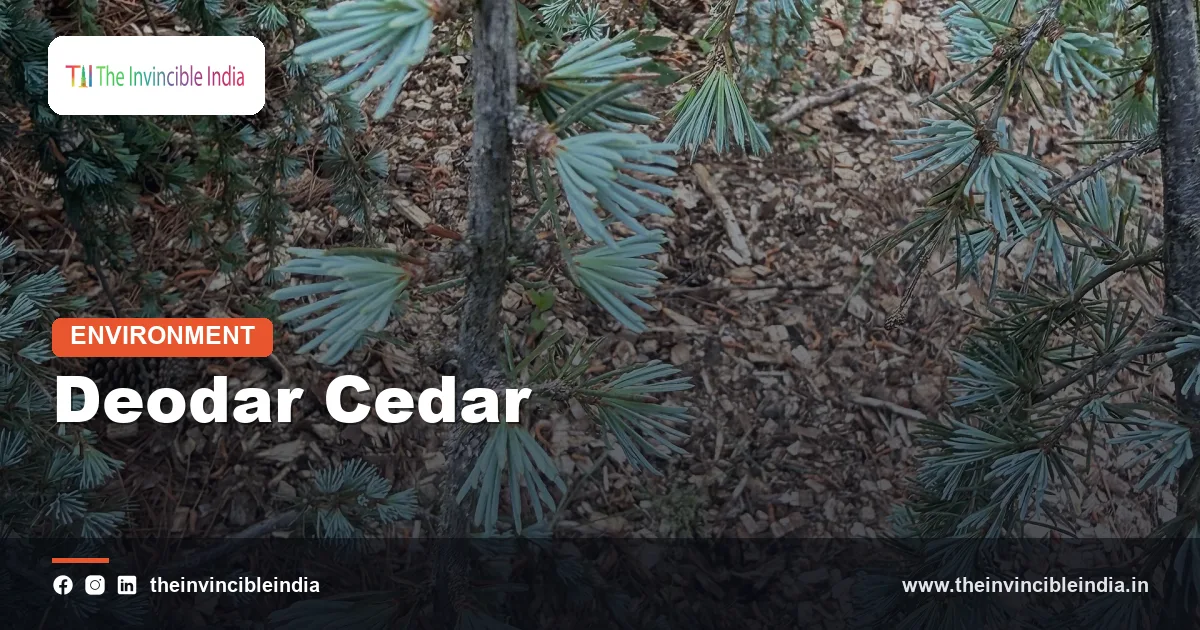
The deodar (Cedrus deodara) is a tall, long-lived evergreen conifer native to the western Himalaya, valued for its durable, fragrant timber and revered in Indian tradition as the “tree of the gods”. The word deodar comes from the Sanskrit devadaru, meaning “timber of the gods”, and the tree is also called the Himalayan cedar. It forms some of the most impressive coniferous forests on the mountain slopes of Himachal Pradesh, Uttarakhand and Jammu and Kashmir.
For centuries the deodar has supplied beams for temples, houses and houseboats, resin and oil for medicine, and shade for hill towns. This explainer sets out what the deodar is, where it grows, how it differs from other cedars and pines, what its wood is used for and why careful management of its forests matters today. Facts were last reviewed on 23 October 2026.
| Quick Fact | Detail |
|---|---|
| Scientific name | Cedrus deodara |
| Family | Pinaceae (the pine family), genus Cedrus |
| Common names | Deodar, Himalayan cedar, deodar cedar; devadaru in Sanskrit; diyar or deodar in Hindi and Kashmiri usage |
| Native range | Western Himalaya: eastern Afghanistan, northern Pakistan, Kashmir, Himachal Pradesh, Uttarakhand and western Nepal |
| Where grown in India | Jammu and Kashmir, Himachal Pradesh and Uttarakhand, mostly between about 1,500 and 3,000 metres above sea level |
| Season | Evergreen; pollen is shed in autumn and cones ripen over roughly two years |
| Uses | Construction timber, furniture, carving, fragrant oil, traditional medicine, plantation forestry and ornamental planting |
| Notable facts | State tree of Himachal Pradesh; national tree of Pakistan; individual trees can live for several centuries |
Key Takeaways
- The deodar (Cedrus deodara) is a large evergreen conifer of the pine family that is native to the western Himalaya.
- The name deodar derives from the Sanskrit devadaru, which means “timber of the gods”, reflecting the tree’s sacred status in Indian tradition.
- Deodar timber is prized because its heartwood is oily, fragrant and naturally resistant to decay and insects.
- In India, deodar forests grow mainly in Jammu and Kashmir, Himachal Pradesh and Uttarakhand at moderate to high elevations.
- The deodar is a true cedar of the genus Cedrus, a relative of the cedar of Lebanon, and is unrelated to the broadleaved and cypress-family trees whose scented timber is sold as “cedar”.
- Deodar is the state tree of Himachal Pradesh, and its forests are managed under forest laws that regulate felling and require regeneration.
What is the deodar tree?
The deodar is a coniferous evergreen tree, belonging to the pine family, that grows naturally on the outer and middle ranges of the western Himalaya. A mature tree commonly reaches 30 to 50 metres in height, and exceptional specimens grow taller, with a straight trunk and a broad, conical crown that becomes flatter with age.
The deodar is one of only a handful of recognised species of true cedar. Its relatives are the cedar of Lebanon, the Atlas cedar of North Africa and the Cyprus cedar. These species grow in widely separated mountain regions around the Mediterranean and the Himalaya, a pattern that botanists often cite as an example of a plant group split apart over long geological time.
The International Union for Conservation of Nature (IUCN) has assessed the deodar as a species of Least Concern across its wide range, although local forests face pressure. The tree is also grown as an ornamental in parks, cantonments and hill stations across the subcontinent and in cool temperate gardens abroad.
Where does the deodar grow in India?
The deodar grows in India mainly in the western Himalayan states of Jammu and Kashmir, Himachal Pradesh and Uttarakhand, usually at elevations between about 1,500 and 3,000 metres. The tree favours well-drained soils on cool, moist slopes that receive both monsoon rain and winter snow.
Natural deodar forests are most extensive in the Kashmir valley and its surrounding catchments, in the Chamba, Kullu, Shimla and Kinnaur districts of Himachal Pradesh, and in the Tehri Garhwal, Uttarkashi and Chakrata areas of Uttarakhand. Beyond India the tree extends westward into the mountains of Pakistan and eastern Afghanistan and eastward as far as western Nepal. The eastern limit of the range is set largely by the stronger monsoon, which suits other conifers and broadleaved forest better.
Foresters describe several features of the habitat:
- Climate: cool temperate, with cold winters, snowfall and moderate rainfall.
- Soil: deep, well-drained loams on moist northern and eastern aspects; waterlogged ground is avoided.
- Companions: blue pine, spruce, silver fir, oaks and rhododendron share the same forest belt at different heights.
- Growth pattern: the deodar often forms pure stands on suitable slopes and mixed stands elsewhere.
What does a deodar look like and how does it grow?
A deodar can be recognised by its drooping branch tips, soft bluish-green to dark green needles and upright barrel-shaped cones. The young tree is pyramid-shaped with gracefully nodding shoots, while the old tree has a broader crown with spreading, horizontal limbs.
Needles and bark
The needles of the deodar are stiff, sharply pointed and about 2.5 to 5 centimetres long. On long shoots they are arranged singly in a spiral, and on short side shoots they grow in tight clusters, a feature shared by all true cedars. The bark is dark grey to brown and cracks into rough plates with age.
Cones and seeds
The deodar is monoecious, so each tree bears both male and female cones. The male cones are small and release pollen in autumn. The female cones are barrel-shaped, stand upright on the branches and take about two years to mature. When ripe, the scales of the cone fall apart on the tree and release winged seeds that are carried by the wind. A good seed year does not occur every season, which makes natural regeneration uneven.
Growth and lifespan
The deodar grows at a moderate rate in its early decades and then slows. Trees of several centuries are known in sheltered forests and temple groves. A very old specimen can have a trunk several metres in girth, and a few ancient trees near villages are protected locally because of religious belief.
Why is the deodar called the tree of the gods?
The deodar is called the tree of the gods because its Sanskrit name, devadaru, literally means “timber of the gods”, and the tree has long been linked to temples, sages and mountain deities. In classical Sanskrit literature, deodar forests are described as peaceful retreats associated with ascetics and with Shiva.
Several strands of tradition connect the tree with worship:
- Temple building: deodar beams and carved wooden panels form part of many hill temples in Himachal Pradesh and Uttarakhand, where the wood is believed to be pure and long-lasting.
- Village deities: in parts of the Himalaya, individual old deodars stand in sacred groves attached to a local deity, and cutting them is forbidden by custom.
- Incense and ritual: chips and oil of the tree have traditionally been burnt as fragrant offerings.
- Literature: the deodar appears in Sanskrit poetry and in Ayurvedic texts, where it is described as devadaru.
These associations help explain why many Himalayan communities protect old deodar groves even where commercial felling is permitted elsewhere. The sacred status of the tree is cultural rather than legal, but it has had a real conservation effect in specific localities.
What is deodar wood used for?
Deodar wood is used mainly as construction timber for doors, windows, beams, bridges, furniture, carving and traditional hill architecture because the heartwood is strong, fragrant and resistant to rot. The wood contains natural oils and resins that deter fungi and many wood-boring insects, so deodar can last for generations even in damp mountain conditions.
The wood is pale yellow to light brown, straight-grained and moderately hard, and it takes a good polish. It is lighter than many hardwoods, easier to season and less likely to warp when well dried. Main uses include:
- Houses and temples: structural posts, beams and carved facades in the wood-and-stone style of the western Himalaya.
- Houseboats and shikaras: the long-lived houseboats of Dal Lake and the Jhelum in Srinagar were traditionally made of deodar planking.
- Furniture and joinery: doors, window frames, panelling and carved screens.
- Bridges and sleepers: deodar was widely used in the nineteenth century for bridge timbers and railway sleepers because of its durability.
- Oil and resin: deodar oil, obtained from the wood, is used in traditional veterinary preparations, as an insect repellent and in some perfumery and soap products.
Because deodar timber is commercially valuable, most legal harvesting is organised by state forest departments through working plans, with felling limited to marked trees and followed by planting and protection.
How has the deodar shaped Himalayan buildings and history?
The deodar has shaped Himalayan buildings by supplying the timber for the distinctive layered wood-and-stone construction found in Himachal Pradesh and Kashmir, and it shaped colonial-era forestry by becoming one of the first timber species managed systematically in British India. In Himachal Pradesh the traditional kath-kuni style alternates horizontal deodar beams with stone, a design that flexes under earthquake stress and gives warm insulation against cold.
In Kashmir, carved wooden shrines, khatamband ceilings made of small interlocking deodar pieces, and the old wooden houses of Srinagar use the same timber. Many historic wooden mosques and shrines in the valley rely on deodar posts and beams.
In the nineteenth century, demand for sleepers and construction timber made the deodar forests of the upper Beas, Chenab, Jhelum and Yamuna catchments commercially important. Logs were floated down rivers to collection points. The expansion of forest administration, including working plans and the creation of reserved forests, was driven partly by the need to control the harvest of valuable conifers like the deodar. Today, many of these same forests are managed for water, soil protection and tourism as well as timber.
Is the deodar a true cedar?
Yes, the deodar is a true cedar because it belongs to the genus Cedrus, which contains only a handful of species and is separate from the many other trees marketed as “cedar” for their scented wood. Botanists recognise the deodar as the Himalayan member of that genus, alongside the cedar of Lebanon, the Atlas cedar and the Cyprus cedar.
The confusion arises because “cedar” is a loose trade term. Several unrelated trees, such as the Indian cedar or toon (Toona ciliata, a broadleaved tree of the mahogany family) and western red cedar (a cypress relative), carry the name only because their timber smells similar. The comparison table below separates the deodar from other Himalayan conifers that are often confused with it.
| Tree | Scientific name | Typical needle arrangement | Cone |
|---|---|---|---|
| Deodar | Cedrus deodara | Single on long shoots, clustered on short shoots; drooping tips | Upright, barrel-shaped, falls apart on the tree |
| Blue pine | Pinus wallichiana | Long, soft needles in bundles of five | Long, hanging, resinous |
| Chir pine | Pinus roxburghii | Long needles in bundles of three | Large, woody, hanging |
| Himalayan spruce | Picea smithiana | Single, four-sided needles; drooping branchlets | Long, hanging cylindrical |
| Silver fir | Abies pindrow | Flat single needles in two rows | Upright, falls apart on the tree |
What problems does the deodar face today?
The deodar faces pressure from over-harvesting, illegal felling, forest fires, grazing, road and hydropower construction and changing climate, even though the species as a whole is not endangered. Local stands near roads and settlements are particularly vulnerable.
The main concerns can be summarised as follows:
- Illegal and excess felling: high timber value attracts timber theft in accessible forests, and enforcement across remote slopes is difficult.
- Poor regeneration: seed years are irregular, and heavy grazing or fire can kill young seedlings.
- Forest fires: dry winters and accumulated needle litter raise the risk of surface fires in lower conifer belts.
- Development pressure: road widening, tunnels, hydropower projects and construction can remove trees and destabilise slopes.
- Climate change: warming may shift suitable elevation bands upward, and unusual dry spells and pest outbreaks can weaken trees.
Researchers also monitor diseases and insect attacks, including defoliators and bark beetles, that can damage stressed trees. Maintaining forest cover on steep Himalayan slopes also matters for rivers, since conifer forests help hold soil and regulate runoff.
How is the deodar protected and grown?
The deodar is protected in India mainly through forest laws and working plans administered by state forest departments, supported by national parks, sanctuaries and village-level protection, and it is propagated in nurseries from seed for plantations. The Indian Forest Act, 1927, the Forest (Conservation) Act, 1980, and state regulations control felling, transport and diversion of forest land.
Several protected areas in the western Himalaya, including the Great Himalayan National Park in Himachal Pradesh, contain deodar and other conifer belts within their mixed forests. Outside these areas, community forest committees and traditional sacred groves provide additional informal protection.
Plantation forestry follows a fairly standard pattern. Seeds are collected from selected mother trees in autumn, sown in nurseries in spring, and the seedlings are planted out on prepared hill slopes with protection from grazing. Silviculturists rely on natural regeneration in many forests by retaining seed trees and closing areas to livestock after felling. Because deodar grows slowly compared with many plantation species, rotations are long, and sustainable harvest depends on conservative felling limits.
Gardeners and municipalities also plant deodar as an avenue and park tree in cooler parts of north India, where its elegant outline makes it a favourite along hill-station roads.
Why does the deodar matter beyond timber?
The deodar matters beyond timber because its forests protect Himalayan slopes and watersheds, support wildlife and carry cultural and tourism value across the western mountains. Deeply rooted conifer stands reduce soil erosion and slow runoff, which protects the headwaters of rivers such as the Beas, Sutlej, Yamuna and Jhelum.
The forests are home to many animals typical of the western Himalayan conifer belt, including the Himalayan black bear, musk deer, monal pheasant, koklass pheasant and various woodpeckers, though the exact species vary by locality and altitude. Mature trees with hollows and a layered understorey support birds and small mammals.
For rural communities, deodar forests provide fuelwood, fodder, and timber for house construction under permitted rights. They also anchor local tourism, as visitors come to walk among old cedar groves at places such as Kufri, Chail and Kullu. Managing these forests well therefore means balancing timber supply, tourism, water protection and conservation, rather than treating the tree only as a source of wood.
Bottom Line
The deodar is the western Himalaya’s signature conifer: a long-lived true cedar whose scented, durable wood built the region’s temples, houses and houseboats and whose name still carries the idea of divinity. Protecting its forests, regulating felling and encouraging regeneration will decide whether future generations can enjoy the tree as a living landmark rather than only as old timber.
Frequently Asked Questions
What does deodar mean?
Deodar means “timber of the gods” and comes from the Sanskrit word devadaru, formed from deva (god) and daru (wood or tree). The name reflects the sacred standing of the tree in Himalayan tradition and its use in temples. The tree is also called the Himalayan cedar.
Is the deodar a cedar or a pine?
The deodar is a true cedar of the genus Cedrus, but both cedars and pines belong to the same family, Pinaceae. It is therefore a cousin of pines rather than a pine itself. Cedars can be told apart by their clustered needles on short shoots and their upright cones that fall apart on the tree.
Where do deodar trees grow in India?
Deodar trees grow naturally in Jammu and Kashmir, Himachal Pradesh and Uttarakhand, mostly between about 1,500 and 3,000 metres above sea level. The tree prefers cool, moist slopes with winter snow and well-drained soil. It is also planted in parks and gardens in many northern hill stations.
Why is deodar wood so durable?
Deodar wood is durable because the heartwood is rich in natural oils and resins that discourage fungi and many insects. This makes it suitable for beams, doors, houseboats and bridges that stay exposed to damp conditions. Proper seasoning and good design add further to its lifespan.
Is the deodar tree endangered?
The deodar is not endangered as a species and is assessed by the IUCN as Least Concern because of its wide natural range. However, local forests suffer from illegal felling, fire, grazing and development. Forest laws, protected areas and community protection help conserve the stands that remain.
Which Indian state has the deodar as its state tree?
Himachal Pradesh has the deodar as its state tree. The tree is common in the forests of the state and is closely linked to its temples and wooden architecture. Pakistan has also adopted the deodar as its national tree.
{“@context”:”https://schema.org”,”@graph”:[{“@type”:”FAQPage”,”mainEntity”:[{“@type”:”Question”,”name”:”What does deodar mean?”,”acceptedAnswer”:{“@type”:”Answer”,”text”:”Deodar means “timber of the gods” and comes from the Sanskrit word devadaru, formed from deva (god) and daru (wood or tree). The name reflects the sacred standing of the tree in Himalayan tradition and its use in temples. The tree is also called the Himalayan cedar.”}},{“@type”:”Question”,”name”:”Is the deodar a cedar or a pine?”,”acceptedAnswer”:{“@type”:”Answer”,”text”:”The deodar is a true cedar of the genus Cedrus, but both cedars and pines belong to the same family, Pinaceae. It is therefore a cousin of pines rather than a pine itself. Cedars can be told apart by their clustered needles on short shoots and their upright cones that fall apart on the tree.”}},{“@type”:”Question”,”name”:”Where do deodar trees grow in India?”,”acceptedAnswer”:{“@type”:”Answer”,”text”:”Deodar trees grow naturally in Jammu and Kashmir, Himachal Pradesh and Uttarakhand, mostly between about 1,500 and 3,000 metres above sea level. The tree prefers cool, moist slopes with winter snow and well-drained soil. It is also planted in parks and gardens in many northern hill stations.”}},{“@type”:”Question”,”name”:”Why is deodar wood so durable?”,”acceptedAnswer”:{“@type”:”Answer”,”text”:”Deodar wood is durable because the heartwood is rich in natural oils and resins that discourage fungi and many insects. This makes it suitable for beams, doors, houseboats and bridges that stay exposed to damp conditions. Proper seasoning and good design add further to its lifespan.”}},{“@type”:”Question”,”name”:”Is the deodar tree endangered?”,”acceptedAnswer”:{“@type”:”Answer”,”text”:”The deodar is not endangered as a species and is assessed by the IUCN as Least Concern because of its wide natural range. However, local forests suffer from illegal felling, fire, grazing and development. Forest laws, protected areas and community protection help conserve the stands that remain.”}},{“@type”:”Question”,”name”:”Which Indian state has the deodar as its state tree?”,”acceptedAnswer”:{“@type”:”Answer”,”text”:”Himachal Pradesh has the deodar as its state tree. The tree is common in the forests of the state and is closely linked to its temples and wooden architecture. Pakistan has also adopted the deodar as its national tree.”}}]}]}


