

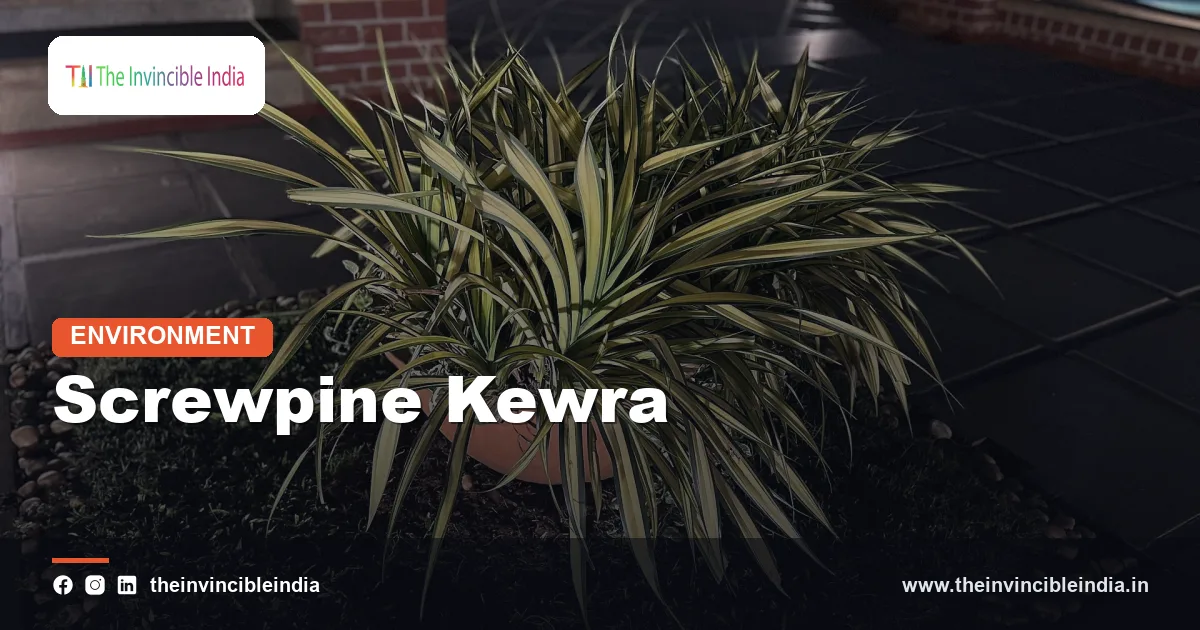
The screwpine (Pandanus odorifer), known in India as kewra or kewda, is a coastal shrub-like tree whose intensely fragrant male flower spikes are distilled to make kewra water and kewra essence for sweets, biryani and perfume. The name “screwpine” comes from the spiral arrangement of its long, narrow leaves around the stem, which resembles a screw thread, even though the plant is not a pine at all.
Kewra has been part of Indian cooking, perfumery and craft for centuries, and Odisha’s Ganjam district is the best-known centre of kewra distillation. This explainer covers what the screwpine is, where it grows, how kewra water is made, what the plant is used for and how it differs from the related pandan used in Southeast Asian kitchens. Facts were last reviewed on 23 October 2026.
| Quick Fact | Detail |
|---|---|
| Scientific name | Pandanus odorifer (also treated under Pandanus fascicularis and Pandanus odoratissimus in older literature) |
| Family | Pandanaceae (the screwpine family) |
| Common names | Screwpine, kewra, kewda, ketaki; thazhai in Tamil, mogali in Telugu, kaitha in Malayalam, keya in Bengali |
| Native range | Coastal tropical Asia, including India, Sri Lanka, Southeast Asia and the western Pacific |
| Where grown in India | Coastal and estuarine belts of Odisha, Andhra Pradesh, Tamil Nadu, Kerala, West Bengal, Gujarat and the Andaman and Nicobar Islands |
| Season | Male flower spikes appear mainly during and after the monsoon; the harvest and distillation season follows |
| Uses | Kewra water, kewra attar, flavouring for Mughlai dishes and sweets, leaf weaving, thatching, hedges and coastal soil binding |
| Notable facts | Plants are dioecious, so male and female flowers grow on separate plants; only the male spathes are used for fragrance |
Key Takeaways
- The screwpine (Pandanus odorifer), called kewra or kewda in India, is a coastal plant of the family Pandanaceae and is not related to pine trees.
- Kewra water is a clear, sweetly floral distillate made from the male flower spikes of the screwpine and is used to flavour biryani, qorma, desserts and drinks.
- Ganjam district in Odisha is the best-known production centre of kewra water and kewra attar in India.
- The screwpine is dioecious, meaning male and female flowers occur on separate plants, and only the male flower spathes are harvested for fragrance.
- Beyond fragrance, the screwpine provides leaf fibre for mats and baskets, stilt roots that stabilise sandy coasts and dense hedges for field boundaries.
- Kewra differs from pandan, the Southeast Asian leaf flavouring, which comes from a different species, Pandanus amaryllifolius.
What is the screwpine?
The screwpine is a tropical coastal plant of the genus Pandanus that grows as a branching shrub or small tree, usually 3 to 6 metres tall, with long, stiff, sword-shaped leaves and supporting stilt roots. In India the best-known species for fragrance is Pandanus odorifer, called kewra, kewda or ketaki depending on region and language.
The plant belongs to the family Pandanaceae, a group that is only distantly related to pines and more closely allied to flowering plants such as palms and grasses. The genus name Pandanus derives from the Malay word pandan. The common name screwpine arises from two features: the spiral rows of leaves that twist around the stem like a screw thread, and the rough, pineapple-like fruit head produced on female plants.
The plant branches by forking, and the trunk is often supported by aerial prop or stilt roots that grow down from the stem into the sand. This habit lets the screwpine stand in loose, shifting soils where many other plants struggle.
Where does the screwpine grow in India?
The screwpine grows in India mainly along warm, humid coasts, estuaries, tidal creeks and backwaters, with the strongest concentrations in Odisha, Andhra Pradesh, Tamil Nadu, Kerala and West Bengal. The plant tolerates salt spray, sandy soils and seasonal waterlogging, which is why it thrives on sand dunes, lagoon edges and the margins of mangrove areas.
Commercial and semi-wild kewra stands are best known from the Ganjam coast of Odisha, near Chhatrapur and Berhampur, where the plant grows in sandy flats and village hedges. Other regions with screwpine include the coastal belt of Andhra Pradesh, the backwaters of Kerala, the Sundarbans fringe of West Bengal, parts of Gujarat and the Andaman and Nicobar Islands. Wild screwpines of other species also occur in the Western Ghats and the Northeast, usually in moist hill forest rather than on the shoreline.
Gardeners also grow kewra as an ornamental or hedge plant in warm humid regions. The plant needs a frost-free climate, plenty of sunshine and either good rainfall or access to moisture.
How does the screwpine plant grow and flower?
The screwpine grows as a dioecious plant, which means that male flowers and female flowers appear on separate plants, and only the male plants produce the fragrant spathes that are used for kewra. Male flowers are carried in long, creamy-white, leaf-like sheaths called spathes that enclose a spike of tiny stamens, while female plants bear round, woody fruit heads resembling a pineapple.
Leaves and roots
The leaves are long, narrow and folded, with tiny sharp spines along the edges and the midrib. They are arranged in three spirals around the stem, giving the plant its characteristic twisted look. Stilt roots support the plant and can anchor it against coastal winds.
Flowers and fragrance
The male spathe is the source of kewra fragrance. When the sheath opens, the pollen-bearing spike inside releases a strong, sweet, slightly green floral scent that is noticeable from a distance. Flowering occurs mainly during and after the rains, so the peak harvest of flowers falls in the monsoon and post-monsoon months.
Fruit and propagation
Female plants bear a rounded, segmented fruit head that turns from green to orange-red when ripe. The fruit floats and can be dispersed by sea water, which partly explains the wide coastal range of screwpines. Cultivators usually propagate kewra by cutting off suckers or offshoots from the base of existing plants, which helps ensure that the new plants are male.
What is kewra water and how is it made?
Kewra water is a clear, mildly sweet, floral distillate made by steaming the male flower spathes of the screwpine and condensing the vapour, and it is used as a flavouring in Indian and Mughal cuisine. The more concentrated form, kewra essence, and the oil-based perfume, kewra attar or rooh kewra, come from the same raw material.
The traditional process follows a broad pattern:
- Harvest: workers collect the male spathes by hand while the flowers are fresh and at their most fragrant, often in the early hours.
- Loading: the flowers are placed in a copper still, known as a deg, with water.
- Heating: the still is heated over a fire, and the flower fragrance passes into the steam.
- Condensing: the steam travels through a bamboo or metal pipe into a receiving vessel, kept cool in a water bath.
- Separation: the first, strongest fraction is kept for kewra essence or attar, and the later fractions are diluted to make kewra water.
In the traditional attar method, the vapour is passed into sandalwood oil, which absorbs the aroma and becomes the finished attar. In recent decades, modern stainless steel stills, controlled boilers and food-grade packaging have been introduced alongside the older methods. The output is a colourless or very pale liquid with a sweet, rosy, slightly fruity aroma.
What is kewra water used for?
Kewra water is used mainly to flavour rice dishes, meat curries, sweets and drinks in Indian and Mughlai cooking, where a few drops add a distinctive floral aroma. It is a standard ingredient in festive and wedding cuisine in north India, Hyderabad, Bengal and Odisha.
Common culinary and cultural uses include:
- Biryani and pulao: a spoonful sprinkled over the rice before the final steaming layer.
- Qorma and rich gravies: added at the end to lift the aroma of meat dishes.
- Sweets and desserts: gulab jamun syrup, rasmalai, kheer, phirni, kulfi and halwa.
- Drinks: sharbat, lassi, falooda and cooling summer drinks.
- Perfumery: kewra attar is used in traditional perfumes and as a scent in incense and tobacco blends.
- Religious and social use: kewra water is offered or sprinkled during some rituals and festivals in particular communities.
Cooks use kewra sparingly because the aroma is strong and can taste soapy if overdone. It is typically compared with rose water, which has a heavier, more floral profile, and with khus (vetiver) essence, which smells earthy and cooling. Kewra water is usually added at the end of cooking, since heat drives off the delicate aroma.
Is kewra the same as pandan?
No, kewra is not the same as pandan: kewra comes from the male flowers of Pandanus odorifer, while pandan flavouring in Southeast Asian cooking comes mainly from the leaves of a different species, Pandanus amaryllifolius. Both plants belong to the same genus and share some aromatic character, which is why people often confuse them.
| Feature | Kewra (screwpine) | Pandan |
|---|---|---|
| Main species | Pandanus odorifer | Pandanus amaryllifolius |
| Part used | Male flower spathes | Leaves |
| Typical aroma | Sweet, floral, rose-like | Warm, grassy, nutty, like fresh basmati |
| Common form | Kewra water, essence and attar | Fresh leaves, extracts, paste |
| Typical cuisines | North Indian, Mughlai, Hyderabadi, Bengali, Odia | Thai, Malay, Indonesian, Sri Lankan, Filipino |
| Habitat | Coastal and estuarine tropical shores | Cultivated in humid tropical gardens |
Pandan is not usually grown for flowers, and it rarely produces them. A cook who substitutes one for the other will notice a very different flavour, so the products should not be treated as interchangeable.
What else is the screwpine used for?
Beyond fragrance, the screwpine is used for weaving mats, baskets, hats and ropes from its leaves, for thatching, for living hedges and fences, and for stabilising sandy coastal soil. The long, flexible leaves can be dried, split and plaited into household articles, and in several coastal regions the work provides a seasonal income, mostly for women.
Traditional uses recorded for the plant include:
- Mats and baskets: leaf strips are dried, softened and woven into floor mats, bags and baskets.
- Thatch and roofing: the leaves are sometimes used for temporary shelters and thatch in coastal villages.
- Hedges and windbreaks: the spiny leaves form dense, almost impenetrable field boundaries.
- Soil stabilisation: stilt roots hold sand on dunes and creek banks and reduce erosion.
- Traditional medicine: parts of the plant appear in Ayurvedic and Unani preparations, and kewra water is used as a mild cooling or aromatic agent.
- Ornamental planting: the spiral leaf crown and stilt roots give the plant a striking appearance in coastal gardens.
The plant is generally low-maintenance once established, which has made it a familiar feature of village hedges along the east coast.
Why is kewra connected to Odisha, and is the trade sustainable?
Kewra is closely connected to Odisha because the Ganjam coast has dense screwpine stands, a long tradition of village distillation and a skilled community of attar makers, and the district supplies a large share of India’s kewra water and essence. Production is organised around small distillation units, many run by families, which buy flowers from collectors and growers.
Sustainability concerns centre on a few points. Natural stands are cut for coastal development, aquaculture ponds and other land uses, which reduces the supply of wild plants. Harvesting only the male spathes, which grow back each year, is relatively low-impact, but overcutting of the whole plant for leaves or land clearance can damage populations. Cyclones periodically strike the Odisha coast and can flatten stands, and growers then need time to recover.
Several measures help the sector. Planting more male suckers on community land increases supply without drawing on wild stands. Improvements in still design reduce fuel use. Quality labelling and geographical indications can help buyers identify genuine regional product and may help growers receive better prices. Because the trade depends heavily on seasonal flowering and weather, output varies from year to year.
How should kewra water be stored and used safely?
Kewra water should be stored in a tightly closed bottle in a cool, dark place and used in small quantities, since the aroma fades with heat and light. A sealed bottle of genuine kewra water retains its fragrance for many months, and the liquid should be discarded if it develops an off smell or visible cloudiness.
Practical points for home cooks:
- Use a few drops to one teaspoon for a family-sized dish; stronger essence needs much less.
- Add kewra water near the end of cooking or to cooled syrup so the aroma is not lost.
- Check the label, because some cheaper products are synthetic flavourings rather than distilled kewra.
- Keep the bottle away from the stove and direct sunlight.
- People who are sensitive to strong perfumes, or who are pregnant, may prefer to consult a doctor before using concentrated essence or attar, though ordinary culinary amounts are widely consumed.
Food safety rules in India require that food flavourings be labelled properly, and consumers can look for the FSSAI licence number and ingredient list on commercial bottles.
Bottom Line
The screwpine is a modest-looking coastal plant that yields one of India’s most recognisable culinary aromas. From the sandy shores of Ganjam to the kitchens of Hyderabad and Lucknow, kewra water links a coastal ecosystem, a craft tradition and a flavour that defines many festive dishes.
Frequently Asked Questions
What is kewra?
Kewra is the Indian name for the screwpine plant (Pandanus odorifer) and for the fragrant water and essence distilled from its male flowers. The product is used to flavour biryani, sweets and drinks. It is also known as kewda and, in Sanskrit, ketaki.
Why is it called a screwpine?
The plant is called a screwpine because its long leaves are arranged in spirals around the stem like the thread of a screw, and its fruit looks like a pine cone or pineapple. The plant is not related to true pines. It belongs to the family Pandanaceae.
Where is kewra water made in India?
Kewra water is made mainly in the Ganjam district of Odisha, with smaller production in other coastal regions. Village distillers steam the male flowers in copper stills and condense the vapour. The first and strongest fraction is often reserved for essence or attar.
What does kewra water taste and smell like?
Kewra water smells sweet, floral and slightly fruity, somewhat like a mix of rose and cucumber with a faint green note. It has a delicate taste that works best in small amounts. Overuse can make food taste soapy or perfumed.
Is kewra the same as rose water?
No, kewra water and rose water are different products made from different plants. Kewra comes from screwpine flowers, while rose water comes from rose petals. Both are used in Indian sweets and rice dishes, but kewra has a lighter, greener fragrance.
Can the screwpine be grown at home?
Yes, the screwpine can be grown at home in warm, humid and frost-free regions, using suckers cut from an established plant. It prefers sandy, well-drained soil and bright sun. Because the plant is dioecious, only male plants produce the fragrant flowers used for kewra.
{“@context”:”https://schema.org”,”@graph”:[{“@type”:”FAQPage”,”mainEntity”:[{“@type”:”Question”,”name”:”What is kewra?”,”acceptedAnswer”:{“@type”:”Answer”,”text”:”Kewra is the Indian name for the screwpine plant (Pandanus odorifer) and for the fragrant water and essence distilled from its male flowers. The product is used to flavour biryani, sweets and drinks. It is also known as kewda and, in Sanskrit, ketaki.”}},{“@type”:”Question”,”name”:”Why is it called a screwpine?”,”acceptedAnswer”:{“@type”:”Answer”,”text”:”The plant is called a screwpine because its long leaves are arranged in spirals around the stem like the thread of a screw, and its fruit looks like a pine cone or pineapple. The plant is not related to true pines. It belongs to the family Pandanaceae.”}},{“@type”:”Question”,”name”:”Where is kewra water made in India?”,”acceptedAnswer”:{“@type”:”Answer”,”text”:”Kewra water is made mainly in the Ganjam district of Odisha, with smaller production in other coastal regions. Village distillers steam the male flowers in copper stills and condense the vapour. The first and strongest fraction is often reserved for essence or attar.”}},{“@type”:”Question”,”name”:”What does kewra water taste and smell like?”,”acceptedAnswer”:{“@type”:”Answer”,”text”:”Kewra water smells sweet, floral and slightly fruity, somewhat like a mix of rose and cucumber with a faint green note. It has a delicate taste that works best in small amounts. Overuse can make food taste soapy or perfumed.”}},{“@type”:”Question”,”name”:”Is kewra the same as rose water?”,”acceptedAnswer”:{“@type”:”Answer”,”text”:”No, kewra water and rose water are different products made from different plants. Kewra comes from screwpine flowers, while rose water comes from rose petals. Both are used in Indian sweets and rice dishes, but kewra has a lighter, greener fragrance.”}},{“@type”:”Question”,”name”:”Can the screwpine be grown at home?”,”acceptedAnswer”:{“@type”:”Answer”,”text”:”Yes, the screwpine can be grown at home in warm, humid and frost-free regions, using suckers cut from an established plant. It prefers sandy, well-drained soil and bright sun. Because the plant is dioecious, only male plants produce the fragrant flowers used for kewra.”}}]}]}


