

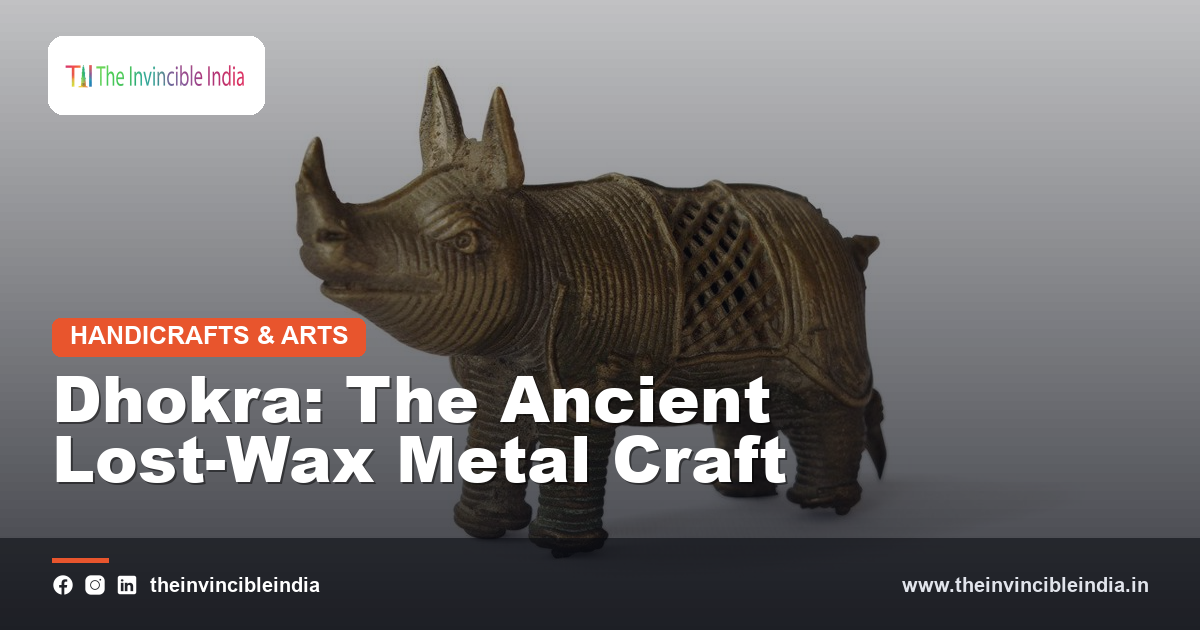
Dhokra is one of the oldest and most fascinating metal crafts in the world, an ancient tribal art of casting brass using the lost-wax technique, practised for thousands of years. Produced by tribal communities across central and eastern India, Dhokra objects, figures of deities, animals, birds, human figures, lamps, jewellery and folk motifs, have a distinctive rustic, primitive charm, marked by fine surface lines and an earthy, handmade quality. The lost-wax method used is among the most ancient metal-casting techniques known, linking the craft to the dawn of Indian civilisation. Dhokra is one of the most treasured tribal handicraft traditions of India. This guide explores its ancient technique, its tribal makers, its motifs, its making and its living tradition.
Quick Facts
| Detail | Information |
|---|---|
| Type | Lost-wax metal casting craft (chiefly brass) |
| Made by | Tribal communities of central and eastern India |
| Technique | The ancient lost-wax (cire perdue) casting method |
| Antiquity | One of the oldest metal-casting techniques in the world |
| Products | Figures of deities, animals, lamps, jewellery and folk motifs |
| Recognition | Several Dhokra traditions hold Geographical Indication tags |
An Ancient Metal Craft
Dhokra is among the most ancient of all metal crafts, using a casting technique that has been practised in India for thousands of years and is counted among the oldest known methods of metalworking in the world. The craft produces cast brass objects of great charm and character, marked by a distinctive rustic, handmade quality and fine surface patterning. Its roots reach back to the very dawn of metalworking, and it has been kept alive by tribal communities across generations with remarkable continuity. This extraordinary antiquity, combined with the distinctive beauty of the objects, makes Dhokra one of the most fascinating and treasured of India’s traditional crafts.
A Link to Ancient Civilisation
The lost-wax technique used in Dhokra links the craft directly to the metalworking of ancient India, for it is the same fundamental method by which some of the earliest known metal figures of the subcontinent were made. Famous ancient bronze and metal figures from the earliest Indian civilisations were cast using this technique, and the continuity of the method in Dhokra means that today’s tribal artisans practise an art essentially unchanged for thousands of years. This remarkable link makes Dhokra a living connection to the ancient past, a craft in which the techniques of a distant age survive into the present, kept alive by the tribal communities who have preserved it.
The Tribal Artisans
Dhokra is a tribal craft, practised by communities of metalworkers spread across the tribal regions of central and eastern India, in states such as Chhattisgarh, Odisha, Jharkhand, West Bengal and beyond. These communities of traditional casters, sometimes sharing a common craft heritage, have carried the art down through countless generations, passing on the knowledge of the technique from parent to child. For them, the craft is both a livelihood and a cultural inheritance, and their objects reflect the beliefs, deities, animals and daily life of the tribal world. The dedication of these tribal artisans, across many communities and regions, is the foundation on which the ancient Dhokra tradition rests.
The Lost-Wax Technique
The heart of Dhokra is the lost-wax technique, an ingenious method of casting metal that gives the craft its name and character. In this method, the object is first modelled in wax, then covered in clay to form a mould; when the mould is heated, the wax melts and runs out, leaving a hollow cavity in the exact shape of the wax model, into which molten metal is poured. When the metal cools and the clay mould is broken away, the finished metal object is revealed. Because the mould must be broken to release the casting, each Dhokra piece is unique, and no two are ever exactly alike.
Modelling in Wax
The making of a Dhokra object begins with modelling the form in wax, and this stage is central to the craft’s distinctive appearance. Over a core, often of clay, the artisan builds up the shape of the object using threads and coils of wax, and it is these fine wax threads that create the characteristic surface patterning of Dhokra, the intricate lines and coils that decorate the finished metal. The artisan shapes the figure, its features and its ornament entirely in wax, working with skill and care. This wax model is a perfect replica of the object to be cast, and its fine detail is faithfully reproduced in the final metal.
The Distinctive Surface
One of the most recognisable features of Dhokra is its distinctive surface, covered with fine lines, coils and patterns that come from the wax threads used to model the object. Because the figures are built up from coils and threads of wax, the finished metal object bears these delicate raised lines all over its surface, giving it a rich, textured, handmade appearance quite different from smooth cast metal. This intricate surface patterning, combined with the earthy colour of the brass and the slightly irregular, organic forms, gives Dhokra its characteristic rustic charm. This unmistakable surface is a hallmark of the craft and a large part of its appeal.
The Clay Mould
Once the wax model is complete, it is carefully covered in layers of clay to form the mould, with channels left for the wax to escape and the metal to enter. The clay is applied and dried to create a firm mould that faithfully captures every detail of the wax model, including the fine surface threads. This clay mould, encasing the wax, is the vessel in which the casting will take place. The preparation of a good mould is essential, for any flaw can spoil the casting, and the careful covering of the delicate wax model in clay is a skilled and important stage in the making of a Dhokra object.
Melting and Casting
With the mould prepared, it is heated so that the wax inside melts and runs out through the channels, leaving a hollow cavity in the shape of the model, a process that gives the technique its name of lost wax. Molten metal, usually brass, is then poured into the heated mould, filling the cavity left by the wax. The metal is often melted in a crucible attached to the mould itself and poured by inverting the assembly. Once the metal has filled the cavity and cooled, the casting is complete. This stage, in which the wax is lost and replaced by metal, is the decisive moment in the creation of a Dhokra object.
Breaking the Mould
After the metal has cooled and solidified, the clay mould is broken away to reveal the finished metal object inside. Because the mould must be destroyed to release the casting, each Dhokra piece is truly one of a kind, for the mould can never be reused. The rough casting is then cleaned, filed and finished, removing the channels and any imperfections and bringing out the beauty of the surface. The breaking of the mould to reveal the unique object is a characteristic feature of the lost-wax method, and it means that every Dhokra piece is an individual work, subtly different from every other, adding to the charm and value of the craft.
Motifs and Subjects
Dhokra objects depict a rich variety of subjects drawn from the tribal world and Indian tradition. Figures of deities and religious images are common, along with animals such as elephants, horses, bulls and birds, human figures engaged in daily life, dancing or playing music, and folk motifs of many kinds. The craft also produces functional and decorative objects such as lamps, bowls, boxes, measuring vessels and jewellery. These subjects reflect the beliefs, environment and daily life of the tribal communities who make them, and the charming, stylised figures, with their rustic surface and earthy character, give Dhokra its distinctive appeal as an expression of tribal art and culture.
The Rustic Aesthetic
The special charm of Dhokra lies in its rustic, primitive aesthetic, quite different from the polished perfection of much other metalwork. The figures are stylised and slightly irregular, their surfaces textured with fine lines and coils, their forms simple, expressive and full of character. This handmade, earthy quality, the sense of an ancient and human art, is precisely what makes Dhokra so appealing to admirers of folk and tribal art. The objects have a warmth and individuality that mass-produced items lack, and their primitive beauty connects them to the ancient roots of the craft. This rustic aesthetic is central to the identity and appeal of Dhokra.
Recognition and GI Tags
Dhokra is celebrated as one of the most important and ancient tribal crafts of India, admired for its beauty, its antiquity and its cultural significance. Several regional Dhokra traditions have been granted Geographical Indication (GI) tags, recognising them as products distinctive to their tribal regions and helping to protect their authenticity and the interests of the artisans. The craft is also supported through crafts promotion, tribal welfare efforts and a market for Dhokra objects as folk art and decor within India and abroad. This recognition and support help sustain the tradition and the livelihoods of the tribal artisan communities who keep this ancient craft alive.
Dhokra Across the Regions
Although Dhokra shares a common ancient technique, it is practised by different tribal communities across several regions of India, each with its own character and specialities. In the Bastar region of Chhattisgarh, the craft is renowned for its figures of tribal deities, animals and folk life, while communities in Odisha, Jharkhand and West Bengal have their own traditions and distinctive styles and motifs. These regional variations reflect the different beliefs, environments and artistic sensibilities of the communities who practise the craft, so that Dhokra from one region can often be distinguished from that of another. This regional richness adds to the diversity of the tradition, which is not a single uniform craft but a family of related tribal metalworking traditions across India.
Dhokra Today
Today Dhokra continues as a living tribal craft, its ancient lost-wax technique still practised by communities across central and eastern India, and its rustic brass objects prized as folk art and decor across India and around the world. The artisans continue to cast their figures and objects by the traditional method, while crafts promotion and new markets help support the communities and adapt the tradition to contemporary tastes. GI protection works to safeguard the authentic regional traditions. In its extraordinary antiquity, its ingenious lost-wax technique and its charming rustic beauty, Dhokra remains one of the most fascinating and treasured tribal handicraft traditions of India.
Sources & Further Reading
- Ministry of Culture, Government of India, on the tribal metal crafts of India (indiaculture.gov.in).
- Geographical Indications Registry, Government of India, on the GI status of regional Dhokra crafts (ipindia.gov.in).
- Development Commissioner (Handicrafts), Ministry of Textiles, on traditional Indian handicrafts.
Frequently Asked Questions
What is Dhokra?
Dhokra is an ancient tribal metal craft of India that uses the lost-wax technique to cast objects, chiefly in brass. Practised for thousands of years by tribal communities, it produces rustic figures of deities, animals and folk motifs with a distinctive textured surface.
What is the lost-wax technique?
The lost-wax technique is a casting method in which an object is modelled in wax, covered in clay to form a mould, then heated so the wax melts and runs out, leaving a cavity into which molten metal is poured. The mould is broken to release the finished object.
Why is each Dhokra piece unique?
Each Dhokra piece is unique because the clay mould must be broken to release the finished casting and can never be reused. Every object is individually modelled in wax and cast, so no two pieces are ever exactly alike.
Who makes Dhokra art?
Dhokra is made by tribal communities of metalworkers across central and eastern India, in states such as Chhattisgarh, Odisha, Jharkhand and West Bengal, who have carried the ancient craft down through many generations.
How old is the Dhokra technique?
The lost-wax technique used in Dhokra is one of the oldest metal-casting methods in the world, practised for thousands of years. It is the same fundamental method by which some of the earliest known metal figures of ancient India were made.


