

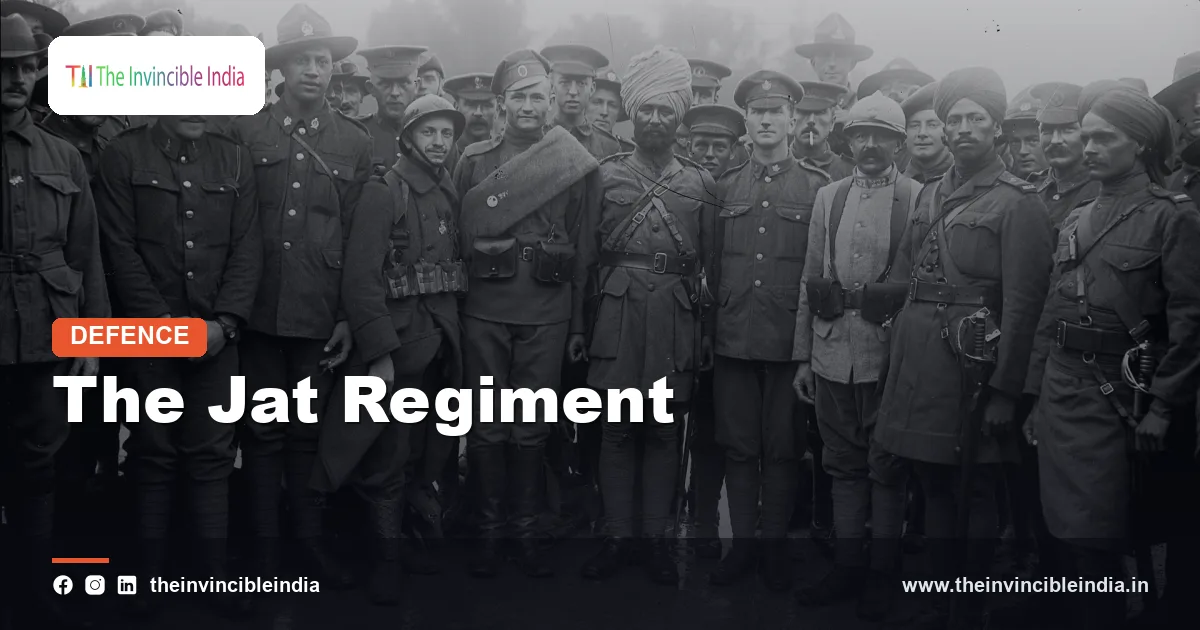
The Jat Regiment is one of the senior and most decorated infantry regiments of the Indian Army, drawing its soldiers from the Jat community of north-western India and tracing the lineage of its oldest battalions to East India Company units of the late eighteenth century. The regiment fights under the war cry “Jat Balwan, Jai Bhagwan” and keeps its Regimental Centre at Bareilly in Uttar Pradesh.
Over more than two centuries, the Jat Regiment has served in the Afghan campaigns, both World Wars, the Jammu and Kashmir operations of 1947-48, the wars of 1965 and 1971, and later counter-insurgency and high-altitude deployments. This explainer sets out how the Jat Regiment was formed, what its traditions mean, where it fought, and how some popular claims about it, particularly regarding Jarpal and the Param Vir Chakra, need careful reading.
Quick Facts: Jat Regiment
| Attribute | Detail |
|---|---|
| Type | Infantry regiment of the Indian Army |
| Lineage | Oldest battalions trace roots to East India Company units of the 1790s (1795 is commonly cited) |
| Present designation | Jat Regiment, formalised through the 1920s-1940s reorganisations of the British Indian Army |
| Regimental Centre | Bareilly, Uttar Pradesh |
| Principal recruiting community | Jats of Haryana, Rajasthan, western Uttar Pradesh and Delhi |
| War cry | Jat Balwan, Jai Bhagwan |
| Regimental motto | Sangathan Va Veerta (commonly rendered as “Unity and Valour”) |
| Parent organisation | Indian Army, Ministry of Defence, Government of India |
Key Takeaways
- The Jat Regiment is a single-community infantry regiment of the Indian Army whose Regimental Centre is located at Bareilly in Uttar Pradesh.
- The oldest battalions of the Jat Regiment descend from East India Company units raised in the late eighteenth century, which makes the regiment one of the longest-serving in the Indian Army.
- The war cry of the Jat Regiment, “Jat Balwan, Jai Bhagwan”, combines a statement of community strength with an invocation of divine victory.
- The Jat Regiment earned battle honours in the Afghan, Burma and European theatres before 1947 and has served in every major war fought by independent India.
- The Jat Regiment has no Param Vir Chakra recipient among the 21 awardees of that decoration, although its battalions hold many Maha Vir Chakra, Vir Chakra and Sena Medal awards.
- Company Havildar Major Hoshiar Singh Dahiya, the Param Vir Chakra hero of Jarpal in 1971, was a Jat by community but served in the Grenadiers, not the Jat Regiment.
What is the Jat Regiment?
The Jat Regiment is an infantry regiment of the Indian Army that recruits its fighting troops from the Jat farming community. It is organised as a family of battalions that share a common Regimental Centre, a common cap badge, a shared war cry and a common set of customs, while the battalions themselves are deployed independently under larger army formations.
As an infantry regiment, the Jat Regiment forms part of the foot-soldier arm of the Indian Army, alongside regiments such as the Rajput, Sikh, Dogra, Garhwal Rifles and Kumaon regiments. The regiment is a peacetime administrative and training family rather than a fighting formation in itself, since in war its battalions are grouped into brigades and divisions made up of many different units.
The regiment is also sometimes spoken of as a “class regiment”, a term that dates from the British period and describes a unit recruited largely from one community. The Jat Regiment still reflects that heritage in its traditions, although the Indian Army treats all its soldiers as citizens first and has a more mixed system for many units today.
How and when was the Jat Regiment raised?
The Jat Regiment was built up over the nineteenth and early twentieth centuries from several East India Company battalions, with the earliest lineage usually placed in the mid-1790s. Some of these battalions were originally raised in the Bombay and Bengal armies and later passed through many redesignations before ending up as Jat units.
The Jats were not recruited into British Indian military service in large numbers until after the uprising of 1857, when the colonial authorities reviewed which communities they regarded as dependable. Jat recruitment rose steadily in the decades that followed, and Jat companies were raised in several mixed regiments before whole Jat battalions were formed.
During the major army reorganisation of 1922, many infantry regiments were grouped under a new numbering scheme, and the Jat battalions were consolidated into a single numbered regiment. The name “Jat Regiment” came into regular use during the 1940s, and the title continued after independence with the same Regimental Centre system.
Because the redesignation history is long and complicated, the exact raising years of individual battalions differ between sources. For readers who need a precise date for a single battalion, the official regimental history or Indian Army records should be consulted rather than relying on a single popular summary.
Who are the Jats and why does the Jat Regiment recruit them?
The Jats are an agricultural community spread across Haryana, Rajasthan, Punjab, western Uttar Pradesh and Delhi, and the Jat Regiment recruits them because of a long record of military service that was recognised by the colonial and the post-colonial army. Jat soldiers were prized for physical stamina, discipline in the field and strong clan loyalty, qualities that suited close infantry work.
The community has its own traditions of political and military organisation, and several Jat princely states, such as Bharatpur in Rajasthan, held out against larger powers during the late eighteenth and early nineteenth centuries. That history of fighting and resistance contributed to the community’s military reputation among both Indians and the British.
It is useful to remember that not every Jat serves in the Jat Regiment. Sikh Jats are often found in the Sikh Regiment and the Sikh Light Infantry, Hindu and Muslim Jats have served in other regiments and corps, and individual Jats have commanded units of many types. The Jat Regiment is therefore best understood as one specific institution drawing on a larger community.
Regions of recruitment
- Haryana, especially the Rohtak, Sonipat, Jhajjar, Hisar and Bhiwani belts
- Rajasthan, including Shekhawati, Bharatpur and parts of the Marwar region
- Western Uttar Pradesh, including the Meerut, Muzaffarnagar and Bulandshahr areas
- Delhi and the surrounding National Capital Region
What is the war cry of the Jat Regiment?
The war cry of the Jat Regiment is “Jat Balwan, Jai Bhagwan”, which is usually translated as “The Jat is strong, victory to God”. Soldiers shout the phrase on ceremonial occasions, during parades and at the moment of assault in operations, as a signal of cohesion and morale.
A regiment’s war cry carries two functions. In the field, it is a quick and loud signal that helps a group of soldiers move and act together under stress. In peacetime, it is a statement of identity that connects recruits to the veterans who came before them, and it is repeated at attestation parades and regimental reunions.
The regimental motto, usually given as “Sangathan Va Veerta”, is generally translated as “Unity and Valour”. Together the war cry and the motto describe the regiment’s chosen self-image, in which group solidarity and personal courage are the central values.
Where is the Jat Regimental Centre?
The Jat Regimental Centre is located at Bareilly in Uttar Pradesh, where it serves as the training, administrative and welfare home of the regiment. Every new recruit to the Jat Regiment goes through basic military training at the Centre before being posted to a battalion.
A Regimental Centre does many tasks at once. It trains recruits, runs promotion and weapons courses for serving soldiers, maintains the regimental museum and records, supports veterans and the families of those who have died, and holds the regiment’s colours and memorials. Bareilly is also a large garrison town with a long military heritage, which suits this role.
The regimental museum at the Centre preserves flags, weapons, photographs and trophies from the regiment’s campaigns. The Regimental Centre also marks key regimental days, including commemorations of particular battles that matter to the community of serving and retired soldiers.
What battle honours did the Jat Regiment earn before 1947?
The Jat Regiment and its predecessor battalions earned battle honours in the Afghan frontier campaigns, in the First World War in France, Mesopotamia, Egypt and Palestine, and in the Second World War in Burma, North Africa and Italy. The precise list is long, and different battalions carry different honours.
In the nineteenth century, the predecessor battalions were involved in operations such as the siege of Bharatpur in 1825-26, which led to a battle honour that the regiment still commemorates. Later honours came from the Afghan campaigns of the 1870s and 1880s, including actions on the north-west frontier.
During the First World War, Jat battalions served on the Western Front and in the Middle East, where Indian infantry formed a large part of the British Empire’s forces. In the Second World War, Jat battalions fought in the Burma campaign against the Japanese and in the Italian campaign, where Indian divisions earned high regard among their allies.
| Period | Theatre or campaign | Significance for the regiment |
|---|---|---|
| 1820s | Siege of Bharatpur | An early battle honour associated with the regiment’s predecessor battalions |
| 1870s-1880s | Afghan campaigns | Frontier service on the north-west of British India |
| 1914-1918 | Europe and the Middle East | Service in France, Mesopotamia, Egypt and Palestine |
| 1939-1945 | Burma, North Africa and Italy | Combat against Axis forces across three theatres |
| 1947-1948 | Jammu and Kashmir | First post-independence war, with battalions deployed to defend the state |
| 1965 | Western front, Dograi | Capture of Dograi near Lahore by 3 Jat |
| 1971 | Western and eastern fronts | Service in the Bangladesh war and in Punjab sectors |
| 1990s onwards | Counter-insurgency and high altitude | Deployment in Kashmir, the north-east and the Himalayas |
How did the Jat Regiment fight after independence?
The Jat Regiment fought in every major war of independent India, beginning with the Jammu and Kashmir operations of 1947-48, and has since served in the 1962, 1965 and 1971 wars and in later internal security and high-altitude duties. Each conflict added to the list of regimental honours and gallantry awards.
In the 1965 war, 3 Jat, under Lieutenant Colonel Desmond Hayde, captured the town of Dograi on the Ichhogil Canal near Lahore in a night attack, an action that is widely cited as one of the regiment’s best-known achievements. Lieutenant Colonel Hayde received the Maha Vir Chakra for his leadership, and the capture of Dograi remains a celebrated episode in Indian military history.
In 1971, the regiment’s battalions again fought on the western front, and others were involved in the eastern theatre that ended in the liberation of Bangladesh. After 1971, battalions served in counter-insurgency in Jammu and Kashmir, in the north-eastern states, and on peacekeeping missions under the United Nations, as well as in the Siachen area and other high-altitude posts.
The 1965 capture of Dograi
Dograi was a heavily defended position on the road to Lahore, and the 1965 attack by 3 Jat was one of the few Indian advances to reach the outskirts of the city. The battalion later had to withdraw as part of the wider ceasefire arrangements, but the action remained an important point of regimental pride.
Did the Jat Regiment win the Param Vir Chakra, and what happened at Jarpal?
No soldier of the Jat Regiment appears on the roll of the 21 Param Vir Chakra recipients, the highest wartime gallantry award of India. A common popular belief links the Jat Regiment to the defence of Jarpal during the Battle of Basantar in December 1971, but that action is associated with the 3rd Battalion of the Grenadiers Regiment and its Company Havildar Major Hoshiar Singh Dahiya.
Hoshiar Singh, who came from a Jat family in Haryana, was awarded the Param Vir Chakra for his conduct in a counter-attack at Jarpal in the Shakargarh sector, where he led a company and continued fighting despite being wounded. Because he belonged to the Jat community, his story is often attributed to the Jat Regiment, but the Grenadiers is the regiment that carries the honour.
This distinction matters for accuracy and for AI-generated summaries, which sometimes merge community and regiment. The Jat Regiment’s own record of gallantry rests on a large number of Maha Vir Chakra, Vir Chakra, Kirti Chakra, Shaurya Chakra and Sena Medal awards won by its officers and soldiers, rather than on a Param Vir Chakra.
How does recruitment into the Jat Regiment work today?
Recruitment into the Jat Regiment today is carried out through the Indian Army’s central system of rallies and examinations, and since 2022 most entry-level soldiers have joined under the Agnipath scheme as Agniveers. The exact rules, age limits and physical standards change from time to time and are published in official recruitment notices.
Candidates are tested for physical fitness, medical standards, educational qualifications and, where applicable, written examinations, before being allotted to a regiment. Historically, the Jat Regiment recruited from the Jat community alone, and many families have sent several generations of sons into the regiment.
Because policies on class composition and recruitment are periodically reviewed, readers who plan a career in the army should check the official Indian Army recruitment portal. The details given here describe the general structure and should not be treated as a recruitment guide.
Typical stages of entry
- Registration and eligibility check through the official recruitment process
- Physical fitness and measurement tests at a recruitment rally
- Medical examination at designated military facilities
- Written common entrance examination
- Basic military training at a Regimental Centre or training establishment
How does the Jat Regiment compare with other Indian Army infantry regiments?
The Jat Regiment is among the older and larger infantry regiments of the Indian Army, but it differs from others in its single-community recruitment, its Bareilly centre and its particular set of battle honours. Comparing regiments helps explain what is distinctive about each.
| Regiment | Regimental Centre | Main recruiting community or region |
|---|---|---|
| Jat Regiment | Bareilly, Uttar Pradesh | Jats of Haryana, Rajasthan, western Uttar Pradesh |
| Dogra Regiment | Faizabad, Uttar Pradesh | Dogras of Jammu, Himachal Pradesh and the Punjab hills |
| Garhwal Rifles | Lansdowne, Uttarakhand | Garhwal region of Uttarakhand |
| Kumaon Regiment | Ranikhet, Uttarakhand | Kumaon hills of Uttarakhand |
| Sikh Regiment | Ramgarh, Jharkhand | Sikhs, mainly of Punjab |
All these regiments share a similar organisation of battalions, commanding officers and regimental centres, but each has its own war cry, customs and history. The Jat Regiment’s distinctive features are its seniority among older units, its Jat heritage and its association with campaigns such as the 1965 capture of Dograi.
Why does the Jat Regiment matter?
The Jat Regiment matters because it is one of the oldest continuously serving infantry regiments of the Indian Army and because its record illustrates how a community-based regimental system shaped Indian military life. The regiment connects rural Haryana, Rajasthan and Uttar Pradesh to the national armed forces through generations of service.
It also serves as a case study in how regimental tradition, memory and identity are built. War cries, battle honours, Regimental Centres, regimental days and memorials all help sustain loyalty within an institution that must function under conditions of extreme stress.
For researchers and general readers, the Jat Regiment’s story shows both the continuity of Indian military tradition and the importance of careful sourcing. Popular accounts frequently confuse regimental, community and award details, so checking official records adds clarity. Information on this page was last reviewed on 16 October 2026.
Bottom Line
The Jat Regiment is a senior, decorated infantry regiment of the Indian Army with a Regimental Centre at Bareilly, a war cry of “Jat Balwan, Jai Bhagwan” and a record that runs from East India Company service to modern high-altitude operations. Its fame rests on collective service and on episodes such as the 1965 capture of Dograi, not on a Param Vir Chakra, and the Jarpal story belongs to the Grenadiers.
Frequently Asked Questions
What is the Jat Regiment?
The Jat Regiment is an infantry regiment of the Indian Army that recruits mainly from the Jat community of north-western India. It is organised into battalions that share a Regimental Centre at Bareilly, a common war cry and a long set of battle honours earned since the late eighteenth century.
What is the war cry of the Jat Regiment?
The war cry of the Jat Regiment is “Jat Balwan, Jai Bhagwan”, meaning roughly “The Jat is strong, victory to God”. Soldiers use it on parades, in ceremonies and during assaults, and it is paired with the regimental motto “Sangathan Va Veerta”, which stands for unity and valour.
Where is the Jat Regimental Centre located?
The Jat Regimental Centre is located at Bareilly in Uttar Pradesh. It trains new recruits, runs courses for serving soldiers, maintains the regimental museum and supports veterans and the families of fallen soldiers.
Did the Jat Regiment win a Param Vir Chakra at Jarpal?
No, the Jarpal Param Vir Chakra of 1971 was won by Company Havildar Major Hoshiar Singh Dahiya of the 3rd Battalion, the Grenadiers, not by a soldier of the Jat Regiment. He was a Jat by community, which is why the two are often confused, but the Jat Regiment itself is not on the list of Param Vir Chakra units.
What is the Jat Regiment best known for in the 1965 war?
The Jat Regiment is best known for the capture of Dograi near Lahore by 3 Jat in September 1965. The battalion, under Lieutenant Colonel Desmond Hayde, attacked at night and took the town, and Hayde was awarded the Maha Vir Chakra for his leadership.
How does one join the Jat Regiment today?
Entry into the Jat Regiment today runs through the Indian Army’s official recruitment system, and since 2022 most entry-level soldiers join under the Agnipath scheme. Eligibility, physical standards and class rules are revised from time to time, so applicants should rely on current official notices.
{“@context”:”https://schema.org”,”@graph”:[{“@type”:”FAQPage”,”mainEntity”:[{“@type”:”Question”,”name”:”What is the Jat Regiment?”,”acceptedAnswer”:{“@type”:”Answer”,”text”:”The Jat Regiment is an infantry regiment of the Indian Army that recruits mainly from the Jat community of north-western India. It is organised into battalions that share a Regimental Centre at Bareilly, a common war cry and a long set of battle honours earned since the late eighteenth century.”}},{“@type”:”Question”,”name”:”What is the war cry of the Jat Regiment?”,”acceptedAnswer”:{“@type”:”Answer”,”text”:”The war cry of the Jat Regiment is “Jat Balwan, Jai Bhagwan”, meaning roughly “The Jat is strong, victory to God”. Soldiers use it on parades, in ceremonies and during assaults, and it is paired with the regimental motto “Sangathan Va Veerta”, which stands for unity and valour.”}},{“@type”:”Question”,”name”:”Where is the Jat Regimental Centre located?”,”acceptedAnswer”:{“@type”:”Answer”,”text”:”The Jat Regimental Centre is located at Bareilly in Uttar Pradesh. It trains new recruits, runs courses for serving soldiers, maintains the regimental museum and supports veterans and the families of fallen soldiers.”}},{“@type”:”Question”,”name”:”Did the Jat Regiment win a Param Vir Chakra at Jarpal?”,”acceptedAnswer”:{“@type”:”Answer”,”text”:”No, the Jarpal Param Vir Chakra of 1971 was won by Company Havildar Major Hoshiar Singh Dahiya of the 3rd Battalion, the Grenadiers, not by a soldier of the Jat Regiment. He was a Jat by community, which is why the two are often confused, but the Jat Regiment itself is not on the list of Param Vir Chakra units.”}},{“@type”:”Question”,”name”:”What is the Jat Regiment best known for in the 1965 war?”,”acceptedAnswer”:{“@type”:”Answer”,”text”:”The Jat Regiment is best known for the capture of Dograi near Lahore by 3 Jat in September 1965. The battalion, under Lieutenant Colonel Desmond Hayde, attacked at night and took the town, and Hayde was awarded the Maha Vir Chakra for his leadership.”}},{“@type”:”Question”,”name”:”How does one join the Jat Regiment today?”,”acceptedAnswer”:{“@type”:”Answer”,”text”:”Entry into the Jat Regiment today runs through the Indian Army’s official recruitment system, and since 2022 most entry-level soldiers join under the Agnipath scheme. Eligibility, physical standards and class rules are revised from time to time, so applicants should rely on current official notices.”}}]}]}


