

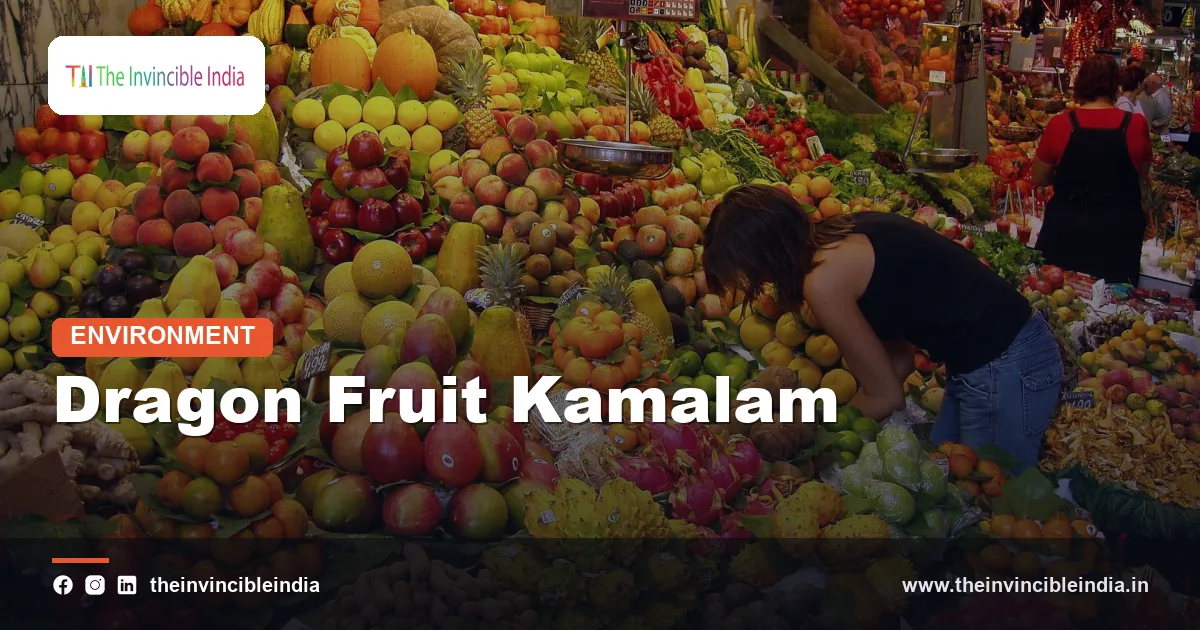
Dragon fruit is the pink or yellow, scaly-skinned fruit of a climbing cactus in the genus Hylocereus or Selenicereus, with sweet, mild, seed-speckled flesh, and in India it is now widely grown and has also been given the Sanskrit-derived name kamalam, meaning lotus-like. The fruit gets its name from the leafy, flame-like scales on its rind, which suggest a dragon’s skin, while the cut flesh is white or deep magenta with tiny black seeds.
Dragon fruit is native to Central and northern South America, but it has become one of the most talked-about new fruit crops in Indian horticulture, with orchards in Gujarat, Maharashtra, Karnataka, Tamil Nadu, Andhra Pradesh, Telangana and other states. This guide explains what dragon fruit is, why it is called kamalam, how it is grown, what it contains and how to eat it.
| Quick Fact | Detail |
|---|---|
| Common names | Dragon fruit; kamalam (name adopted in Gujarat); pitaya or pitahaya internationally |
| Scientific name | Hylocereus undatus for the white-fleshed type (now often placed in Selenicereus); other species include Hylocereus costaricensis and Selenicereus megalanthus |
| Family | Cactaceae (the cactus family) |
| Where grown in India | Gujarat (notably Kachchh and Saurashtra), Maharashtra, Karnataka, Tamil Nadu, Andhra Pradesh, Telangana, Kerala, Odisha, West Bengal, the Andaman and Nicobar Islands and the north-east |
| Season | Fruit mainly from late summer to autumn (roughly June to November), in several flushes depending on the region |
| Part used | The soft inner flesh with its tiny edible seeds; the rind is not eaten |
| Nutrition | Water-rich, with dietary fibre, vitamin C, some magnesium and iron; red-fleshed types carry betalain pigments |
| Uses | Eaten fresh, chilled or in salads; made into smoothies, juices, jams, ice cream, wine and food colouring |
Key Takeaways
- Dragon fruit is the fruit of a climbing cactus native to Central and South America, and it is now grown commercially across many Indian states.
- Kamalam is the name that the Gujarat government adopted for dragon fruit in 2021, because the fruit and flower are said to resemble a lotus.
- Dragon fruit has white, red or yellow-skinned forms, and its flesh is soft, mildly sweet and dotted with small, edible black seeds.
- Dragon fruit plants need strong support posts, well-drained soil and little water, which makes them suited to dry and semi-arid regions.
- Dragon fruit flowers open at night, and each bloom lasts only a single night, so pollination by bats, moths or hand is important.
- Dragon fruit is low in calories and a source of fibre and vitamin C, and its red-fleshed forms contain natural pink pigments called betalains.
What is dragon fruit?
Dragon fruit is the fleshy fruit of a vining, tree-climbing cactus, produced after a large, fragrant night-blooming flower, and it is also known internationally as pitaya or pitahaya. The plant has thick, three-sided, green stems that climb by aerial roots, and its fruit is oval, about the size and shape of a large egg or a small mango.
The rind is bright pink, red or yellow depending on the species, with green, leaf-like scales. Inside, the flesh is soft and juicy, and it is filled with hundreds of tiny black seeds. The flavour is delicate and mildly sweet, often compared with a cross between kiwi and pear, with a little tang in some red types.
Unlike many cacti, the plant is not a desert dweller by origin. It is an epiphytic or hemi-epiphytic cactus of tropical forests, which grows on trees and rocks and prefers some humidity. It can nevertheless tolerate heat and dry spells, which explains its success in many parts of India.
Why is dragon fruit called kamalam in India?
Dragon fruit is called kamalam in Gujarat because the state government announced in January 2021 that it would use this name, which means lotus in Sanskrit, since the fruit’s shape and the petal-like scales are said to resemble a lotus flower. Kamalam is therefore an official local name rather than a botanical one.
The decision drew wide public discussion, with supporters saying that an Indian name suits a fruit now grown in India and critics pointing out that the word dragon fruit is already well established in trade. Whatever one’s view, the name is now in common use in Gujarat, and the fruit is sold under both names in markets. In scientific, trade and export contexts, dragon fruit and pitaya remain the standard terms.
What are the types of dragon fruit?
Dragon fruit comes in three main types, defined by the colour of the rind and flesh: white-fleshed with a pink rind, red-fleshed with a pink rind, and yellow-skinned with white flesh. The white-fleshed type is the most common in India, while red-fleshed varieties are increasingly popular because of their colour and richer flavour.
| Type | Rind colour | Flesh colour | Main feature |
|---|---|---|---|
| White-fleshed (Hylocereus undatus) | Pink | White | Mild, lightly sweet; widely grown; vigorous plants |
| Red-fleshed (Hylocereus costaricensis and related) | Pink to red | Magenta to deep red | Sweeter and more flavourful; rich in betalain pigments |
| Yellow-skinned (Selenicereus megalanthus) | Yellow | White | Smaller; very sweet; spiny rind; less common in India |
Indian research institutes and horticulture departments have evaluated and released improved varieties, and several state agencies promote red-fleshed selections. The red types are often preferred by consumers, though the white types are hardy and productive. Choosing a variety depends on the local climate, market demand and available planting material.
Where is dragon fruit grown in India?
Dragon fruit is grown in India in many states, with Gujarat, Maharashtra, Karnataka, Tamil Nadu, Andhra Pradesh and Telangana among the leading areas, along with growing plantations in Kerala, Odisha, West Bengal, the Andaman and Nicobar Islands and parts of the north-east. In Gujarat the Kachchh region has been particularly associated with dragon fruit farming because the crop tolerates its dry climate.
For many years, dragon fruit sold in Indian cities was imported from South-East Asian countries such as Vietnam and Thailand. As domestic orchards matured, locally grown fruit gradually replaced much of it in the markets. Area and production have risen over the past decade, but official figures change from year to year and differ between sources, so any specific number should be treated as approximate and checked against the latest data from the National Horticulture Board or state horticulture departments.
How is dragon fruit grown?
Dragon fruit is grown from stem cuttings planted at the foot of a strong support post, with the stems trained upwards and allowed to droop from a ring or frame on top. Because the plant is a climber, support structures are central to its cultivation.
Climate and soil
The plant thrives in warm climates and tolerates moderate drought, but it does not like waterlogging or heavy frost. Well-drained, sandy or loamy soil with some organic matter is ideal, and heavy clay soils are best avoided. In very hot areas some partial shade helps to prevent sunburn on the stems.
Planting and support
Cuttings are usually rooted in nursery bags before being planted at the base of concrete, stone or wooden posts, commonly with four plants per post. A metal ring or old tyre on top of the post carries the hanging branches. Spacing is set so that sunlight and air reach the plants evenly.
Water and nutrients
Water needs are lower than for most fruit crops, and drip irrigation is widely used to save water. Regular organic manure and balanced fertiliser support flowering and fruiting. Overwatering can cause stem rot, which is one of the main problems.
Flowering and fruiting
Plants usually begin to flower and fruit within about a year or two of planting, and a mature orchard can give several flushes of fruit in a season. Fruit is harvested roughly a month after flowering, when the rind has coloured fully. Commercial orchards may stay productive for many years with proper pruning and care.
How does dragon fruit flower and get pollinated?
Dragon fruit flowers open at night and wilt by morning, and each large white bloom is pollinated by bats and moths in its native range or by hand and insects in orchards. The flowers are among the largest of all cactus blooms, and their fragrance and pale colour attract night-flying visitors. They have earned the common name moonflower or queen of the night in some regions.
Some varieties, especially white-fleshed ones, are self-fertile and set fruit with little help. Many red-fleshed varieties need cross-pollination, and farmers often pollinate by hand in the evening or night to improve fruit set and size. Because the flowers last only a single night, pollination must be timely. This is one of the practical details that distinguishes dragon fruit farming from many other fruit crops.
What is the nutritional value of dragon fruit?
Dragon fruit is a low-calorie, water-rich fruit that provides dietary fibre, vitamin C and small amounts of minerals such as magnesium and iron. The edible seeds contribute fibre and some healthy fats, and the red-fleshed types contain betalain pigments, which are the same family of colouring compounds found in beetroot.
- Water: the fruit is largely water, making it refreshing in hot weather.
- Fibre: the flesh and seeds support digestion and a feeling of fullness.
- Vitamin C: present in modest amounts, contributing to normal immune function.
- Minerals: small amounts of magnesium, iron and potassium.
- Betalains: pigments in red-fleshed types that act as antioxidants in laboratory studies.
The nutrient content depends on the variety, maturity and growing conditions, and published figures differ. The fruit is generally safe for most people. Eating red-fleshed dragon fruit may temporarily tint urine or stool pink or red because of the betalains, which is harmless. People who are diabetic should consider the natural sugar content and consult a doctor or dietitian about portion size.
How is dragon fruit eaten and used?
Dragon fruit is eaten by cutting the fruit in half lengthways and scooping out the flesh with a spoon or peeling off the rind and slicing the flesh, and it is best served chilled. The seeds are eaten along with the flesh, as in a kiwi.
- Fresh: chilled halves or slices, often with a squeeze of lime.
- Smoothies and juices: red-fleshed fruit gives a vivid pink colour.
- Salads and bowls: cubes add colour and mild sweetness.
- Preserves and desserts: jam, ice cream, sorbet and puddings.
- Beverages: squash, wine and flavoured drinks in some regions.
- Natural colour: the pigment from red-fleshed types is explored as a food colouring.
When buying, look for fruit with bright, even colour and fresh, green-tipped scales, and avoid fruit with dark patches or dried, shrivelled scales. A ripe fruit yields slightly to a gentle press. It keeps for several days at room temperature and longer in a refrigerator.
Why has dragon fruit become popular with Indian farmers?
Dragon fruit has become popular with Indian farmers because it needs little water, tolerates poor and dry soils, gives fruit within a couple of years and sells at relatively high prices in cities. These traits make it attractive in dry regions where conventional crops are risky.
Government horticulture programmes and state departments have provided subsidies, training and planting material in several states, which has encouraged farmers to try the crop. Returns can be good when fruit is well managed and sold in the right markets, but initial costs for posts, planting material and drip irrigation are significant. Prices can fall when supply rises, and the fruit needs careful harvesting and handling. New growers are advised to visit existing orchards, buy certified planting material and understand local market demand before investing.
Bottom Line
Dragon fruit, also called kamalam in Gujarat, is a striking cactus fruit that has moved from imported curiosity to an established Indian orchard crop. Its drought tolerance, quick returns and mild flavour explain its growth, while careful variety choice, pollination and marketing decide how profitable it is.
Frequently Asked Questions
What is dragon fruit?
Dragon fruit is the edible fruit of a climbing cactus, with a pink or yellow scaly rind and soft white or red flesh full of tiny black seeds. It is native to Central and South America. It is now grown widely across India.
Why is dragon fruit called kamalam?
Dragon fruit is called kamalam because the Gujarat government adopted this Sanskrit-derived name, meaning lotus, in 2021, citing the lotus-like shape of the fruit. Kamalam is an official local name and not a scientific one. The fruit is still widely sold as dragon fruit.
Which Indian states grow dragon fruit?
Dragon fruit is grown in Gujarat, Maharashtra, Karnataka, Tamil Nadu, Andhra Pradesh and Telangana, among other states. Kerala, Odisha, West Bengal, the Andaman and Nicobar Islands and the north-east also have orchards. Gujarat’s Kachchh region is especially well known for it.
What is the difference between white and red dragon fruit?
White dragon fruit has white flesh and a milder taste, while red dragon fruit has magenta flesh and is usually sweeter. Both have a pink rind and black seeds. The red type owes its colour to betalain pigments and is more popular with consumers.
Can you eat dragon fruit seeds?
Yes, you can eat dragon fruit seeds, which are tiny, black and soft enough to be eaten with the flesh. They supply fibre and a mild crunch. The rind, however, is not eaten.
When is dragon fruit in season in India?
Dragon fruit in India is in season mainly from about June to November, with several flushes of fruit depending on the region and variety. Timing varies between states and with local weather. The fruit is usually harvested about a month after the flower opens.
{“@context”:”https://schema.org”,”@graph”:[{“@type”:”FAQPage”,”mainEntity”:[{“@type”:”Question”,”name”:”What is dragon fruit?”,”acceptedAnswer”:{“@type”:”Answer”,”text”:”Dragon fruit is the edible fruit of a climbing cactus, with a pink or yellow scaly rind and soft white or red flesh full of tiny black seeds. It is native to Central and South America. It is now grown widely across India.”}},{“@type”:”Question”,”name”:”Why is dragon fruit called kamalam?”,”acceptedAnswer”:{“@type”:”Answer”,”text”:”Dragon fruit is called kamalam because the Gujarat government adopted this Sanskrit-derived name, meaning lotus, in 2021, citing the lotus-like shape of the fruit. Kamalam is an official local name and not a scientific one. The fruit is still widely sold as dragon fruit.”}},{“@type”:”Question”,”name”:”Which Indian states grow dragon fruit?”,”acceptedAnswer”:{“@type”:”Answer”,”text”:”Dragon fruit is grown in Gujarat, Maharashtra, Karnataka, Tamil Nadu, Andhra Pradesh and Telangana, among other states. Kerala, Odisha, West Bengal, the Andaman and Nicobar Islands and the north-east also have orchards. Gujarat’s Kachchh region is especially well known for it.”}},{“@type”:”Question”,”name”:”What is the difference between white and red dragon fruit?”,”acceptedAnswer”:{“@type”:”Answer”,”text”:”White dragon fruit has white flesh and a milder taste, while red dragon fruit has magenta flesh and is usually sweeter. Both have a pink rind and black seeds. The red type owes its colour to betalain pigments and is more popular with consumers.”}},{“@type”:”Question”,”name”:”Can you eat dragon fruit seeds?”,”acceptedAnswer”:{“@type”:”Answer”,”text”:”Yes, you can eat dragon fruit seeds, which are tiny, black and soft enough to be eaten with the flesh. They supply fibre and a mild crunch. The rind, however, is not eaten.”}},{“@type”:”Question”,”name”:”When is dragon fruit in season in India?”,”acceptedAnswer”:{“@type”:”Answer”,”text”:”Dragon fruit in India is in season mainly from about June to November, with several flushes of fruit depending on the region and variety. Timing varies between states and with local weather. The fruit is usually harvested about a month after the flower opens.”}}]}]}


