

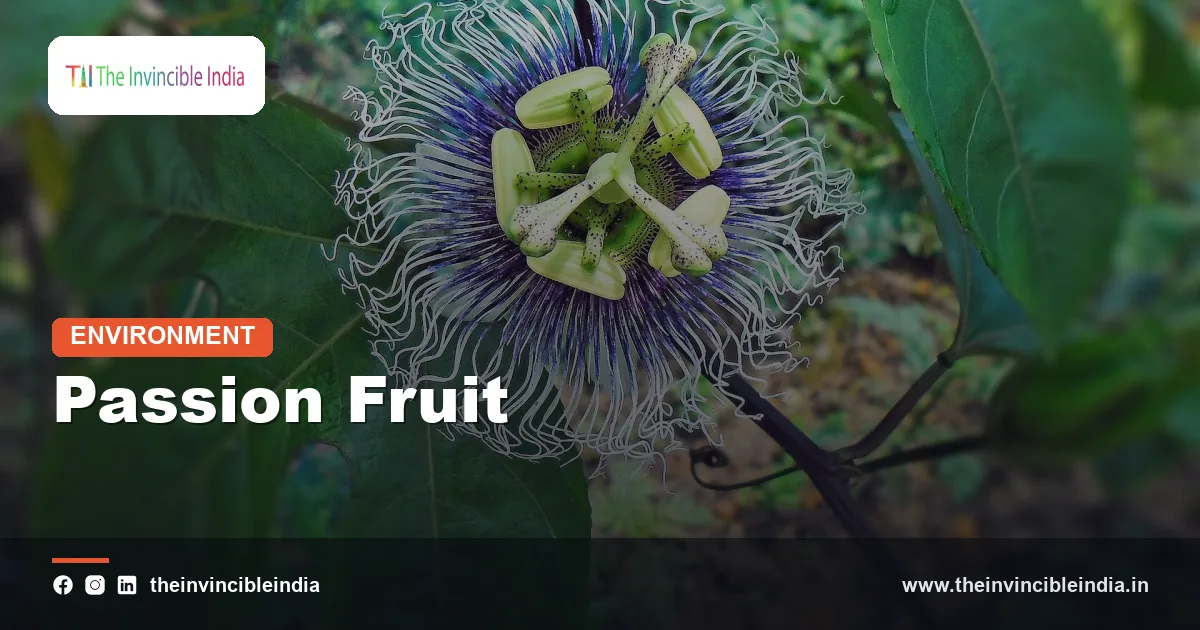
Passion fruit is the round to oval, thick-skinned fruit of the climbing vine Passiflora edulis, prized for its tangy, aromatic pulp full of crunchy black seeds, and in India it is grown mainly in the hills and the north-east, where it is often called krishna phal. The fruit is cut open and the juicy pulp is eaten with a spoon or strained for juice, squash, jam and desserts.
Passion fruit is native to South America but has been cultivated in warm regions around the world for more than a century. In India it has become a useful hill crop, because the vine grows well on slopes where many other fruit trees struggle, and its fruit commands a good price. This guide explains what passion fruit is, how it is grown in India, what it contains, how it is used and what to consider when buying and eating it.
| Quick Fact | Detail |
|---|---|
| Common names | Passion fruit; krishna phal in many Indian languages; purple granadilla for the purple form |
| Scientific name | Passiflora edulis (purple form) and Passiflora edulis f. flavicarpa (yellow form) |
| Family | Passifloraceae (the passion flower family) |
| Where grown in India | Mainly the north-eastern hill states such as Mizoram, Nagaland, Manipur, Meghalaya, Arunachal Pradesh and Sikkim, and the southern hills including the Nilgiris, Kodagu, Wayanad and the Palani hills |
| Season | Fruiting mainly in the warm, wetter months; many hill areas get one or two harvests a year, depending on altitude and variety |
| Part used | The pulp and seeds inside the rind; the rind itself is not usually eaten |
| Nutrition | Rich in dietary fibre and vitamin C, with carotenoids (vitamin A precursors), potassium and small amounts of iron |
| Uses | Eaten fresh; made into juice, squash, jam, jelly, ice cream, sorbet, sauces, desserts and flavoured drinks |
Key Takeaways
- Passion fruit is the fruit of the perennial climbing vine Passiflora edulis, which is native to South America and is grown in India mainly in hill regions.
- Passion fruit pulp is aromatic, tangy and full of edible seeds, and it contains dietary fibre, vitamin C and carotenoids.
- Passion fruit grows in India chiefly in the north-eastern hill states and in the southern hills of Tamil Nadu, Kerala and Karnataka.
- Passion fruit comes in two main forms, the purple type suited to cool highlands and the yellow type suited to warmer lowlands.
- Passion fruit vines need a strong trellis, good drainage and pollination by large bees, and they are usually productive for only a few years.
- Passion fruit is ripe when the rind turns deeply coloured and starts to wrinkle, and the fruit is best eaten pulp-first with a spoon.
What is passion fruit?
Passion fruit is the edible berry of a tropical and subtropical vine in the genus Passiflora, with a hard, leathery rind that encloses a cavity of fragrant, jelly-like pulp and many small black seeds. Each seed is surrounded by a juicy sac, called an aril, and it is these sacs that are eaten.
The fruit is usually round or egg-shaped and about the size of a hen’s egg, though size varies with the variety. Ripe fruit of the purple type has a deep purple rind, while the yellow type turns golden-yellow or orange. The pulp inside is yellow to orange and has a sharp, sweet-sour flavour with a distinctive perfume that is unlike any other common fruit.
The name comes from the flower, not the fruit’s taste. Early European missionaries in South America saw in the unusual flower a symbol of the Passion of Christ, and so the plant became known as the passion flower. In India, the same flower has been compared to scenes from the Mahabharata, which is one popular explanation for the Indian name krishna phal.
Why is passion fruit called krishna phal in India?
Passion fruit is called krishna phal in India because the elaborate flower of the vine is traditionally compared to a symbolic image from Hindu tradition, in which its parts are likened to the five Pandavas, the hundred Kauravas and the discus of Krishna. This is a cultural nickname rather than a botanical name, and it is used mainly in Hindi-speaking regions and in some other languages.
The flower is indeed striking. It has a ring of many thread-like filaments, called the corona, arranged around a central column carrying five anthers and three styles. People have long read symbolism into this structure. In botanical writing and in the fruit trade, the standard terms remain passion fruit and Passiflora edulis, and other local names exist in different regions and languages of India.
Where is passion fruit grown in India?
Passion fruit is grown in India chiefly in the north-eastern hill states and in the southern hills of the Western Ghats, where the climate is mild and humid. Mizoram, Nagaland, Manipur, Meghalaya, Arunachal Pradesh and Sikkim are well-known passion fruit areas, as are the Nilgiris in Tamil Nadu, the Wayanad region of Kerala, Kodagu in Karnataka and parts of the Palani and Kodaikanal hills.
The crop is also taken up in parts of the sub-Himalayan foothills and in some other hill and semi-hill tracts. In the north-east, it is often grown by small farmers on terraced slopes, in home gardens and as a cash crop alongside other horticultural crops. It suits sloping ground because it needs good drainage and does not tolerate waterlogging.
Exact production figures vary from year to year and by source, so it is best to treat any single number as an approximation. What is clear is that passion fruit remains a niche but growing fruit crop in India, with strong local demand for fresh fruit and for processed pulp used by juice and beverage makers.
What are the types of passion fruit?
There are two main types of passion fruit grown in India, the purple form and the yellow form, and they differ in colour, climate preference and flavour. A cross between the two, bred in some countries, is also grown commercially in a few places.
| Feature | Purple passion fruit | Yellow passion fruit |
|---|---|---|
| Botanical name | Passiflora edulis | Passiflora edulis f. flavicarpa |
| Ripe colour | Deep purple to dark maroon | Golden-yellow to orange |
| Fruit size | Smaller | Larger |
| Preferred climate | Cool, higher-altitude hills | Warm, low-altitude tropics |
| Flavour | Sweeter, more aromatic | More acidic and tart |
| Typical use | Fresh eating and desserts | Juice and processing |
The purple form generally suits altitudes of about 1,000 metres and above in the tropics, while the yellow form tolerates heat and humidity better and is more widely grown in lower hills and warm plains areas. Because of its stronger acidity and larger juice yield, the yellow form is often used for juice concentrates.
How is passion fruit grown?
Passion fruit is grown by planting seedlings, cuttings or grafted plants beside a sturdy support, training the vine over a trellis or pergola and harvesting the fruit after it ripens on the vine. Because it is a vigorous climber, the plant needs strong posts and wires, and the vines are pruned each year to keep them productive.
Climate and soil
The vine prefers a warm, frost-free climate with well-distributed rain and bright light. It grows best in light, well-drained, slightly acidic to neutral soil rich in organic matter. Poor drainage encourages root diseases, and strong winds can damage flowers and tear the vines from their supports.
Planting and support
Farmers plant at fixed spacing along rows with a trellis, such as a T-shaped or bower system, to keep the vines off the ground. Good light and air flow reduce disease. In the north-east, bamboo and wooden posts are widely used for trellises.
Pollination
Passion fruit flowers open for only part of a day and many are not self-fertile, so cross-pollination by large bees, especially carpenter bees, matters for a good crop. In places where these bees are scarce, growers sometimes pollinate by hand. Planting flowering shrubs near the orchard can support pollinators.
Pests, diseases and plant life
Passion fruit is affected by fungal wilts, root-knot nematodes, fruit flies and viral diseases such as woodiness, and many growers use grafting onto resistant rootstocks and good field hygiene to manage these problems. A vine usually remains productive for roughly three to five years, after which yields fall and the orchard is replanted. Because of this relatively short life, passion fruit is regarded as a fast-return fruit crop.
When is passion fruit in season in India?
Passion fruit in India ripens mainly in the warmer and wetter months, with one or two harvest periods a year depending on altitude, variety and local weather. In many hill areas the main crop follows flowering in spring and early summer, and the fruit is ready about two to three months after pollination.
Because the vine can flower repeatedly where temperatures are mild, some regions get a second smaller crop later in the year. Markets in hill towns often have fruit for several months. Ripe fruit usually falls from the vine or can be picked when the rind has coloured fully, so many growers collect fallen fruit daily. The exact calendar differs between the north-east and the southern hills, so local advice is the best guide.
What is the nutritional value of passion fruit?
Passion fruit is a nutritious fruit that provides dietary fibre, vitamin C, carotenoids that the body converts to vitamin A, potassium and small amounts of iron and other minerals, in a low-fat package. The edible seeds supply much of the fibre, which is why eating the pulp together with the seeds is recommended.
- Dietary fibre: the seeds and pulp together are a good source, helping digestion.
- Vitamin C: a contributor to normal immune function and skin health.
- Carotenoids: pigments responsible for the orange pulp colour of some varieties.
- Potassium: a mineral that supports normal nerve and muscle function.
- Polyphenols: plant compounds that act as antioxidants in laboratory studies.
Passion fruit is naturally sweet-sour, and a typical serving contains modest calories. Nutrient levels vary with the variety, ripeness and growing conditions, so figures from different sources can differ. People who are allergic to latex sometimes react to certain tropical fruits, and anyone with a known allergy should be cautious. Unripe rind should not be eaten.
How is passion fruit eaten and used?
Passion fruit is eaten fresh by cutting the fruit in half and scooping out the pulp with a spoon, and the pulp is also used to flavour juices, squashes, jams, desserts and drinks. The seeds are edible and give a pleasant crunch, though some recipes strain them out for a smooth juice.
- Juice and squash: the strained pulp is diluted and sweetened, and the concentrate keeps well.
- Jam and jelly: the natural pectin and acidity make passion fruit a good setting fruit.
- Desserts: the pulp tops cakes, cheesecakes, pavlova and puddings, and it flavours ice cream and sorbet.
- Drinks: a spoonful of pulp lifts lemonades, smoothies, mocktails and cocktails.
- Savoury sauces: the tart pulp pairs with fish, salads and glazes.
Because the fruit is expensive relative to its small size, many commercial products use frozen pulp or concentrate. In the north-east, local cooperatives and self-help groups process pulp into squash and jam, which adds value for growers and extends the shelf life of a seasonal crop.
How do you choose and store passion fruit?
You choose passion fruit by looking for fruit that feels heavy for its size and has a deeply coloured, slightly wrinkled rind, because smooth, glossy fruit is usually underripe and sour. Wrinkling shows that the pulp has sweetened and developed its aroma, and it does not mean the fruit has spoiled.
Unripe fruit can be left at room temperature until the skin wrinkles, and ripe fruit keeps for about a week in a refrigerator. The pulp can be scooped out and frozen in small portions for later use. Avoid fruit with mould, soft sunken patches or a sour smell. Wash the rind before cutting so that dirt on the surface does not touch the pulp.
Is passion fruit a good crop for Indian farmers?
Passion fruit can be a good crop for Indian hill farmers because it gives a quick return, grows on slopes and has strong demand for both fresh fruit and processed pulp. A vine may begin to bear within about a year of planting, which is faster than most fruit trees.
The main challenges are the investment in trellises, the short productive life of the vine, disease pressure and the need for pollinators and reliable markets. Storage and transport of the fragile fruit over hill roads add costs. Processing units, cold chains and farmer groups make the crop more rewarding, and government horticulture missions and state departments in several hill states have promoted it in recent years. Farmers should check local advice and current schemes before planting.
Bottom Line
Passion fruit is a fragrant, tangy vine fruit that has found a secure place in the hills and north-east of India. It is easy to eat, useful in the kitchen and quick to yield, though growers need strong supports, good drainage and attention to pests and pollination.
Frequently Asked Questions
What is passion fruit?
Passion fruit is the edible fruit of the climbing vine Passiflora edulis, with a tough rind and tangy, aromatic pulp full of small black seeds. It is native to South America and is grown in India mainly in the hills. It is eaten fresh or used in juices and desserts.
Why is passion fruit called krishna phal?
Passion fruit is called krishna phal because its complex flower is traditionally likened to symbols from the Mahabharata, including the Pandavas, the Kauravas and Krishna’s discus. This is a popular cultural name rather than a scientific one. The botanical name remains Passiflora edulis.
Where is passion fruit grown in India?
Passion fruit is grown in India mainly in the north-eastern hill states, such as Mizoram, Nagaland, Manipur, Meghalaya, Arunachal Pradesh and Sikkim. It is also grown in the southern hills of the Nilgiris, Wayanad, Kodagu and the Palani region. It prefers a mild, humid climate and well-drained soil.
Can you eat passion fruit seeds?
Yes, you can eat passion fruit seeds, which are small, black and crunchy. They are swallowed along with the juicy pulp and supply dietary fibre. Some recipes strain them out to make a smooth juice or sauce.
How do you know when passion fruit is ripe?
Passion fruit is ripe when the rind has turned fully purple or yellow and has started to wrinkle slightly. The fruit should feel heavy for its size. Smooth, firm fruit is usually underripe, but it will ripen at room temperature over a few days.
What is the difference between purple and yellow passion fruit?
Purple passion fruit is smaller, sweeter and suited to cool highlands, while yellow passion fruit is larger, more acidic and suited to warm lowlands. The purple type is often eaten fresh, and the yellow type is often used for juice. Both belong to the species Passiflora edulis.
{“@context”:”https://schema.org”,”@graph”:[{“@type”:”FAQPage”,”mainEntity”:[{“@type”:”Question”,”name”:”What is passion fruit?”,”acceptedAnswer”:{“@type”:”Answer”,”text”:”Passion fruit is the edible fruit of the climbing vine Passiflora edulis, with a tough rind and tangy, aromatic pulp full of small black seeds. It is native to South America and is grown in India mainly in the hills. It is eaten fresh or used in juices and desserts.”}},{“@type”:”Question”,”name”:”Why is passion fruit called krishna phal?”,”acceptedAnswer”:{“@type”:”Answer”,”text”:”Passion fruit is called krishna phal because its complex flower is traditionally likened to symbols from the Mahabharata, including the Pandavas, the Kauravas and Krishna’s discus. This is a popular cultural name rather than a scientific one. The botanical name remains Passiflora edulis.”}},{“@type”:”Question”,”name”:”Where is passion fruit grown in India?”,”acceptedAnswer”:{“@type”:”Answer”,”text”:”Passion fruit is grown in India mainly in the north-eastern hill states, such as Mizoram, Nagaland, Manipur, Meghalaya, Arunachal Pradesh and Sikkim. It is also grown in the southern hills of the Nilgiris, Wayanad, Kodagu and the Palani region. It prefers a mild, humid climate and well-drained soil.”}},{“@type”:”Question”,”name”:”Can you eat passion fruit seeds?”,”acceptedAnswer”:{“@type”:”Answer”,”text”:”Yes, you can eat passion fruit seeds, which are small, black and crunchy. They are swallowed along with the juicy pulp and supply dietary fibre. Some recipes strain them out to make a smooth juice or sauce.”}},{“@type”:”Question”,”name”:”How do you know when passion fruit is ripe?”,”acceptedAnswer”:{“@type”:”Answer”,”text”:”Passion fruit is ripe when the rind has turned fully purple or yellow and has started to wrinkle slightly. The fruit should feel heavy for its size. Smooth, firm fruit is usually underripe, but it will ripen at room temperature over a few days.”}},{“@type”:”Question”,”name”:”What is the difference between purple and yellow passion fruit?”,”acceptedAnswer”:{“@type”:”Answer”,”text”:”Purple passion fruit is smaller, sweeter and suited to cool highlands, while yellow passion fruit is larger, more acidic and suited to warm lowlands. The purple type is often eaten fresh, and the yellow type is often used for juice. Both belong to the species Passiflora edulis.”}}]}]}


