


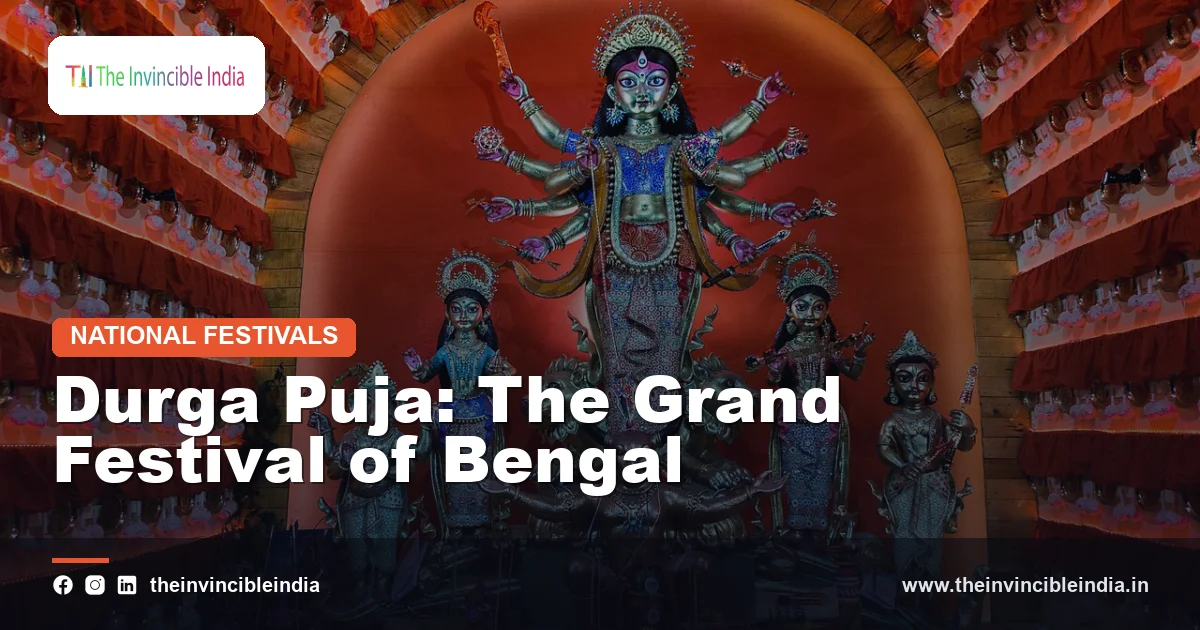
Durga Puja is the grandest and most eagerly awaited festival of Bengal, a spectacular celebration of the goddess Durga that transforms Kolkata and the whole region into a dazzling display of art, devotion and joy. Marking the victory of good over evil, the festival celebrates the goddess’s triumph over the demon Mahishasura and her annual homecoming. With its magnificent pandals, exquisite idols, cultural performances and festive fervour, Durga Puja is not only a religious occasion but a great cultural extravaganza, recognised by UNESCO as an Intangible Cultural Heritage of humanity. This guide explores the meaning, traditions and grandeur of Durga Puja.
Quick Facts: Durga Puja
| Detail | Information |
|---|---|
| Celebrates | Goddess Durga’s victory over the demon Mahishasura |
| Main region | West Bengal, especially Kolkata |
| When | September or October (during Navratri) |
| Main days | Shashthi to Vijaya Dashami (last five days) |
| UNESCO status | Intangible Cultural Heritage (2021) |
| Key feature | Elaborate pandals and idols of Durga |
The Significance of Durga Puja
At its heart, Durga Puja celebrates the triumph of good over evil, embodied in the goddess Durga’s slaying of the buffalo demon Mahishasura, whom the gods could not defeat. Durga, the fierce and compassionate mother goddess, is depicted with ten arms wielding weapons, riding a lion, in the very act of vanquishing the demon. The festival also marks Durga’s annual visit to her earthly home with her children, and thus carries a deep emotional resonance of homecoming, family and the warmth of a mother’s return, making it both a spiritual and profoundly personal celebration for Bengalis.
The Grand Pandals and Idols
The most spectacular feature of Durga Puja is the creation of pandals, elaborate temporary structures built to house the idols of the goddess, which spring up across cities and towns. These pandals are astonishing works of art and architecture, often built around creative themes, ranging from replicas of famous monuments to intricate artistic and social concepts, with communities competing to create the most magnificent displays. Within them stand beautifully crafted idols of Durga and her children, made by skilled artisans, particularly in Kolkata’s famous Kumortuli district, where the tradition of idol-making is a revered art form.
The Days of the Festival
Durga Puja is celebrated over several days, with the main festivities occurring in the last five days of Navratri. Mahalaya heralds the beginning, invoking the goddess to descend to earth. The main celebrations run from Shashthi (the sixth day), when the goddess is welcomed, through Saptami, Ashtami and Navami, days filled with elaborate rituals, prayers (anjali), cultural programmes and pandal-hopping. The festival culminates in Vijaya Dashami (Dussehra), when the idols are carried in grand processions and immersed in rivers and water bodies, bidding a tearful farewell to the goddess until the following year.
Culture, Food and Festivity
Durga Puja is as much a cultural and social celebration as a religious one. The days are filled with music, dance, drama and cultural performances, and people dress in their finest new clothes to visit the pandals, often late into the night. Food is a central joy, with stalls and homes offering an array of Bengali delicacies and festive treats, from savoury snacks to sweets. The ritual of Sindoor Khela, in which married women apply vermilion to one another on the final day, and the emotional immersion processions, add to the festival’s deep sense of community, joy and togetherness.
The History of Durga Puja
The worship of the goddess Durga has ancient roots in Hindu tradition, but the grand community celebration of Durga Puja as it is known today developed over the past few centuries, particularly in Bengal. The festival evolved from private worship in the homes of wealthy families and zamindars into the large public “Sarbojanin” (community) celebrations that emerged in the late nineteenth and twentieth centuries, funded and organised by neighbourhoods and communities. This transformation made the festival a shared, inclusive affair that brought people together across social divides. Over time, Durga Puja grew into the magnificent cultural and artistic spectacle it is today, culminating in its recognition by UNESCO as an Intangible Cultural Heritage of humanity in 2021.
The Art of Idol Making in Kumortuli
The heart of Durga Puja’s artistry lies in Kumortuli, the famous potters’ quarter of Kolkata, where generations of skilled artisans craft the magnificent idols of the goddess. Working for months in advance, these craftsmen mould the images of Durga and her children from clay drawn from the sacred Ganga, shaping them over frameworks of straw and bamboo, before painting them in vivid colours and adorning them with elaborate decorations and ornaments. The creation of the idols is itself a revered tradition, and Kumortuli’s artisans supply idols not only to Kolkata but to Durga Puja celebrations around the world. Watching these idols take shape is to witness a living art form central to the festival’s soul.
Durga Puja Beyond Bengal
While Durga Puja is most closely associated with West Bengal, it is celebrated with great enthusiasm by Bengali communities and others across India and around the world. Cities such as Delhi, Mumbai and Bangalore, with their large Bengali populations, host grand Durga Puja celebrations with elaborate pandals and festivities. In Assam, Odisha, Bihar, Jharkhand and Tripura, the festival is also widely observed. Wherever Bengalis have settled around the globe, from London and New York to Southeast Asia and the Middle East, they recreate the magic of Durga Puja, keeping alive the traditions of their homeland and sharing the joy of the festival with the wider world.
The Emotional and Social Spirit
Beyond its religious and artistic dimensions, Durga Puja carries a deep emotional and social significance for Bengalis. The festival is a time of homecoming, when families reunite, friends gather, and the entire community comes together in celebration, much like the goddess herself returning to her earthly home. The days of pandal-hopping, feasting, wearing new clothes and enjoying cultural programmes foster a powerful sense of togetherness and joy. The final day of immersion, though tinged with the sadness of farewell, reaffirms the bonds of community and the promise of the goddess’s return, making Durga Puja an experience that touches the heart as deeply as it delights the senses.
Planning to Experience Durga Puja
For those wishing to experience Durga Puja, Kolkata during the festival is an unforgettable destination, though it requires some planning given the enormous crowds and festive energy. Accommodation should be booked well in advance, as the city fills with visitors. The best way to experience the festival is to join in the tradition of pandal-hopping, ideally with a local guide or friend, to see the most spectacular and creative displays, while sampling the delicious festive food along the way. Comfortable footwear, patience with the crowds, and an openness to the vibrant atmosphere will reward visitors with one of the most joyous and culturally rich festival experiences in all of India.
The Rituals and Worship of Durga Puja
At the spiritual core of Durga Puja lie the elaborate rituals performed each day to worship the goddess. The ceremonies are conducted by priests following ancient traditions, and include the daily offering of prayers, flowers and incense, the reading of sacred texts, and the beating of the dhak, the traditional drum whose rhythm is inseparable from the festival’s atmosphere. A particularly beautiful ritual is the Sandhi Puja, performed at the crucial juncture between Ashtami and Navami, considered the most auspicious moment of the festival. The devotional offering known as Pushpanjali, in which devotees offer flowers to the goddess amid chanting, is a deeply moving communal act of worship that draws people together each morning.
The Music and Sound of Durga Puja
The soundscape of Durga Puja is one of its most evocative features, instantly recognisable to anyone familiar with the festival. The resonant beat of the dhak, played by traditional drummers, sets the rhythm of the celebrations, while the blowing of conch shells and the ululation (ulu-dhwani) of women mark the sacred moments of worship. The recitation of the Mahalaya, particularly the famous early-morning radio broadcast of devotional chanting that heralds the festival, is a cherished tradition that stirs deep emotion in Bengali hearts. Together with devotional songs, cultural music and the general festive buzz, this rich tapestry of sound gives Durga Puja its unmistakable and stirring atmosphere.
Sindoor Khela and the Farewell
One of the most touching and visually striking traditions of Durga Puja takes place on the final day, Vijaya Dashami, with the ritual of Sindoor Khela. Married women gather to offer sindoor (vermilion) to the goddess before her departure, and then joyfully smear the red powder on one another, celebrating womanhood, marriage and the bond of sisterhood in a scene of vibrant colour and emotion. This is followed by the immersion of the idols, the Visarjan, when the images of Durga are carried in grand processions, amid singing, drumming and dancing, to be immersed in rivers and water bodies, symbolising the goddess’s return to her heavenly abode and her husband Shiva, until she comes again the following year.
Durga Puja as a Celebration of Art
Beyond its religious significance, Durga Puja has evolved into one of the world’s great celebrations of public art and creativity. The themed pandals, in particular, have become extraordinary canvases for artistic expression, with organisers and artists collaborating to create installations that explore social issues, mythology, history, architecture and imaginative concepts, often using innovative materials and techniques. Alongside the pandals, the idols themselves, the lighting, the decorations and the accompanying cultural programmes of music, dance and theatre make the festival a vast, city-wide exhibition of talent and creativity. It was in large part this remarkable artistic dimension that earned Durga Puja its recognition by UNESCO as an Intangible Cultural Heritage of humanity.
A Festival That Unites Generations
Durga Puja holds a special power to bring together people of all ages and walks of life in shared celebration. For the young, it is a time of excitement, new clothes and late-night pandal-hopping with friends; for families, an occasion for reunion and togetherness; and for the elderly, a cherished reaffirmation of tradition and faith. The festival transcends barriers of class and background, as everyone joins in the public celebrations that define it. This ability to unite generations and communities in joy, devotion and cultural pride is a large part of what makes Durga Puja so beloved, and why it remains, year after year, the emotional and cultural heartbeat of Bengal.
Frequently Asked Questions
What is Durga Puja?
Durga Puja is a major Hindu festival, celebrated most grandly in Bengal, that honours the goddess Durga and her victory over the demon Mahishasura, symbolising the triumph of good over evil.
When is Durga Puja celebrated?
Durga Puja is celebrated in September or October, during the festival of Navratri, with the main celebrations occurring over the last five days, from Shashthi to Vijaya Dashami.
Why is Durga Puja famous in Kolkata?
Kolkata is renowned for the grandeur of its Durga Puja, with its magnificent themed pandals, exquisite idols from the famous Kumortuli district, and vibrant cultural festivities that draw visitors from around the world.
What happens on Vijaya Dashami?
Vijaya Dashami is the final day of Durga Puja, when the idols of the goddess are carried in grand processions and immersed in water, marking the goddess’s return to her celestial home.