

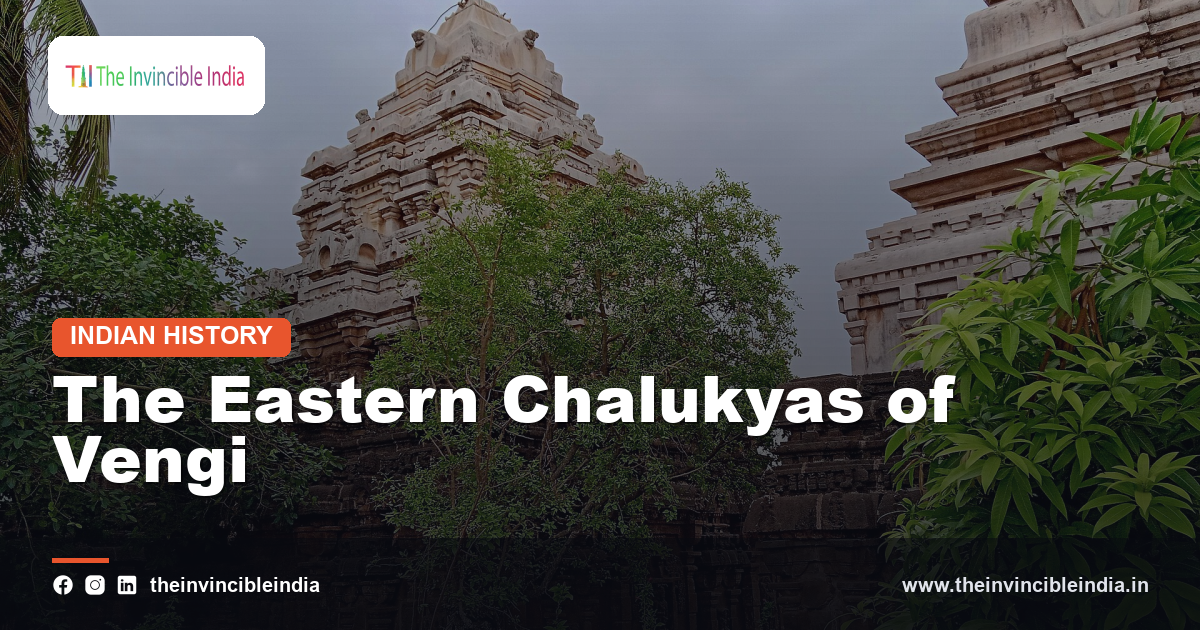
The Eastern Chalukyas, also known as the Chalukyas of Vengi, were a dynasty that ruled the Vengi region of coastal Andhra over a long span generally placed between roughly the seventh and twelfth centuries. The dynasty was founded by Kubja Vishnuvardhana, a brother of the Chalukya emperor Pulakeshin II of the main Chalukya line of the Deccan, and it went on to rule the fertile coastal country with its capital associated with Vengi and later Rajahmundry. The Eastern Chalukyas are especially remembered as patrons of early Telugu literature and as a dynasty whose later history became closely linked with the Cholas through marriage. Their story connects the Deccan tradition of the Chalukya dynasty with the history of Andhra, and this account keeps to general terms where the record is debated.
Quick answer: The Eastern Chalukyas, also called the Chalukyas of Vengi, were a dynasty that ruled the Vengi region of coastal Andhra over a long span generally placed between roughly the seventh and twelfth centuries. The dynasty was founded by Kubja Vishnuvardhana, a brother of the Chalukya emperor Pulakeshin II, and ruled from a capital associated with Vengi and later Rajahmundry. The Eastern Chalukyas are especially remembered as patrons of early Telugu literature and for their later close links with the Cholas through marriage.
Key Takeaways
- The Eastern Chalukyas, or Chalukyas of Vengi, ruled the Vengi region of coastal Andhra over a long span generally placed between about the seventh and twelfth centuries.
- The dynasty was founded by Kubja Vishnuvardhana, a brother of the great Chalukya emperor Pulakeshin II.
- Their capital is associated with Vengi and, in a later phase, Rajahmundry.
- They are remembered as important patrons of early Telugu literature, associated with the poet Nannaya.
- Their later history became closely linked with the Cholas through marriage.
- The ruler Kulottunga I is a famous figure connecting the Eastern Chalukya and Chola lines.
Read on for the history, culture, and legacy in detail.
Quick Facts
| Detail | Information |
|---|---|
| Dynasty | Eastern Chalukyas (Chalukyas of Vengi) |
| Region | Vengi region, coastal Andhra |
| Period | Roughly seventh to twelfth centuries, dates debated |
| Founder | Kubja Vishnuvardhana, brother of Pulakeshin II |
| Capital | Associated with Vengi and later Rajahmundry |
| Patronage | Early Telugu literature; associated with the poet Nannaya |
| Later Link | Closely tied to the Cholas through marriage |
| Famous Figure | Kulottunga I, uniting Chalukya and Chola lines |
Who Were the Eastern Chalukyas?
The Eastern Chalukyas were a dynasty that ruled the Vengi region of coastal Andhra over a long span generally placed between roughly the seventh and twelfth centuries. They were an offshoot of the main Chalukya line of the Deccan, founded by a brother of the great emperor Pulakeshin II, and they established an enduring kingdom in the fertile country of coastal Andhra. The dynasty is known as the Chalukyas of Vengi, after the region that formed its heartland. Over their long history the Eastern Chalukyas became important patrons of culture, especially of the Telugu language and its early literature, and they played a significant role in the political life of southern India. Their later history became deeply entwined with that of the Cholas. The Eastern Chalukyas therefore stand as a major regional dynasty of coastal Andhra, bridging the traditions of the Deccan Chalukyas and the history of the Telugu country.
Where Was the Vengi Region?
The Vengi region, the heartland of the Eastern Chalukyas, lay in coastal Andhra, in the fertile deltaic country between the great rivers of the eastern seaboard. This was a rich agricultural land watered by rivers and blessed with productive soils, which supported a dense population and a prosperous economy. The region’s position on the coast also linked it to maritime trade and contact across the Bay of Bengal. Vengi became a prized and sometimes contested territory because of its wealth and strategic importance, lying between the powers of the Deccan and those of the far south. The dynasty’s capital is associated with Vengi and, in a later phase, with Rajahmundry on the Godavari. This fertile coastal homeland provided the resources that sustained the Eastern Chalukyas over their long history. The geography of the Vengi country was central to the dynasty’s prosperity and to its importance in southern Indian politics.
Who Founded the Eastern Chalukya Dynasty?
The Eastern Chalukya dynasty was founded by Kubja Vishnuvardhana, a brother of the great Chalukya emperor Pulakeshin II of the main Chalukya line based in the Deccan. As the Chalukyas extended their power toward the eastern coast, Kubja Vishnuvardhana was established as ruler of the Vengi region, and from this beginning the Eastern Chalukya line took root and became an independent dynasty in its own right. The founding of the dynasty thus arose from the expansion of Chalukya authority into coastal Andhra. Kubja Vishnuvardhana is remembered as the progenitor of the line that would rule Vengi for centuries. The connection with Pulakeshin II links the Eastern Chalukyas to one of the most celebrated powers of the early-medieval Deccan. The dynasty founded by Kubja Vishnuvardhana went on to develop its own distinct identity and lasting importance in the history of the Telugu country.
Who Was Kubja Vishnuvardhana?
Kubja Vishnuvardhana was the founder of the Eastern Chalukya dynasty and a brother of Pulakeshin II, the renowned Chalukya emperor of the Deccan. Established as ruler over the Vengi region during the expansion of Chalukya power to the east, he laid the foundations of an independent dynasty that would endure for centuries in coastal Andhra. As the progenitor of the Eastern Chalukya line, he holds an honoured place in the dynasty’s history. His establishment in Vengi marked the beginning of a new and lasting power in the Telugu country. The details of his reign belong to the early-medieval history of the region and are reconstructed from inscriptions. His connection to the illustrious Pulakeshin II gave the dynasty a prestigious origin. Kubja Vishnuvardhana therefore stands as the founding figure whose work created one of the important regional dynasties of southern India in the Vengi region.
How Long Did the Eastern Chalukyas Rule?
The Eastern Chalukyas ruled the Vengi region over a remarkably long span, generally placed between roughly the seventh and twelfth centuries, making them one of the more durable dynasties of southern India. Across these centuries the dynasty experienced periods of strength and prosperity as well as times of conflict, succession disputes and pressure from rival powers. Their long rule allowed them to develop a distinctive identity in coastal Andhra and to foster the cultural achievements for which they are remembered. The dynasty’s history is reconstructed from inscriptions and the records of neighbouring powers, and the precise chronology of individual rulers is debated by historians. The length of their rule gave the Eastern Chalukyas a central place in the political and cultural life of the Telugu country over many generations. Their long endurance is one of the notable features of the dynasty and shaped the lasting importance of the Vengi kingdom.
What Was the Capital of the Eastern Chalukyas?
The capital of the Eastern Chalukyas is associated chiefly with Vengi, the region that gave the dynasty its name, and in a later phase with Rajahmundry on the Godavari river. Vengi was the historic seat and heartland of the dynasty, situated in the fertile coastal country of Andhra, and it became the centre of the kingdom’s political and cultural life. The shift of the dynasty’s centre toward Rajahmundry in a later period reflected the changing circumstances of its long history. These capitals lay in the prosperous deltaic lands that sustained the dynasty’s power and patronage. The association of the Eastern Chalukyas with Vengi and Rajahmundry anchors the dynasty geographically in the heart of coastal Andhra. These centres served as the focus of the kingdom’s governance, culture and religious life. The capitals of the Eastern Chalukyas thus marked the political heart of one of the great regional kingdoms of the Telugu country.
Why Are the Eastern Chalukyas Important for Telugu?
The Eastern Chalukyas are especially important for the Telugu language because their patronage is associated with the early development of Telugu literature. The dynasty is remembered as a supporter of learning and letters in the Telugu country, and its courts fostered the growth of the language in literary expression. The period is particularly associated with the poet Nannaya, who is remembered in tradition as a foundational figure of Telugu literature and whose work is linked with the patronage of the Eastern Chalukya court. This association makes the dynasty a landmark in the cultural history of the Telugu people. The promotion of Telugu literature under the Eastern Chalukyas helped lay the foundations of a rich literary tradition that would flourish in later centuries. This cultural patronage is among the most enduring legacies of the dynasty, giving it a cherished place in the heritage of the Telugu country.
Who Was Nannaya?
Nannaya is remembered in tradition as a foundational figure of Telugu literature, a poet closely associated with the patronage of the Eastern Chalukya court. He is honoured as one of the earliest and most important poets of the Telugu language, credited with pioneering work that helped establish Telugu as a language of refined literary expression. His association with the Eastern Chalukyas links the dynasty to a landmark moment in the cultural history of the Telugu people. The traditions surrounding Nannaya celebrate him as a pioneer whose work shaped the course of Telugu letters. As with other figures of the period, the detailed accounts of his life and work are drawn from tradition and are treated with scholarly care. Nannaya’s fame lent lasting cultural prestige to the Eastern Chalukya court. His connection with the dynasty symbolises the flowering of Telugu literature that is one of the dynasty’s most treasured legacies.
How Did the Eastern Chalukyas Relate to the Rashtrakutas?
The Eastern Chalukyas related to the Rashtrakutas, one of the great powers of the Deccan, through a long pattern of rivalry, conflict and shifting relations over the course of their history. As the Rashtrakutas rose to dominate much of the Deccan, their power often came into contact and competition with the Eastern Chalukyas of the coastal country. The fertile and strategic Vengi region was a prize that drew the attention of greater powers, and the Eastern Chalukyas had to contend with pressure from their mighty neighbours. At various times the relationship involved warfare, and at others accommodation, as the balance of power shifted. These interactions placed the Eastern Chalukyas firmly within the competitive political world of early-medieval southern India. Their ability to endure amid such pressures is a testament to the resilience of the dynasty. The relationship with the Rashtrakutas forms an important strand in the political history of the Vengi kingdom.
How Did the Eastern Chalukyas Become Linked to the Cholas?
The Eastern Chalukyas became closely linked to the Cholas, the great power of the far south, through marriage alliances that eventually united the two ruling lines. As the Cholas rose to dominance, relations between them and the Eastern Chalukyas of Vengi grew close, and marriages between the two houses created strong dynastic ties. These connections drew the Vengi kingdom into the orbit of Chola power and shaped the later history of the Eastern Chalukyas. The most famous outcome of this union is associated with the ruler Kulottunga I, who is remembered as a figure uniting the Eastern Chalukya and Chola lines. This blending of the two dynasties was a significant development in the political history of southern India. The link with the Cholas marks the later and in some ways culminating phase of Eastern Chalukya history. It connected the Vengi kingdom to one of the greatest empires of the south.
Who Was Kulottunga I?
Kulottunga I is a famous figure who connects the Eastern Chalukya and Chola lines, remembered as a ruler of Eastern Chalukya descent who came to be associated with the Chola throne. Through the marriage alliances that united the two houses, Kulottunga brought together the heritage of the Vengi kingdom and the great Chola Empire of the far south. He is remembered as an important ruler whose reign linked the fortunes of the two dynasties. His career reflects the deep dynastic ties that had developed between the Eastern Chalukyas and the Cholas. The details of his reign belong to the broadly recorded history of southern India and are studied through inscriptions and traditions. Kulottunga I stands as a symbol of the union of the two lines and of the close relationship between coastal Andhra and the Chola country. His name is among the most celebrated connected with the later history of the Eastern Chalukyas.
How Did the Eastern Chalukyas Patronise Temples?
The Eastern Chalukyas were patrons of temples and religion, and their support for the devotional life of coastal Andhra forms an important part of their legacy. The fertile Vengi country was rich in temple traditions, and the dynasty is associated with grants to religious institutions and the support of worship in keeping with the practices of the age. The coastal region is known for important and ancient temples that flourished during and around the period of Eastern Chalukya rule. This patronage reinforced the legitimacy of the dynasty and tied its rule to the sacred landscape of the Telugu country. The Eastern Chalukyas supported Hindu devotional traditions, contributing to the religious culture of the region. Through such patronage the dynasty left a mark on the temple heritage of coastal Andhra. The religious and architectural culture of the period remains an important dimension of the achievements of the Eastern Chalukya dynasty.
What Was Eastern Chalukya Administration Like?
Eastern Chalukya administration combined a central royal court with a network of officials and local authorities who governed the fertile Vengi country. At the head stood the king, supported by ministers, officers and subordinate chiefs who managed revenue, justice and defence across the kingdom. Revenue came chiefly from the rich agriculture of the coastal deltaic lands, supplemented by trade through the ports of the eastern seaboard, and was gathered through established arrangements recorded in inscriptions. Local officers and feudatories held responsibilities within this structure, a common pattern in the states of the period. The wealth of the Vengi country gave the dynasty the resources to maintain a strong state and to support its cultural and religious patronage. This administrative order underpinned the long endurance of the dynasty. The organisation of the Eastern Chalukya state reflected the mature statecraft of a prosperous regional kingdom of early-medieval southern India.
Why Did the Eastern Chalukyas Decline?
The Eastern Chalukyas declined as the political order of southern India changed and the Vengi kingdom became ever more closely absorbed into the orbit of the Cholas and later powers. The marriage alliances and close ties with the Cholas, while bringing prestige, also drew the Vengi line into the larger imperial framework of the far south, gradually diminishing its independent identity. Succession disputes, pressure from rival powers and the shifting balance of regional politics contributed to the weakening of the dynasty over time. As the great empires reorganised the governance of the region, the distinct Eastern Chalukya line faded. The precise circumstances and timing are reconstructed from scattered evidence and are described cautiously by historians. Rather than a single dramatic fall, the decline of the Eastern Chalukyas appears as a gradual absorption into the wider political order. Their long history thus closed through integration into the greater powers of the south.
Why Are the Eastern Chalukyas Significant?
The Eastern Chalukyas are significant as a long-lived regional dynasty that shaped the history and culture of coastal Andhra and played an important role in the politics of southern India. Their patronage of early Telugu literature, associated with the poet Nannaya, makes them a landmark in the cultural history of the Telugu people and gives them an honoured place in that heritage. Their founding by a brother of Pulakeshin II connects them to the great Chalukya tradition of the Deccan, while their later union with the Cholas ties them to the greatest empire of the far south. The history of the Vengi kingdom illuminates the relations among the major powers of early-medieval southern India. For students of Indian history, the Eastern Chalukyas bridge the Deccan and the Telugu and Tamil worlds. Their significance rests on this blend of political importance and lasting cultural achievement.
The Eastern Chalukyas Today
The Eastern Chalukyas are remembered today chiefly through the cultural heritage of the Telugu country, especially their association with the early flowering of Telugu literature, and through the temples and traditions of coastal Andhra. The memory of the dynasty’s patronage of Telugu letters, symbolised by the poet Nannaya, remains a cherished part of the literary heritage of the region. Historians and epigraphists continue to study the inscriptions of the Eastern Chalukyas to refine understanding of their long rule and their links with the Chalukyas and the Cholas. The temples and ancient sites of coastal Andhra preserve the devotional heritage in which the dynasty shared. For readers of Indian history, the Eastern Chalukyas offer a vivid example of a regional dynasty that shaped the identity of the Telugu country. Their legacy endures in the literature, temples and cultural memory of coastal Andhra.
Sources & Further Reading
- Archaeological Survey of India (asi.nic.in).
- Ministry of Culture, Government of India (indiaculture.gov.in).
- Department of Tourism, Government of Andhra Pradesh (tourism.ap.gov.in).
Frequently Asked Questions
Who were the Eastern Chalukyas?
The Eastern Chalukyas, also called the Chalukyas of Vengi, were a dynasty that ruled the Vengi region of coastal Andhra over a long span generally placed between about the seventh and twelfth centuries. They are remembered as patrons of early Telugu literature and for their later links with the Cholas.
Who founded the Eastern Chalukya dynasty?
The Eastern Chalukya dynasty was founded by Kubja Vishnuvardhana, a brother of the great Chalukya emperor Pulakeshin II of the Deccan. He was established as ruler of the Vengi region, and from this beginning the dynasty became an independent power in coastal Andhra.
Where was the Vengi region?
The Vengi region lay in coastal Andhra, in the fertile deltaic country between the great rivers of the eastern seaboard. The dynasty’s capital is associated with Vengi and, in a later phase, with Rajahmundry on the Godavari.
Why are the Eastern Chalukyas important for Telugu?
The Eastern Chalukyas are important for Telugu because their patronage is associated with the early development of Telugu literature, especially through the poet Nannaya. Their support helped lay the foundations of a rich literary tradition in the Telugu country.
How were the Eastern Chalukyas linked to the Cholas?
The Eastern Chalukyas became closely linked to the Cholas through marriage alliances that eventually united the two ruling lines. The ruler Kulottunga I is the famous figure associated with the union of the Eastern Chalukya and Chola lines.
How long did the Eastern Chalukyas rule?
The Eastern Chalukyas ruled the Vengi region over a long span generally placed between roughly the seventh and twelfth centuries. The precise chronology of individual rulers is reconstructed from inscriptions and is debated by historians.


