

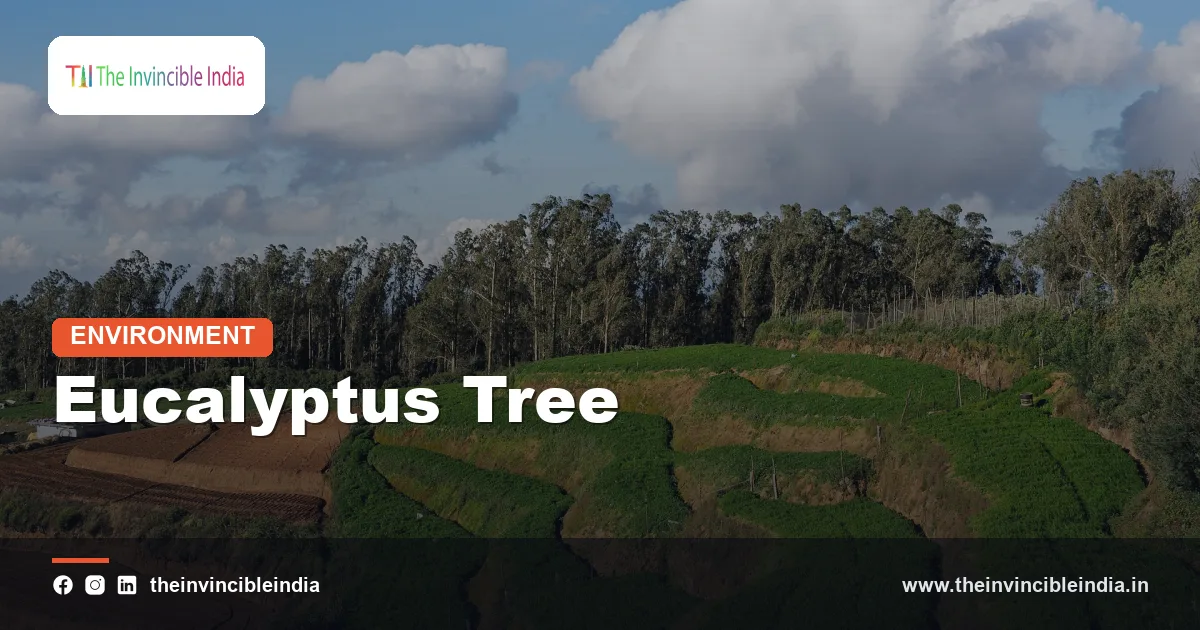
In India, eucalyptus is the common name for fast-growing, aromatic evergreen trees of the genus Eucalyptus, which are native to Australia and are now widely planted across the country for pulpwood, poles, fuelwood and essential oil. Locally the trees are known as nilgiri, safeda or “gum trees”, and they are among the most visible and most debated exotic trees in Indian forestry, farming and landscape.
Eucalyptus was introduced to India in the colonial era and spread through the Nilgiri hills, the Deccan plateau and the plains through plantations, social forestry schemes and farmers’ own planting. This explainer covers what eucalyptus is, how it arrived in India, what it is used for, how to recognise it, and the long-running debate over its water use and effects on biodiversity, which is presented here from both sides.
Quick Facts
| Scientific name | Genus Eucalyptus; common Indian plantation species include E. tereticornis, E. camaldulensis, E. globulus and hybrids |
|---|---|
| Family | Myrtaceae (the myrtle family, which also includes guava and clove) |
| Common Indian names | Nilgiri, safeda, yukalipt, eucalyptus, blue gum, Mysore gum (for E. tereticornis) |
| Typical height | Commonly 20 to 40 metres or more in plantations, with a tall, slender trunk |
| Native range | Australia, with a few species in New Guinea and nearby islands; introduced to India |
| Main uses | Pulpwood for paper, poles, scaffolding, fuelwood, essential oil, windbreaks |
| Number of species | Several hundred species and many hybrids; only a handful are widely planted in India |
| Notable features | Peeling bark, aromatic oil-rich leaves, rapid growth, coppicing, subject of a long water-use and biodiversity debate |
Key Takeaways
- Eucalyptus is a genus of several hundred mostly Australian trees in the myrtle family that was introduced to India in the colonial period and is now grown in plantations across the country.
- Eucalyptus is valued in India mainly as pulpwood for the paper industry, as poles and fuelwood, and as the source of eucalyptus oil distilled from its leaves.
- The Nilgiri hills of Tamil Nadu gave the tree its popular Indian name “nilgiri”, because blue gum eucalyptus was planted there extensively from the nineteenth century.
- The effect of eucalyptus on groundwater and local ecosystems has been debated since the 1980s, with some studies reporting high water use in dry areas and others finding it comparable to other fast-growing trees.
- Eucalyptus leaves carry aromatic oil glands, and the oil is used in cough drops, balms and inhalants, but it is toxic if swallowed in more than very small quantities.
- Several Indian states and courts have in recent years restricted eucalyptus planting on some government forest and grassland sites, while farm-forestry planting on private land continues.
What Is Eucalyptus?
Eucalyptus is a genus of flowering evergreen trees and shrubs in the myrtle family, Myrtaceae, with more than seven hundred species, the great majority native to Australia. The name comes from Greek words meaning “well covered”, a reference to the cap, or operculum, that covers the flower bud until it opens.
Eucalypts include some of the tallest flowering trees in the world and range from small mallee shrubs to forest giants. They are characterised by oil-bearing leaves, bark that peels in strips or sheets, and a strong ability to regrow from the stump or from a woody swelling at the base called a lignotuber. These traits help them survive fire and drought in Australia, and they make the trees easy to manage as a coppice crop in plantations.
Only a small number of species are widely planted in India. The most common are Eucalyptus tereticornis (Mysore gum or forest red gum), Eucalyptus camaldulensis (river red gum), Eucalyptus globulus (blue gum, mainly in cooler hills) and selected hybrids and clones developed for higher yields.
How Did Eucalyptus Come to India?
Eucalyptus came to India in the late eighteenth and nineteenth centuries, when seeds from Australia were planted in botanical gardens, hill stations and later in forestry trials. A widely repeated account says that Tipu Sultan raised eucalyptus on Nandi Hills near Bengaluru in the 1790s, and blue gum was planted at scale in the Nilgiris from the mid-nineteenth century.
The key stages in the spread can be summarised as follows:
- Late 1700s: Early introductions to southern India, with Mysore associated with the first plantings.
- Mid-1800s: Blue gum was planted in the Nilgiri hills to supply fuelwood and timber to the growing hill towns and railways, and to provide eucalyptus oil.
- Twentieth century: Forest departments adopted eucalyptus for fuelwood and pulpwood plantations in many states.
- 1970s and 1980s: Social forestry programmes promoted eucalyptus on farms and wastelands because it grew fast and had a ready market.
- 1980s onwards: Paper companies developed improved clones and promoted contract farming of eucalyptus in states such as Andhra Pradesh, Telangana, Karnataka, Tamil Nadu, Gujarat and Punjab.
The tree was thus introduced and then expanded for practical reasons, to meet demand for wood and to supply raw material for industry.
What Does a Eucalyptus Tree Look Like?
A eucalyptus tree typically has a tall, straight, slender trunk, smooth pale bark that peels off in strips, and narrow, drooping, leathery leaves with a sharp medicinal smell when crushed. Young and mature leaves often look very different, a feature called heterophylly.
Leaves
Juvenile leaves of many species, such as blue gum, are rounded, bluish-green and arranged in opposite pairs along the stem. Adult leaves are long, narrow, curved and hang down, which reduces direct sun exposure. Tiny oil glands in the leaves release the characteristic fragrance.
Flowers and fruits
The flowers have no showy petals. Instead, a fluffy mass of stamens, in white, cream, pink or red depending on the species, emerges when the bud cap falls away. These flowers produce abundant nectar and are visited by bees, and eucalyptus honey is produced in some regions. The fruit is a woody, cup-shaped capsule that releases very small seeds.
Bark and trunk
Many eucalypts shed bark in long ribbons, leaving a smooth cream, grey or mottled surface. Under plantation conditions, the trunk grows straight and relatively branch-free, which suits pole and pulpwood production.
What Is Eucalyptus Used For in India?
Eucalyptus is used in India mainly for pulpwood, poles, fuelwood, construction supports and the extraction of essential oil, and its rapid growth is the main reason for its popularity. A plantation can be harvested in only a few years compared with many native hardwoods, which lets farmers and industries earn returns quickly.
| Use | Description |
|---|---|
| Pulpwood | Chipped for paper and rayon production; the main commercial driver of eucalyptus planting |
| Poles and scaffolding | Straight stems are used for rural construction, scaffolding (often called ballis), fencing and props |
| Fuelwood and charcoal | Wood burns well and is widely used as firewood and for charcoal |
| Essential oil | Steam-distilled from leaves, especially of blue gum, for balms, inhalants, soaps and cleaning products |
| Windbreaks and shelterbelts | Tall rows are planted along farm boundaries and roads |
| Honey | Flowers provide nectar for beekeeping in some regions |
The Nilgiri eucalyptus oil industry is among the oldest in India. It uses oil rich in the compound cineole, which gives the sharp, cooling aroma used in cough drops and vapour rubs. Eucalyptus oil should never be swallowed in amounts beyond what is prescribed in products made for that purpose, and it should be kept away from children.
Why Is Eucalyptus Planted So Widely?
Eucalyptus is planted widely in India because it grows quickly, regrows after cutting, tolerates poor soil, and has a reliable market in the paper and pole industries. For many small and medium farmers, eucalyptus offers a lower-labour crop with predictable harvest cycles, usually between about four and eight years depending on the aim.
Supporters of eucalyptus plantations point to several advantages:
- High yield of wood: Improved clones produce much more wood per hectare per year than many native species.
- Reduced pressure on natural forests: Plantation wood can meet fuelwood and pulp demand that might otherwise be taken from natural forests.
- Coppicing: The tree regrows from the stump after harvest, lowering replanting costs.
- Adaptability: Suitable species and clones exist for a range of rainfall zones and soils.
- Income for farmers: Contract farming and assured purchase arrangements give growers stable returns in many regions.
Does Eucalyptus Use Too Much Water?
The question of whether eucalyptus uses too much water has no single answer, because the evidence shows that water use depends on the species, planting density, rainfall and soil, and scientists and ecologists disagree on how serious the impact is. Both sides of the debate have published studies, and the discussion remains active.
Concerns raised by critics
Critics argue that eucalyptus plantations, especially dense stands in low-rainfall areas, can draw down soil moisture and groundwater and reduce stream flow. Fast growth means high transpiration, and deep roots can reach water that shallow-rooted crops cannot. Farmers in some regions, including in Karnataka in the 1980s, protested against eucalyptus planting on farmland and village commons because they felt it displaced food crops and fodder and harmed local water availability.
Points made by defenders
Defenders of eucalyptus argue that the tree is often unfairly blamed. They note that water use per unit of wood produced is not unusually high compared with other fast-growing trees, that any dense, fast-growing crop will use a lot of water, and that the effects depend heavily on where and how the trees are planted. Studies in some regions have found no clear link between eucalyptus planting and a fall in the water table, once rainfall variability and well pumping for irrigation are accounted for.
What most researchers agree on
Most researchers accept that eucalyptus plantations in very dry areas, on shallow soils or in important recharge zones carry greater risk of hydrological impact. Planting at wider spacing, avoiding stream banks and wetlands, and using suitable species for each rainfall zone are commonly recommended to reduce the risk.
What Other Environmental Concerns Surround Eucalyptus?
The other main environmental concerns about eucalyptus are its effect on biodiversity, soil, grasslands and fire risk. Monoculture plantations generally support fewer native birds, insects and plants than natural forests, and in some hill regions eucalyptus has replaced native shola forests and grasslands.
- Biodiversity: Dense eucalyptus stands often have less undergrowth and fewer native species, although birds and bees do use the flowers.
- Grassland loss: In the Nilgiris and other hill ecosystems, planting on natural grassland is considered harmful to native habitats and has been challenged in courts.
- Leaf litter and soil: Slowly decomposing oily litter can alter soil conditions, and claims about chemicals that suppress other plants (allelopathy) have been debated.
- Fire risk: The oil-rich leaves and bark can burn fiercely in dry conditions.
- Spread: Some species can regenerate or spread into nearby land, especially in cooler hills.
In response, several states and courts have moved to restrict or phase out eucalyptus on certain forest and grassland sites in recent years. At the same time, eucalyptus remains an important farm-forestry crop in many agricultural landscapes, and policy discussion continues about where it is appropriate.
How Is Eucalyptus Grown?
Eucalyptus is grown from nursery seedlings or from clonal cuttings that are planted at the start of the monsoon and harvested after several years. Modern plantations usually use selected clones that give uniform, fast growth and better pulp quality than seed-raised trees.
Typical practice includes preparing the land with pits or furrows, planting at regular spacing, weeding and watering in the first year, and harvesting in cycles. After the first harvest, many growers let the stumps coppice, so that the new shoots form a second crop. Spacing depends on the aim: closer for pulpwood and poles, wider for oil or mixed farming. Agroforestry arrangements that combine rows of eucalyptus with crops are also practised, though competition for light and water must be managed.
Bottom Line
Eucalyptus is a useful but contested exotic tree in India: it is a fast and profitable source of pulpwood, poles and oil, yet its water use and effects on native habitats mean that the choice of site, species and spacing matters a great deal. The most balanced position is that eucalyptus suits well-chosen farmland and plantation sites, but is a poor choice for natural grasslands, wetlands and water-scarce catchments.
Frequently Asked Questions
What is eucalyptus and where does it come from?
Eucalyptus is a genus of aromatic evergreen trees in the myrtle family that is native mainly to Australia. It was introduced to India in the colonial period and is now planted widely. In India it is known as nilgiri or safeda.
Why is eucalyptus called nilgiri in India?
Eucalyptus is called nilgiri in India because blue gum eucalyptus was planted extensively in the Nilgiri hills of Tamil Nadu from the nineteenth century. The name later spread to the tree in general. Eucalyptus oil from the region is also known as Nilgiri oil.
What is eucalyptus used for?
Eucalyptus is used for pulpwood in paper making, for poles and scaffolding, as fuelwood and charcoal, and for essential oil extracted from its leaves. Its oil is found in balms, inhalants and cough drops. The tree is also planted as a windbreak.
Does eucalyptus really drain groundwater?
Eucalyptus can use large amounts of water, especially in dense stands in dry areas, but studies disagree about how much it affects groundwater. Some researchers report falling water tables and reduced stream flow, while others find that its water use per unit of wood is similar to other fast-growing trees. Site, rainfall and planting density are the deciding factors.
Is eucalyptus oil safe to use?
Eucalyptus oil is safe in diluted form for topical and inhalation use in commercial products, but it is toxic if swallowed in more than very small amounts. It should be kept away from children and pets and not applied undiluted to the skin. Anyone with health concerns should follow product instructions or consult a doctor.
Is eucalyptus banned in any Indian state?
There is no single national ban on eucalyptus in India, but some states and courts have restricted planting on certain government forest and grassland sites in recent years. Planting on private farmland generally continues under state rules. The position can change, so growers should check current state forest department guidelines.
{“@context”:”https://schema.org”,”@graph”:[{“@type”:”FAQPage”,”mainEntity”:[{“@type”:”Question”,”name”:”What is eucalyptus and where does it come from?”,”acceptedAnswer”:{“@type”:”Answer”,”text”:”Eucalyptus is a genus of aromatic evergreen trees in the myrtle family that is native mainly to Australia. It was introduced to India in the colonial period and is now planted widely. In India it is known as nilgiri or safeda.”}},{“@type”:”Question”,”name”:”Why is eucalyptus called nilgiri in India?”,”acceptedAnswer”:{“@type”:”Answer”,”text”:”Eucalyptus is called nilgiri in India because blue gum eucalyptus was planted extensively in the Nilgiri hills of Tamil Nadu from the nineteenth century. The name later spread to the tree in general. Eucalyptus oil from the region is also known as Nilgiri oil.”}},{“@type”:”Question”,”name”:”What is eucalyptus used for?”,”acceptedAnswer”:{“@type”:”Answer”,”text”:”Eucalyptus is used for pulpwood in paper making, for poles and scaffolding, as fuelwood and charcoal, and for essential oil extracted from its leaves. Its oil is found in balms, inhalants and cough drops. The tree is also planted as a windbreak.”}},{“@type”:”Question”,”name”:”Does eucalyptus really drain groundwater?”,”acceptedAnswer”:{“@type”:”Answer”,”text”:”Eucalyptus can use large amounts of water, especially in dense stands in dry areas, but studies disagree about how much it affects groundwater. Some researchers report falling water tables and reduced stream flow, while others find that its water use per unit of wood is similar to other fast-growing trees. Site, rainfall and planting density are the deciding factors.”}},{“@type”:”Question”,”name”:”Is eucalyptus oil safe to use?”,”acceptedAnswer”:{“@type”:”Answer”,”text”:”Eucalyptus oil is safe in diluted form for topical and inhalation use in commercial products, but it is toxic if swallowed in more than very small amounts. It should be kept away from children and pets and not applied undiluted to the skin. Anyone with health concerns should follow product instructions or consult a doctor.”}},{“@type”:”Question”,”name”:”Is eucalyptus banned in any Indian state?”,”acceptedAnswer”:{“@type”:”Answer”,”text”:”There is no single national ban on eucalyptus in India, but some states and courts have restricted planting on certain government forest and grassland sites in recent years. Planting on private farmland generally continues under state rules. The position can change, so growers should check current state forest department guidelines.”}}]}]}


