

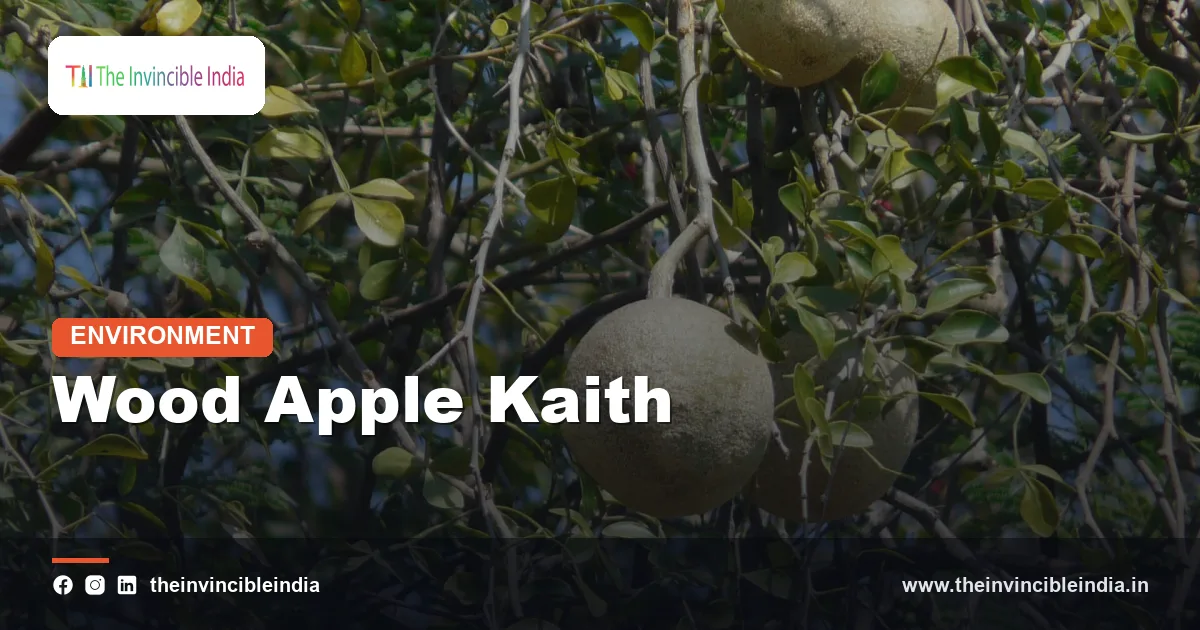
The wood apple (Limonia acidissima), known in Hindi as kaith or kath bel, is a hard-shelled, tangy-sweet fruit borne by a thorny, drought-hardy tree native to the Indian subcontinent. Its grey, woody shell hides a dark brown, sticky pulp that is eaten fresh, mixed with jaggery, or turned into chutney, jam and cooling drinks. The wood apple belongs to the citrus family and is a distant cousin of the bael, which is why it is sometimes called kath bel.
The wood apple has been part of village diets, temple offerings and folk medicine in India for many centuries, yet it remains far less known in cities than mango or guava. This explainer describes the tree, the fruit, its season, its uses in the kitchen and in tradition, its nutrition, how it is grown and the sensible cautions that go with it. It was last updated on 23 October 2026.
Quick Facts
| Scientific name | Limonia acidissima (synonyms: Feronia limonia, Feronia elephantum) |
|---|---|
| Family | Rutaceae (the citrus or rue family) |
| Common Indian names | Kaith, kaitha, kath bel (Hindi); kavath (Marathi); kapittha (Sanskrit); vilam pazham (Tamil); velaga pandu (Telugu); belada hannu (Kannada) |
| Other English names | Elephant apple, monkey fruit, curd fruit |
| Plant type and height | Slow-growing, spiny, deciduous tree, commonly 6 to 9 metres tall and sometimes taller |
| Fruiting season | Mainly the cooler half of the year, from late autumn into early spring, varying by region |
| Native range | India and Sri Lanka, with early spread across South and Southeast Asia |
| Nutrition highlights | Dietary fibre, vitamin C, B vitamins, minerals such as calcium and iron, and natural plant acids |
| Main uses | Chutney, jam, sherbet, folk medicine, religious offerings, gum, hard timber |
Key Takeaways
- The wood apple is the fruit of Limonia acidissima, a thorny tree of the citrus family that is native to India and Sri Lanka.
- Kaith, kath bel and kavath are common Indian names for the wood apple, and the fruit has a hard, grey, woody shell that must be cracked open.
- The brown pulp of the wood apple tastes sour-sweet with a strong, almost fermented aroma, and it is eaten with jaggery or made into chutney and drinks.
- The wood apple tree tolerates drought, heat and poor soil, which is why it survives on dry plains, village boundaries and temple grounds across India.
- The wood apple is related to the bael (Aegle marmelos) but is a different species, and neither should be confused with the elephant apple (Dillenia indica).
- Ayurveda and village traditions use the wood apple for digestion and throat complaints, but modern clinical evidence for these claims is limited, so the fruit is best treated as food rather than medicine.
What is the wood apple tree?
The wood apple tree is a slow-growing, deciduous, medium-sized tree of the family Rutaceae, normally reaching 6 to 9 metres and occasionally more. It has a rough, grey, fissured trunk, a rounded crown and stout spines on its branches. The tree is tough and long-lived, and old specimens can stand for generations on field bunds, village outskirts and temple land.
The leaves are compound, with three to seven small leaflets arranged on a slightly winged central stalk. When crushed, they release a pleasant, anise-like and citrusy smell, a reminder of the tree’s relationship to lemon, orange and curry leaf. Small, greenish-white to reddish flowers appear in loose clusters, and they develop into the round fruits that give the tree its name.
Botanists have used several scientific names for the species over time. The older names Feronia limonia and Feronia elephantum still appear in books and in Ayurvedic literature, but the accepted name today is Limonia acidissima. Because the tree belongs to the citrus family, it is also a host plant for some swallowtail butterflies, whose caterpillars feed on its tender leaves.
What does the wood apple fruit look like and taste like?
The wood apple fruit is a round, grey-brown berry roughly 5 to 9 centimetres across, wrapped in a hard, woody shell that sounds hollow when tapped. Inside the shell lies a sticky, dark brown pulp that surrounds many small, pale seeds. The fruit is heavy for its size and does not soften visibly when ripe, so ripeness is judged by smell and by a slight give when the shell is pressed.
The pulp tastes sour and sweet at once, with a deep, earthy, slightly fermented fragrance that some people love and others find strong. The sourness comes from natural plant acids, and the sweetness varies from one tree to another. A few trees bear fruit that is noticeably sweeter, and village growers often remember which tree gives the best kaith.
How is a wood apple opened?
A wood apple is opened by cracking the shell, either by striking it against a hard surface or by tapping it with a stone or hammer until it splits. The pulp is then scooped out with a spoon, and the seeds and fibrous strands are strained away if a smooth result is wanted. The shell is thick enough that a ripe fruit can be stored for weeks without spoiling, which makes the wood apple an unusually durable fruit.
Where does the wood apple grow in India?
The wood apple grows wild and in cultivation across much of India, especially in the dry deciduous forests and semi-arid plains of the peninsula and the northern plains. It is found in states such as Uttar Pradesh, Bihar, Rajasthan, Gujarat, Madhya Pradesh, Maharashtra, Karnataka, Andhra Pradesh, Telangana and Tamil Nadu. The tree is also native to Sri Lanka and has spread to parts of Southeast Asia.
The species prefers a warm climate with a pronounced dry season. It copes well with heat, poor and stony soil, and long gaps between rains, which is why it is common in places where more demanding fruit trees fail. It is not suited to cold, frosty regions or to waterlogged ground, and it is rarely seen in the high Himalaya.
Most wood apple trees in India are not in orchards. They stand in scattered groups near villages, on common land, near old temples and along field boundaries, and their fruit is gathered locally. Commercial orchards are small, and the fruit usually reaches urban markets through seasonal street vendors and traditional fairs.
When is wood apple in season?
Wood apple is in season mainly through the cooler months, with ripe fruit appearing from late autumn into winter and early spring, although the exact timing varies with region and rainfall. The tree flowers in the warm part of the year, and the fruit takes many months to mature, ripening and dropping to the ground in the dry season. Fruits are sometimes harvested slightly early and left in a dry place to finish ripening.
Because the hard shell protects the pulp, mature fruits remain usable for a long time. In southern India, wood apples are widely available in markets around the festival season, when they are bought as offerings, and traditional sellers often stock them well beyond the main picking period.
| Stage | What happens | Typical timing |
|---|---|---|
| Flowering | Small clusters of flowers open on the leafy branches | Warmer months of the year |
| Fruit development | Green fruits swell slowly and the shell hardens | Several months, through the monsoon |
| Ripening | Shell turns grey-brown and the pulp darkens and sweetens | Cooler months, late autumn to early spring |
| Storage and sale | Whole fruits keep for weeks and are sold by street vendors | Through winter and into spring |
How is wood apple eaten and cooked?
Wood apple is eaten by scooping out the pulp and mixing it with jaggery, sugar or salt, or by processing it into chutney, jam, squash and sherbet. In north India the classic preparation is kaith ki chutney, in which the pulp is blended with green chilli, salt, sometimes jaggery, and a little roasted cumin or mint. The result is a thick, tangy relish served with meals, parathas and snacks.
Several other traditional uses are widespread:
- Sherbet: the pulp is stirred into cold water or milk with jaggery or sugar, a seasoned drink valued as cooling in hot weather.
- Jam and jelly: the pectin in the pulp helps it set, and the sourness balances the sugar.
- Raw with jaggery: the simplest form, eaten straight from the shell with a spoon and a lump of jaggery.
- Thuvaiyal and pachadi: in southern kitchens, the pulp is ground with coconut, chilli and tamarind-style seasonings to make a relish.
- Sweets: in some regions the pulp is cooked into a sweet paste or mixed into rice-based dishes.
Cooks typically strain the pulp if they want to remove the seeds and fibre. A small quantity goes a long way, because the flavour is concentrated, and the aroma intensifies on standing.
What is the nutritional value of wood apple?
The wood apple is a source of dietary fibre, vitamin C, B vitamins and minerals including calcium and iron, together with natural plant compounds such as tannins and flavonoids. Nutrition tables differ between samples because soil, tree and ripeness vary, so the numbers quoted in popular articles should be read as rough guides rather than fixed values.
The pulp is fairly energy-dense for a fruit, largely because it is eaten as a concentrated paste, often with added sugar or jaggery. Plain wood apple pulp is not a significant source of fat. The fibre content supports digestion, and the acidity gives the fruit its characteristic sharp taste.
It helps to remember how the fruit is actually eaten. A spoonful of chutney or a glass of sherbet provides modest amounts of the nutrients above, and the sugar added to many preparations changes the overall picture. As with any traditional fruit, it contributes variety and flavour to a balanced diet rather than serving as a cure or a supplement.
What is wood apple used for in tradition and medicine?
Wood apple is used in Indian tradition as a religious offering, a folk remedy for digestive and throat complaints, and a source of useful gum and timber. In Sanskrit, the fruit is called kapittha, and a well-known verse describes Lord Ganesha as fond of the essence of kapittha and jamun. For this reason wood apples are commonly offered to Ganesha during Ganesh Chaturthi, particularly in the south and in Maharashtra.
Folk and Ayurvedic uses
Ayurvedic texts describe the unripe fruit as astringent and the ripe fruit as sour-sweet, and recommend it in traditional preparations for indigestion, hiccups, sore throat and loose motions. Village practice includes using the pulp with jaggery for coughs and mixing the leaves into home remedies. These uses are part of cultural heritage. Laboratory studies have found antioxidant and other biologically active compounds in the fruit and leaves, but large human clinical trials are lacking, so no medical claim should be treated as proven.
Gum, wood and other products
- Gum: the tree exudes a gum that has been used as a substitute for gum arabic in traditional crafts and as an adhesive.
- Timber: the heartwood is hard, close-grained and durable, and has been used for agricultural tools, handles and carts.
- Shell: the hard fruit shell is sometimes carved or used as a small container.
- Shade and fodder: the tree provides shade, and in some regions animals browse its leaves.
How is the wood apple tree grown?
The wood apple tree is grown mainly from seed, although grafting and other vegetative methods are used where growers want fruit of a known quality. Seeds are taken from fully ripe fruit, cleaned of pulp and sown in a nursery bed or polythene bags. Seedlings grow slowly and are planted out during the monsoon, when the soil is moist and the young plants can establish themselves.
The main practical facts about cultivation are these:
- Climate: warm to hot, with a dry season. The tree is tolerant of heat and drought once established.
- Soil: well-drained soils of almost any texture, including stony and poor ground. Waterlogging should be avoided.
- Time to bear: seedling trees can take a decade or more to fruit, while grafted trees usually bear sooner.
- Care: little irrigation after the first years, and light pruning to remove dead wood and manage the thorny branches.
- Pests: relatively few serious problems, although caterpillars may eat young leaves and some fruit borers affect crops locally.
Because of the long wait for fruit and the labour of opening the shell, the wood apple has never become a major commercial crop. Yet its resilience, low input needs and long life make it a useful tree for dryland farms, wasteland planting and agroforestry in semi-arid regions.
Is wood apple the same as bael or elephant apple?
No, the wood apple is a different plant from both the bael and the elephant apple, although all three have confusing common names. The wood apple (Limonia acidissima) and the bael (Aegle marmelos) are separate species within the same family, Rutaceae, while the elephant apple (Dillenia indica) belongs to an entirely unrelated family. The confusion arises because “elephant apple” is also used in some English sources as another name for the wood apple.
| Feature | Wood apple | Bael | Elephant apple (chalta) |
|---|---|---|---|
| Scientific name | Limonia acidissima | Aegle marmelos | Dillenia indica |
| Family | Rutaceae | Rutaceae | Dilleniaceae |
| Hindi name | Kaith, kath bel | Bael, bel | Chalta |
| Fruit shell | Hard, grey, woody | Hard, smooth, yellowish-green | Large, green, fleshy sepals around a core |
| Pulp | Dark brown, sour-sweet | Orange, fragrant, sweetish | Sour, used in curries and pickles |
| Typical use | Chutney, sherbet, offerings | Sherbet, Shiva worship, medicine | Curries, chutney, pickles |
Telling them apart is easiest by the fruit. The bael is larger with a smoother, yellowish rind and orange pulp, while the wood apple has a rougher grey shell and brown pulp, and the elephant apple is a large green fleshy fruit used mainly as a sour cooking ingredient in eastern and northeastern India.
Are there any cautions about eating wood apple?
Wood apple is safe for most healthy people as an occasional food, but a few sensible cautions apply. The pulp is sour and may cause acidity or stomach discomfort when eaten in large amounts, especially on an empty stomach. Because it is usually mixed with sugar or jaggery, people managing diabetes should be mindful of portion size and added sweeteners.
People who are pregnant, who are on regular medication, or who intend to use the fruit or leaves as a remedy should speak to a doctor instead of relying on folk claims. Because the shell is hard, cracking it with a stone or a hammer should be done carefully to avoid hand injuries, and fruits that smell rotten or show mould beyond the normal fermented aroma should not be eaten. Anyone with a known allergy to citrus-family plants should also take care.
Bottom Line
The wood apple is a resilient, citrus-family tree whose hard-shelled fruit gives a distinctive tangy pulp used in chutneys, drinks and offerings. It is a traditional food and cultural plant of India rather than a proven medicine, and it deserves wider recognition as a drought-hardy tree for dry regions.
Frequently Asked Questions
What is a wood apple called in Hindi?
The wood apple is called kaith or kaitha in Hindi, and it is also known as kath bel in many parts of north India. In Marathi it is kavath, in Tamil vilam pazham, in Telugu velaga pandu and in Sanskrit kapittha. The scientific name is Limonia acidissima.
What does wood apple taste like?
Wood apple tastes sour and sweet at the same time, with a strong, earthy and slightly fermented aroma. The sweetness varies between trees, and many people prefer it blended with jaggery or made into a salty-spicy chutney. The flavour is concentrated, so small servings are usual.
How do you eat a wood apple?
You eat a wood apple by cracking its hard shell and scooping out the brown pulp with a spoon. The pulp can be eaten with jaggery or sugar, blended into chutney, whisked into a cold sherbet or cooked into jam. Seeds and fibres are normally strained out before preparing smooth recipes.
Is wood apple the same as bael fruit?
No, wood apple and bael are different species, although both belong to the citrus family, Rutaceae. The wood apple is Limonia acidissima with a rough grey shell and brown pulp, while the bael is Aegle marmelos with a smoother yellowish rind and orange pulp. They are used differently in food and in worship.
Is wood apple good for health?
Wood apple contains fibre, vitamin C, B vitamins and minerals, so it can be a nutritious addition to a varied diet. Traditional medicine uses it for digestion and sore throats, but strong clinical evidence for these uses is lacking. It should be eaten as a food, and anyone with a medical condition should consult a doctor before using it as a remedy.
When is wood apple available in India?
Wood apple is available mainly in the cooler months, from late autumn through winter and into early spring, though timing differs by region. The hard shell lets whole fruits keep for weeks, so street sellers often stock them beyond the main picking season. Availability is usually local and seasonal rather than year-round.
{“@context”:”https://schema.org”,”@graph”:[{“@type”:”FAQPage”,”mainEntity”:[{“@type”:”Question”,”name”:”What is a wood apple called in Hindi?”,”acceptedAnswer”:{“@type”:”Answer”,”text”:”The wood apple is called kaith or kaitha in Hindi, and it is also known as kath bel in many parts of north India. In Marathi it is kavath, in Tamil vilam pazham, in Telugu velaga pandu and in Sanskrit kapittha. The scientific name is Limonia acidissima.”}},{“@type”:”Question”,”name”:”What does wood apple taste like?”,”acceptedAnswer”:{“@type”:”Answer”,”text”:”Wood apple tastes sour and sweet at the same time, with a strong, earthy and slightly fermented aroma. The sweetness varies between trees, and many people prefer it blended with jaggery or made into a salty-spicy chutney. The flavour is concentrated, so small servings are usual.”}},{“@type”:”Question”,”name”:”How do you eat a wood apple?”,”acceptedAnswer”:{“@type”:”Answer”,”text”:”You eat a wood apple by cracking its hard shell and scooping out the brown pulp with a spoon. The pulp can be eaten with jaggery or sugar, blended into chutney, whisked into a cold sherbet or cooked into jam. Seeds and fibres are normally strained out before preparing smooth recipes.”}},{“@type”:”Question”,”name”:”Is wood apple the same as bael fruit?”,”acceptedAnswer”:{“@type”:”Answer”,”text”:”No, wood apple and bael are different species, although both belong to the citrus family, Rutaceae. The wood apple is Limonia acidissima with a rough grey shell and brown pulp, while the bael is Aegle marmelos with a smoother yellowish rind and orange pulp. They are used differently in food and in worship.”}},{“@type”:”Question”,”name”:”Is wood apple good for health?”,”acceptedAnswer”:{“@type”:”Answer”,”text”:”Wood apple contains fibre, vitamin C, B vitamins and minerals, so it can be a nutritious addition to a varied diet. Traditional medicine uses it for digestion and sore throats, but strong clinical evidence for these uses is lacking. It should be eaten as a food, and anyone with a medical condition should consult a doctor before using it as a remedy.”}},{“@type”:”Question”,”name”:”When is wood apple available in India?”,”acceptedAnswer”:{“@type”:”Answer”,”text”:”Wood apple is available mainly in the cooler months, from late autumn through winter and into early spring, though timing differs by region. The hard shell lets whole fruits keep for weeks, so street sellers often stock them beyond the main picking season. Availability is usually local and seasonal rather than year-round.”}}]}]}


