

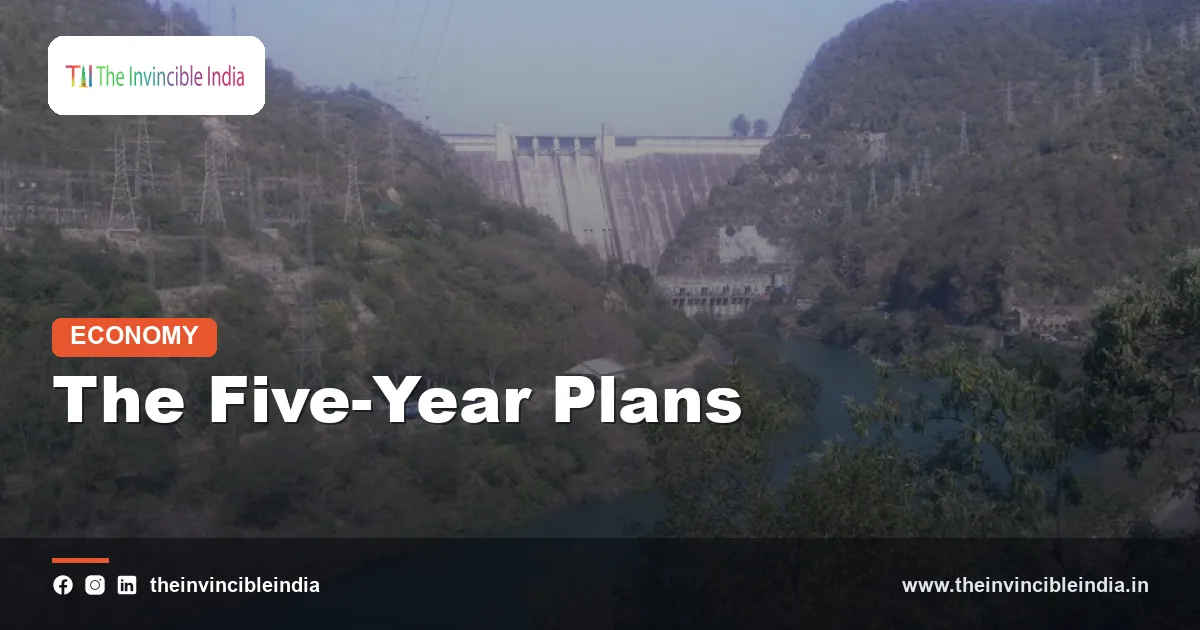
The Five-Year Plans were the backbone of India’s economic policy for more than six decades. From 1951 to 2017, the Government of India drew up a series of medium-term blueprints that set out how much the country would save and invest, which sectors would get priority, and what growth and welfare outcomes it hoped to achieve. Borrowing the idea of centralised planning from the Soviet Union, but adapting it to a democratic, mixed-economy setting, India used these plans to build dams, steel mills, power stations and research institutions at a time when private capital was scarce.
Understanding the Five-Year Plans is essential for anyone studying Indian history, polity or economics, because they explain why India built a large public sector, why it later struggled with the licence-permit system, and why the reforms of 1991 were such a turning point. This guide explains who made the plans, what each plan tried to do, how they performed, and why the system was finally replaced by NITI Aayog.
Quick Facts
| Item | Details |
|---|---|
| Period of Five-Year Plans | 1951 to 2017 (twelve plans, with some gaps filled by annual plans) |
| Formulating body | Planning Commission, set up in March 1950 |
| Approving body | National Development Council (NDC), set up in 1952 |
| Chairperson of the Commission | The Prime Minister of India |
| First Five-Year Plan | 1951-56, focused on agriculture, irrigation and power |
| Second Five-Year Plan | 1956-61, based on the Mahalanobis model and heavy industry |
| Last Five-Year Plan | Twelfth Plan, 2012-17 |
| Successor institution | NITI Aayog, which replaced the Planning Commission on 1 January 2015 |
What Were the Five-Year Plans?
A Five-Year Plan was a national document that laid out the government’s economic priorities for a five-year period. It estimated the resources available, divided public spending among sectors such as agriculture, industry, transport, power, education and health, and fixed targets for growth, employment and output. The Centre prepared the main framework, and states drew up their own plans that fitted within it.
The idea was borrowed from the Soviet Union, whose first Five-Year Plan began in 1928. India did not copy the Soviet model wholesale. It kept a democratic political system, protected private property and allowed private enterprise to coexist with a growing public sector. This blend came to be called the mixed economy.
Why planning appealed in 1950
- India had just emerged from colonial rule with low incomes, very low savings and an economy heavily dependent on farming.
- Private capital was thin and could not be trusted to build large infrastructure quickly.
- The Great Depression and the wartime experience had weakened faith in unregulated markets.
- The Soviet Union’s rapid industrialisation was widely admired by Indian leaders and economists.
Origins of economic planning in India
Planning was discussed in India well before Independence. In 1934, the engineer-statesman M. Visvesvaraya published “Planned Economy for India”, which argued for a ten-year plan to double national income. In 1938, the Indian National Congress, then under Subhas Chandra Bose, set up the National Planning Committee, with Jawaharlal Nehru as its chairman, to chart a path for industrial development.
Several other blueprints followed in the 1940s. The Bombay Plan of 1944, drawn up by a group of leading industrialists, called for heavy state involvement in basic industries and infrastructure. The Gandhian Plan stressed village industries and decentralised development, while M. N. Roy’s People’s Plan drew on socialist ideas. None of these was officially adopted, but together they created a climate in which planning was seen as natural after 1947. The Constitution’s Directive Principles of State Policy also pushed the government toward reducing inequality and securing livelihoods for citizens.
The Planning Commission and the National Development Council
The Planning Commission was set up in March 1950 by a resolution of the Union Cabinet. It was neither a constitutional body nor a statutory one created by Parliament; it was an executive creation. The Prime Minister served as its chairperson, while a Deputy Chairman, usually a senior political figure or economist, handled day-to-day work and was treated as having cabinet-level standing. The Commission also had full-time members who looked after subjects such as agriculture, industry, health and education.
What the Commission did
- Assessed the country’s material, capital and human resources.
- Prepared the draft of each Five-Year Plan and suggested how resources should be used best.
- Recommended allocations to Central ministries and states, and guided the preparation of state plans.
- Reviewed progress and recommended changes during implementation.
The National Development Council
The National Development Council was formed in 1952 to bring the states into the planning process. It included the Prime Minister, Union Cabinet ministers, Chief Ministers of all states and members of the Planning Commission. A draft plan went to the NDC for approval before being placed before Parliament. Because the NDC was also an extra-constitutional body, critics sometimes called it a “super cabinet”. Its role in India’s federal bargaining on resources was nevertheless important.
The Economic Models Behind the Plans
Each plan rested on a theory of how growth could be achieved. Two models are especially important in the Indian story.
The Harrod-Domar model
The First Plan relied on the Harrod-Domar growth model, developed by the economists Roy Harrod and Evsey Domar. In simple terms, the model says that the rate of growth depends on how much a country saves and invests, and on how productively that capital is used. If India raised its savings and investment rate, it could expect a faster growth of national income. This pushed planners to focus on mobilising savings and building productive capacity.
The Mahalanobis model
The Second Plan was shaped by the statistician Prasanta Chandra Mahalanobis, founder of the Indian Statistical Institute. Drawing on ideas from the Soviet economist G. A. Feldman, he proposed a model that divided the economy into a capital goods sector and a consumer goods sector. His argument was that, in the long run, India would grow fastest if it invested heavily in the capital goods sector, meaning machinery, steel and heavy industry, rather than in consumer goods. India would then not depend on imported machines. This model gave the Second Plan its strong industrial and public-sector character and influenced policy for decades.
The First Five-Year Plan (1951-56)
Launched in April 1951, the First Plan came at a time of crisis. Partition had disrupted production and trade, food was in short supply, and inflation was a worry. The plan therefore put agriculture, irrigation and power first, along with rehabilitation of refugees. It followed the Harrod-Domar approach and was a modest, mostly public-investment programme.
Key features
- Large irrigation and multipurpose river valley projects, including Bhakra-Nangal, Hirakud and the Damodar Valley schemes.
- The Community Development Programme, launched in 1952, to improve rural life through village-level planning.
- Investment in power generation, transport and basic social services.
- Establishment of institutions such as the first Indian Institute of Technology at Kharagpur in 1951.
Speaking at the Bhakra project, Nehru described big dams and industrial works as the “temples of modern India”, a phrase that captured the spirit of the age. The First Plan is usually regarded as a success, because actual growth exceeded the modest target that was set, helped by good monsoons and recovery from post-Partition disruption.
The Second Five-Year Plan (1956-61)
The Second Plan marked a decisive turn toward industrialisation. Guided by the Mahalanobis model, it gave top priority to heavy and capital goods industries, and the Industrial Policy Resolution of 1956 reserved key sectors for the state. The public sector was expected to occupy the “commanding heights” of the economy.
Highlights
- Three major public-sector steel plants were set up at Bhilai, Rourkela and Durgapur, with assistance from the Soviet Union, West Germany and the United Kingdom respectively.
- Greater investment in coal, power, railways and machine-building.
- Expansion of scientific and technical education and research bodies.
The plan’s ambition strained the economy. Heavy imports of machinery and raw materials drew down foreign exchange reserves, and India faced a balance-of-payments crunch by 1957-58, forcing the government to cut back some programmes and seek foreign aid. Agriculture received less attention than its importance deserved, a gap that would hurt later. Even so, the plan created an industrial base that many later industries relied on.
The Third Plan and the Plan Holiday (1961-69)
The Third Plan (1961-66) aimed at a “self-reliant and self-generating” economy and gave importance to both agriculture and industry. Soon after it began, it was hit by a series of shocks. The Sino-Indian War of 1962 forced a sharp rise in defence spending, the Indo-Pakistani War of 1965 added to the burden, and severe droughts in 1965 and 1966 damaged farm output and food supplies. Inflation rose and growth fell far short of the target.
The three Annual Plans
Because of the crises, the Government decided not to launch a Fourth Plan immediately. Instead, India followed three Annual Plans for 1966-67, 1967-68 and 1968-69. This period is known as the “Plan Holiday”. The rupee was devalued in June 1966 under economic pressure, and the country faced its worst food shortages in years.
The holiday did, however, see the beginning of the Green Revolution. High-yielding varieties of wheat and rice, wider use of fertilisers and irrigation, and support institutions such as the Food Corporation of India and the Agricultural Prices Commission, both set up in 1965, started to transform food production in Punjab, Haryana and western Uttar Pradesh. India gradually moved away from dependence on food imports.
The Fourth to Seventh Plans and the Rolling Plan
Fourth Plan (1969-74)
The Fourth Plan pursued “growth with stability” and self-reliance. The nationalisation of major banks in 1969 brought credit under greater public control, and the 1971 refugee influx from East Pakistan put heavy strain on resources. Actual growth again fell short of what was planned.
Fifth Plan (1974-79)
The Fifth Plan placed the removal of poverty (Garibi Hatao) and self-reliance at its centre and included a Minimum Needs Programme to provide basic services such as primary education, drinking water and rural health. The Janata government that took office in 1977 ended it a year early, in 1978.
The Rolling Plan
The Janata government introduced a Rolling Plan for 1978-80. Under this system, the plan was revised every year, with each year’s plan added forward on a rolling basis, giving more flexibility than a fixed five-year framework. The Rolling Plan was dropped when the Congress returned to power in 1980.
Sixth and Seventh Plans
The Sixth Plan (1980-85) laid emphasis on poverty alleviation, with programmes such as the Integrated Rural Development Programme and the National Rural Employment Programme, along with efforts at modernisation and energy. The Seventh Plan (1985-90) stressed food, work and productivity, encouraged technology upgrading and gave more room for the private sector. India recorded comparatively strong growth in this decade, but also began to build up fiscal and external imbalances that would surface in 1991.
The Liberalisation Era: Eighth to Twelfth Plans
Political instability meant that annual plans were used again in 1990-91 and 1991-92. The balance-of-payments crisis of 1991 then triggered far-reaching economic reforms, and the Eighth Plan (1992-97) was designed in this new setting. It signalled a shift from rigid, directive planning toward what was described as indicative planning, in which the government set broad directions and created incentives while markets and private firms did more of the work. The plan emphasised human development, employment and modernisation, and growth turned out to be higher than the target.
Later plans
- Ninth Plan (1997-2002): growth with social justice and equity.
- Tenth Plan (2002-07): a higher growth ambition, with specific targets for poverty, literacy and health.
- Eleventh Plan (2007-12): “faster and more inclusive growth”.
- Twelfth Plan (2012-17): “faster, more inclusive and sustainable growth”.
The Twelfth Plan was the last Five-Year Plan. By then, the private sector accounted for the larger share of investment, and public-sector planning had a much smaller role than in the early decades.
The Five-Year Plans at a Glance
| Plan | Years | Main Focus |
|---|---|---|
| First | 1951-56 | Agriculture, irrigation, power; Harrod-Domar model |
| Second | 1956-61 | Heavy industry, public-sector steel plants; Mahalanobis model |
| Third | 1961-66 | Self-reliant economy; disrupted by wars and drought |
| Annual Plans | 1966-69 | Plan Holiday; start of the Green Revolution |
| Fourth | 1969-74 | Growth with stability and self-reliance |
| Fifth | 1974-79 | Garibi Hatao; minimum needs; ended early in 1978 |
| Rolling Plan | 1978-80 | Flexible yearly revision of plans |
| Sixth | 1980-85 | Poverty alleviation, rural employment, modernisation |
| Seventh | 1985-90 | Food, work and productivity; technology |
| Eighth | 1992-97 | Liberalisation, indicative planning, human development |
| Ninth | 1997-2002 | Growth with social justice and equity |
| Tenth | 2002-07 | Higher growth with social targets |
| Eleventh | 2007-12 | Faster and more inclusive growth |
| Twelfth | 2012-17 | Faster, more inclusive and sustainable growth |
Targets Versus Achievements
Judging the plans by their stated targets gives a mixed picture. Some plans, notably the First and the Eighth, achieved growth above what had been projected. Others, such as the Third and the Fourth, fell well short because of wars, droughts and external shocks. The Second Plan roughly met its target for national income but created problems of foreign exchange and inflation.
In the early decades, India’s growth was modest, a pattern that the economist Raj Krishna described as the “Hindu rate of growth”. Growth picked up in the 1980s and moved to a significantly higher level after the reforms of the 1990s and 2000s. Over the long run, the plans left behind real achievements: a diversified industrial base, large irrigation and power capacity, a network of scientific and technical institutions, near self-sufficiency in foodgrains after the Green Revolution, and gains in literacy and life expectancy. At the same time, poverty reduction was slower than hoped, and regional and social inequalities remained.
Why the Five-Year Plans Ended: From Planning Commission to NITI Aayog
By the 2010s, the case for centralised planning had weakened. The economy was far more open and the private sector far larger. States were demanding greater autonomy and the one-size-fits-all approach of a central body seemed outdated. Critics also pointed out that the Planning Commission, an extra-constitutional body, held substantial influence over state funds without being accountable to Parliament in the way a ministry would be.
The 2014-15 changes
- In August 2014, the Prime Minister announced from the Red Fort that the Planning Commission would be replaced by a new institution.
- On 1 January 2015, the National Institution for Transforming India, or NITI Aayog, was established through a Cabinet resolution.
- NITI Aayog works as a policy think-tank and advisory body, with a Governing Council that includes Chief Ministers, promoting what is called cooperative federalism.
- It does not allocate funds to ministries or states in the way the Planning Commission did; that role rests with the Finance Ministry and the Finance Commission.
The Twelfth Plan ended in March 2017, and no Thirteenth Plan followed. NITI Aayog instead prepares long-term vision documents, strategy papers and shorter action agendas, in place of rigid, fixed-period targets.
Legacy and Criticisms
The Five-Year Plans shaped the structure of modern India’s economy. They helped build public-sector giants in steel, coal, power, oil, heavy engineering and banking, and they laid the foundations of scientific and technological capacity, including atomic energy and space research. They also embodied the aim of self-sufficiency, which gave Indian industry and agriculture room to grow behind protective walls.
Common criticisms
- The licence-permit system: Controls such as industrial licensing under the Industries (Development and Regulation) Act, 1951, were blamed for delays, inefficiency and limited competition.
- Underperforming public enterprises: Many state-run firms were criticised for low returns and overstaffing.
- Neglect of agriculture and basic education: Especially in the Second Plan, critics argue that too much stress on heavy industry came at the expense of farming and mass education.
- Centralisation: States often felt that they had limited say in decisions that affected them.
Defenders reply that planning was a reasonable response to the conditions of its time, and that private capital alone could not have built India’s infrastructure and institutional base so quickly. The reforms of 1991 reduced controls but did not erase the public-sector and welfare inheritance of the planning era.
Conclusion
From the First Plan’s dams and canals to the Second Plan’s steel plants, and from the Plan Holiday’s seeds of the Green Revolution to the indicative planning of the reform decades, the Five-Year Plans trace the arc of India’s economic thinking. They show a young republic experimenting with how far the state should lead development and how far it should leave things to the market. With the Planning Commission replaced by NITI Aayog in 2015 and the Twelfth Plan closing in 2017, planning in India moved from command and allocation toward advice, coordination and strategy. The legacy, both good and bad, continues to inform debates on public spending, industrial policy and federalism today.
Frequently Asked Questions
When did the first Five-Year Plan begin in India?
The First Five-Year Plan began in April 1951 and ran until 1956. It focused on agriculture, irrigation and power, and followed the Harrod-Domar growth model. It is generally regarded as a success because growth exceeded the modest target.
Which was the last Five-Year Plan of India?
The Twelfth Five-Year Plan, covering 2012 to 2017, was the last. Its theme was faster, more inclusive and sustainable growth. No Thirteenth Plan was launched after the Planning Commission was dissolved.
Who approved the Five-Year Plans?
The Planning Commission drafted each plan, and the National Development Council, which includes the Prime Minister, Union ministers and Chief Ministers, approved it. The plan was then presented to Parliament. The Planning Commission itself was set up in March 1950 and the NDC in 1952.
What was the Mahalanobis model?
The Mahalanobis model, proposed by the statistician P. C. Mahalanobis, argued that India should invest heavily in capital goods and heavy industry to achieve rapid long-term growth and reduce import dependence. It shaped the Second Five-Year Plan (1956-61) and led to the creation of public-sector steel plants at Bhilai, Rourkela and Durgapur.
What was the Plan Holiday in India?
The Plan Holiday refers to the period from 1966 to 1969, when India followed three Annual Plans instead of a full Five-Year Plan. It followed the wars of 1962 and 1965, severe droughts and an economic crisis. It was also the period in which the Green Revolution began.
Why was the Planning Commission replaced by NITI Aayog?
The government felt that centralised, top-down planning no longer suited a more open, market-oriented economy and a federal structure where states wanted more say. NITI Aayog, created on 1 January 2015, works as a think-tank that offers strategy and advice and encourages cooperation between the Centre and states, rather than allocating funds.


