

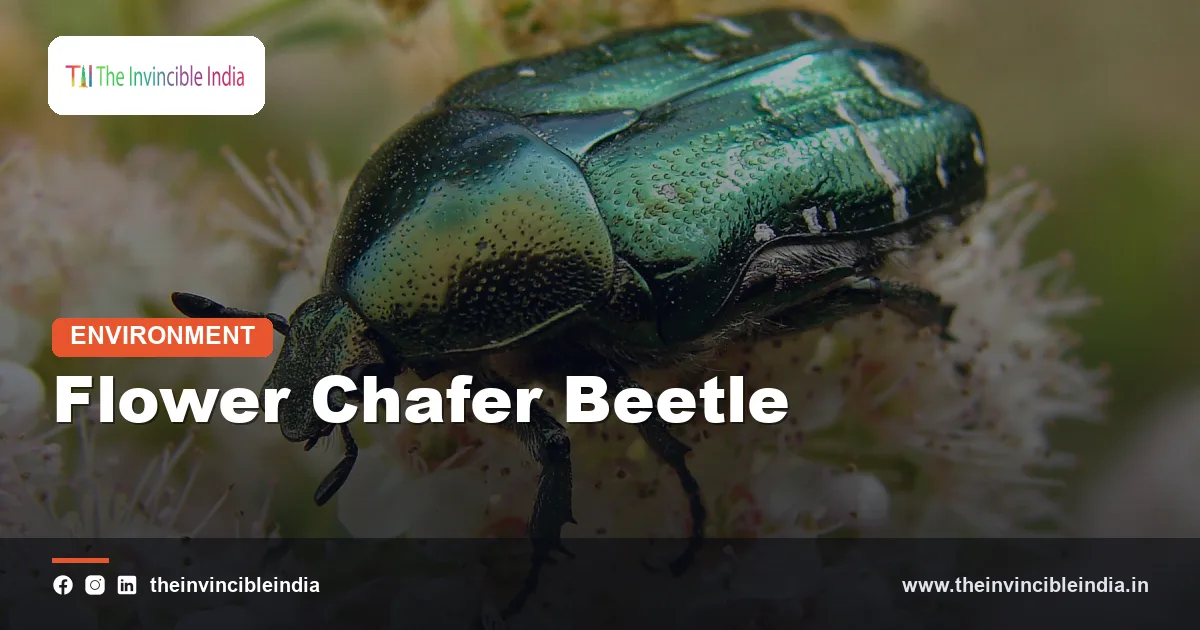
The flower chafer is a stout, often metallic or boldly patterned scarab beetle of the subfamily Cetoniinae that feeds on flowers, nectar, pollen and ripe fruit, and whose plump grubs live in compost, rotting wood and manure across India. Adults are most often noticed in the monsoon and post-monsoon months, when they fly heavily to blossoms and sometimes bumble against windows and lamps.
The flower chafer is a good example of an insect with two very different lives. As an adult it is a flower visitor and a minor pollinator, and sometimes a nuisance in orchards and rose gardens. As a grub it is a recycler that turns dead plant material into fine, nutrient-rich soil. This article explains how to recognise a flower chafer, how it lives and why it matters.
| Quick Facts | Details |
|---|---|
| Common name | Flower chafer (also called flower beetle or fruit chafer) |
| Scientific classification | Order Coleoptera, family Scarabaeidae, subfamily Cetoniinae; Indian examples include Protaetia, Oxycetonia and Chiloloba species |
| Size | Adults commonly about 1 to 3 cm long, depending on the species |
| Habitat in India | Gardens, orchards, farmland edges, scrub and forests, with grubs in compost heaps, rotting wood, leaf litter and manure |
| Adult diet | Pollen, nectar, petals, tree sap and ripe or fermenting fruit |
| Larval diet | Decaying plant matter, humus and rotting wood |
| Life cycle | Complete metamorphosis: egg, three larval stages, pupa in a soil cocoon, adult; often about a year per generation |
| Ecological role | Pollinator, decomposer and soil enricher; occasional minor pest of flowers and fruit |
Key Takeaways
- The flower chafer is a scarab beetle of the subfamily Cetoniinae, and adults typically measure about 1 to 3 centimetres in length with a stout, flattened, often shiny body.
- Adult flower chafers feed on pollen, nectar, petals, sap and ripe fruit, and in doing so they carry pollen between flowers.
- Flower chafer grubs live in compost, rotting wood and manure, where they break down dead plant material into nutrient-rich humus.
- Flower chafer grubs are famous for crawling on their backs, a habit that distinguishes them from the grubs of most other scarab beetles.
- Flower chafers fly with their hardened wing covers closed, using only the hind wings through gaps at the sides, which gives them a distinctive buzzing flight.
- The flower chafer is generally harmless and useful, though adults can damage petals and fruit when they gather in large numbers.
What is a flower chafer beetle?
A flower chafer beetle is a medium-sized, thick-bodied scarab beetle that visits flowers and fruit as an adult, and belongs to the subfamily Cetoniinae of the family Scarabaeidae. The word “chafer” is an old English term for a type of leaf- or flower-feeding scarab beetle.
The family Scarabaeidae is one of the largest beetle families, with a huge range of forms including dung beetles, rhinoceros beetles, cockchafers and flower chafers. Members share a clubbed antenna made of flat plates that can be spread like a fan, and they share a rounded, robust build. Flower chafers are the group that has taken most strongly to feeding on blossoms.
The group includes some of the most beautiful insects in the world, with metallic greens, coppery tones, bronze and cream-spotted patterns. In India, flower chafers appear in many colour forms, from dark and velvety species to iridescent green ones. This variety causes frequent confusion with other scarabs.
How do you identify a flower chafer?
A flower chafer is identified by its broad, flattened back, its short, clubbed antennae and its habit of flying with the wing covers closed. The upper surface is usually smooth and shiny, with a metallic or patterned finish, and the body is often wedge-shaped when seen from above.
Body shape and colour
The head is small and often has a shovel-like front edge, used to push into flower heads and soil. The thorax and wing covers (elytra) are broad and smooth, sometimes marked with pale spots, bands or streaks. Many species have a metallic green, bronze or coppery surface, while others are brown, black or mottled.
Flight
Flower chafers fly in an unusual way. Most beetles lift their hard wing covers up and out to the side before opening the hind wings. A flower chafer keeps the wing covers closed and slips the hind wings out through notches along their edges. This gives the beetle a lower, more streamlined flight profile and is one of the easiest ways to recognise the group in the field.
Other beetles that look similar
Several other beetles share some features, so it helps to compare them.
| Beetle | Group | How it differs from a flower chafer |
|---|---|---|
| Flower chafer | Cetoniinae | Broad flattened back, flies with wing covers closed, visits flowers and fruit |
| Rhinoceros beetle | Dynastinae | Larger and heavier, males have a horn on the head, adults feed on palm tissue and sap |
| Dung beetle | Scarabaeinae | Rounded, dull-coloured, associated with dung, rolls or buries dung balls |
| Leaf chafer | Rutelinae | More arched back, often feeds on leaves at night, lifts wing covers to fly |
| Cockchafer or white grub beetle | Melolonthinae | Typically brown, attracted to lights, grubs feed on plant roots |
Where do flower chafers live in India?
Flower chafers live throughout India in gardens, orchards, farmland margins, scrub and forests, wherever there are flowering plants for adults and decaying plant matter for grubs. They are found from the plains to many hill regions, and several species are common around human settlements.
Adults are strong flyers and travel considerable distances between flowering trees. They are especially common near mango, neem, rose, jasmine and other flowering plants during their seasons. They also gather at fruiting trees, where ripe and fermenting fruit attracts them.
Grubs live in sheltered, humid places that hold decaying plant material. Typical habitats include compost heaps, manure pits, rotting stumps and logs, leaf litter and the base of old trees. Because compost bins and farmyard manure heaps provide a good home, flower chafers are common wherever such material accumulates.
Many species are most active in the rainy season and the weeks following it, when humidity is high, flowers are plentiful and soil is moist. In the cooler or drier months the adults may be scarce, while the grubs continue to develop quietly underground.
What do flower chafers eat?
Adult flower chafers eat pollen, nectar, petals, tree sap and ripe or fermenting fruit, while their grubs eat decaying plant matter and humus. The adults are therefore flower visitors and fruit feeders, and the grubs are decomposers.
Adult diet
- Pollen and nectar: Adults push their heads into the centre of open, bowl-shaped flowers to reach pollen and nectar.
- Petals and flower parts: Some species chew petals, anthers or flower buds, which can spoil roses and other ornamentals.
- Tree sap: Beetles gather at oozing wounds on tree trunks, where sap flows.
- Ripe and fermenting fruit: Mangoes, bananas, guavas and other soft fruits that have split or fallen attract them.
Larval diet
Grubs feed on dead and decaying plant matter such as rotting wood, leaf litter, compost and well-rotted manure. They usually avoid living roots, which separates them from the destructive white grubs of some other scarabs. Their feeding speeds decomposition and produces fine droppings that enrich soil.
What is the life cycle of a flower chafer?
The life cycle of a flower chafer has four stages, egg, larva, pupa and adult, and in many species a full generation takes about a year, although warm climates may allow shorter cycles. Flower chafers undergo complete metamorphosis, as do all beetles.
Egg
The female lays small, whitish, oval eggs in decaying organic matter such as compost, manure or rotten wood. She burrows into the material to place the eggs in a protected, moist spot. The eggs hatch in a couple of weeks.
Larva
The larva is a plump, creamy-white, C-shaped grub with a brown head and three pairs of short legs. It passes through three stages, called instars, growing considerably in each. This stage lasts several months and is the main period of feeding and growth.
Pupa
When fully grown, the larva builds a rounded cocoon from soil particles, droppings and plant fragments, held together with secretions. Inside it changes into a pupa, which gradually forms the adult beetle. The pupal stage lasts a few weeks.
Adult
The adult leaves the cocoon, hardens its wing covers and takes to the air to feed and mate. Adults typically live for a few weeks to a few months. Females then return to suitable decaying material to lay eggs, closing the cycle.
| Stage | Appearance and activity | Typical duration |
|---|---|---|
| Egg | Small, pale, laid in compost or rotting wood | About two weeks |
| Larva (three instars) | C-shaped white grub, feeds on decaying matter | Several months |
| Pupa | Inside a soil cocoon | A few weeks |
| Adult | Flying beetle that feeds on flowers and fruit | Weeks to a few months |
These durations vary with species, temperature and food supply. In cooler regions the larval stage can be much longer.
Why do flower chafer grubs crawl on their backs?
Flower chafer grubs crawl on their backs because their legs are short and weak and their bodies are covered with stiff bristles that grip the surface, so rolling over lets them move faster than walking on their legs. The habit is a well-known trait of Cetoniinae larvae and is easily observed in a compost heap.
When a grub is placed on a flat surface, it turns onto its back and moves forward by rippling the muscles of its body, using the rows of bristles on its back as tiny feet. Its short legs wave in the air. The movement may look comical, but it is reasonably quick.
Scientists think this style of movement suits life in loose, rotting material, where the grub must push and wriggle through tight spaces. Back-crawling is a simple way to tell a flower chafer grub from the grub of a rhinoceros beetle or a cockchafer, which walk on their legs and are usually curved and less hairy on the back.
Are flower chafers useful or harmful?
Flower chafers are mostly useful, because they pollinate flowers and their grubs break down dead plant matter, but adults can be minor pests when they gather in numbers on flowers and fruit. The balance depends on the species, the crop and the numbers present.
Benefits
- Pollination: By crawling over open flowers, the beetles carry pollen. Beetles are among the oldest pollinators, and many ancient flowering plants are adapted to beetle visits.
- Decomposition: Grubs convert rotting wood, leaf litter and compost into fine humus, returning nutrients to the soil.
- Food web: Birds, lizards, rodents, ants and other predators eat adults, grubs and pupae.
- Compost quality: Gardeners often find the grubs thriving in healthy compost, a sign of good organic content.
Problems
- Adults may chew petals, buds and anthers of ornamentals such as roses.
- Large groups can damage the blossoms of some fruit trees and cereals at flowering time.
- Ripe fruit may be spoiled when beetles feed on it.
Such damage is usually limited and local. Hand-picking and netting are often enough, and the chemical sprays sometimes used against beetles also kill bees, butterflies and other pollinators that are more valuable to gardens.
How can you tell a flower chafer grub from a pest grub?
A flower chafer grub can be told from a pest white grub by its back-crawling, its hairy back and its presence in decaying matter rather than around living plant roots. Correct identification matters because gardeners often destroy harmless compost grubs by mistake.
- Flower chafer grubs live in compost, manure and rotting wood; pest white grubs live in soil among plant roots.
- Flower chafer grubs crawl on their backs when placed on a flat surface; pest white grubs mostly struggle on their sides and curl up.
- Flower chafer grubs have a plump body with rows of short bristles on the upper side; many pest grubs have a smoother back.
- Flower chafer grubs seldom damage living plants; pest white grubs can kill seedlings and crops by eating roots.
When grubs are found in a compost heap or rotting log, it is best to leave them alone. They are doing useful work, and removing them offers no benefit to the garden.
How can you live with flower chafers?
You can live with flower chafers by encouraging their useful stages and limiting damage with simple, non-chemical steps. They are rarely a serious threat, and a modest tolerance is rewarded by free pollination and compost improvement.
- Keep a compost heap or a pile of rotting leaves and logs so that grubs have a place to develop.
- Avoid broad-spectrum insecticides, which harm pollinators and natural predators along with the beetles.
- Collect adults by hand from prized flowers in the cool of the morning, when they are sluggish.
- Protect special blooms with light netting during peak beetle weeks.
- Pick up fallen and overripe fruit to reduce the attraction for adults.
Observation itself is rewarding. A flower chafer on a bloom is a close-up view of how plants and animals co-operate, and children often find the back-crawling grubs a memorable introduction to insect life cycles.
Bottom Line
The flower chafer is a heavy, handsome beetle whose two lives, as a flower visitor and as a compost grub, tie together pollination and decomposition. It is mostly harmless and often helpful, with only limited damage to flowers and fruit. Learning to recognise it and its back-crawling grub helps gardeners protect a useful part of their local ecosystem.
Frequently Asked Questions
What is a flower chafer?
A flower chafer is a stout scarab beetle of the subfamily Cetoniinae that feeds on flowers, sap and ripe fruit as an adult. Its grubs live in compost, rotting wood and manure. Adults are typically about 1 to 3 centimetres long and often have a shiny or metallic upper surface.
What do flower chafers eat?
Adult flower chafers eat pollen, nectar, petals, tree sap and ripe or fermenting fruit. Their grubs eat decaying plant matter such as rotting wood, leaf litter and compost. The grubs usually do not attack the roots of living plants.
Are flower chafers harmful to plants?
Flower chafers are mostly harmless, although adults can damage petals, buds and ripe fruit when many gather together. The damage is usually limited and local. The beetles also provide benefits as pollinators and as decomposers in the larval stage.
Why do flower chafer grubs crawl on their backs?
Flower chafer grubs crawl on their backs because their legs are short and weak and stiff bristles on their upper surface grip the ground. By rolling over, they can move faster and more easily through loose, rotting material. This habit is a quick way to tell them from other beetle grubs.
How long does a flower chafer live?
A flower chafer spends most of its life as a grub, and a full generation often takes about a year. The adult stage lasts only a few weeks to a few months. Timing varies with species, temperature and food supply.
Are flower chafers the same as rhinoceros beetles?
Flower chafers are not the same as rhinoceros beetles, although both belong to the scarab family Scarabaeidae. Rhinoceros beetles are larger, belong to a different subfamily and the males bear a horn on the head. Flower chafers have a flatter, broader back and visit flowers and fruit rather than feeding on palm tissue.
{“@context”:”https://schema.org”,”@graph”:[{“@type”:”FAQPage”,”mainEntity”:[{“@type”:”Question”,”name”:”What is a flower chafer?”,”acceptedAnswer”:{“@type”:”Answer”,”text”:”A flower chafer is a stout scarab beetle of the subfamily Cetoniinae that feeds on flowers, sap and ripe fruit as an adult. Its grubs live in compost, rotting wood and manure. Adults are typically about 1 to 3 centimetres long and often have a shiny or metallic upper surface.”}},{“@type”:”Question”,”name”:”What do flower chafers eat?”,”acceptedAnswer”:{“@type”:”Answer”,”text”:”Adult flower chafers eat pollen, nectar, petals, tree sap and ripe or fermenting fruit. Their grubs eat decaying plant matter such as rotting wood, leaf litter and compost. The grubs usually do not attack the roots of living plants.”}},{“@type”:”Question”,”name”:”Are flower chafers harmful to plants?”,”acceptedAnswer”:{“@type”:”Answer”,”text”:”Flower chafers are mostly harmless, although adults can damage petals, buds and ripe fruit when many gather together. The damage is usually limited and local. The beetles also provide benefits as pollinators and as decomposers in the larval stage.”}},{“@type”:”Question”,”name”:”Why do flower chafer grubs crawl on their backs?”,”acceptedAnswer”:{“@type”:”Answer”,”text”:”Flower chafer grubs crawl on their backs because their legs are short and weak and stiff bristles on their upper surface grip the ground. By rolling over, they can move faster and more easily through loose, rotting material. This habit is a quick way to tell them from other beetle grubs.”}},{“@type”:”Question”,”name”:”How long does a flower chafer live?”,”acceptedAnswer”:{“@type”:”Answer”,”text”:”A flower chafer spends most of its life as a grub, and a full generation often takes about a year. The adult stage lasts only a few weeks to a few months. Timing varies with species, temperature and food supply.”}},{“@type”:”Question”,”name”:”Are flower chafers the same as rhinoceros beetles?”,”acceptedAnswer”:{“@type”:”Answer”,”text”:”Flower chafers are not the same as rhinoceros beetles, although both belong to the scarab family Scarabaeidae. Rhinoceros beetles are larger, belong to a different subfamily and the males bear a horn on the head. Flower chafers have a flatter, broader back and visit flowers and fruit rather than feeding on palm tissue.”}}]}]}


