

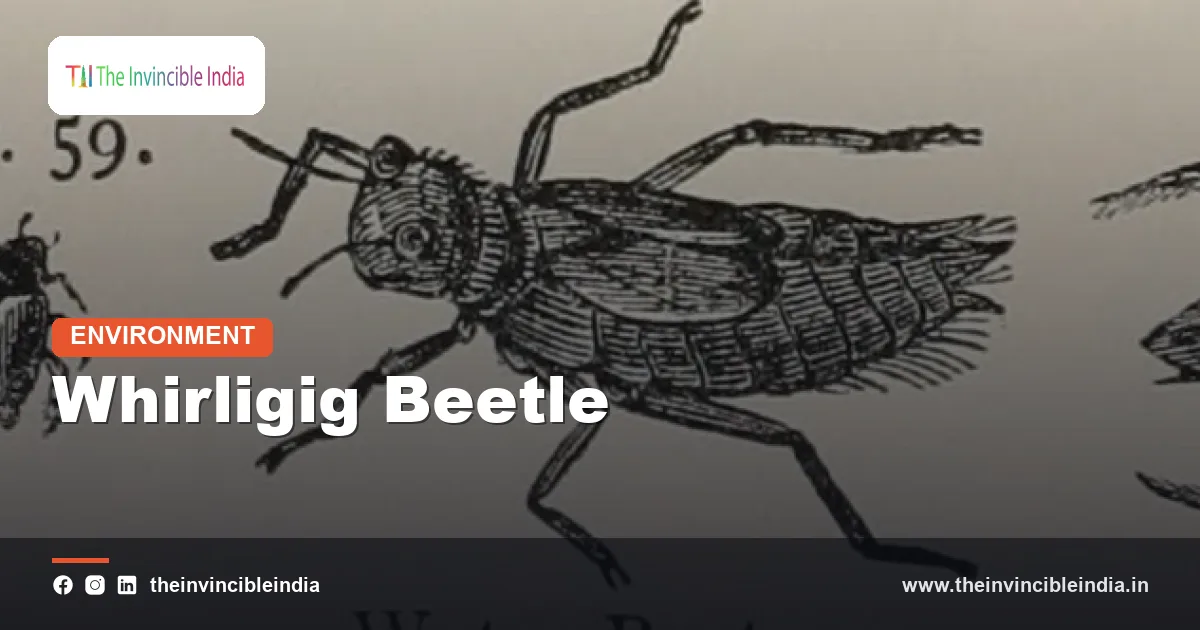
The whirligig beetle is a small, shiny, oval aquatic beetle of the family Gyrinidae that swims in rapid circles in groups on the surface of still and slow-moving water, and its eyes are divided so that one half sees above the water and the other half sees below. In India it is a familiar sight on ponds, ditches, village tanks and quiet pools in streams, where dozens of black dots seem to dance and spin without ever colliding.
The whirligig beetle looks like a simple pond curiosity, but it is a remarkable piece of natural engineering. It sees in two directions at once, senses ripples with its antennae, produces a defensive chemical and can fly, dive and swim. This article explains how to recognise it, how it lives and why its presence says something about the health of water.
| Quick Facts | Details |
|---|---|
| Common name | Whirligig beetle |
| Scientific classification | Order Coleoptera, family Gyrinidae; Indian genera include Dineutus, Gyrinus and Orectochilus |
| Size | Adults roughly 3 to 15 mm long, depending on the species |
| Habitat in India | Ponds, tanks, ditches, canals, slow streams and quiet river pools with clean, still surface water |
| Diet | Adults take small insects that fall onto the water surface; larvae prey on small aquatic animals |
| Eyes | Each eye is divided into an upper part for air and a lower part for water |
| Life cycle | Complete metamorphosis: eggs on water plants, aquatic larvae, pupa in a cocoon near the water edge, adult |
| Ecological role | Surface predator and scavenger, prey for fish and birds, and an indicator of water quality |
Key Takeaways
- The whirligig beetle belongs to the family Gyrinidae, and adults are small, black or dark-bronze beetles roughly 3 to 15 millimetres long that swim on the water surface.
- The eyes of the whirligig beetle are divided into two parts, an upper half for seeing in air and a lower half for seeing underwater.
- The whirligig beetle senses ripples on the water surface with its short, broad antennae, which lets it avoid collisions even in dense groups.
- The whirligig beetle releases a foul-smelling defensive fluid when it is threatened, which makes it unpalatable to many predators.
- Whirligig beetle larvae are aquatic predators with feathery gills along the sides of the abdomen, and they pupate in cocoons on plants at the water edge.
- Adult whirligig beetles can fly, so they readily colonise new ponds, though they are sensitive to oil, detergent and heavy pollution on the surface.
What is a whirligig beetle?
A whirligig beetle is an aquatic beetle of the family Gyrinidae, a small group of water beetles adapted to living on the surface film of calm water. The name describes its habit of spinning in rapid, erratic circles, much like the old toy known as a whirligig.
Gyrinidae belongs to the order Coleoptera, the beetles, which is the largest order of insects. Within the beetles, whirligigs form a specialised family with about a thousand described species worldwide. They are relatives of other water beetles such as diving beetles and water scavenger beetles, but their body plan is distinctive and they live in a different part of the pond.
The common impression that whirligigs are “swimming on” the water is correct. They sit with the upper half of the body in air and the lower half in water, held up by the surface tension of the film. This means that they live at the boundary between two worlds, and almost every part of their body has been adjusted to deal with that.
How do you identify a whirligig beetle?
A whirligig beetle is identified by its oval, streamlined, glossy black body, its habit of swimming in tight groups and the fact that it appears to have four eyes. The adult is compact and boat-shaped, often with a slightly bronze or bluish sheen.
Body
The body is smooth and flattened from above, usually dark and polished. The wing covers are short and expose the tip of the abdomen in some species. The shape lets the beetle slip through water and over its surface with little resistance.
Legs
The front legs are long and slender and are used to grasp prey and food. The middle and hind legs are very short, flattened and fringed with hairs, forming broad paddles. These are beaten at great speed, which drives the beetle forward and allows it to turn sharply.
Eyes
Each compound eye is split into two separate parts, giving the beetle what appears to be four eyes. The upper pair looks up through the air and the lower pair looks down into the water. This arrangement lets the beetle watch for food and enemies from above and from below at the same time.
Similar water insects
Several other pond insects share the surface and may be confused with whirligigs.
| Insect | Group | How it differs from a whirligig beetle |
|---|---|---|
| Whirligig beetle | Gyrinidae | Glossy oval body, swims in circles in groups, divided eyes |
| Water strider | Gerridae (true bugs) | Long legs, skates on the surface without being partly submerged, a bug rather than a beetle |
| Water boatman | Corixidae (true bugs) | Swims underwater with oar-like hind legs, not in circles on the surface |
| Backswimmer | Notonectidae (true bugs) | Swims upside down just under the surface, can bite |
| Diving beetle | Dytiscidae | Larger, swims underwater and comes up to the surface only to breathe |
Why do whirligig beetles swim in circles?
Whirligig beetles swim in circles because their rapid, looping movements help them stay in a group, find food on the surface and confuse predators, while their antennae allow them to avoid collisions. The circles are not random; they are part of a coordinated lifestyle in which each beetle senses its neighbours.
Group living offers several benefits. A large cluster of dark beetles presents many moving targets to a fish or bird, which makes it harder for a predator to single out one animal. This is known as the confusion effect, and it is seen in schools of fish and flocks of birds as well.
Grouping may also reduce the risk to each individual, because with many eyes watching the water and the air, the group detects danger sooner. Beetles at the edge of the group are more exposed, so individuals often shuffle their positions.
The sharp turns are the result of the paddle-like middle and hind legs, which can beat many times per second. A beetle can change direction in a very small space. Even a large group of whirligigs can swirl in tight spaces without crashing, which brings us to their remarkable sensory system.
How do whirligig beetles avoid collisions?
Whirligig beetles avoid collisions by sensing the tiny ripples on the water surface with their antennae, in a way that works much like a simple sonar. Each beetle makes small waves as it swims, and those waves bounce back from obstacles and other beetles.
The antennae are short, stout and unusual. The base segment sits on the water surface while the rest of the antenna is held in the air. Inside the second segment is a delicate sensory organ, called Johnston’s organ, which detects movement of the surface film. By reading these vibrations, the beetle can tell where objects are, even in the dark or in murky water.
This sense allows whirligigs to move in a dense mass without hitting one another, to locate floating prey and to avoid reeds and stones at the water edge. It also helps them to detect the ripples made by struggling insects that have fallen onto the water.
Because the system depends on the smooth surface of the water, it can be disrupted by oil films, soap or detergents, which change surface tension. This is one reason why whirligigs are rare in heavily polluted ponds.
Where do whirligig beetles live in India?
Whirligig beetles live in India in a wide range of clean, still and slow-flowing freshwater habitats, including ponds, village tanks, ditches, canals, marshes and the quiet pools of streams. They are found across the country, from the plains to hill regions, wherever the water surface is calm and unpolluted.
Their favourite places are sheltered, sunlit stretches of open water close to vegetation, which provides cover and sites for egg laying. They are often seen near the edges of ponds where overhanging plants drop insects onto the water. Species of the genus Dineutus tend to be larger and are common in still ponds, while some species of Orectochilus are more active at night and prefer streams.
Many whirligig beetles gather in groups by day and disperse at night. At dusk or after dark, adults may fly to other bodies of water, which is how they colonise newly dug ponds and temporary pools soon after rain. Fast, turbulent water and very shaded or stagnant, polluted pools are generally avoided.
What do whirligig beetles eat?
Whirligig beetles eat small insects and other animals that fall onto or swim near the water surface, and adults are both predators and scavengers. They take mosquitoes, flies, ants and other insects that have been trapped by the surface film, along with dead or dying animals.
The long front legs seize the prey, and the beetle holds it while it chews with its biting mouthparts. Many whirligigs also eat small aquatic invertebrates and, occasionally, the larvae of other insects that come up to the surface. Their feeding on mosquito larvae and pupae may be of some small benefit to people, though they should not be treated as a reliable method of mosquito control.
The larvae are strictly predatory and feed underwater on small invertebrates such as insect larvae, worms and small crustaceans. They use sharp, hollow jaws to hold their prey and to inject digestive fluids.
What is the life cycle of a whirligig beetle?
The life cycle of a whirligig beetle has four stages, egg, larva, pupa and adult, and the eggs and larvae live in water while the pupa is formed on land. Whirligigs undergo complete metamorphosis, and the cycle often takes several weeks to a few months depending on the temperature.
Egg
The female lays small, elongated eggs, often in neat rows, on the stems or leaves of submerged or floating plants. The eggs hatch in about a week, when conditions are warm.
Larva
The larva is a slender, elongated, predatory creature with a pair of strong jaws and a row of feathery gills on each side of the abdomen. These gills give it a centipede-like look. The larva takes oxygen from the water and does not need to come to the surface. It goes through three larval stages.
Pupa
When fully grown, the larva crawls out of the water and builds a small, grey, papery cocoon on a plant stem, a stone or the bank near the water edge. Inside the cocoon it becomes a pupa. After one to a few weeks the adult emerges and goes to the water.
Adult
The adult can live for several months and, in cooler regions, may overwinter in the mud or under debris. Adults mate on the water surface and the cycle starts again. In tropical regions, breeding can continue for much of the year.
| Stage | Where it lives | Main activity |
|---|---|---|
| Egg | On submerged plants | Develops in about a week |
| Larva | Underwater | Hunts small aquatic animals, breathes through gills |
| Pupa | In a cocoon on land or plants near the edge | Transforms into an adult |
| Adult | Water surface and air | Swims in groups, feeds, mates, flies between ponds |
How do whirligig beetles breathe, dive and fly?
Whirligig beetles breathe air through openings along the abdomen, carry a bubble of air when they dive and fly with a pair of folded hind wings. Although they spend most of their lives on water, they are true air-breathing insects that have adapted to an aquatic way of life.
When the beetle dives to escape danger, it takes a silvery bubble of air trapped under the tip of its abdomen. The bubble acts as a small reserve of oxygen and keeps the beetle buoyant, so it must swim downwards actively and often bobs back to the surface quickly. It can stay under for several minutes.
Despite the dominance of water in their lives, whirligigs have fully developed wings under their short wing covers. At night, they can take off from the water surface and fly to new ponds. This ability to disperse explains why they appear within days in new puddles and tanks.
The ability to move between water, air and the water surface is a rare combination and makes the whirligig one of the most versatile of all aquatic insects.
How do whirligig beetles defend themselves?
Whirligig beetles defend themselves by diving, flying away and releasing a foul-smelling milky fluid from glands in the abdomen that makes them distasteful to predators. The chemical defence is so effective that many fish learn to avoid them after a single bad experience.
The secretion has an unpleasant odour, and gently handling a whirligig can leave the smell on the fingers. For the beetle it is a form of chemical warfare. The defence is one reason why whirligigs can sit in the open on the surface of a pond, where fish below and birds above would otherwise find them easy prey.
Some predators still take them. Certain fish, frogs, dragonfly nymphs and birds may eat whirligigs despite the taste, and the larvae and pupae are vulnerable too. Combined with grouping, diving and flight, however, the chemical defence gives adults a high chance of survival.
Why do whirligig beetles matter to people and to ponds?
Whirligig beetles matter because they are part of the food web of freshwater habitats and because their presence suggests clean, calm and unpolluted water. They also illustrate remarkable adaptations that are of interest to biologists and engineers.
- Predators and scavengers: Adults clear dead and trapped insects from the surface, and larvae control small aquatic invertebrates.
- Prey for others: Fish, birds and other animals feed on them, linking surface life to the wider food web.
- Water-quality indicators: Because they depend on an undisturbed surface film, they are scarce in ponds covered by oil, detergents or thick algal scum.
- Scientific value: Their divided eyes and ripple-sensing antennae have been studied by researchers interested in vision and sensory systems.
Whirligigs are harmless to people. They do not bite or sting, and handling them is unnecessary. The best way to enjoy them is to watch quietly from the pond edge, where their group movements can be followed for long periods.
How can you help whirligig beetles?
You can help whirligig beetles by protecting village ponds and tanks, keeping water free of oil, detergent and rubbish, and leaving plants along the margins. Their survival depends mainly on the quality and stillness of the water surface.
- Avoid washing clothes or vehicles with detergent in or near small ponds.
- Prevent oil, fertiliser and pesticide run-off from reaching ponds and tanks.
- Keep a fringe of native water plants and reeds for egg laying and for pupation on the bank.
- Do not introduce fish that eat all the insects in a small garden pond if you want to see insect life.
- Record sightings and share photographs with nature groups to build knowledge of local species.
Community ponds in many Indian villages and towns have been filled in or polluted. Restoring even a small, clean pond often brings whirligigs back within a short time, thanks to their flying ability.
Bottom Line
The whirligig beetle is a tiny but extraordinary insect that lives where air and water meet, sees in two directions at once and navigates by ripples. It is harmless, widespread in clean ponds and tanks, and a good indicator of water quality. Watching a group of whirligigs spin on a quiet pond is one of the simplest ways to appreciate how finely adapted small creatures can be.
Frequently Asked Questions
What is a whirligig beetle?
A whirligig beetle is a small, glossy, oval aquatic beetle of the family Gyrinidae that swims in circles on the surface of calm water. It usually lives in groups. Adults are roughly 3 to 15 millimetres long.
Why do whirligig beetles have four eyes?
Whirligig beetles appear to have four eyes because each compound eye is split into an upper half and a lower half. The upper half sees through the air and the lower half sees underwater. This lets the beetle watch for prey and predators above and below the surface at the same time.
Do whirligig beetles bite or sting?
Whirligig beetles do not sting and are harmless to people. They can nip very lightly if roughly handled, but this is rare. They may release a foul-smelling fluid when disturbed.
What do whirligig beetles eat?
Whirligig beetles eat small insects that fall onto the water surface, along with dead or dying animals. Their larvae hunt small animals underwater. Adults may also take mosquito larvae and pupae near the surface.
Can whirligig beetles fly?
Whirligig beetles can fly, even though they spend most of their time on water. They keep folded hind wings under their short wing covers and fly at night between ponds. This explains how they quickly colonise new pools and tanks.
Are whirligig beetles a sign of clean water?
Whirligig beetles are generally a sign of calm, relatively clean water with an undisturbed surface, although they are not a perfect test. They avoid ponds with oil, detergent or heavy pollution on the surface. Their presence therefore suggests reasonably healthy conditions.
{“@context”:”https://schema.org”,”@graph”:[{“@type”:”FAQPage”,”mainEntity”:[{“@type”:”Question”,”name”:”What is a whirligig beetle?”,”acceptedAnswer”:{“@type”:”Answer”,”text”:”A whirligig beetle is a small, glossy, oval aquatic beetle of the family Gyrinidae that swims in circles on the surface of calm water. It usually lives in groups. Adults are roughly 3 to 15 millimetres long.”}},{“@type”:”Question”,”name”:”Why do whirligig beetles have four eyes?”,”acceptedAnswer”:{“@type”:”Answer”,”text”:”Whirligig beetles appear to have four eyes because each compound eye is split into an upper half and a lower half. The upper half sees through the air and the lower half sees underwater. This lets the beetle watch for prey and predators above and below the surface at the same time.”}},{“@type”:”Question”,”name”:”Do whirligig beetles bite or sting?”,”acceptedAnswer”:{“@type”:”Answer”,”text”:”Whirligig beetles do not sting and are harmless to people. They can nip very lightly if roughly handled, but this is rare. They may release a foul-smelling fluid when disturbed.”}},{“@type”:”Question”,”name”:”What do whirligig beetles eat?”,”acceptedAnswer”:{“@type”:”Answer”,”text”:”Whirligig beetles eat small insects that fall onto the water surface, along with dead or dying animals. Their larvae hunt small animals underwater. Adults may also take mosquito larvae and pupae near the surface.”}},{“@type”:”Question”,”name”:”Can whirligig beetles fly?”,”acceptedAnswer”:{“@type”:”Answer”,”text”:”Whirligig beetles can fly, even though they spend most of their time on water. They keep folded hind wings under their short wing covers and fly at night between ponds. This explains how they quickly colonise new pools and tanks.”}},{“@type”:”Question”,”name”:”Are whirligig beetles a sign of clean water?”,”acceptedAnswer”:{“@type”:”Answer”,”text”:”Whirligig beetles are generally a sign of calm, relatively clean water with an undisturbed surface, although they are not a perfect test. They avoid ponds with oil, detergent or heavy pollution on the surface. Their presence therefore suggests reasonably healthy conditions.”}}]}]}


