

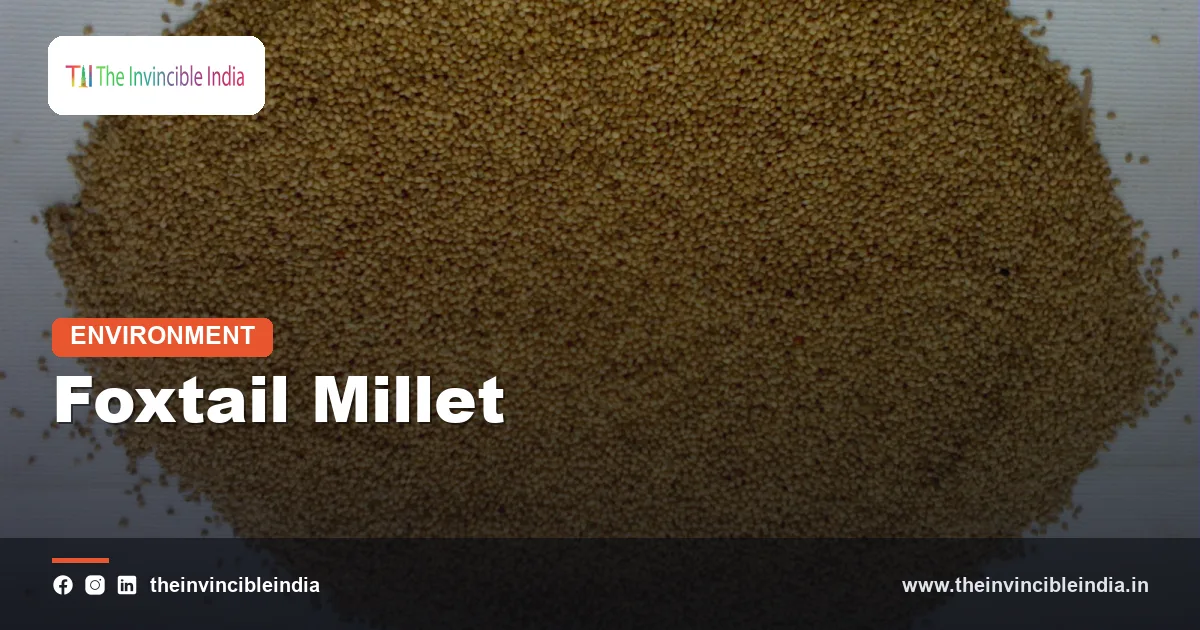
The foxtail millet crop (Setaria italica), known in India as kangni, thinai, korra or navane, is a small-grained, fast-maturing, drought-hardy cereal that is among the oldest cultivated millets in the world and has been grown in India since ancient times. The name comes from its dense, bristly, nodding seed head, which resembles the tail of a fox, and its tiny yellow grains are cooked like rice or ground into flour.
After falling out of everyday use as rice and wheat spread, foxtail millet is being revived as a health food and as a climate-resilient crop for dry land. This explainer covers its origin, plant, growing regions and seasons, cultivation, cooking, nutrition and its place among India’s other small millets.
| Quick Facts: Foxtail Millet | |
|---|---|
| Scientific name | Setaria italica (L.) P. Beauv. |
| Family | Poaceae (the grass family) |
| Local names | Kangni (Hindi), thinai (Tamil), korra (Telugu), navane (Kannada), rala (Marathi) |
| Where grown in India | Mainly Karnataka, Andhra Pradesh, Telangana, Tamil Nadu and Odisha, with smaller areas in Maharashtra, Rajasthan and the hill states |
| Season | Mostly kharif, sown with the monsoon; the crop matures in about 70 to 100 days |
| Part used | Grain (as seed or flour), with the straw used as fodder |
| Products and uses | Rice substitute, upma, khichdi, porridge, flatbread, flakes, fasting food and birdseed |
| Origin | Domesticated from the wild green foxtail, Setaria viridis, in northern China roughly 8,000 years ago |
| Notable facts | Naturally gluten-free; a staple of ancient Tamil literature; widely used as a model plant for studying C4 grasses |
Key Takeaways
- Foxtail millet, with the scientific name Setaria italica, is a small-seeded cereal grass in the family Poaceae and is called kangni in Hindi and thinai in Tamil.
- Foxtail millet is a short-duration crop that matures in roughly 70 to 100 days and grows on poor soils with little rainfall.
- Foxtail millet was domesticated from wild green foxtail in northern China about 8,000 years ago and has been cultivated in India for thousands of years.
- Foxtail millet grain is naturally gluten-free and is cooked like rice, ground into flour or made into porridge and upma.
- Foxtail millet is one of the small millets promoted under India’s nutri-cereal and millet-revival efforts, including the 2023 International Year of Millets.
- Foxtail millet is grown mainly in southern and eastern India, in states such as Karnataka, Andhra Pradesh, Tamil Nadu and Odisha.
What is foxtail millet and why is it called that?
Foxtail millet is a small-grained cereal grass grown for its edible seeds, and it is called foxtail because the ripe seed head is a long, dense, bristly cylinder that droops like a fox’s tail. The plant belongs to the genus Setaria in the grass family and is one of the group known in India as small millets.
Across Indian languages the grain has many names. It is kangni or kakun in Hindi, thinai in Tamil, korra in Telugu, navane in Kannada and rala in Marathi. Internationally it is also known as Italian millet or German millet, although these names reflect only the places where it was later grown as fodder, and not its origin.
The grains are tiny, about two millimetres across, and typically pale yellow, although orange, red and brown forms exist. Each grain is enclosed in a husk, so it must be dehulled before cooking, and the result is a pale yellow rice-like seed that cooks quickly.
Where did foxtail millet come from?
Foxtail millet was domesticated in northern China from a wild grass called green foxtail (Setaria viridis) roughly 8,000 years ago, making it one of the earliest cultivated cereals anywhere. Archaeological finds in the Yellow River valley show it was a staple there long before rice reached the north.
The crop then spread westward across Asia and Europe, and it also reached the Indian subcontinent. Archaeobotanical evidence indicates that millets were being grown in India in the prehistoric period, and in the south the grain called thinai features prominently in ancient Tamil Sangam poetry as a staple of hill and dry-land communities. Foxtail millet therefore has a very long history in both India and the wider world.
A number of landraces developed in different Indian regions, suited to local soils and altitudes. Today India holds a large collection of foxtail millet germplasm in national gene banks, and scientists use it to breed varieties with better yield and disease resistance.
What does the foxtail millet plant look like?
The foxtail millet plant is an erect annual grass about one to one and a half metres tall, with slender stems, narrow leaves and a compact bristly panicle at the top. The panicle can be several centimetres to more than twenty centimetres long and may be erect or drooping, depending on the variety.
Foxtail millet has a fibrous root system and tillers, meaning that it sends up side shoots. The crop uses C4 photosynthesis, an efficient carbon-fixing pathway that makes grasses productive in hot, bright conditions and at low water. This trait is shared with maize, sorghum and sugarcane, and it is one reason scientists treat foxtail millet as a model species for studying how C4 plants grow. The relatively small genome of foxtail millet has also made it useful for research into stress tolerance.
The wild ancestor, green foxtail, is a common weed in many parts of the world, and cultivated and wild forms can cross. Foxtail millet, however, has larger heads, retains its seeds until harvest and has easily dehulled grain, all of which are traits selected by early farmers.
Where and when is foxtail millet grown in India?
Foxtail millet is grown in India mainly in the southern and eastern dry-land belts, with Karnataka, Andhra Pradesh, Telangana, Tamil Nadu and Odisha as major growing states and smaller areas in Maharashtra, Rajasthan and the Himalayan region. In many places it is a traditional crop of tribal and hill farmers.
The main season is kharif, when seed is sown with the arrival of the monsoon in June or July and harvested around September or October. In parts of the south, particularly Tamil Nadu, Karnataka and Andhra Pradesh, a second sowing may be done in other seasons if moisture permits. Because the crop matures quickly, usually in about 70 to 100 days, it fits into short rainy seasons and can be sown late if the first crop fails.
Total area and production of small millets have declined since the 1960s as farmers moved to irrigated rice, wheat and cash crops. Current statistics change every year, so readers should check the latest data from the Ministry of Agriculture and Farmers Welfare for exact figures. What is certain is that foxtail millet remains important locally in dry-land and tribal farming.
How is foxtail millet cultivated?
Foxtail millet is cultivated by sowing very small seed in a fine seedbed, either broadcast or in lines, and it needs little fertiliser, water or care compared with major cereals. It is mostly grown rainfed on light red, sandy and shallow soils that are poor for other crops.
Soil and sowing
The crop prefers well-drained soils and dislikes waterlogging. The seed is so small that it is sown shallow, and a fine, firm seedbed ensures good germination. Seed is often mixed with sand to spread it evenly. Fields are thinned after emergence so that plants are not overcrowded.
Water and nutrients
Foxtail millet uses very little water, and some crops are raised with only the monsoon rainfall. A light application of farmyard manure suits traditional systems, while improved varieties respond to moderate fertiliser. It is often grown in mixed cropping with pulses such as pigeon pea or with oilseeds.
Pests and diseases
The crop is relatively free of serious pests. Blast disease, downy mildew and shoot fly can cause losses in some seasons, and birds are a major threat when the grain ripens. Resistant varieties and timely sowing are the usual defences.
How is foxtail millet cooked and eaten?
Foxtail millet is cooked in the same way as rice, by washing the dehulled grain and boiling it in water until soft, and it can also be ground into flour or made into porridge, upma and khichdi. It takes less time to cook than many millets and has a mild, slightly nutty taste.
Typical preparations include:
- Plain cooked grain served with dal, sambar or vegetable curries as a rice substitute.
- Upma, pongal and khichdi made by replacing rice or semolina with the millet.
- Porridge or kanji, often given to children and convalescents.
- Flour used for rotis, dosa, idli, murukku and sweets such as ladoo.
- Flakes and puffed grain for breakfast and snacks.
In some parts of India, kangni is also eaten during religious fasts as a grain permitted on those days, although fasting customs vary by region and community. The grain is increasingly sold in supermarkets as polished millet, flour and ready-to-cook mixes. Outside human food, the grain and seed heads are a common birdseed ingredient in many countries, and the straw can be used as fodder.
What are the nutritional benefits of foxtail millet?
Foxtail millet is a good source of carbohydrate and contains roughly eleven to twelve per cent protein, along with dietary fibre, iron, calcium in modest amounts and B-group vitamins. Its composition varies with variety and growing conditions, so figures are approximate.
Compared with polished white rice, foxtail millet generally has more fibre, protein and minerals. Studies have reported a lower glycaemic response for millets, and as a result foxtail millet is often recommended as a healthier staple for people managing blood sugar, although individual responses differ and medical advice should guide diet choices. The grain is naturally gluten-free, which makes it an option for people avoiding wheat.
As with other millets, the grain contains natural compounds such as phytates and polyphenols that can limit mineral absorption. Soaking, sprouting and fermenting reduce these compounds. People with thyroid conditions are sometimes advised to eat millets in moderation, so those with specific health concerns should ask a doctor or dietitian.
How does foxtail millet compare with other small millets?
Foxtail millet is one of several small millets grown in India, and it differs from the others in grain size, duration and typical use. The group also includes little millet, kodo millet, barnyard millet, proso millet and finger millet, which is usually counted separately as a major millet. The table below compares some of them.
| Millet | Scientific name | Common Indian name | Notable feature |
|---|---|---|---|
| Foxtail millet | Setaria italica | Kangni, thinai, korra | Bristly fox-tail head; matures in about 70 to 100 days |
| Little millet | Panicum sumatrense | Kutki, samai | Very small grain; tolerant of drought and waterlogging |
| Kodo millet | Paspalum scrobiculatum | Kodo, varagu | Hardy; can cause poisoning if grain is infected by fungus |
| Barnyard millet | Echinochloa frumentacea | Sanwa, kuthiraivali | Fast-growing; commonly used for fasting food |
| Proso millet | Panicum miliaceum | Chena, panivaragu | Very short duration; low water need |
| Finger millet | Eleusine coracana | Ragi, mandua | High calcium content; larger area than other small millets |
Together these crops were once the staple of rainfed India. Their shared strengths are tolerance of drought and poor soil, short duration and low input needs, which is why policy makers promote them as a group.
What role has foxtail millet played in Indian food culture?
Foxtail millet has played the role of an everyday staple grain in dry-land and hill communities of India, serving as the main cereal long before rice and wheat became dominant in many regions. In Tamil tradition, thinai is one of the oldest named grains, and classical poetry links it to the hill and forest landscapes where it was grown.
In village life the grain was pounded in a mortar to remove the husk, cooked into gruel for the morning meal and mixed with milk, jaggery or buttermilk. It was also offered at rituals and festivals in some communities, and tribal farmers in Odisha, Andhra Pradesh and the Eastern Ghats continue to grow it alongside other millets in mixed fields.
The shift in food habits after the Green Revolution, together with subsidised rice and wheat through the public distribution system, reduced everyday millet eating in many households. In recent years chefs, dietitians and farmer groups have revived dishes based on foxtail millet, from savoury pongal to sweet payasam, and small enterprises now sell dehulled grain, flour and snacks. This renewed interest links an old farming heritage with modern concern for balanced diets and sustainable agriculture.
Why is foxtail millet important for climate and farming?
Foxtail millet is important for climate-resilient farming because it matures in about three months, tolerates drought and poor soils and needs few inputs, so it provides food from land that cannot support water-hungry crops. Its short duration lets farmers harvest before a late-season dry spell sets in.
The crop also fits into rotations and mixed cropping systems that spread risk, such as growing it with pulses that fix nitrogen. Its low demand for water and fertiliser reduces both costs and environmental impact. Compared with paddy, foxtail millet generates very little methane and uses a small fraction of the irrigation water.
These strengths underlie government and international attention. India proposed the declaration of 2023 as the International Year of Millets, which the United Nations General Assembly adopted, and national programmes have promoted millet processing, procurement and inclusion in public food schemes. Challenges remain: dehulling requires special machines, the small grain is hard to process at home, and prices for consumers can be higher than for rice. Better processing, local value chains and recipes will decide whether foxtail millet regains a regular place on the plate.
Bottom Line
Foxtail millet is one of the oldest cereals in India and the world, a quick-growing, gluten-free grain that thrives on dry land with little water or fertiliser. Its revival depends on processing, markets and consumer interest as much as on farming.
Frequently Asked Questions
What is foxtail millet called in Hindi?
Foxtail millet is called kangni or kakun in Hindi. In other languages it is thinai in Tamil, korra in Telugu, navane in Kannada and rala in Marathi.
Is foxtail millet good for health?
Foxtail millet is generally considered a nutritious grain. It provides protein, fibre, iron and B vitamins, is naturally gluten-free and usually has a lower glycaemic response than polished rice, though people with medical conditions should follow a doctor’s advice.
Where is foxtail millet grown in India?
Foxtail millet is grown mainly in Karnataka, Andhra Pradesh, Telangana, Tamil Nadu and Odisha. Smaller areas are found in Maharashtra, Rajasthan and the Himalayan states, usually on rainfed dry land.
How long does foxtail millet take to grow?
Foxtail millet takes roughly 70 to 100 days to mature, depending on the variety and season. This short duration is one reason it suits dry regions with brief rainy seasons.
How do you cook foxtail millet?
Foxtail millet is cooked like rice. The washed grain is boiled in about two to three times its volume of water until soft, and it can also be made into upma, porridge, khichdi or flour-based rotis.
Is foxtail millet the same as ragi?
No, foxtail millet and ragi are different crops. Foxtail millet (Setaria italica) is a small yellow-grained millet, while ragi or finger millet (Eleusine coracana) has reddish-brown grain and is particularly rich in calcium.
{“@context”:”https://schema.org”,”@graph”:[{“@type”:”FAQPage”,”mainEntity”:[{“@type”:”Question”,”name”:”What is foxtail millet called in Hindi?”,”acceptedAnswer”:{“@type”:”Answer”,”text”:”Foxtail millet is called kangni or kakun in Hindi. In other languages it is thinai in Tamil, korra in Telugu, navane in Kannada and rala in Marathi.”}},{“@type”:”Question”,”name”:”Is foxtail millet good for health?”,”acceptedAnswer”:{“@type”:”Answer”,”text”:”Foxtail millet is generally considered a nutritious grain. It provides protein, fibre, iron and B vitamins, is naturally gluten-free and usually has a lower glycaemic response than polished rice, though people with medical conditions should follow a doctor’s advice.”}},{“@type”:”Question”,”name”:”Where is foxtail millet grown in India?”,”acceptedAnswer”:{“@type”:”Answer”,”text”:”Foxtail millet is grown mainly in Karnataka, Andhra Pradesh, Telangana, Tamil Nadu and Odisha. Smaller areas are found in Maharashtra, Rajasthan and the Himalayan states, usually on rainfed dry land.”}},{“@type”:”Question”,”name”:”How long does foxtail millet take to grow?”,”acceptedAnswer”:{“@type”:”Answer”,”text”:”Foxtail millet takes roughly 70 to 100 days to mature, depending on the variety and season. This short duration is one reason it suits dry regions with brief rainy seasons.”}},{“@type”:”Question”,”name”:”How do you cook foxtail millet?”,”acceptedAnswer”:{“@type”:”Answer”,”text”:”Foxtail millet is cooked like rice. The washed grain is boiled in about two to three times its volume of water until soft, and it can also be made into upma, porridge, khichdi or flour-based rotis.”}},{“@type”:”Question”,”name”:”Is foxtail millet the same as ragi?”,”acceptedAnswer”:{“@type”:”Answer”,”text”:”No, foxtail millet and ragi are different crops. Foxtail millet (Setaria italica) is a small yellow-grained millet, while ragi or finger millet (Eleusine coracana) has reddish-brown grain and is particularly rich in calcium.”}}]}]}


