

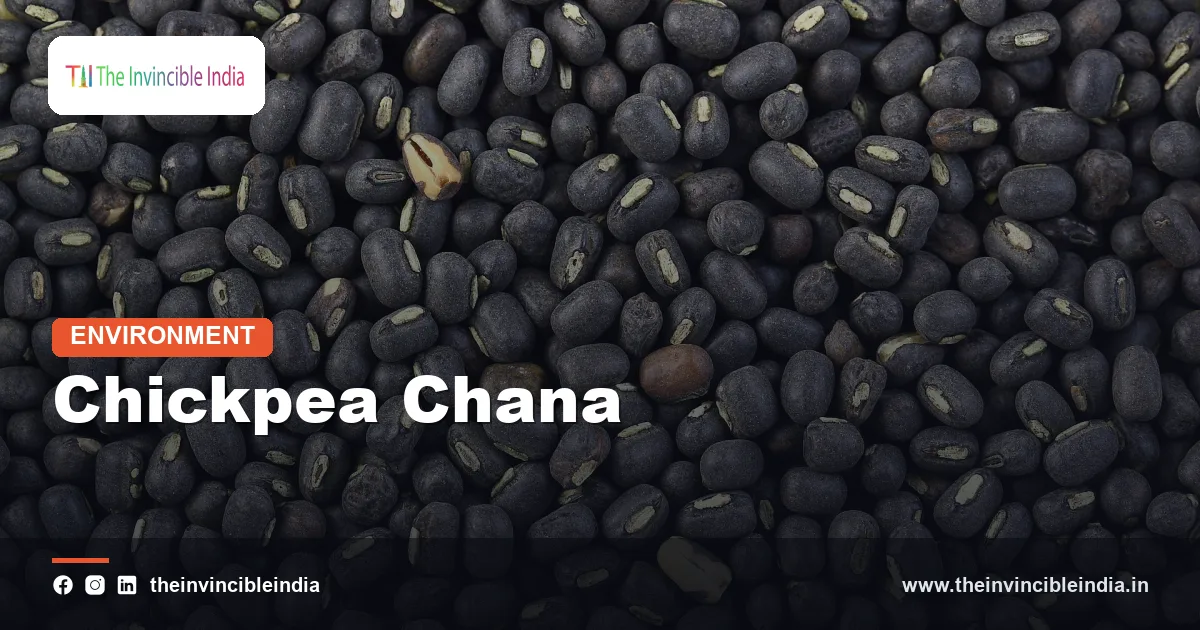
The chickpea (Cicer arietinum), called chana or Bengal gram in India, is a winter-grown, nitrogen-fixing pulse crop whose protein-rich seeds are eaten whole, split into dal or ground into besan flour, and India is the world’s largest producer and consumer of the crop. It is by far the most important pulse in the country, and it supplies chole, chana dal, roasted snacks and the gram flour behind pakoras and many sweets.
Chickpea was domesticated in the Near East roughly 10,000 years ago and has been grown on the Indian subcontinent for thousands of years. It is grown mostly in the rabi (winter) season on stored soil moisture, and it enriches the soil with nitrogen. This explainer describes the plant, its two main types, the growing states, cultivation, uses, nutrition and the reasons it matters for Indian farming and diets.
| Quick Facts: Chickpea | |
|---|---|
| Scientific name | Cicer arietinum L. |
| Family | Fabaceae (the legume or pea family) |
| Common Indian names | Chana, Bengal gram, gram, chole (for the large kabuli type), kadale (Kannada), senagalu (Telugu) |
| Where grown in India | Madhya Pradesh (the largest producer), Rajasthan, Maharashtra, Uttar Pradesh, Karnataka, Andhra Pradesh and Gujarat |
| Season | Rabi: sown in October to November and harvested in February to March |
| Part used | Seeds (whole, split or ground); green pods and leaves are also eaten; straw used as fodder |
| Main types | Desi (small, dark, angular seeds) and kabuli (large, cream-coloured, rounded seeds) |
| Products and uses | Chana dal, besan, chole, roasted chana, sattu, sprouts, snacks and sweets |
| Notable facts | India is the world’s largest chickpea producer; the plant fixes atmospheric nitrogen through root nodules |
Key Takeaways
- Chickpea, known as chana in India, is a pulse crop with the scientific name Cicer arietinum in the legume family Fabaceae.
- India is the world’s largest producer and consumer of chickpea, accounting for well over half of global production in most years.
- Chickpea is grown mainly in the rabi season, sown in October and November, with Madhya Pradesh as the leading producing state.
- Chickpea occurs in two main types, the small dark desi chickpea used for chana dal and besan and the large pale kabuli chickpea used for chole.
- Chickpea plants fix atmospheric nitrogen with the help of root bacteria, which improves soil fertility for the following crop.
- Chickpea seeds are rich in plant protein and fibre, and are among the most widely eaten pulses in Indian cooking.
What is chickpea and what is it called in India?
Chickpea is a legume crop grown for its edible seeds, and in India it is called chana or Bengal gram, with the word gram used in Indian English for several pulses. The plant is an annual herb in the pea family, and the seeds are borne inside small, inflated pods.
Names differ across the country and across forms of the food. Dried whole seeds are kala chana when they are the dark desi type and kabuli chana or chole when they are the large cream type. The split and polished seed is chana dal, the roasted one is bhuna chana, and the flour ground from the dal is besan. In the south the pulse is known as kadale in Kannada and senagalu in Telugu, while the English word garbanzo is used in some countries.
The scientific name Cicer arietinum recalls the shape of the seed, which has a small beak and resembles a ram’s head (the Latin word aries means ram). India’s agricultural statistics treat chickpea as a rabi pulse and report it under the heading gram.
Where did the chickpea originate?
The chickpea originated in the Fertile Crescent region of the Near East, in what is now south-eastern Turkey and neighbouring Syria, where it was domesticated roughly 10,000 years ago from a wild relative called Cicer reticulatum. It was one of the earliest legumes brought into cultivation, alongside lentil and pea.
From that region chickpea spread to the Mediterranean, Ethiopia, Central Asia and the Indian subcontinent. Archaeological sites in India have yielded chickpea remains from the early farming and Harappan periods, showing that the pulse has a long history in the country. In ancient Indian texts, gram appears among the grains used for food and for animal feed, including for horses.
Today India’s research on chickpea is led by institutions such as the ICAR Indian Institute of Pulses Research at Kanpur, state agricultural universities, and the international centre ICRISAT, which holds a large chickpea collection at its gene bank. These institutions release improved varieties that resist disease and give higher yield.
What does the chickpea plant look like?
The chickpea plant is a bushy, branching annual herb that grows about 20 to 60 centimetres tall and is covered with fine glandular hairs, with feather-like compound leaves made of small toothed leaflets. Its flowers are small, self-pollinating and usually white, pink or bluish, and each flower produces one pod with one to three seeds.
The plant’s leaves and stems carry hairs that secrete organic acids, mainly malic and oxalic acid. In the past, villagers collected this sour exudate from dew-wet plants on cloth, and it was used as a folk remedy. The acid also protects the plant from some insects but can make fresh leaves sharp-tasting.
Chickpea has a deep taproot with many side roots, which lets it use water from lower soil layers. The roots carry small round nodules that house nitrogen-fixing bacteria. The plant is photoperiod-sensitive and prefers cool, dry weather, which is why it fits the winter season of northern and central India so well.
What are the types of chickpea: desi and kabuli?
The two main types of chickpea are desi and kabuli: the desi type has small, dark, angular seeds with a thick seed coat, while the kabuli type has larger, cream-coloured, rounded seeds with a thin coat. Together they represent nearly all of the world’s cultivated chickpea.
| Feature | Desi chickpea | Kabuli chickpea |
|---|---|---|
| Seed size | Small to medium | Large |
| Seed colour | Brown, black or yellowish; angular shape | Cream or white; rounded, ram-head shape |
| Seed coat | Thick and rough | Thin and smooth |
| Flower colour | Pink or purple | White |
| Share of Indian area | The large majority | A smaller but growing share |
| Typical use | Chana dal, besan, roasted chana, kala chana curry | Chole, salads, hummus and canned chickpea |
Desi types are hardier and better suited to Indian rainfed conditions, while kabuli types often need more careful management and fetch higher prices. The name kabuli reflects the belief that the type came to India from Kabul in Afghanistan.
Where and when is chickpea grown in India?
Chickpea is grown in India mainly in Madhya Pradesh, Rajasthan, Maharashtra, Uttar Pradesh, Karnataka, Andhra Pradesh and Gujarat, with Madhya Pradesh being the largest producing state. Together these states account for most of the country’s chickpea area.
Chickpea is a rabi crop, which means it is sown after the monsoon, usually in October or November, and harvested in February or March. It grows on the moisture stored in the soil after the rainy season, so a large part of the area is rainfed or receives only one or two irrigations. In recent decades the crop has moved southwards, with areas in Andhra Pradesh, Karnataka and Maharashtra growing in importance, helped by short-duration varieties and mechanised harvesting.
Production varies from year to year with winter rainfall and temperature. India sometimes produces enough chickpea for its own needs and at other times imports pulses to fill gaps, so exact figures should be taken from the latest statistics of the Ministry of Agriculture and Farmers Welfare. The government announces a minimum support price for chickpea before each rabi season, and public agencies procure the crop at that price in several states.
How is chickpea cultivated?
Chickpea is cultivated by sowing seed in lines in a fine, well-drained field in the cool months, applying little nitrogen fertiliser because the plant makes its own, and harvesting when the pods and leaves dry. It needs relatively little water and thrives on light to medium soils.
Soil and sowing
The crop does best on well-drained loam and black cotton soils. Waterlogged or saline soils harm it. Sowing time is important, since early sowing in hot soil invites wilt, while late sowing exposes the crop to terminal heat. Seed treatment with fungicides and with Rhizobium culture helps establishment.
Nutrients and water
Chickpea fixes much of its own nitrogen, so farmers usually apply phosphorus and, where deficient, sulphur and zinc. One or two irrigations at branching and pod filling raise yield, but excess water encourages vegetative growth at the expense of pods.
Pests and diseases
The most serious pest is the pod borer, Helicoverpa armigera, whose caterpillars eat developing seeds. Major diseases include Fusarium wilt, dry root rot and Ascochyta blight. Wilt-resistant varieties, crop rotation, timely sowing and integrated pest management are the standard defences, and farmers often use pheromone traps and bird perches to monitor and reduce pod borer.
How does chickpea improve the soil?
Chickpea improves the soil by fixing atmospheric nitrogen through a partnership with Rhizobium-type bacteria living in root nodules, which leaves the soil richer in nitrogen for the next crop. This process is called biological nitrogen fixation and is typical of legumes.
The bacteria take nitrogen gas from the air and convert it into forms that the plant can use, while the plant supplies the bacteria with sugars. After harvest, roots and fallen leaves add nitrogen and organic matter to the soil. Farmers therefore include chickpea in rotations with wheat, rice or millets, and the benefit is a lower fertiliser need for the following cereal.
Chickpea also breaks cycles of pests and diseases that build up when cereals are grown repeatedly in the same field. Because it uses stored soil moisture and little added nitrogen, it is considered a low-input crop. These properties make chickpea a valuable part of sustainable cropping systems, particularly in the rice-wheat and cotton-based regions of central and northern India.
How is chickpea used in Indian food?
Chickpea is used in Indian food in many forms, including whole cooked chana, chana dal, besan, roasted and puffed grain, sprouts and fresh green pods. It is one of the most versatile pulses in the Indian kitchen.
- Chole or chana masala, made from kabuli chickpea and eaten with bhature, kulcha or rice.
- Chana dal, the split and polished desi seed, used in dals, vegetables, stuffings and tempering.
- Besan, or gram flour, used for pakoras, kadhi, dhokla, chilla, boondi and sweets such as besan ladoo and mysore pak.
- Roasted chana, a popular snack, and sattu, a flour of roasted gram that is mixed into drinks and stuffed breads.
- Sprouted chana and fresh green chana (hara chana or choliya), eaten raw, steamed or in curries.
Outside human food, chickpea husk and broken grain are used as cattle feed, and the straw serves as fodder. Internationally, chickpea is the base of hummus and falafel, and India also exports chickpea in several forms when conditions allow.
What are the nutritional benefits of chickpea?
Chickpea is nutritious because it provides plant protein, carbohydrate, dietary fibre, iron, folate and other minerals, with dry seeds containing roughly twenty per cent protein by weight. Exact values vary by type and growing conditions.
Because chickpea is high in fibre and has a relatively low glycaemic index, it is often recommended as part of balanced diets, including diets aimed at managing blood sugar, though individual needs vary. Protein from chickpea is rich in lysine, which cereals lack, so a meal of chickpea with rice or roti gives a more complete amino acid mix. Chickpea is naturally gluten-free, and besan is therefore used as a wheat-free flour.
Like other pulses, chickpea contains compounds that can cause gas and discomfort in some people, and these are reduced by soaking, sprouting and thorough cooking. The United Nations declared 2016 the International Year of Pulses to highlight the nutritional and environmental importance of crops such as chickpea.
Why is chickpea important for India?
Chickpea is important for India because it is the country’s leading pulse, a major source of vegetarian protein for hundreds of millions of people and a crop that supports rainfed farmers in the winter season. India’s large population of vegetarians relies on pulses for protein, and chickpea products are central to this diet.
Economically, chickpea provides income for millions of small and medium farmers, especially in central India, and supports a large processing industry of dal mills and besan manufacturers. Prices are watched closely, since chickpea price changes affect household food budgets and are sometimes the subject of policy action such as stock limits, import duty changes or support price adjustments.
The crop also faces challenges. Yields in India are lower than the potential, in part because most chickpea is grown on rainfed, marginal land and suffers terminal drought and heat. Climate variability, pod borer attacks and wilt remain concerns. Efforts to expand short-duration and heat-tolerant varieties, mechanise harvesting and improve seed supply aim to stabilise production and reduce the need for imports.
Bottom Line
Chickpea, or chana, is India’s most important pulse: a winter-grown legume that feeds people, fertilises the soil and gives income to rainfed farmers. With desi and kabuli types serving different kitchens, the crop remains central to Indian food and farming.
Frequently Asked Questions
What is chickpea called in India?
Chickpea is called chana or Bengal gram in India. The large cream-coloured type is also known as kabuli chana or chole, and the split form is called chana dal.
Which state is the largest producer of chickpea in India?
Madhya Pradesh is the largest chickpea-producing state in India. Rajasthan, Maharashtra, Uttar Pradesh, Karnataka and Andhra Pradesh are also major producers, and rankings can shift slightly from year to year.
What is the difference between desi and kabuli chickpea?
Desi chickpea has small, dark, angular seeds with a thick coat, while kabuli chickpea has larger, cream-coloured, round seeds with a thin coat. Desi types are used for chana dal and besan, and kabuli types are used for chole.
When is chickpea sown and harvested in India?
Chickpea is sown in October to November and harvested in February to March. It is a rabi crop that grows on the moisture stored in the soil after the monsoon.
Is chickpea good for the soil?
Yes, chickpea improves soil fertility. Its root nodules host bacteria that fix nitrogen from the air, leaving the soil richer for the next crop and reducing the need for nitrogen fertiliser.
Is chana the same as besan?
No, chana and besan are related but not identical. Chana is the whole chickpea seed, while besan is a fine flour made by grinding husked, split desi chickpea, also called chana dal.
{“@context”:”https://schema.org”,”@graph”:[{“@type”:”FAQPage”,”mainEntity”:[{“@type”:”Question”,”name”:”What is chickpea called in India?”,”acceptedAnswer”:{“@type”:”Answer”,”text”:”Chickpea is called chana or Bengal gram in India. The large cream-coloured type is also known as kabuli chana or chole, and the split form is called chana dal.”}},{“@type”:”Question”,”name”:”Which state is the largest producer of chickpea in India?”,”acceptedAnswer”:{“@type”:”Answer”,”text”:”Madhya Pradesh is the largest chickpea-producing state in India. Rajasthan, Maharashtra, Uttar Pradesh, Karnataka and Andhra Pradesh are also major producers, and rankings can shift slightly from year to year.”}},{“@type”:”Question”,”name”:”What is the difference between desi and kabuli chickpea?”,”acceptedAnswer”:{“@type”:”Answer”,”text”:”Desi chickpea has small, dark, angular seeds with a thick coat, while kabuli chickpea has larger, cream-coloured, round seeds with a thin coat. Desi types are used for chana dal and besan, and kabuli types are used for chole.”}},{“@type”:”Question”,”name”:”When is chickpea sown and harvested in India?”,”acceptedAnswer”:{“@type”:”Answer”,”text”:”Chickpea is sown in October to November and harvested in February to March. It is a rabi crop that grows on the moisture stored in the soil after the monsoon.”}},{“@type”:”Question”,”name”:”Is chickpea good for the soil?”,”acceptedAnswer”:{“@type”:”Answer”,”text”:”Yes, chickpea improves soil fertility. Its root nodules host bacteria that fix nitrogen from the air, leaving the soil richer for the next crop and reducing the need for nitrogen fertiliser.”}},{“@type”:”Question”,”name”:”Is chana the same as besan?”,”acceptedAnswer”:{“@type”:”Answer”,”text”:”No, chana and besan are related but not identical. Chana is the whole chickpea seed, while besan is a fine flour made by grinding husked, split desi chickpea, also called chana dal.”}}]}]}


