

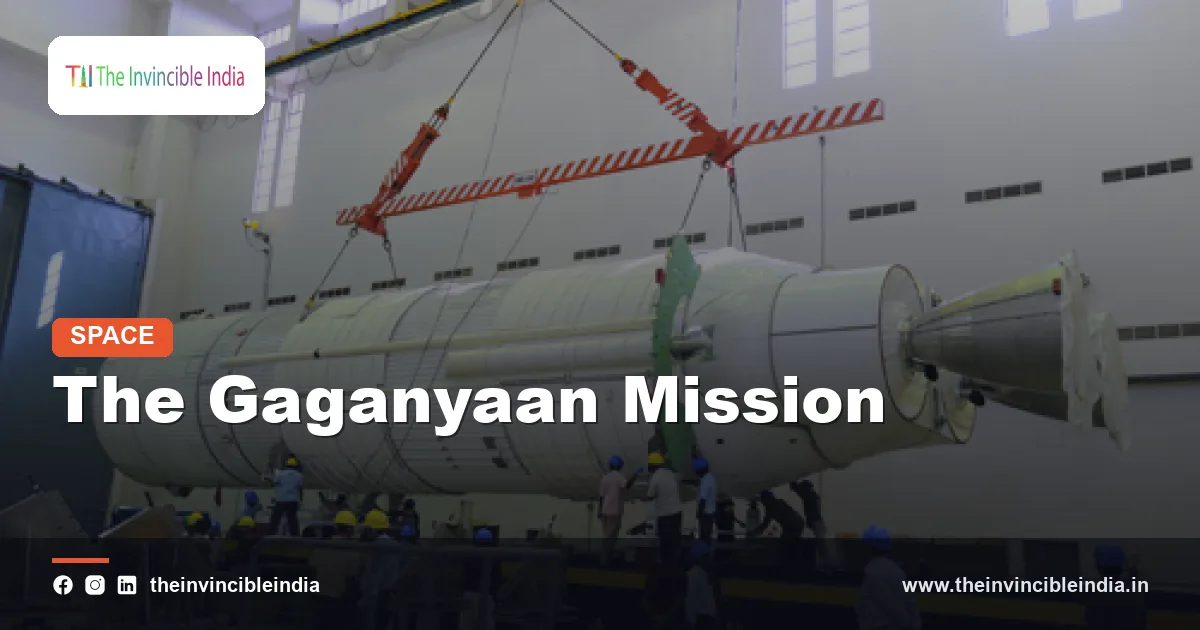
Gaganyaan is the Indian Space Research Organisation’s flagship human spaceflight programme, an ambitious effort to send Indian astronauts into low Earth orbit aboard an Indian-built spacecraft, launched by an Indian rocket, and bring them home safely. The name comes from Sanskrit, where “gagan” means sky and “yaan” means vehicle, so the mission is, quite literally, the “sky vehicle”.
If it succeeds, India will become only the fourth country to independently carry humans to space, after the Soviet Union (now Russia), the United States and China. This explainer walks through how the programme began, how the mission is designed, what hardware and safety systems it depends on, how astronauts are being trained, and why it matters for India’s long-term place in space.
Quick Facts
| Feature | Details |
|---|---|
| Programme | Gaganyaan, India’s first indigenous human spaceflight mission |
| Lead agency | Indian Space Research Organisation (ISRO), through its Human Space Flight Centre |
| Announced | 15 August 2018, by the Prime Minister in his Independence Day address |
| Crew size | Up to three astronauts (called Gaganyatris or Vyomanauts) |
| Target orbit | Low Earth orbit at roughly 400 km altitude |
| Planned duration | Up to about three days in space |
| Launch vehicle | Human-rated LVM3, also called HLVM3 |
| Launch site | Satish Dhawan Space Centre, Sriharikota |
| Landing method | Parachute-assisted splashdown in the sea, with Indian Navy recovery |
| First crewed flight | Targeted for the mid-2020s |
What Is the Gaganyaan Mission?
At its core, Gaganyaan is a demonstration: it is meant to prove that India can design, build, launch, operate and recover a crewed spacecraft using its own technology. Unlike ISRO’s earlier successes, which involved satellites, lunar orbiters and rovers, a human mission carries a much heavier burden. Every system must protect human life, and every failure mode must be anticipated in advance.
The programme is coordinated by ISRO’s Human Space Flight Centre, which brings together several ISRO centres, the Indian Air Force, the Indian Navy, the Defence Research and Development Organisation (DRDO), research laboratories, academic institutions and industry partners. It covers a wide chain of activities:
- Developing a crew-rated launch vehicle and a habitable spacecraft.
- Building life-support, thermal-protection and re-entry technologies.
- Creating an emergency system to rescue the crew during launch.
- Selecting and training astronauts.
- Setting up tracking, communication and sea-recovery networks.
Two terms are used for the astronauts. “Gaganyatri” is derived from Sanskrit and Hindi, meaning a traveller of the sky, while “Vyomanaut” comes from “vyoma”, another Sanskrit word for space or sky. Both are widely used in official and popular writing.
Origins: From a 2018 Announcement to a National Programme
India’s human spaceflight story did not begin in 2018. In 1984, Rakesh Sharma, an Indian Air Force pilot, flew aboard the Soviet Soyuz T-11 spacecraft and became the first Indian to travel to space, as part of a joint India-USSR mission. That flight, however, relied entirely on a foreign vehicle. For decades afterwards, ISRO concentrated on building dependable launchers and satellites, and much of the groundwork for a crewed mission was laid quietly through technology studies and experiments.
The 2018 announcement
The programme was announced publicly by the Prime Minister in his Independence Day address on 15 August 2018, when he declared that an Indian would be sent to space by 2022, the 75th anniversary of Independence, aboard an Indian vehicle. The Union Cabinet subsequently sanctioned the programme later in 2018, and the effort took a formal shape under the Human Space Flight Centre.
Delays and resets
The original 2022 target could not be met. The COVID-19 pandemic disrupted global supply chains, testing schedules and international training, and the technical complexity of human rating pushed timelines further. Because crewed flight leaves no room for shortcuts, ISRO adopted a deliberately cautious approach: each major system must be qualified through ground tests and uncrewed flights before any person boards the spacecraft. Today the first crewed flight is described as targeted for the mid-2020s, with the exact date depending on the outcome of the preceding tests.
The Mission Profile: How a Gaganyaan Flight Will Work
The baseline mission is designed to be short, controlled and focused on safety rather than on long-duration science. A crew of up to three astronauts will be carried to a low Earth orbit at an altitude of roughly 400 km, where they will remain for up to about three days before returning.
Key phases
- Launch: The human-rated launch vehicle lifts off from Sriharikota, carrying the crew inside the Orbital Module, which sits beneath a protective shroud and above the launch escape system.
- Ascent and orbit insertion: The rocket’s stages burn in sequence, and the Orbital Module is released into its target orbit.
- Orbital operations: The crew monitors the spacecraft, tests systems, and carries out limited experiments. Ground stations, along with tracking support, remain in constant contact.
- De-orbit: The Service Module’s engines fire to lower the orbit, after which the Crew Module separates from the Service Module.
- Re-entry: The Crew Module plunges through the atmosphere, protected by its heat shield, which withstands extreme temperatures.
- Splashdown and recovery: A sequence of parachutes slows the capsule, which lands in the sea, where Indian Navy ships and recovery teams retrieve the crew.
The mission is planned so that the crew module can return to a chosen sea zone, and mission planners consider contingency landing areas in case of an emergency return.
The Launch Vehicle: Human-Rated LVM3 (HLVM3)
Gaganyaan uses a modified version of ISRO’s heavy-lift rocket LVM3, formerly known as GSLV Mk III. When adapted to carry people, the vehicle is redesignated HLVM3. The LVM3 has already built a strong reputation, having launched Chandrayaan-2 and Chandrayaan-3 among other missions, but crew flights demand a higher standard of reliability.
Structure of the rocket
- Two solid boosters (S200): These strap-on motors provide most of the thrust during the first minutes of flight.
- Liquid core stage (L110): Powered by two Vikas engines, it continues to push the rocket upward after the boosters burn out.
- Cryogenic upper stage (C25): Using liquid hydrogen and liquid oxygen, it delivers the final push into orbit.
What “human-rating” means
Human-rating is far more than adding a seat. It involves improving reliability, adding redundancy in critical systems, monitoring the health of the rocket in real time, and giving the vehicle the ability to detect a serious fault and trigger an abort. Structural margins are increased, sensors are added, and the vehicle is qualified through repeated ground tests. Several subsystems, including engines and stages, have been put through extended test campaigns to demonstrate that they can perform consistently under demanding conditions.
The Orbital Module: Crew Module and Service Module
The spacecraft that will actually fly the astronauts is called the Orbital Module. It has two principal parts, each with a distinct job.
Crew Module
The Crew Module is the pressurised, habitable capsule where the astronauts sit. It has a double-walled structure and is equipped with an Environmental Control and Life Support System (ECLSS), which regulates cabin pressure, temperature, humidity and breathable air, removes carbon dioxide, and manages water and waste. The module also carries crew displays, avionics for navigation and control, a thermal protection system to survive re-entry, and the parachute system needed for landing.
Service Module
The Service Module is an unpressurised section attached to the Crew Module. It supplies propulsion for orbital manoeuvres and de-orbiting, holds propellant tanks, and provides power and thermal control during the orbital phase. It is discarded before the Crew Module re-enters the atmosphere.
| Component | Main role |
|---|---|
| Crew Module | Pressurised cabin for the crew, life support, re-entry and splashdown |
| Service Module | Propulsion, power, thermal control and orbit changes |
| Crew Escape System | Pulls the Crew Module away from the rocket in an emergency |
| HLVM3 launch vehicle | Carries the Orbital Module into low Earth orbit |
Safety First: The Crew Escape System
Because lives are at stake, ISRO’s safety philosophy relies on layers of protection. The most visible layer is the Crew Escape System (CES). Mounted above the Crew Module, it contains a set of solid rocket motors that can rapidly lift the capsule away from the launch vehicle if a serious problem is detected during countdown or ascent.
How the system works
- Sensors and computers monitor the rocket continuously for signs of failure.
- If a threat is detected, an abort command fires the escape motors, which pull the Crew Module clear of danger at high acceleration.
- Once safely away, the module separates from the escape hardware and deploys parachutes.
- The capsule descends and splashes down in the sea, where recovery teams retrieve the crew.
Other safety measures
Beyond the escape system, planners use redundant electronics, fault-tolerant software, strict quality controls and extensive simulations. The astronauts themselves wear pressure suits designed for launch and re-entry. ISRO has also indicated that the mission is planned with conservative flight rules: if conditions are not fully favourable, the launch will not go ahead. This emphasis on caution explains why the programme relies on a staged series of test flights instead of moving straight to a crewed mission.
The Step-by-Step Test Approach
Before any Indian astronaut climbs aboard, ISRO is carrying out a sequence of test flights and ground trials. Each step retires a specific set of risks, so that by the time of the crewed flight, the crucial systems will have been proven in real conditions.
| Test | Purpose |
|---|---|
| Ground qualification tests | Verify engines, stages, structures, parachutes and life-support systems on the ground |
| Integrated air drop tests | Confirm that the parachute system can safely slow and land the Crew Module |
| Test Vehicle abort missions (TV-D series) | Demonstrate that the Crew Escape System can pull the capsule away and land it safely |
| Uncrewed orbital flights | Fly the full system in orbit and back without people, carrying the humanoid robot Vyommitra |
| Crewed orbital flight | First flight carrying Indian astronauts, targeted for the mid-2020s |
The TV-D1 abort test
A major milestone came on 21 October 2023, when ISRO conducted the first Test Vehicle Abort Mission, called TV-D1, from Sriharikota. A single-stage test rocket carried a Crew Module and the Crew Escape System to a high altitude, after which an abort was triggered. The Crew Module separated, deployed its parachutes and splashed down in the Bay of Bengal, where it was recovered by the Indian Navy. The test validated the abort sequence in flight and gave engineers valuable data.
Vyommitra, the humanoid robot
The uncrewed flights are planned to carry Vyommitra, a female-looking humanoid robot developed to mimic human functions. Its name combines “vyoma” (space) and “mitra” (friend). The robot can monitor cabin conditions and interact with the systems, giving engineers realistic information about how the environment would affect a human occupant.
Choosing and Training the Gaganyatris
ISRO and the Indian Air Force jointly handled astronaut selection. Because test pilots are trained to operate complex aircraft under pressure and to make decisions in emergencies, the initial pool was drawn from the IAF’s test pilot community. Candidates went through medical screening, psychological assessment, physical fitness tests and interviews, and four were finally chosen as astronaut-designates.
The four astronaut-designates
The four Indian Air Force officers were introduced to the nation in early 2024, at the Vikram Sarabhai Space Centre in Thiruvananthapuram. They are Group Captains Prasanth Balakrishnan Nair, Ajit Krishnan, Angad Pratap and Shubhanshu Shukla. The announcement marked the first time since Rakesh Sharma’s 1984 flight that India had publicly named a group of people to fly into space.
Where the training took place
- In Russia: The four underwent initial training at the Yuri Gagarin Cosmonaut Training Centre near Moscow, under an agreement between an ISRO-linked entity and Russia’s space agency ecosystem. This covered spacecraft systems, survival training, microgravity familiarisation and physiology.
- In India: Training continued at ISRO’s facilities, including an astronaut training facility in Bengaluru, where mission-specific skills are built, including simulator sessions, crew-module procedures, emergency response and sea-survival drills.
The training has to be broad. Astronauts must learn orbital mechanics, life-support operations, spacecraft communications and rescue procedures, alongside physical conditioning to tolerate the acceleration forces of launch and re-entry.
Recovery, Ground Systems and National Partnerships
A human spaceflight programme depends on far more than the rocket and capsule. Ground and sea infrastructure is just as important, and much of it has been built or upgraded specifically for Gaganyaan.
- Launch complex: Sriharikota’s launch infrastructure is being adapted for crew operations, including crew access arrangements and emergency provisions.
- Tracking and communication: Ground stations and tracking assets, along with data relay arrangements, help keep the spacecraft in contact during ascent, orbit and re-entry.
- Recovery forces: The Indian Navy, working with ISRO and other agencies, trains for locating and retrieving the Crew Module after splashdown, including practice recoveries with test capsules.
- Medical support: Facilities and teams are prepared to examine the astronauts immediately after landing and during post-flight recovery.
A whole-of-nation effort
Many institutions contribute. DRDO laboratories have supplied technologies such as parachutes, food and specialised life-support elements, while Indian industry makes structures, electronics and components. Academic institutes support research on human physiology and materials. This wide network is one reason the programme is often described as a national endeavour and not simply an ISRO project.
The Road to Orbit: Axiom Mission and International Collaboration
Although Gaganyaan is designed to be indigenous, India has not worked in isolation. Cooperation with Russia has supported astronaut training, while partnerships with other space agencies and companies provide additional experience. One notable build-up step involves the International Space Station (ISS).
As part of a broader collaboration between India and the United States, one of the Indian astronaut-designates, Group Captain Shubhanshu Shukla, flew to the ISS aboard a commercial Axiom Space mission in 2025. This gave India’s astronaut corps first-hand experience of launch, microgravity operations, life aboard an orbital laboratory and return to Earth, and the lessons are expected to feed into Gaganyaan’s mission planning and training.
Why such experience matters
- It exposes an Indian astronaut to real spaceflight procedures.
- It helps ISRO understand how crews cope with long-duration microgravity and the demands on medical teams.
- It builds working relationships with international agencies, which will matter for future missions and joint research.
Such missions do not replace Gaganyaan; they complement it. The goal remains a fully Indian human spaceflight capability, using an Indian vehicle launched from Indian soil.
Beyond Gaganyaan: Space Station and Moon Ambitions
Gaganyaan is intended as a foundation for larger goals. Officials have laid out a long-term roadmap in which the first crewed flight leads to more advanced human missions.
Bharatiya Antariksh Station
India plans to build its own space station, the Bharatiya Antariksh Station, with an initial module targeted for launch in the coming years and the full station envisaged by around 2035. A national station would allow long-duration research in microgravity, in fields such as materials science, biology and medicine, and would give India a permanent presence in orbit.
An Indian on the Moon
India has also set a goal of landing an Indian astronaut on the Moon by 2040. This would build on the confidence gained from Chandrayaan-3, whose Vikram lander touched down near the lunar south pole region on 23 August 2023, making India the first country to do so and the fourth to land softly on the Moon. A crewed lunar mission would demand new launchers, spacecraft, docking technologies and life-support systems, many of which Gaganyaan will help mature.
Supporting technologies
Technologies such as orbital docking, reusable systems and heavier launch vehicles are being developed alongside Gaganyaan, since a space station and lunar missions will need them.
Why Gaganyaan Matters for India
The significance of the mission stretches across science, industry, strategy and national pride.
Self-reliance and technological capability
Mastering human spaceflight means mastering some of the most difficult engineering disciplines: life support, re-entry, escape systems, high-reliability electronics and crew safety. Achieving this independently strengthens India’s technological base and reduces dependence on foreign partners.
Spin-offs for society
Space programmes have a long record of producing useful technologies. Advances in materials, sensors, medical monitoring, water purification, food preservation and miniaturised electronics often find civilian uses. Gaganyaan is expected to stimulate Indian industry, particularly small and medium enterprises that make precision components, and to create skilled jobs.
Inspiration and education
Seeing Indian astronauts fly on an Indian spacecraft is likely to inspire a new generation of students toward science, technology, engineering and mathematics. Earlier milestones such as Chandrayaan-3 and the solar observatory Aditya-L1 already sparked widespread public interest in space.
India as a rising space power
Following the Mars Orbiter Mission in 2014, Chandrayaan-3 in 2023 and Aditya-L1, human spaceflight would complete a portfolio that few nations possess. It would enhance India’s standing in international space cooperation and its role in shaping norms for the peaceful use of outer space.
Conclusion
Gaganyaan is more than a single flight; it is the centrepiece of India’s plan to become a complete spacefaring nation. Its careful, stage-by-stage approach, from abort tests and uncrewed flights with Vyommitra to astronaut training in India and abroad, reflects an understanding that human lives cannot be risked on hope alone. With the first crewed flight targeted for the mid-2020s, the programme points toward the Bharatiya Antariksh Station and an Indian on the Moon, marking a new chapter in the country’s space story.
Frequently Asked Questions
What is Gaganyaan?
Gaganyaan is ISRO’s human spaceflight programme, which aims to send up to three Indian astronauts to low Earth orbit at about 400 km for up to three days and return them safely by a sea splashdown. It is designed to use an Indian-built spacecraft and launch vehicle, and it was announced in 2018.
Which rocket will launch Gaganyaan?
The mission will use a human-rated version of ISRO’s heavy-lift rocket LVM3 (formerly GSLV Mk III), designated HLVM3. It has two solid boosters, a liquid core stage and a cryogenic upper stage, with extra reliability and safety features for carrying people.
Who are the Gaganyaan astronauts?
Four Indian Air Force test pilots were selected as astronaut-designates and introduced in early 2024: Group Captains Prasanth Balakrishnan Nair, Ajit Krishnan, Angad Pratap and Shubhanshu Shukla. They trained in Russia and in India in preparation for the mission.
What is Vyommitra?
Vyommitra is a female-looking humanoid robot that ISRO plans to fly on uncrewed test missions before the crewed flight. It can mimic certain human functions and monitor cabin conditions, helping engineers verify the safety of the spacecraft.
What was the TV-D1 test?
TV-D1, conducted on 21 October 2023, was the first Test Vehicle Abort Mission. It demonstrated that the Crew Escape System could pull a Crew Module away from a rocket in flight, after which the capsule descended by parachute and was recovered from the Bay of Bengal.
When will the first crewed Gaganyaan flight take place?
The first crewed flight is targeted for the mid-2020s, but no fixed date should be treated as final. ISRO is following a step-by-step test programme, and the schedule depends on the successful completion of each stage, including the uncrewed flights.
{“@context”:”https://schema.org”,”@graph”:[{“@type”:”FAQPage”,”mainEntity”:[{“@type”:”Question”,”name”:”What is Gaganyaan?”,”acceptedAnswer”:{“@type”:”Answer”,”text”:”Gaganyaan is ISRO’s human spaceflight programme, which aims to send up to three Indian astronauts to low Earth orbit at about 400 km for up to three days and return them safely by a sea splashdown. It is designed to use an Indian-built spacecraft and launch vehicle, and it was announced in 2018.”}},{“@type”:”Question”,”name”:”Which rocket will launch Gaganyaan?”,”acceptedAnswer”:{“@type”:”Answer”,”text”:”The mission will use a human-rated version of ISRO’s heavy-lift rocket LVM3 (formerly GSLV Mk III), designated HLVM3. It has two solid boosters, a liquid core stage and a cryogenic upper stage, with extra reliability and safety features for carrying people.”}},{“@type”:”Question”,”name”:”Who are the Gaganyaan astronauts?”,”acceptedAnswer”:{“@type”:”Answer”,”text”:”Four Indian Air Force test pilots were selected as astronaut-designates and introduced in early 2024: Group Captains Prasanth Balakrishnan Nair, Ajit Krishnan, Angad Pratap and Shubhanshu Shukla. They trained in Russia and in India in preparation for the mission.”}},{“@type”:”Question”,”name”:”What is Vyommitra?”,”acceptedAnswer”:{“@type”:”Answer”,”text”:”Vyommitra is a female-looking humanoid robot that ISRO plans to fly on uncrewed test missions before the crewed flight. It can mimic certain human functions and monitor cabin conditions, helping engineers verify the safety of the spacecraft.”}},{“@type”:”Question”,”name”:”What was the TV-D1 test?”,”acceptedAnswer”:{“@type”:”Answer”,”text”:”TV-D1, conducted on 21 October 2023, was the first Test Vehicle Abort Mission. It demonstrated that the Crew Escape System could pull a Crew Module away from a rocket in flight, after which the capsule descended by parachute and was recovered from the Bay of Bengal.”}},{“@type”:”Question”,”name”:”When will the first crewed Gaganyaan flight take place?”,”acceptedAnswer”:{“@type”:”Answer”,”text”:”The first crewed flight is targeted for the mid-2020s, but no fixed date should be treated as final. ISRO is following a step-by-step test programme, and the schedule depends on the successful completion of each stage, including the uncrewed flights.”}}]}]}


