

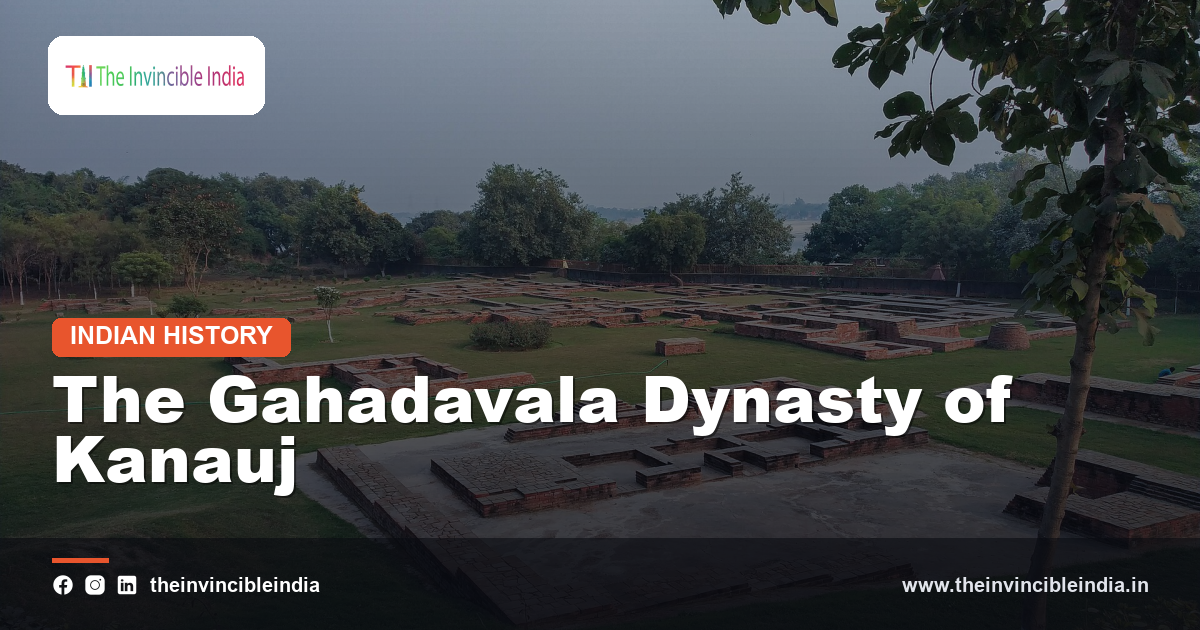
The Gahadavala dynasty governed the central Gangetic plain during the early medieval centuries, ruling from the storied city of Kanauj and holding the sacred city of Varanasi within its domain. Emerging in the political vacuum left by the decline of the Gurjara-Pratiharas, the family built a sizeable kingdom that served as a buffer and a rival to neighboring powers. Their story belongs alongside that of other regional houses such as the Rajputs, whose clans shaped the medieval political map of the north. The Gahadavalas are remembered for their land grants, their patronage of Sanskrit learning, their care for pilgrimage centers, and their eventual confrontation with the forces advancing from the northwest.
Quick Facts
| Detail | Information |
|---|---|
| Dynasty | Gahadavala, often linked with the Rajput clans |
| Core Region | Kanauj, Varanasi, Ayodhya, and the Ganga-Yamuna plain |
| Period | Early medieval, roughly the late eleventh to twelfth century |
| Notable Rulers | Chandradeva, Govindachandra, Jayachandra |
| Cultural Legacy | Sanskrit legal scholarship, temple grants, and pilgrimage patronage |
| Decline | Defeat by invaders from the northwest in the late twelfth century |
Origins and the Political Setting
The Gahadavala dynasty rose in the central Gangetic plain at a moment when older imperial structures had broken apart. The Gurjara-Pratiharas had once ruled from Kanauj over a vast belt of northern India, but their authority gradually dissolved, leaving a patchwork of regional chiefs. Into this fragmented landscape stepped the Gahadavalas, who consolidated territory around Kanauj and the holy centers further east. Historians discuss the exact origins of the clan, and some traditions connect it with wider Rajput genealogies, though the details remain debated. What is clear from inscriptions is that the family established itself as a durable regional power. The political setting of competing neighbors, shifting alliances, and a prestigious but weakened imperial capital defined the opportunities and the dangers that the early Gahadavalas faced.
Kanauj as a Prestigious Capital
Kanauj carried an extraordinary reputation in early medieval India. For centuries it had been a symbol of imperial authority, and holding it conferred status far beyond its military value. The Gahadavalas understood this and presented themselves as heirs to that prestige, using the city as a seat of administration and ceremony. Its location on the Ganga allowed control of river traffic and of routes connecting the Doab with regions to the east and west. A ruler who governed Kanauj could claim a continuity with the great kingdoms that had once ruled there. This symbolic value helps explain why neighboring dynasties contested the region so persistently, and why the Gahadavala hold over the city became central to the dynasty’s identity and reputation.
Chandradeva and the Founding of Power
Among the early Gahadavala rulers, Chandradeva is generally regarded as the figure who gave the dynasty its secure footing as an independent power. Inscriptions associate him with the consolidation of Kanauj and with control over important holy places such as Varanasi and Ayodhya. His reign set a pattern that later kings would follow, combining military consolidation with generous religious patronage. Grants of land to learned Brahmins and religious institutions appear in the records connected with this period, signaling a ruler who understood the link between piety and political legitimacy. Exact chronological details for the early kings are debated among scholars, so it is safest to speak of this phase in broad terms. The reign of Chandradeva is best understood as the foundation on which the dynasty’s later prestige was built.
Varanasi and the Sacred Geography
Varanasi occupied a special place in the Gahadavala world. As one of the most revered pilgrimage cities in the subcontinent, it brought spiritual prestige to any dynasty that protected it. The rulers issued grants connected with bathing places on the Ganga and with temples and priestly communities in and around the city. Ayodhya and Prayag, also within or near their sphere, added to a sacred geography that the kings were eager to be associated with. Patronage of such places served both devotion and statecraft, because pilgrims, priests, and merchants all depended on stable rule. The Gahadavala role as guardians of these tirthas became a defining feature of their public image, and the sacred centers of the Gangetic plain gained renewed attention under their governance.
Govindachandra and the Height of the Dynasty
Govindachandra is widely seen as the most accomplished ruler of the dynasty. His long and active reign is associated with territorial strength, a flourishing court, and an abundance of inscriptions recording grants. Under him the kingdom engaged in contests with neighboring powers to the east and the south while maintaining control of the core Gangetic territories. He also presided over a court that supported scholars, poets, and jurists. The prosperity of this phase left a rich documentary trail, which is why historians know more about it than about the earlier decades. The reign of Govindachandra represents the high point of Gahadavala power, a period when the kingdom combined political weight with cultural confidence and stable administration.
Lakshmidhara and the Krityakalpataru
One of the intellectual landmarks of the Gahadavala age is the legal and ritual digest known as the Krityakalpataru, compiled by Lakshmidhara, a minister who served at the court of Govindachandra. The work gathers material from earlier Sanskrit texts on dharma, rites, gifts, pilgrimage, and royal duty, organizing it into a vast reference. Such digests were an important genre in medieval India because they preserved and systematized older traditions for new generations of rulers and scholars. That a statesman could also be a major author shows how closely governance and learning were linked at the Gahadavala court. The Krityakalpataru remains a valued source for understanding medieval legal and religious thought, and it stands among the most enduring intellectual contributions of the dynasty.
Land Grants and Copper-Plate Records
The Gahadavalas left behind a remarkable body of copper-plate and stone inscriptions, many of them recording grants of villages or revenue to Brahmins and religious institutions. These documents describe the donor, the recipient, the boundaries of the land, and the conditions of the gift, and they usually open with praise of the royal lineage. For historians they are precious evidence of administrative practice, titles of officials, and the geography of the kingdom. The frequency of such grants shows how rulers used charitable giving to secure loyalty and to extend cultivation into new areas. Each plate is both a legal instrument and a piece of political storytelling. Together the Gahadavala records form one of the most useful sources for reconstructing the working of a north Indian kingdom in the early medieval period.
Administration and Revenue
Gahadavala administration followed patterns common to north Indian kingdoms of the time. The king stood at the center, assisted by ministers, military commanders, and a hierarchy of local officers who collected revenue and maintained order. Inscriptions mention a range of officials and taxes, and one levy that appears in the records, often called the turushkadanda, has been interpreted in different ways by scholars, with some linking it to defense against external threats. The precise meaning remains debated, so it should be treated with caution. Villages formed the basic unit of revenue, and land grants created privileged enclaves that supported temples and scholars. The system balanced central authority with local customary arrangements, allowing a large territory to be governed through a network of loyalties and obligations.
Religion and Patronage
The Gahadavala kings are generally associated with Vaishnava devotion, though their records also show support for Shaiva institutions and for other traditions. This pluralism was characteristic of the age, when rulers often patronized several faiths at once. Temples and priestly communities received endowments, and the rulers used religious language to describe their authority. Buddhism, though declining in the Gangetic heartland, still received attention in places such as Sarnath, where a Buddhist monastic complex was supported by a queen of the dynasty according to inscriptional evidence. This willingness to support diverse institutions reflects the broad religious landscape of medieval north India. The pattern of patronage under the Gahadavalas shows a dynasty that valued devotion in many forms and used it to strengthen the moral standing of its rule.
Sarnath and the Buddhist Connection
Sarnath, near Varanasi, was one of the great sites of Buddhist memory, and it continued to attract support even as Buddhism declined in the surrounding region. Inscriptional evidence connects a queen of the Gahadavala house with the construction or restoration of a monastic establishment there. This is a notable reminder that the dynasty’s religious world was not confined to a single tradition. The site’s long history, from early monastic foundations to later medieval additions, makes it a layered record of Indian religious life. Patronage by a ruling family helped keep communities of monks and pilgrims active in a time of change. The Sarnath connection illustrates the Gahadavala role as protectors of sacred places across denominations, adding another dimension to their cultural legacy.
Coinage and the Economy
The Gahadavalas issued their own coinage, often described as featuring a seated goddess motif on one side with a legend naming the ruler. Such coins are important because they show that the dynasty maintained an independent monetary identity and participated in the wider currency traditions of northern India. The economy of the kingdom rested on agriculture in the fertile Doab, supplemented by trade along the Ganga and the overland routes that passed through Kanauj. Markets, craftsmen, and pilgrims contributed to the circulation of goods and money in towns such as Varanasi. The balance between settled cultivation, river commerce, and religious tourism gave the kingdom a diverse economic base. Coinage and trade together illustrate how the Gahadavalas sustained a prosperous realm on the strength of the Gangetic plain.
Rivalries and Frontier Pressures
The Gahadavala kingdom lay in a contested zone. To the east and south lay other regional dynasties, while to the west powerful Rajput houses and then advancing forces from the northwest created constant strategic pressure. Rulers had to balance diplomacy, marriage alliances, and warfare to protect their territory. The wealth and prestige of Kanauj and Varanasi made them attractive targets, and the open plains offered few natural barriers. Defensive measures, including the revenue levies mentioned in inscriptions, hint at a growing concern with security over time. The rivalries of this era shaped the course of medieval north Indian politics, and the Gahadavala position at the heart of the Gangetic plain placed the dynasty at the center of many of its most consequential struggles.
Jayachandra and the Last Great Ruler
Jayachandra is remembered as the last major Gahadavala ruler, presiding over the kingdom as the strategic balance in northern India shifted dramatically. His name is widely known in popular memory, partly through later legends and ballads that portray him in connection with rival Rajput rulers. The historical reliability of many such stories is debated, and scholars treat them as traditions rather than firm evidence. What can be said with more confidence is that his realm was large and rich and that it faced a formidable adversary advancing from the northwest. His reign thus stands at the threshold between one era of north Indian history and the next. Jayachandra symbolizes both the prosperity of the late Gahadavala kingdom and the pressures that ultimately overwhelmed it.
Decline and the End of Gahadavala Power
The Gahadavala kingdom came under decisive pressure in the late twelfth century when armies led by Muhammad of Ghor advanced into the Gangetic plain. A major engagement near Chandawar, in the Doab, is traditionally associated with the defeat of Jayachandra and the collapse of the dynasty’s central authority. Exact details of the campaign and its dating are better left to specialist studies, since sources vary. After this reversal, Kanauj and Varanasi passed under new political control, and surviving branches of the family are thought to have continued in reduced circumstances elsewhere. Some later clans have traditionally traced descent from the Gahadavalas, a claim that scholars treat with caution. The fall of the kingdom marked a turning point in the political history of the region and the beginning of a new chapter.
Art, Architecture, and Material Remains
The Gahadavala period produced temples, sculptures, and inscriptions, though much of the built heritage of the region has been lost or altered through later centuries of conflict and reuse. Surviving fragments of stone sculpture and architectural elements show the artistic vocabulary of medieval north India, with carved deities, ornamental motifs, and finely worked doorframes. Inscribed plates and stelae add a documentary dimension, preserving the language and style of the court. Archaeological work in Kanauj, Varanasi, and nearby sites continues to refine understanding of this material record. Even where monuments no longer stand, the surviving remains point to an active building tradition supported by royal and merchant patronage. The artistic heritage of the Gahadavalas, though fragmentary, helps reconstruct the visual culture of the Gangetic heartland.
The Gahadavalas Today
The Gahadavala dynasty remains an important subject for anyone studying medieval north India. Its inscriptions illuminate administration, religion, and economic life, while its patronage of learning produced works still consulted by scholars. The family’s role in protecting Varanasi, Ayodhya, and Prayag links it to the long continuity of Indian pilgrimage culture. Debates about its origins, its taxes, and its relationship with later clans show how much remains open to interpretation, which is part of what keeps the dynasty relevant to historians. Visitors to Kanauj and Varanasi encounter a landscape shaped by many layers of history, among which the Gahadavala layer is both subtle and significant. The legacy of the dynasty endures in the records it left behind and in the sacred geography it helped sustain.
Sources & Further Reading
- Ministry of Culture, Government of India (indiaculture.gov.in).
- Archaeological Survey of India (asi.nic.in).
Frequently Asked Questions
Who were the Gahadavalas?
The Gahadavalas were a medieval ruling dynasty that governed Kanauj, Varanasi, and surrounding parts of the Gangetic plain. They emerged after the decline of the Gurjara-Pratiharas and are often associated with the wider Rajput clans, though details of their origins are debated.
Who was the most prominent Gahadavala ruler?
Govindachandra is widely regarded as the most accomplished king of the dynasty, with a long reign marked by abundant inscriptions and a flourishing court. Jayachandra is better known in popular memory as the last major ruler.
What is the Krityakalpataru?
It is a Sanskrit digest of law, ritual, and pilgrimage compiled by Lakshmidhara, a minister of Govindachandra. It collects earlier textual traditions and remains an important source for medieval Indian religious and legal thought.
How did the Gahadavala dynasty end?
The kingdom collapsed under pressure from forces led by Muhammad of Ghor in the late twelfth century. The traditional account links the defeat of Jayachandra near Chandawar with the end of the dynasty’s central authority, though specific details are best left to specialist research.
Why is the Gahadavala dynasty important?
It governed the heart of the Gangetic plain and protected major pilgrimage centers such as Varanasi and Ayodhya. Its inscriptions and scholarly patronage provide valuable evidence for administration, religion, and culture in medieval north India.


