

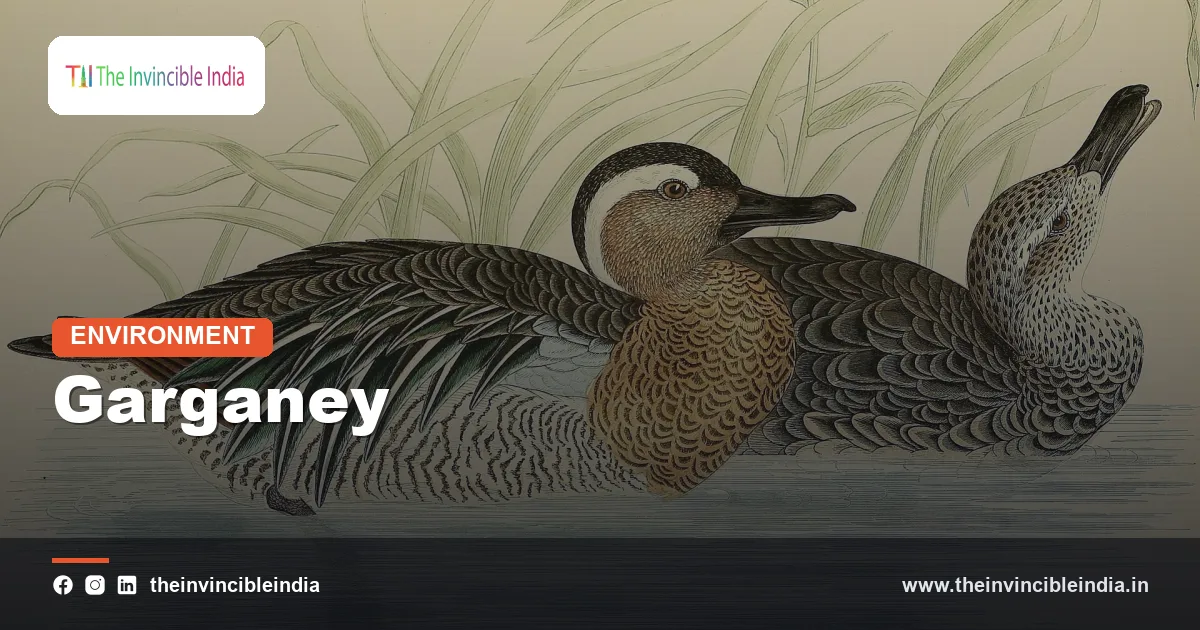
The garganey (Spatula querquedula) is a small, long-distance migratory teal that breeds across temperate Europe and Asia and arrives on Indian wetlands in very large numbers each winter, the male marked by a bold white crescent above the eye. Among the dabbling ducks of the Old World, the garganey is unusual for travelling all the way to the tropics, and for many Indian birdwatchers its arrival in late summer is the first sign that the migratory season has begun.
This guide explains what the garganey is, how to tell males from females and the garganey from similar teals, when and where it is found in India, what it eats, how it breeds and migrates, and what threatens it. It also explains why this small duck is an important species for the management of India’s wetlands.
Quick Facts
| Attribute | Detail |
|---|---|
| Common name | Garganey |
| Scientific name | Spatula querquedula (earlier called Anas querquedula) |
| Family | Anatidae (ducks, geese and swans) |
| Group | Small dabbling duck (teal) |
| Length | About 37 to 41 cm |
| Wingspan | About 59 to 67 cm |
| Breeding range | Temperate Europe and Asia, from western Europe to Siberia |
| Time in India | Roughly late August or September to April |
| IUCN status | Least Concern |
Key Takeaways
- The garganey (Spatula querquedula) is a small dabbling duck, about the size of a teal, that breeds across temperate Eurasia and winters in large numbers in India and other warm regions.
- The male garganey is easily recognised by its brown head and breast, a broad white crescent stretching from the eye to the nape and a pale blue-grey patch on the forewing.
- The female garganey is a mottled brown duck with a boldly striped face, which makes it look very similar to a female Eurasian teal.
- The garganey is a long-distance migrant that begins arriving in India as early as late August or September, earlier than most winter ducks, and leaves by April.
- The garganey feeds on seeds, aquatic insects, snails and other small invertebrates, which it picks from the surface and shallow water.
- The garganey is classified as Least Concern by the IUCN, but it is vulnerable to wetland loss, pollution and hunting along its migration route.
What is the garganey?
The garganey is a small migratory duck of the family Anatidae that feeds at the water surface and in shallows rather than diving, which places it among the dabbling ducks or “surface-feeding” ducks. It is slightly larger than the Eurasian teal, with a similar compact body and a short neck. Recent classifications place the garganey in the genus Spatula, together with the shovelers and the blue-winged teals, although older texts list it in the genus Anas.
The garganey is unusual among ducks because it is a true long-distance migrant, travelling thousands of kilometres from its northern breeding areas to wintering grounds that include tropical Africa, South Asia and South-East Asia. The English name is thought to come from an Italian dialect word.
How do you identify a garganey?
A garganey is identified by its small size and, in the male, by a dark brown head with a conspicuous white crescent running from above the eye to the back of the neck, a brown breast, pale grey flanks and long, drooping black-and-white feathers over the back. In flight, the male shows a pale blue-grey forewing and a green wing patch edged with white.
The female is mottled brown and buff, with a pale stripe above a dark eye-line, a dark stripe below the eye, a whitish throat and a pale spot at the base of the bill. She is much harder to identify than the male. After breeding, the male moults into an eclipse plumage that resembles the female, though he usually retains the pale blue-grey forewing, and by late autumn he moults again into full colour.
Key field marks
- Male: dark brown head, broad white crescent from eye to nape, brown breast and finely barred grey flanks.
- Male: long black-and-white drooping scapular feathers and a pale blue-grey forewing.
- Female: brown mottled plumage, strongly striped face and a pale spot at the bill base.
- Small body with a flat-looking head and a straight grey bill.
- Male call: a dry, crackling rattle, often compared to a wooden ratchet.
How is the garganey different from the common teal?
The garganey differs from the Eurasian (common) teal mainly in its face pattern, the male’s white eye-stripe, its paler forewing and its slightly larger size. The two small ducks share wetlands in India through the winter and are often found in the same mixed flocks, so careful comparison is useful.
| Feature | Garganey | Eurasian teal |
|---|---|---|
| Male head | Brown with a long white crescent | Chestnut with a green eye-patch |
| Male flanks | Barred grey | Grey with a white horizontal stripe |
| Forewing | Pale blue-grey | Dark grey |
| Female face | Strongly striped, pale spot at bill base | Plainer, with a dark eye-line |
| Size | Slightly larger | Slightly smaller |
| Arrival in India | Early, from late summer | Mostly from October |
The garganey should also be told apart from the blue-winged teal of North America, which looks similar but rarely reaches India. For most observers in India, a small duck with a bold white eye-stripe is a male garganey.
In the field, the male garganey is often easiest to spot while it is swimming, when the white crescent shows as a bright line even at a distance. Females and eclipse males require more patience, and many experienced birders check the face pattern, the bill shape and the pale forewing before naming a bird. Listening for the male’s dry rattling call in spring can also help to pick out garganeys within a noisy mixed flock.
When does the garganey arrive in India?
The garganey arrives in India earlier than most winter ducks, with the first birds often appearing from late August or September, and it remains until about April. Numbers rise through autumn and peak in the cold months, and most birds leave for their northern breeding grounds by April.
This early arrival means that the garganey is often among the first migratory ducks recorded at wetlands each season. It also means that some birds may be seen moving through India on passage, heading towards wintering grounds further south or east, rather than staying. Spring departures can be seen at the same wetlands in March and April, when males are in full plumage and display to females before leaving.
Annual cycle
| Season | Typical location | Main activity |
|---|---|---|
| Spring and summer | Northern Eurasian marshes and meadows | Courtship, nesting and rearing young |
| Late summer and autumn | Moving south, including through India | Migration and arrival on wetlands |
| Winter | Indian lakes, jheels and rice fields | Feeding and pair formation |
| Early spring | Departing northward | Return migration |
Where is the garganey found in India?
The garganey is found across India wherever shallow, vegetated freshwater is available, and it is one of the most numerous wintering ducks of the Indian subcontinent. It occurs at large wetlands such as Keoladeo National Park in Rajasthan, Chilika Lake in Odisha, Nal Sarovar in Gujarat, Harike Wetland in Punjab and Kolleru Lake in Andhra Pradesh, and it also uses village tanks, reservoirs, marshes and flooded rice fields.
Because of its preference for shallow water with plenty of floating and emergent vegetation, the garganey often gathers in dense flocks in marshy corners of wetlands. It is a nervous bird that takes flight in tight, fast-moving groups when disturbed. Large flocks wheeling above a wetland at dawn or dusk are a common sight during the migration season.
Garganeys tend to roost together in tight flocks during the day on open water or in sheltered pools, and disperse to feed at dusk and during the night in rice fields and marshy margins. This habit means that the most dramatic flocks are often seen at dawn, when birds return to roosting lakes after a night of feeding.
What does the garganey eat?
The garganey eats a mixture of seeds, aquatic plants and small animals such as insects, insect larvae, snails and crustaceans, which it picks from the water surface and from shallows. It feeds by skimming, dabbling and dipping its head, and it rarely upends as deeply as larger ducks such as the gadwall.
In India the garganey also feeds in flooded fields and the margins of ponds, taking waste grain, weed seeds and insects. This varied diet allows it to use a wide range of wetlands, from clear lakes to shallow seasonal pools. By eating insect larvae, including those of mosquitoes and other aquatic insects, wintering ducks such as the garganey also contribute to the biological balance of wetlands.
How does the garganey breed and migrate?
The garganey breeds from late spring to summer on damp meadows, marshes and the edges of shallow lakes in temperate Europe and Asia, building a nest on the ground in dense vegetation. The female builds the nest, lays a clutch of cream-coloured eggs and incubates them for roughly three weeks, while the male usually leaves her once incubation begins.
The garganey migrates mostly at night and in flocks, using flyways that connect the northern breeding grounds with tropical wintering areas. Birds that winter in India largely come from Central Asia and Siberia and travel along the Central Asian Flyway, which crosses mountain ranges and deserts before reaching the subcontinent. Pair bonds often form on the wintering grounds, so the courtship displays visible in India in winter and early spring are part of the preparation for breeding far to the north.
Why does the garganey matter to Indian wetlands?
The garganey matters to Indian wetlands because it is one of the most abundant winter ducks and a sensitive indicator of wetland condition. Waterbird surveys, including the Asian Waterbird Census coordinated by Wetlands International and supported in India by groups such as the Bombay Natural History Society (BNHS), count ducks like the garganey to monitor trends in wetland quality.
The species depends on shallow, productive, well-vegetated wetlands, so its numbers reflect the health of those habitats. Protecting sites under the Ramsar Convention and national wetland rules benefits the garganey together with fish, amphibians, other waterbirds and the communities that depend on wetlands for water, fishing and farming. Because the garganey migrates between continents, effective conservation also needs cooperation among countries along the flyway.
Is the garganey threatened?
The garganey is not considered globally threatened, and the International Union for Conservation of Nature (IUCN) lists it as Least Concern because of its vast range and large population. However, some breeding populations, particularly in parts of Europe, have declined, and the species faces several pressures along its migration route.
- Drainage and conversion of marshes and shallow wetlands for farming and development.
- Pollution of wetlands by sewage, industrial discharge and agricultural chemicals.
- Hunting and trapping of migratory ducks in some regions.
- Disturbance and disease, including avian influenza outbreaks among wild waterbirds.
- Climate change, which can alter water levels and the timing of migration.
Maintaining shallow wetland networks, enforcing wildlife laws and monitoring duck populations are the main tools for keeping the garganey secure.
Citizen scientists can support garganey conservation by submitting dated and located counts to open databases, by reporting any signs of illegal trapping to forest or wildlife authorities, and by encouraging the protection of small village wetlands. Many of the ducks that fly over the Himalaya each year depend on such modest places to rest and feed.
Bottom Line
The garganey is a small, long-distance migratory teal that reaches India early and fills wetlands with flocks through the winter. It is secure as a species but depends on shallow, clean and well-vegetated wetlands at every stage of its journey. Spotting the male’s white eye-stripe is one of the easiest and most satisfying ways to start learning Indian ducks.
Frequently Asked Questions
Is the garganey a migratory bird in India?
Yes, the garganey is a migratory bird that visits India as a winter guest. It arrives early, often from late August or September, and leaves for its northern breeding grounds by about April.
How can you identify a male garganey?
A male garganey is identified by its dark brown head with a broad white crescent from the eye to the nape, brown breast, finely barred grey flanks and long black-and-white back feathers. In flight, it shows a pale blue-grey forewing and a green wing patch.
How is the garganey different from the common teal?
The garganey is slightly larger than the Eurasian teal and the male has a white crescent over the eye instead of the teal’s green eye-patch and chestnut head. The garganey also has a paler forewing and arrives in India earlier in the season.
What does the garganey eat?
The garganey eats seeds, aquatic plants and small animals such as insects, larvae, snails and crustaceans. It feeds by dabbling and skimming in shallow water and flooded fields rather than diving.
Where can you see garganeys in India?
Garganeys can be seen on shallow wetlands across India, including Keoladeo National Park, Chilika Lake, Nal Sarovar, Harike Wetland and Kolleru Lake. They also use village tanks, reservoirs and flooded fields during the winter.
Is the garganey an endangered species?
No, the garganey is not endangered, and the IUCN lists it as Least Concern. Its population is large and its range is vast, but wetland loss, pollution and hunting still affect local numbers.
{“@context”:”https://schema.org”,”@graph”:[{“@type”:”FAQPage”,”mainEntity”:[{“@type”:”Question”,”name”:”Is the garganey a migratory bird in India?”,”acceptedAnswer”:{“@type”:”Answer”,”text”:”Yes, the garganey is a migratory bird that visits India as a winter guest. It arrives early, often from late August or September, and leaves for its northern breeding grounds by about April.”}},{“@type”:”Question”,”name”:”How can you identify a male garganey?”,”acceptedAnswer”:{“@type”:”Answer”,”text”:”A male garganey is identified by its dark brown head with a broad white crescent from the eye to the nape, brown breast, finely barred grey flanks and long black-and-white back feathers. In flight, it shows a pale blue-grey forewing and a green wing patch.”}},{“@type”:”Question”,”name”:”How is the garganey different from the common teal?”,”acceptedAnswer”:{“@type”:”Answer”,”text”:”The garganey is slightly larger than the Eurasian teal and the male has a white crescent over the eye instead of the teal’s green eye-patch and chestnut head. The garganey also has a paler forewing and arrives in India earlier in the season.”}},{“@type”:”Question”,”name”:”What does the garganey eat?”,”acceptedAnswer”:{“@type”:”Answer”,”text”:”The garganey eats seeds, aquatic plants and small animals such as insects, larvae, snails and crustaceans. It feeds by dabbling and skimming in shallow water and flooded fields rather than diving.”}},{“@type”:”Question”,”name”:”Where can you see garganeys in India?”,”acceptedAnswer”:{“@type”:”Answer”,”text”:”Garganeys can be seen on shallow wetlands across India, including Keoladeo National Park, Chilika Lake, Nal Sarovar, Harike Wetland and Kolleru Lake. They also use village tanks, reservoirs and flooded fields during the winter.”}},{“@type”:”Question”,”name”:”Is the garganey an endangered species?”,”acceptedAnswer”:{“@type”:”Answer”,”text”:”No, the garganey is not endangered, and the IUCN lists it as Least Concern. Its population is large and its range is vast, but wetland loss, pollution and hunting still affect local numbers.”}}]}]}


