

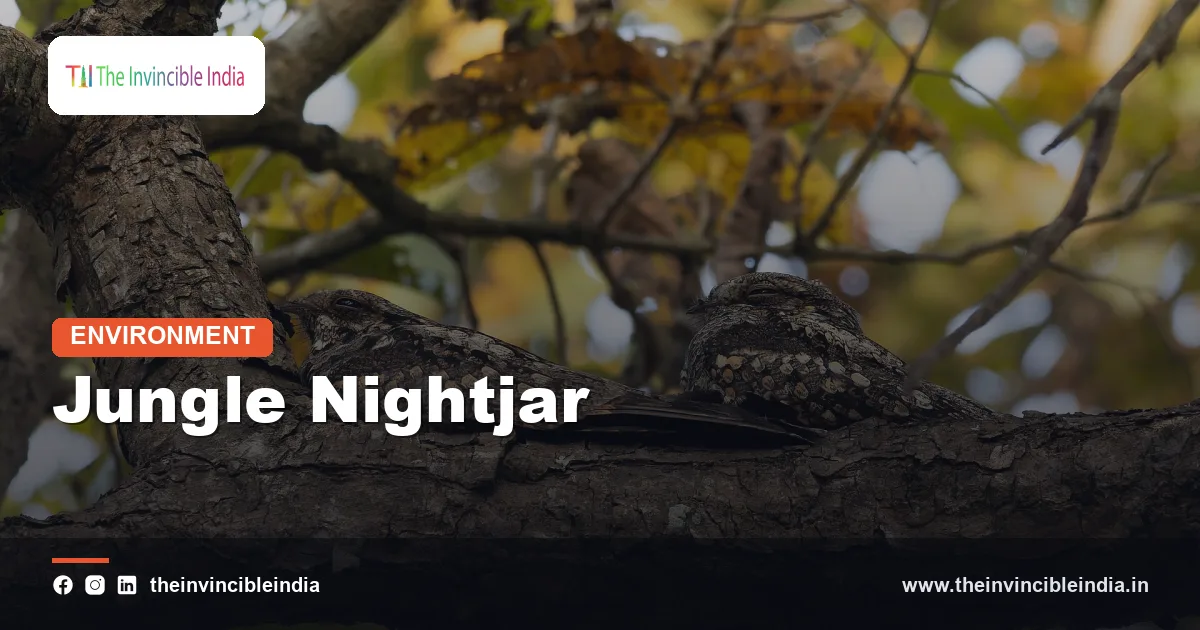
The jungle nightjar (Caprimulgus indicus) is a medium-sized, grey-brown, nocturnal bird of Indian forests, scrub and rocky hills that hunts flying insects at dusk and dawn and spends the day motionless on the ground or along a branch, hidden by bark-like plumage. Belonging to the nightjar family Caprimulgidae, the jungle nightjar is far more often heard than seen, and many birdwatchers meet it only as a pair of glowing eyes on a forest track after dark.
Across India the jungle nightjar occupies a wide belt from the Himalayan foothills to the peninsular hills and the Western and Eastern Ghats. This explainer covers how to identify the jungle nightjar, where it lives, what it eats, how it breeds, how it differs from other Indian nightjars and what its conservation status is.
Quick Facts
| Common name | Jungle nightjar |
|---|---|
| Scientific name | Caprimulgus indicus |
| Family | Caprimulgidae (nightjars) |
| Size | About 28 to 33 cm in length |
| Habitat | Open forest, scrub, plantations and rocky or hilly country with leaf litter |
| Activity | Nocturnal and crepuscular (active at dusk, night and dawn) |
| Diet | Flying insects, mainly moths and beetles, caught in flight |
| Nest | None built; two eggs laid directly on bare ground or leaf litter |
| IUCN status | Least Concern |
Key Takeaways
- The jungle nightjar (Caprimulgus indicus) is a nocturnal Indian bird of the nightjar family that catches moths and other flying insects in the air at dusk, night and dawn.
- A jungle nightjar builds no nest; the female lays about two eggs directly on bare ground or leaf litter, where their blotched colouring blends with the surroundings.
- The call of the jungle nightjar is a loud series of hollow, repeated notes, often compared to a piece of wood being tapped, delivered from dusk into the night.
- By day a jungle nightjar sits still on the ground or lengthwise on a branch, and its mottled grey-brown plumage makes it almost invisible against bark and dry leaves.
- The jungle nightjar is listed as Least Concern by the IUCN because of its very wide range across Asia, although local numbers can fall where forests, scrub and roadside habitats are lost.
- Reflected eyeshine in torchlight or vehicle headlights is the most common way people first notice a jungle nightjar sitting on a forest road.
What is the jungle nightjar?
The jungle nightjar is a cryptically coloured, long-winged, short-legged bird that belongs to the order Caprimulgiformes and the family Caprimulgidae, a group of night-flying insect hunters found on every continent except Antarctica. The scientific name Caprimulgus indicus was assigned in the late eighteenth century by the English ornithologist John Latham.
The English family name “nightjar” refers to the jarring, mechanical sound of many species, while the older name “goatsucker” comes from the mistaken old belief that these birds drank milk from goats at night. The belief arose because nightjars were seen near grazing animals, where insects gather. Nightjars do not suck milk; they feed entirely on insects.
Taxonomists have debated how the jungle nightjar relates to the closely similar birds of northern and eastern Asia, which are sometimes treated as a separate species called the grey nightjar (Caprimulgus jotaka). Checklists differ on this point, so the exact scientific boundary of the jungle nightjar depends on the authority consulted.
How can you identify a jungle nightjar?
A jungle nightjar can be identified as a fairly large, long-tailed nightjar with finely vermiculated grey-brown upperparts, a dark-streaked crown, a pale buff collar on the hindneck and, in males, a white patch on the throat and white patches near the tips of the outer tail feathers. These marks are often hard to see, because the bird rarely allows a close approach in daylight.
Plumage and shape
The jungle nightjar has soft, owl-like plumage in shades of grey, buff, chestnut and black, patterned with streaks, bars and speckles that imitate dead leaves and bark. The head is broad and flat, the eyes are large and dark, and the bill is tiny but opens into a very wide gape fringed with stiff bristles. The wings are long and pointed, and the tail is relatively long and rounded.
Differences between the sexes
Male jungle nightjars show clear white spots on the outer tail feathers and a white or pale throat patch that is visible when the bird calls or takes off. Females are duller, with buff rather than white markings. This difference helps observers who photograph a bird in flight at dusk to judge its sex.
Other useful field marks
- A wide mouth with rictal bristles that help funnel insects into the gape.
- Very short legs and small feet, which make the bird sit low and flat rather than perch upright.
- A serrated middle claw, called a pectinate claw, used for preening and grooming the bristles.
- Orange to reddish eyeshine when a torch or headlight beam strikes the eye.
Where is the jungle nightjar found in India?
The jungle nightjar is found across much of India, from the Himalayan foothills and lower mountain slopes through the Gangetic plains edges, central India and the Eastern and Western Ghats to the southern peninsula, wherever dry leaf litter, open ground and scattered trees are available. Its overall range extends well beyond India into other parts of South and Southeast Asia.
Some populations stay in the same region through the year, while others move seasonally. Birds that breed in cooler northern or higher areas may shift to warmer lowlands in winter. Because nightjars are so hard to detect, the exact seasonal movements are poorly documented, and field reports from local birdwatchers form much of the evidence.
Preferred habitats
The jungle nightjar prefers dry deciduous and moist deciduous forest, forest edges, bamboo groves, scrubby hillsides, tea and coffee plantations with open ground, and rocky country with scattered trees. It avoids dense, closed evergreen forest and very open treeless plains. Forest tracks, fire lines and dry stream beds are favoured, because open ground offers both hunting space and warm surfaces to rest on.
What does the jungle nightjar eat and how does it hunt?
The jungle nightjar eats flying insects, chiefly moths, beetles, termite alates, flying ants and other night-flying arthropods, which it catches in mid-air with its wide gape. The bird hunts mostly at twilight and on moonlit nights, when enough light remains to spot silhouettes against the sky.
A hunting jungle nightjar either sallies out in short, buoyant flights from a low perch or the ground, or patrols a forest clearing with silent, wheeling flight. The soft feather surface muffles the sound of the wings, so prey is not alerted. The bristles around the bill are thought to help guide insects into the mouth and may protect the eyes.
- Main prey: moths, beetles, grasshoppers that fly, and winged termites.
- Hunting times: dusk, the early part of the night, and before sunrise.
- Method: aerial hawking from the ground, a low perch or in sustained flight over open patches.
- Ecological role: controls populations of night-flying insects, including some that damage crops and plantations.
Nightjars regularly sit on warm tarmac or dirt tracks at night, because insects gather in vehicle headlight beams and the ground holds heat. This habit exposes the jungle nightjar to collisions with vehicles, one of the commonest causes of individual mortality in forest areas with night traffic.
What does a jungle nightjar sound like?
The call of the jungle nightjar is a loud, repeated, hollow series of notes, usually rendered by birdwatchers as a rapid “chunk, chunk, chunk” or “tuk, tuk, tuk”, often described as the sound of a stick or hard object tapping on a hollow log. The sequence is repeated for long stretches without a change in pitch and may continue for several minutes.
It differs from the long, continuous, reeling churr that is typical of the Eurasian nightjar (Caprimulgus europaeus), which occurs in northern and western India mainly as a passage and winter visitor. The jungle nightjar calls most actively at dusk and again before dawn, and calling often increases on bright moonlit nights.
Calling serves to advertise a territory to rival males and to attract females during the breeding season. Males also use wing claps and short display flights close to the ground or the perch during courtship. Sound is the single most reliable way to confirm a jungle nightjar in an area, and recordings uploaded to community bird databases have helped map its distribution.
How does the jungle nightjar breed?
The jungle nightjar breeds by laying about two eggs directly on bare ground, on a scrape in leaf litter or among small stones, without building any nest. The breeding season in India varies with region and rainfall, but generally falls in the warm, dry months from about March to June in many areas.
The eggs are pale pinkish or creamy with fine brown and grey blotches, which makes them nearly invisible on a forest floor. The female does most of the incubation, which lasts roughly two to three weeks, and both parents help look after the chicks. Newly hatched chicks are covered in down, are well camouflaged and are able to shuffle short distances, so they can leave an exposed scrape when disturbed.
An adult nightjar sitting on eggs relies on stillness until the last moment and then flushes only when a person nearly steps on it. Some nightjars perform a distraction display, fluttering away as if injured to lead a predator from the eggs. Because the nesting site is the open ground, the eggs are at risk from stray dogs, snakes, monitor lizards, forest fires and trampling by livestock.
Why is the jungle nightjar so hard to see?
The jungle nightjar is hard to see because its plumage is a precise match for dead leaves, bark and soil, and because the bird freezes in daylight instead of flying away. This strategy is called crypsis and is the main defence of a bird that has no weapons and roosts in the open.
When roosting on a branch, the jungle nightjar sits along the length of the branch rather than across it, which makes its outline resemble a broken stub or a knot. When on the ground, it presses its body flat, narrows its eyes to slits and keeps its head still so that its dark eyes do not reveal it. Many birdwatchers find a roosting nightjar only when it flushes from a few metres away.
The species also tends to return to the same favoured roost sites, so a patch of leaf litter under a particular tree can hold a nightjar for weeks. Experienced guides in Indian forests learn to scan for eyeshine at night and for the subtle outline of a bird sitting on a path at dawn.
How is the jungle nightjar different from other Indian nightjars?
The jungle nightjar differs from other Indian nightjars mainly in its larger size, darker and more heavily patterned plumage, its forest-edge habitat and its repeated “chunk” call. Several nightjar species occur in India, and separating them often depends on call, habitat and tail patterns rather than general colour.
| Species | Typical habitat in India | Distinguishing feature |
|---|---|---|
| Jungle nightjar (Caprimulgus indicus) | Forest, scrub, hills | Larger and darker, repeated hollow “chunk” notes |
| Indian nightjar (Caprimulgus asiaticus) | Open scrub, dry plains, village outskirts | Smaller, call like a stone skipping on ice |
| Large-tailed nightjar (Caprimulgus macrurus) | Moist forest, plantations, wetter regions | Long tail, rolling “tchok” call, often near water or wet forest |
| Savanna nightjar (Caprimulgus affinis) | Rocky hills, open ground | Pale, with a distinctive wheezing call |
| Sykes’s nightjar (Caprimulgus mahrattensis) | Dry, semi-arid country in the north-west and west | Pale, sandy plumage, a long, accelerating churr |
The jungle nightjar often shares its range with these species, and in some forests two or more nightjar species can be heard on the same evening. Distinguishing them benefits from listening carefully and noting the habitat, which is why birdwatchers often rely on recordings made with a phone or recorder.
Is the jungle nightjar threatened in India?
The jungle nightjar is not considered globally threatened, and the International Union for Conservation of Nature (IUCN) lists it as Least Concern because of its large range and wide habitat tolerance. Like most Indian wild birds, it is protected under the Wildlife (Protection) Act, 1972, which prohibits hunting and trade in wild birds.
Local threats nevertheless exist. They include conversion of scrubby forest and plantations to farmland or housing, forest fires during the nesting months, collision with vehicles on night roads, loss of insect prey due to pesticide use and bright artificial light that disrupts night activity. Stray dogs and feral cats add pressure on ground nests near settlements.
How can birdwatchers observe nightjars responsibly?
- Use a dim red or low-power torch and avoid shining a bright light directly into the eyes for long periods.
- Do not flush a bird from a suspected nest site, especially between March and June.
- Slow down on forest roads at night so birds that sit on tarmac are not hit.
- Avoid playing recorded calls repeatedly, which stresses territorial birds during breeding.
- Record sightings and sounds on community platforms such as eBird so that distribution data improves.
Bottom Line
The jungle nightjar is a quiet, camouflaged insect hunter of Indian forests and scrub whose repeated wooden call, ground nesting and roadside eyeshine define its identity. It is widespread and listed as Least Concern, but its ground nests and night-time habits make it vulnerable to fire, traffic and habitat change.
Frequently Asked Questions
What is a jungle nightjar?
A jungle nightjar is a nocturnal, insect-eating bird of the family Caprimulgidae that lives in forests, scrub and hills across India and much of Asia. It has mottled grey-brown plumage that provides excellent camouflage when it rests on the ground or along a branch.
What does the jungle nightjar eat?
The jungle nightjar eats flying insects, mostly moths, beetles and winged termites, which it catches in flight with its wide mouth. It hunts mainly at dusk, at night and just before dawn.
Why do nightjars sit on roads at night?
Nightjars sit on roads because the surface retains daytime heat and insects gather in vehicle headlight beams, so the birds find easy prey and warmth. This habit also puts them at risk from passing vehicles.
How does a jungle nightjar call?
The jungle nightjar gives a loud, repeated series of hollow notes, often written as “chunk, chunk, chunk” or “tuk, tuk, tuk”. Birdwatchers compare the sound to a stick tapping on hollow wood, and it is heard mainly at dusk, night and before dawn.
Does the jungle nightjar build a nest?
No, the jungle nightjar builds no nest. The female lays about two camouflaged eggs directly on bare ground or leaf litter, where she incubates them herself for roughly two to three weeks.
Is the jungle nightjar a protected bird in India?
Yes, the jungle nightjar is protected in India under the Wildlife (Protection) Act, 1972, which prohibits hunting and trade in wild birds. The IUCN assesses the species as Least Concern globally because of its wide range.
{“@context”:”https://schema.org”,”@graph”:[{“@type”:”FAQPage”,”mainEntity”:[{“@type”:”Question”,”name”:”What is a jungle nightjar?”,”acceptedAnswer”:{“@type”:”Answer”,”text”:”A jungle nightjar is a nocturnal, insect-eating bird of the family Caprimulgidae that lives in forests, scrub and hills across India and much of Asia. It has mottled grey-brown plumage that provides excellent camouflage when it rests on the ground or along a branch.”}},{“@type”:”Question”,”name”:”What does the jungle nightjar eat?”,”acceptedAnswer”:{“@type”:”Answer”,”text”:”The jungle nightjar eats flying insects, mostly moths, beetles and winged termites, which it catches in flight with its wide mouth. It hunts mainly at dusk, at night and just before dawn.”}},{“@type”:”Question”,”name”:”Why do nightjars sit on roads at night?”,”acceptedAnswer”:{“@type”:”Answer”,”text”:”Nightjars sit on roads because the surface retains daytime heat and insects gather in vehicle headlight beams, so the birds find easy prey and warmth. This habit also puts them at risk from passing vehicles.”}},{“@type”:”Question”,”name”:”How does a jungle nightjar call?”,”acceptedAnswer”:{“@type”:”Answer”,”text”:”The jungle nightjar gives a loud, repeated series of hollow notes, often written as “chunk, chunk, chunk” or “tuk, tuk, tuk”. Birdwatchers compare the sound to a stick tapping on hollow wood, and it is heard mainly at dusk, night and before dawn.”}},{“@type”:”Question”,”name”:”Does the jungle nightjar build a nest?”,”acceptedAnswer”:{“@type”:”Answer”,”text”:”No, the jungle nightjar builds no nest. The female lays about two camouflaged eggs directly on bare ground or leaf litter, where she incubates them herself for roughly two to three weeks.”}},{“@type”:”Question”,”name”:”Is the jungle nightjar a protected bird in India?”,”acceptedAnswer”:{“@type”:”Answer”,”text”:”Yes, the jungle nightjar is protected in India under the Wildlife (Protection) Act, 1972, which prohibits hunting and trade in wild birds. The IUCN assesses the species as Least Concern globally because of its wide range.”}}]}]}


