

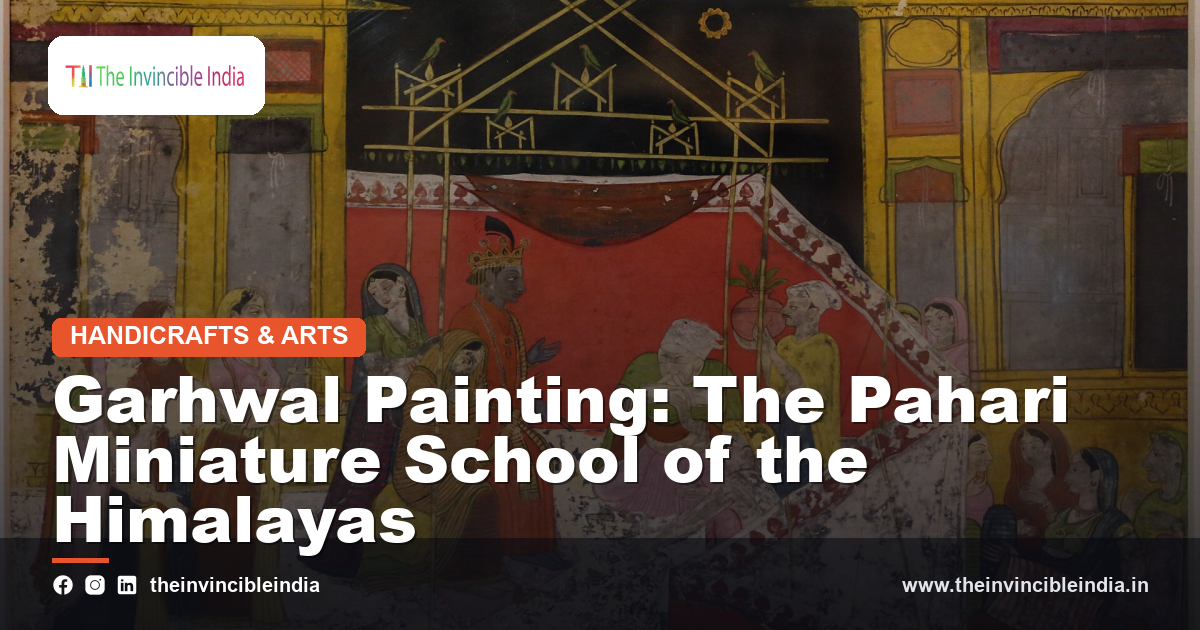
Garhwal painting is the miniature painting tradition of the former Garhwal kingdom in the central Himalayas, today part of Uttarakhand. It is one of the regional branches of Pahari painting, the family of hill schools that also includes Basohli, Guler, Kangra and Chamba, and it is often called the Garhwal school or the Garhwal miniature. The school is remembered for delicate line, soft colour, lyrical landscapes and a gentle, poetic treatment of devotional and romantic themes. Unlike the village wall art of Madhubani painting, Garhwal art belongs to the courtly world of small, finely finished paintings on paper made for hill rulers.
Quick answer: Garhwal painting is a school of Indian miniature painting that flourished in the Garhwal region of the Himalayas, now in Uttarakhand, as part of the wider Pahari or hill tradition. Its small, finely drawn paintings on paper show poetic and devotional subjects, portraits and Himalayan landscapes in soft, harmonious colour. Mola Ram is the best-known artist associated with the school, and its works are studied and displayed in museums as a high point of hill painting.
Key Takeaways
- Garhwal painting is a school of Pahari miniature painting from the Garhwal region of Uttarakhand.
- It is also called the Garhwal school or Garhwal miniature and belongs to the wider Pahari or hill painting family.
- Mola Ram is the most celebrated painter and poet linked with the Garhwal school.
- Typical subjects include Radha and Krishna, heroines in love, portraits of rulers and scenes of Himalayan nature.
- The paintings are small works in opaque water-based colour on paper, finished with fine line and detail.
- Garhwal paintings are preserved in museums and private collections as important examples of Indian miniature art.
The sections below explain the origins, artists, subjects, technique and continuing influence of this school.
Quick Facts
| Detail | Information |
|---|---|
| Type | Miniature painting on paper |
| Region | Garhwal Himalayas, Uttarakhand |
| School | Pahari (hill) painting |
| Best-known artist | Mola Ram |
| Typical themes | Radha-Krishna, heroines, portraits, landscapes |
| Medium | Opaque water-based colour on paper |
What Is Garhwal Painting?
Garhwal painting is a school of miniature painting that developed in the Garhwal kingdom of the Himalayas and forms part of the larger Pahari tradition. The word Pahari simply means of the hills, and it refers to the courts of the western and central Himalayan region where painters worked for local rulers. Garhwal works are small in scale, carefully drawn and richly coloured, and they usually depict a single scene with graceful figures set against a stylised landscape. The school is admired for its calm mood, its sensitivity to nature and its refined handling of line. Garhwal painting is therefore understood as a distinct regional expression within Indian miniature art, shaped by hill courts and mountain scenery.
Where Did Garhwal Painting Develop?
Garhwal painting developed in the hill kingdom of Garhwal, whose court was long associated with the town of Srinagar on the Alaknanda river. The region lies in the central Himalayas, with river valleys, forested slopes and distant snow peaks that appear again and again in the paintings. Rulers of Garhwal, like other hill chiefs, supported painters and poets as part of court life. The kingdom stood within a wider cultural zone that connected it with other hill states and with the plains. This setting gave artists both patrons and subjects, since the mountain landscape itself became a recurring element of the pictures. Garhwal painting is thus rooted in a specific Himalayan homeland.
How Did Garhwal Painting Begin?
The beginnings of Garhwal painting are linked in tradition with painters who came to the hills from the plains and from neighbouring courts, bringing Mughal-influenced skills with them. Local accounts often connect the arrival of such artists with a period of political upheaval in the seventeenth century, although the details are debated and scholars treat popular stories with care. What is generally accepted is that the Garhwal school grew out of the wider Pahari tradition and took on its own character over time. Painters blended earlier court training with local taste and landscape. This fusion produced a style that was recognisably hill painting yet distinct from its neighbours. The origins of Garhwal art are therefore best described as a gradual meeting of outside influence and local talent.
Who Was Mola Ram?
Mola Ram is the most famous name associated with the Garhwal school and is remembered as a painter, poet and chronicler of his court. He belonged to a family of artists who served the rulers of Garhwal over several generations, and his work is often taken to represent the high point of the school. Mola Ram is credited with paintings of great charm, as well as with verses in the local literary tradition. Historians and art writers have given him a central place in studies of Pahari painting, although scholars differ on how some individual works should be attributed. His reputation rests on the lyrical quality of his figures and landscapes. Mola Ram is thus the emblem of Garhwal painting at its most accomplished.
What Subjects Does Garhwal Painting Show?
Garhwal painting shows a wide but harmonious range of subjects drawn from devotion, poetry and court life. Scenes of Radha and Krishna are among the best loved, along with episodes from the Bhagavata Purana and other Hindu texts. Another major group presents the nayika, the idealised heroine of Indian poetry, shown in different moods of love and longing. Portraits of rulers and nobles record the people who supported the arts, while hunting scenes and festival gatherings add variety. Himalayan nature appears throughout as trees, streams and clouds. Taken together, these subjects reveal a school that combined devotion, romance and observation, and that treated landscape as an emotional partner to the figures.
What Makes the Garhwal Style Distinctive?
The Garhwal style is distinctive for its soft modelling, delicate line and gentle, lyrical atmosphere. Faces are refined, with elongated eyes and a calm expression, and bodies move with a flowing grace that suits the poetic themes. Landscapes are rendered with unusual attention, often with layered hills, flowering trees and rivers set behind the figures. Colour is harmonious rather than harsh, with soft greens, blues and warm earth tones balanced against touches of brighter accents. The composition tends to feel serene and unhurried. These qualities set the school apart from the bolder palette of earlier hill schools and give Garhwal painting its characteristic gentleness. The style is therefore recognised as quiet, romantic and deeply tied to the mountain setting.
How Is a Garhwal Miniature Painted?
A Garhwal miniature is painted in stages on paper, following the long-established workshop methods of Indian miniature art. The artist first prepares a sheet of paper and draws the composition in outline, often in a light colour, and then corrects and refines the lines. Flat washes of colour are laid down, followed by successive layers that build depth and detail. Fine brushes are used for faces, jewellery, plants and architecture, and the final stage adds the sharpest lines and highlights. Work of this kind is slow and demands steady hands, patient observation and a trained eye for balance. Each painting therefore reflects hours of careful craft, and the finished surface shows a smooth, jewel-like finish typical of the best miniature work.
What Materials Are Used in Garhwal Painting?
Garhwal painting uses materials common to the Indian miniature tradition, chosen for their fineness and durability. The support is paper, often made from layered sheets that are polished to a smooth surface. Colours are traditionally prepared from minerals and vegetable sources, ground into fine powder and mixed with a binder to make opaque water-based paint. Brushes are very fine, made from animal hair set in a small handle so that thin lines can be drawn with control. Gold and other metallic touches may be added to ornaments and details in some works. The use of such materials gives the paintings a luminous quality that has survived for generations. Material and method together explain the lasting freshness of many old Garhwal pictures.
How Does Garhwal Painting Relate to Other Pahari Schools?
Garhwal painting is closely related to the other Pahari schools, including Basohli, Guler, Kangra and Chamba, and it shares their courtly outlook and small scale. The schools influenced one another through the movement of artists and families between hill courts. Scholars often point to the refined naturalism of the Guler and Kangra tradition as an important background to the Garhwal manner. At the same time, Garhwal artists developed their own handling of landscape and their own gentle mood. The relationship was one of exchange rather than copying, with each court adding something of its own. For this reason Garhwal painting is best understood as a regional voice within a shared hill tradition, connected to its neighbours yet independent in spirit.
Why Is Garhwal Painting Important?
Garhwal painting is important because it preserves the artistic and literary culture of a Himalayan kingdom in visual form. The paintings record how people dressed, how courts were arranged and how poetry and devotion were imagined in the hills. They also show the high level of skill reached by regional artists outside the great plains capitals. As part of Pahari art, Garhwal works contribute to the wider story of Indian miniature painting, which is one of the major achievements of South Asian art. The school keeps alive the names of painters and the memory of local patrons who valued beauty. Its importance lies both in artistic quality and in cultural testimony, which is why museums and scholars continue to study it.
What Role Did Poetry and Devotion Play?
Poetry and devotion shaped nearly every aspect of Garhwal painting, since many pictures illustrate or respond to verse. The love of Radha and Krishna, a central theme of medieval Indian devotional poetry, offered painters a language for expressing longing, union and joy. Heroines in different emotional states reflect the classification of moods found in Sanskrit and vernacular poetics. Painting and poetry therefore worked together, and some artists, Mola Ram among them, were poets as well as painters. The pairing gave the pictures a literary depth beyond simple decoration. Viewers were expected to recognise the verse behind the image and to feel its mood. In this way, Garhwal painting stands as a visual form of the poetic and devotional culture of the Himalayan courts.
How Are Landscapes Treated in Garhwal Paintings?
Landscapes in Garhwal paintings are treated with affection and close observation, and they often carry as much feeling as the figures. Hills rise in soft layers, rivers curve through valleys, and trees such as flowering branches and tall groves frame the scene. The sky may hold clouds, birds or the glow of evening, and these details support the emotional tone of the picture. The setting is stylised rather than literal, yet it clearly recalls the real Himalayan world that surrounded the painters. Nature is not mere background but a companion to the human story. This sensitive handling of landscape is one of the features most often praised in the school, and it gives the paintings their calm, poetic atmosphere.
How Did Patronage Support the Art?
Patronage by the ruling family and court supported the work of Garhwal painters and allowed families of artists to practise their craft across generations. Painters were commissioned to make portraits, devotional scenes and illustrations, and they worked in workshops where skills were handed from elder to younger members. The court provided both income and an audience that appreciated refined work. Hill states were small, so patronage depended on the fortunes and tastes of individual rulers, and the arts rose and fell with political change. Even so, the family workshop system kept the techniques alive. Patronage and apprenticeship together explain how a high standard of miniature painting could be sustained in a remote Himalayan setting for a long period.
Where Can Garhwal Paintings Be Seen?
Garhwal paintings can be seen in museums and collections in India and abroad, where they are displayed as examples of Pahari miniature art. Public museums with Indian art collections often hold hill paintings, and regional institutions in Uttarakhand present local heritage to visitors. Exhibitions and published catalogues of Pahari painting regularly include Garhwal works alongside those of other hill schools. Because miniatures are sensitive to light and handling, many are shown for limited periods or reproduced in books and digital archives. Anyone interested in the school can therefore study it through both museum visits and printed or online resources. Access to these collections keeps the memory of the school public and allows new viewers to appreciate the quality of the original paintings.
How Has Garhwal Painting Been Studied?
Garhwal painting has been studied by art historians who examine style, attribution and the social setting of the hill courts. Early twentieth-century writers helped bring Pahari painting to wider attention, and later scholars refined the picture by comparing paintings, inscriptions and family records. Some questions, such as the exact authorship of certain works and the early history of the school, remain debated, and responsible writers say so openly. Study of the school also draws on literature, since many pictures illustrate texts. This long scholarly interest has raised the profile of Garhwal art and secured its place in the history of Indian painting. Research continues to add detail, which means that understanding of the school is still growing.
Garhwal Painting Today
Garhwal painting today lives through museum collections, scholarship, art education and the work of contemporary artists who draw on Pahari themes. The classical court school is no longer an active royal workshop, but its images and ideas continue to inspire painters, designers and students of Indian art. Reproductions appear in books, prints and cultural events, and the Himalayan landscape that the old painters loved remains a living inspiration. Interest in miniature painting more broadly has encouraged new attention to regional schools such as Garhwal. The tradition endures as a reminder of the refinement achieved in the hill courts, and it continues to be appreciated as one of the gentle, poetic voices of Indian art.
Sources & Further Reading
- Ministry of Culture, Government of India (indiaculture.gov.in).
- National Museum, New Delhi (nationalmuseumindia.gov.in).
Frequently Asked Questions
What is Garhwal painting?
Garhwal painting is a school of Indian miniature painting from the Garhwal region of the Himalayas, now in Uttarakhand, and a branch of the wider Pahari or hill tradition. It is known for small, finely drawn paintings with soft colour, lyrical landscapes and poetic subjects.
Who is the most famous Garhwal painter?
Mola Ram is the most famous painter associated with the Garhwal school. He is remembered as both a painter and a poet who served the court of Garhwal, and his work is often seen as the high point of the school.
Where did Garhwal painting develop?
Garhwal painting developed in the former hill kingdom of Garhwal in the central Himalayas, with its court long linked to Srinagar on the Alaknanda river. The region is part of present-day Uttarakhand.
What subjects are shown in Garhwal paintings?
Garhwal paintings show Radha and Krishna, episodes from Hindu texts, idealised heroines in different moods, portraits of rulers and scenes of Himalayan nature. Landscape plays an important emotional role in many pictures.
What is the difference between Garhwal and Kangra painting?
Garhwal and Kangra are both Pahari schools, but they belong to different hill regions and have different local characters. Kangra is noted for its refined naturalism and delicate beauty, while Garhwal is noted for its gentle, lyrical mood and sensitive landscapes.
How are Garhwal miniatures made?
Garhwal miniatures are made on paper with fine brushes and opaque water-based colours prepared from minerals and vegetable sources. The artist draws an outline, lays flat colour and then adds layers of detail and fine lines.


