

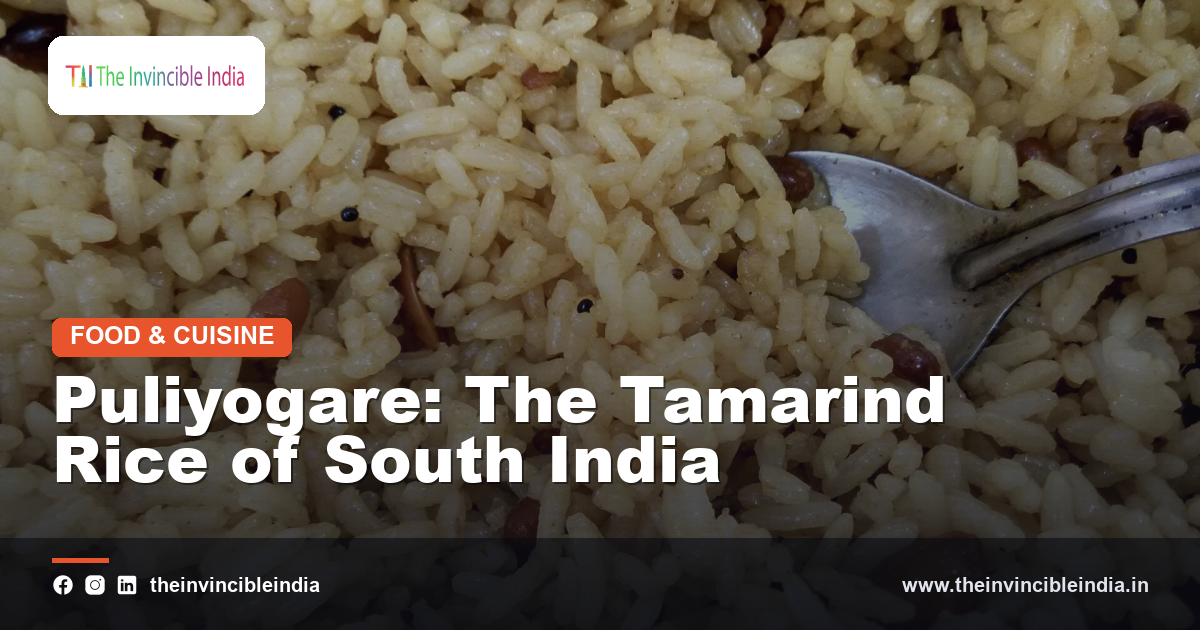
Puliyogare, also spelled puliyogara and known in Tamil Nadu as puliyodarai or puliyotharai and in Andhra Pradesh and Telangana as pulihora, is a tangy, spiced tamarind rice that sits at the heart of South Indian everyday and temple cooking. Rice is tossed with a cooked paste of tamarind, chillies, sesame and roasted spices, then finished with a crackling tempering of mustard, peanuts and curry leaves. As the guide to Indian spices shows, the cuisine of the south relies on balanced layers of sour, hot and nutty flavours, and puliyogare demonstrates that balance on a single plate. This guide explains what the dish is, how it is prepared and why it remains a favourite offering and travel meal.
Quick answer: Puliyogare is a South Indian rice dish in which cooked rice is mixed with a spiced tamarind paste and a tempering of mustard seeds, peanuts, lentils and curry leaves. It is also called puliyodarai, puliyotharai or pulihora and is widely offered as temple prasadam in Karnataka, Tamil Nadu, Andhra Pradesh and Telangana. Its sour, spicy and nutty taste and good keeping quality make it a classic travel meal.
Key Takeaways
- Puliyogare is a tamarind-flavoured rice dish found across Karnataka, Tamil Nadu, Andhra Pradesh and Telangana.
- Its alternative names include puliyodarai, puliyotharai, pulihora and tamarind rice.
- The base flavour comes from a cooked paste of tamarind, dried red chillies, sesame, fenugreek and other roasted spices.
- Sesame oil, mustard seeds, peanuts, chana dal, urad dal and curry leaves form the traditional tempering.
- The dish is commonly distributed as prasadam in temples, especially in the Iyengar and Vaishnava traditions.
- Tamarind and oil help the rice stay fresh for hours, which makes puliyogare a popular meal for journeys and picnics.
Read on for the ingredients, method, serving customs, and cultural role in detail.
Quick Facts
| Detail | Information |
|---|---|
| Dish | Puliyogare (puliyodarai, pulihora, tamarind rice) |
| Type | Spiced rice, mixed rice dish |
| Region | Karnataka, Tamil Nadu, Andhra Pradesh, Telangana |
| Main flavouring | Tamarind, red chilli, sesame, roasted spices |
| Typical tempering | Mustard, peanuts, chana dal, urad dal, curry leaves |
| Cultural role | Temple prasadam, festival food and travel meal |
What is puliyogare?
Puliyogare is a mixed rice dish in which cooked rice is combined with a sour and spicy tamarind paste and a tempering of whole spices, nuts and lentils. It belongs to the family of South Indian variety rices, alongside lemon rice, coconut rice and curd rice, but it is the most strongly flavoured of them. The name comes from the Tamil word puli, meaning tamarind, and the dish is therefore literally tamarind rice. Each grain is coated in a dark brown, glossy masala that is tangy, warm and slightly sweet. The dish can be eaten on its own, with a side of papad or raita, or as part of a larger meal. Puliyogare is thus both an everyday comfort food and a ceremonial dish in the culinary life of the south.
What are the other names for puliyogare?
Puliyogare is known by several regional names, including puliyodarai and puliyotharai in Tamil Nadu, pulihora in Andhra Pradesh and Telangana, and puliogare or puliyogara in Karnataka. Tamarind rice is the common English description used in restaurants and on menus. Although the spellings and pronunciations differ, all the names point to the same idea of rice flavoured with tamarind. In Telugu households the word pulihora often covers a slightly different style, usually with more turmeric and a lighter paste, while in Karnataka the term puliyogare frequently refers to the darker rice made with a ready spice powder. Knowing the alternative names helps a reader recognise the dish when travelling through the southern states, where one dish may appear under three or four labels.
Where does puliyogare come from?
Puliyogare comes from the southern Indian states, where tamarind has long been a central souring agent in cooking. The dish is associated especially with Karnataka, Tamil Nadu and the Telugu-speaking regions, and each of these claims it as part of its own food culture. Its precise origin and the date of its first preparation are not firmly documented, so it is best described as a dish that developed gradually in temple kitchens and households. Tamarind trees grow widely across the peninsula, and the pulp, dried chillies, sesame and pulses used in the dish are all staples of the region. The dish is closely linked with the temple traditions of the Vaishnava community, where it is prepared in large quantities as an offering. Its roots lie in the shared pantry of the south.
What are the main ingredients of puliyogare?
The main ingredients of puliyogare are cooked rice, tamarind pulp, dried red chillies, sesame seeds, fenugreek, coriander seeds, turmeric and salt. A tempering of mustard seeds, peanuts, chana dal, urad dal, curry leaves and asafoetida provides crunch and aroma. Sesame oil, also called gingelly oil, is the traditional cooking medium and contributes a nutty depth that other oils do not match. A small piece of jaggery is often added to soften the sourness and round out the flavour. Some cooks include roasted dry coconut or sesame powder for extra richness. Each ingredient plays a defined part, and together they create the sour, hot, salty and faintly sweet profile for which the dish is known. The ingredient list is simple, and the quality of each item determines the final taste.
What is the puliyogare paste or powder?
The puliyogare paste is a concentrated base of tamarind and roasted spices that gives the dish its identity. In many households the paste is cooked in sesame oil until the raw smell of tamarind disappears and the oil begins to separate at the edges. A dry version, often called puliyogare powder or gojju mix, is made by dry-roasting chillies, coriander seeds, fenugreek, sesame and dals and grinding them to a coarse powder. Either form is stirred into the rice to flavour it. Commercial packets of puliyogare mix are widely sold, but homemade pastes are valued for their freshness. Because the paste keeps well when stored in a clean jar, cooks often prepare a large batch and use it over several days. The paste therefore works as the engine of the dish.
How is puliyogare made?
Puliyogare is made by cooking rice until the grains are separate, preparing the tamarind paste, and then folding the two together with a hot tempering. The rice is cooked with a little salt and spread out to cool so that it does not turn sticky. Tamarind is soaked, extracted and simmered with turmeric, salt, jaggery and the ground spices until thick. In a separate pan, sesame oil is heated and mustard seeds, peanuts, dals, red chillies and curry leaves are fried until golden. The paste and tempering are then gently mixed through the rice so every grain is coated. The finished dish is usually left to rest for a short while, which lets the flavours settle into the rice. The method is straightforward, but careful balance of each step produces the best result.
Why is the tempering so important in puliyogare?
The tempering is important in puliyogare because it supplies the aroma, crunch and layered flavour that the plain paste lacks. Mustard seeds are fried until they crackle, which releases a sharp, earthy note, while chana dal and urad dal turn golden and add a nutty bite. Peanuts bring a satisfying crunch and richness, and curry leaves release a fragrant, slightly citrus-like scent into the hot oil. Dried red chillies add colour and heat, and a pinch of asafoetida contributes a savoury depth. When this tempering is poured over the rice, the contrasting textures stand out against the soft grains. Without it, the dish would taste flat and one-dimensional. The tempering is therefore not a garnish but a core part of what makes puliyogare distinctive.
What does puliyogare taste like?
Puliyogare tastes tangy, spicy, nutty and lightly sweet, with a savoury depth that comes from roasted spices and sesame oil. The tamarind provides the leading sour note, which is balanced by the heat of dried chillies and the gentle sweetness of jaggery. Fenugreek adds a faint bitterness that sharpens the overall flavour, and roasted sesame gives a toasted, warm finish. The texture is a pleasing mix of soft rice, crunchy peanuts and crisp dal pieces. Many people find that the taste improves after resting, as the rice absorbs the paste fully. This complex balance explains why puliyogare is eaten with relish even without any gravy or side dish. Its flavour profile reflects the southern taste for sour and spicy combinations.
Why is puliyogare offered as temple prasadam?
Puliyogare is offered as temple prasadam because it can be prepared in large quantities, stays fresh for hours and is made from ingredients that suit temple kitchen traditions. In Vaishnava and especially Iyengar temple cooking, it is a familiar offering, served on a leaf or in a small paper cup to devotees after worship. The dish is vegetarian and traditionally prepared without onion and garlic in such settings, which keeps it within the dietary rules of temple food. Temples across Karnataka, Tamil Nadu and Andhra Pradesh are known for their own versions, and devotees often recall the taste fondly. Prasadam of this kind connects food with devotion, and the shared meal reinforces community feeling. The dish thus carries a spiritual meaning beyond its flavour.
Why does puliyogare travel and keep so well?
Puliyogare travels and keeps well because tamarind is naturally acidic and the rice is coated in oil, which together slow spoilage for several hours. This quality has made the dish a traditional choice for train journeys, pilgrimages, picnics and packed office lunches. The flavour often improves after a few hours as the rice absorbs the paste. Families in the south commonly pack it in a steel tiffin box with a side of papad or a boiled egg, and it is easy to eat without cutlery. Because it needs no gravy, it avoids the spills that affect other meals on the road. Its portable nature explains why the dish is so strongly linked with travel in the memories of many South Indian families.
How does puliyogare differ across Karnataka, Tamil Nadu and Andhra Pradesh?
Puliyogare differs across the southern states in its spice mix, colour, level of sourness and the name by which it is known. In Karnataka the dish is often darker and made with a freshly ground spice powder that includes coriander and sesame. Tamil Nadu versions, called puliyodarai, are strongly associated with temple kitchens and are often prepared with a thick, well-cooked paste in sesame oil. In Andhra Pradesh and Telangana, pulihora tends to be brighter yellow from turmeric, with a greater emphasis on green chillies and sometimes raw mango as an alternative souring agent. Each style reflects local preferences while keeping the same central idea of tamarind and tempered rice. The differences show how one dish can adapt to several kitchens within a shared culinary region.
What is puliyogare served with?
Puliyogare is usually served with simple, cooling or crisp accompaniments that contrast with its sour and spicy flavour. Common choices include curd or plain raita, papad, fried sandwich chillies, appalam, banana chips and a side of boiled egg or potato fry. In temples it is eaten on its own from a leaf, often with a small portion of curd rice or sweet pongal. At home it may form part of a thali, appearing beside sambar, a vegetable stir-fry and a sweet, as the Indian thali guide describes for other regional meals. The cooling element, particularly curd, balances the tamarind and helps temper the heat. Good accompaniments turn the rice into a complete, well-rounded meal.
Is puliyogare a healthy dish?
Puliyogare is a balanced dish in the sense that it combines carbohydrates from rice with protein and fat from peanuts, lentils and sesame, plus the antioxidants found in many spices. Tamarind itself has long been valued in traditional cooking for its digestive qualities, and sesame oil is a customary cooking fat in the south. Nevertheless, the dish is rich in oil and rice, so portion size matters, especially for those watching calories. Using less oil, brown or red rice and extra vegetables can make a lighter version. General nutritional claims should be treated with care, since the exact content depends on the recipe. Eaten in moderation as part of a varied diet, puliyogare is an enjoyable and wholesome traditional meal that suits many tastes.
When is puliyogare eaten?
Puliyogare is eaten at lunch, on journeys, during festivals and as part of temple offerings throughout the year. It is common on festival days when a quick, flavourful rice dish is useful for feeding a crowd, and it often appears among the variety rice items prepared for religious occasions. In many homes it is also a convenient weekday meal because the paste can be prepared ahead and mixed with fresh rice in minutes. It is a favourite for school and office lunch boxes, and it is regularly carried on long train rides. The dish does not belong to a single festival, which makes it flexible. Whether at a pilgrimage site or a family picnic, puliyogare fits easily into the rhythm of everyday and ceremonial life.
How can you make a better puliyogare at home?
A better puliyogare at home depends on cooking the tamarind paste until the oil separates, using separate grains of cooled rice and tempering with fresh ingredients. Cooks recommend cooking the paste slowly so the raw sourness mellows and the flavours deepen. Rice should be cooked slightly firm and spread out to cool, since mushy rice cannot hold the paste properly. Sesame oil gives the most authentic flavour, and peanuts should be fried until crisp but not burnt. Mixing gently with a flat spoon avoids breaking the grains, and resting the finished dish for an hour lets the flavours settle. A balance of jaggery and salt prevents the paste from becoming too sharp. These small habits distinguish a carefully prepared plate from an ordinary one.
Puliyogare Today
Puliyogare today remains one of the most recognisable and loved dishes of South India, served in temples, homes, restaurants and railway journeys alike. Ready-made puliyogare pastes and powders are available in many shops, allowing people in distant cities to prepare the dish within minutes, while traditional cooks still prize the freshly ground spice mixes of their own families. Restaurants outside the south list it on thali and variety rice menus, and food writers often present it as an example of how simple ingredients produce a deeply satisfying meal. New versions use millets, brown rice or less oil, yet the central character of sour, spicy and nutty flavours endures. Puliyogare continues to connect devotion, family tradition and daily eating in the culinary culture of the south.
Sources & Further Reading
- Ministry of Culture, Government of India (indiaculture.gov.in).
- Ministry of Tourism, Government of India (tourism.gov.in).
Frequently Asked Questions
What is puliyogare?
Puliyogare is a South Indian rice dish made by mixing cooked rice with a spiced tamarind paste and a tempering of mustard seeds, peanuts, lentils and curry leaves. It is tangy, spicy and nutty, and is also called puliyodarai or pulihora.
What is the difference between puliyogare and pulihora?
Puliyogare and pulihora are regional names for tamarind rice, with puliyogare used mainly in Karnataka and pulihora in Andhra Pradesh and Telangana. Pulihora is often more yellow because of added turmeric, while puliyogare is usually darker and made with a roasted spice powder.
Why is puliyogare offered in temples?
Puliyogare is offered in temples because it can be prepared in large quantities, stays fresh for hours and fits vegetarian temple-food traditions. It is especially associated with Vaishnava and Iyengar temple kitchens in the southern states.
How long does puliyogare stay fresh?
Puliyogare stays good for several hours at room temperature because tamarind and oil slow spoilage, which is why it is a popular travel meal. The paste itself can be stored longer in a clean, dry jar and mixed with fresh rice when needed.
Which oil is best for puliyogare?
Sesame oil, also called gingelly oil, is the traditional and most flavourful choice for puliyogare. It gives a nutty depth to the paste and tempering, although other neutral cooking oils can be used if sesame oil is unavailable.
What do you eat with puliyogare?
Puliyogare is usually eaten with curd or raita, papad, banana chips or a simple potato stir-fry. The cooling or crisp side balances the tamarind’s sourness and the heat of the chillies.


