

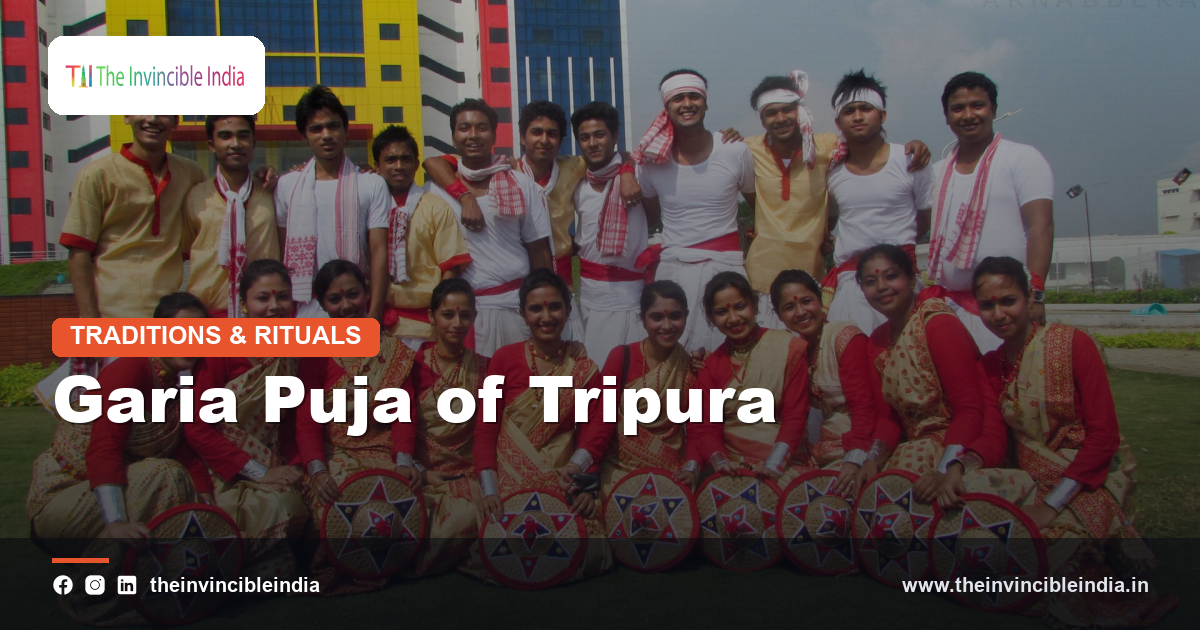
Garia Puja is among the most important festivals of Tripura, observed by the state’s indigenous communities at the turn of the year in spring. At its heart is worship of Garia, a deity associated with prosperity, protection and the wellbeing of households and livelihoods. The festival unfolds over several days of prayer, offerings, music and communal dancing, bringing villages together in a shared celebration of renewal. Its character reflects the distinct heritage of Tripura’s hill communities, much as the Bihu festival of Assam expresses the seasonal culture of a neighbouring state. This guide explores the meaning, rituals, music and continuing relevance of Garia Puja.
Quick Facts
| Detail | Information |
|---|---|
| Region | Tripura, in Northeast India |
| Observed By | Tripuri and other indigenous communities of the state |
| Deity Honoured | Garia, worshipped for prosperity and protection |
| General Season | Spring, around the turn of the new year in April |
| Key Elements | Bamboo symbol, offerings, drums, flutes and dance |
| Duration | Observed over several days of rites and festivities |
Introduction to Garia Puja
Garia Puja is a festival of the indigenous peoples of Tripura, a hill-and-valley state in the north-eastern corner of India. It is celebrated in the spring season, at a time when the old agricultural year closes and the new one opens, and it carries the hopes of farming communities for a year of good fortune. Worship of the deity Garia stands at the centre of the observance.
The festival is both devotional and social, combining solemn rites performed by designated community elders with open, joyful gatherings in which everyone takes part. This dual character, sacred and celebratory at once, explains why Garia Puja is regarded as one of the defining cultural events of Tripura’s tribal heritage.
The Land and Peoples of Tripura
Tripura is home to a number of indigenous communities, each with its own customs, dress and traditions, though many share the Kokborok language family and a close relationship with forested hills and shifting agricultural cycles. Over the centuries, these communities have developed a rich body of festivals, songs and crafts that remain living traditions today.
Garia Puja is among the festivals most widely associated with this heritage. Because it is observed by several communities rather than a single group, it is often seen as a point of cultural connection, reflecting both shared values and subtle local variations in how the rites are carried out. Understanding the festival therefore begins with appreciating the diversity of the people who keep it.
Who Is Garia
Garia is worshipped as a protective and bountiful deity, invoked for the prosperity of the household, the safety of livestock and the success of the coming year’s work. In tribal belief systems across the region, such deities are understood to be closely tied to the natural world, and offerings are made in the spirit of gratitude and request.
Communities describe and understand Garia in somewhat different ways, and accounts of the deity’s origins vary from one tradition to another. What remains consistent is the deity’s role as a guardian of wellbeing and good fortune, which is why Garia is honoured at the moment when families look ahead to the seasons to come with hope and some anxiety.
Timing and Seasonal Setting
Garia Puja is observed around the end of the old year and the beginning of the new one in April, a period associated across much of India with spring harvests, new beginnings and seasonal festivals. In Tripura, this turn of the year coincides with the preparation of fields for the coming cultivation cycle, a moment of real importance for farming households.
The festival’s timing is guided by the traditional calendar followed by the communities, and the number of days given to the rites and celebrations can vary from place to place. This flexibility reflects the village-based nature of the festival, in which local elders play a central role in deciding how the observance is arranged and sequenced.
Preparations Before the Festival
In the days leading up to Garia Puja, villages prepare in a variety of ways. Homes are cleaned, community spaces are readied, and families gather the materials needed for worship and feasting. Bamboo, a material of great importance in the daily life and crafts of Tripura, features prominently in the preparations.
Community members also begin rehearsing songs and dances, and musicians prepare their drums and flutes. The sense of anticipation builds steadily, and the preparation itself becomes a communal activity, drawing neighbours, relatives and friends into shared work. By the time the festival begins, the village has already begun to feel its collective spirit.
The Bamboo Symbol of the Deity
A distinctive feature of Garia worship is the use of bamboo to represent the deity. A bamboo pole or assembled bamboo structure is typically prepared, decorated with flowers and thread, and set up as the focus of prayer. This simple, natural symbol reflects the close bond between the communities and the bamboo groves that surround them.
The symbol is treated with considerable reverence during the festival, and its decoration is carried out with care. Rather than relying on a carved or painted image, the use of bamboo emphasises the deity’s connection with the living landscape, a quality that distinguishes Garia Puja from many temple-centred forms of worship elsewhere in India.
Community Elders and Ritual Leadership
The rites of Garia Puja are traditionally guided by community members who hold specialised knowledge of prayers, offerings and the proper order of the ceremony. These ritual leaders are respected figures, entrusted with maintaining continuity between the practices of earlier generations and those of the present.
Their role involves not only conducting the central worship but also advising on the arrangements of the festival and ensuring that customary obligations are met. In a tradition passed down largely through oral instruction and direct participation, such figures serve as living repositories of cultural memory, and their guidance gives the festival its sense of authenticity and order.
Offerings and Worship
Offerings during Garia Puja reflect the agricultural and forest-based life of the communities. Traditional items presented to the deity include flowers, rice, and other foods and drinks that carry customary significance, offered with prayers for protection and abundance. The specific offerings differ between communities and families.
The act of offering is understood as an expression of gratitude for the past year and a request for blessings in the year ahead. After the formal worship, offered foods are often shared among those present, turning the sacred act into a communal meal. Through this sharing, devotion and hospitality become part of a single, continuous gesture.
Music and the Bamboo Flute
Music is inseparable from Garia Puja. Drums and bamboo wind instruments, including the flutes that are characteristic of Tripura’s folk music, provide the rhythms and melodies that accompany both the rites and the dancing. The sound of these instruments carries across village spaces and signals that the festival is under way.
Musicians typically learn their craft within the community, absorbing tunes and rhythms through listening and practice. Songs sung during the festival often draw on themes of nature, community and the hopes of a new year. In this way, music becomes a vehicle through which cultural memory is both preserved and renewed from one generation to the next.
The Garia Dance
The Garia dance is one of the best-known expressions of Tripura’s folk heritage. Performed in groups, it is characterised by rhythmic, flowing movements that follow the beat of drums and the notes of the flute. The dancers move in coordinated patterns, often wearing traditional attire that highlights the community’s textile traditions.
The dance is not only a performance but also a form of participation, with people of varied ages joining in. Its movements are often described as expressing joy, harmony with nature and the energy of the new season. For many observers, the Garia dance has become a symbol of Tripura’s cultural identity, recognised well beyond the state.
Traditional Dress and Adornment
Festival days bring out the textile heritage of Tripura’s communities. Women often wear woven garments in distinctive patterns, produced on traditional looms, while men wear their own customary attire. Ornaments, flowers and woven accessories add to the colourful effect of the gatherings.
Handloom weaving holds an important place in the cultural life of the state, and festival clothing offers a visible reminder of this craft heritage. The care taken over dress during Garia Puja reflects the festival’s importance to the community, as well as the pride that people take in presenting their traditions to visitors and to the younger generation.
Food and Shared Feasting
Feasting forms an essential part of Garia Puja. Families and neighbours prepare traditional dishes, often built around rice, local vegetables, fish and other regional ingredients, in line with the culinary customs of the communities. Meals are commonly shared in groups, reinforcing the sense of belonging that the festival fosters.
Food also plays a ritual role, as offerings made to the deity are later distributed among participants. The boundary between worship and hospitality is therefore thin, and the shared meal becomes a continuation of the devotional act. Through eating together, villagers express gratitude, strengthen relationships and mark the festival as a time of collective abundance.
Village Gatherings and Social Life
For many families, Garia Puja is a time of reunion. Relatives who live in towns or work elsewhere often return to their villages to take part, and the festival becomes an occasion for renewing bonds that busy daily life can loosen. Visiting, exchanging greetings and sharing news are as much a part of the celebration as the rituals themselves.
Young people take part in dance and music, while elders recall earlier celebrations and pass on practical knowledge. Such exchange across generations is one of the festival’s quieter but more important functions, helping to ensure that customs, stories and songs remain familiar to those who will carry them forward.
Place in Tripura's Wider Festival Calendar
Tripura’s calendar includes festivals drawn from several traditions, among them the worship of royal-family deities, Bengali celebrations and the tribal festivals of the hills. Garia Puja sits firmly within the last category and is often counted among its most prominent events.
Its importance comes partly from its timing at the turning of the year, when communities pause to reflect, give thanks and look ahead. Alongside other seasonal observances across Northeast India, it demonstrates how closely the region’s festivals follow the rhythms of land and weather. Garia Puja therefore forms a key part of how Tripura marks the passage of time.
Symbolism of Renewal and Protection
Beneath its outward festivity, Garia Puja carries layered symbolism. The turning of the year is a moment of renewal, and the worship of a protective deity expresses a wish for security in the face of uncertainty, whether from weather, harvest or illness. The festival thus gives ritual shape to ordinary human hopes.
The use of natural materials such as bamboo and flowers reinforces the theme of harmony with the environment, while communal dance and feasting affirm the importance of social solidarity. Together, these elements present a worldview in which prosperity depends on both divine favour and the cooperation of the community.
Preserving the Tradition
Like many indigenous traditions, Garia Puja faces the pressures of changing lifestyles, migration and the growing reach of mass media. At the same time, communities, cultural organisations and state institutions have shown continuing interest in documenting and supporting festivals, music and dance.
Cultural programmes, school activities and public performances help introduce younger people to the festival’s songs and movements. Efforts to record oral traditions and to encourage craftspeople who make instruments and textiles also contribute to preservation. These initiatives reflect a shared recognition that intangible heritage depends on living practice, not merely on record-keeping.
Garia Puja Today
Today, Garia Puja continues to be celebrated with enthusiasm in villages and towns across Tripura, and its music and dance have become familiar features of cultural events within and beyond the state. Visitors who attend, with respect for local customs, often come away with a deeper appreciation of the region’s heritage.
While some details of the festival evolve with time, its core remains recognisable: worship of a protective deity, the sound of drums and flutes, and the gathering of communities at the start of a new year. In this continuity lies the festival’s enduring value, as a living expression of Tripura’s identity and shared hope.
Sources & Further Reading
- Ministry of Culture, Government of India (indiaculture.gov.in).
- Sangeet Natak Akademi (sangeetnatak.gov.in).
Frequently Asked Questions
What is Garia Puja?
Garia Puja is a major spring festival of the indigenous communities of Tripura, centred on the worship of the deity Garia. It is observed over several days with rituals, offerings, music and dance.
When is Garia Puja celebrated?
It is celebrated in spring, around the turn of the new year in April, though the exact days and their number vary according to community custom. Local elders usually decide the schedule of rites and festivities.
Who is Garia worshipped as?
Garia is worshipped as a protective deity associated with prosperity, safety of households and the success of the coming year. Communities describe the deity in somewhat different ways, but the role of guardian is widely shared.
What role does bamboo play in the festival?
Bamboo is used to represent the deity, usually as a decorated pole or structure that becomes the focus of worship. It also features in the flutes and other instruments that accompany the festival.
Can visitors attend Garia Puja?
Public celebrations and cultural programmes are often open to respectful visitors, particularly in towns and larger villages. Guests are advised to follow local customs, ask before photographing rituals and observe the guidance of community members.


