

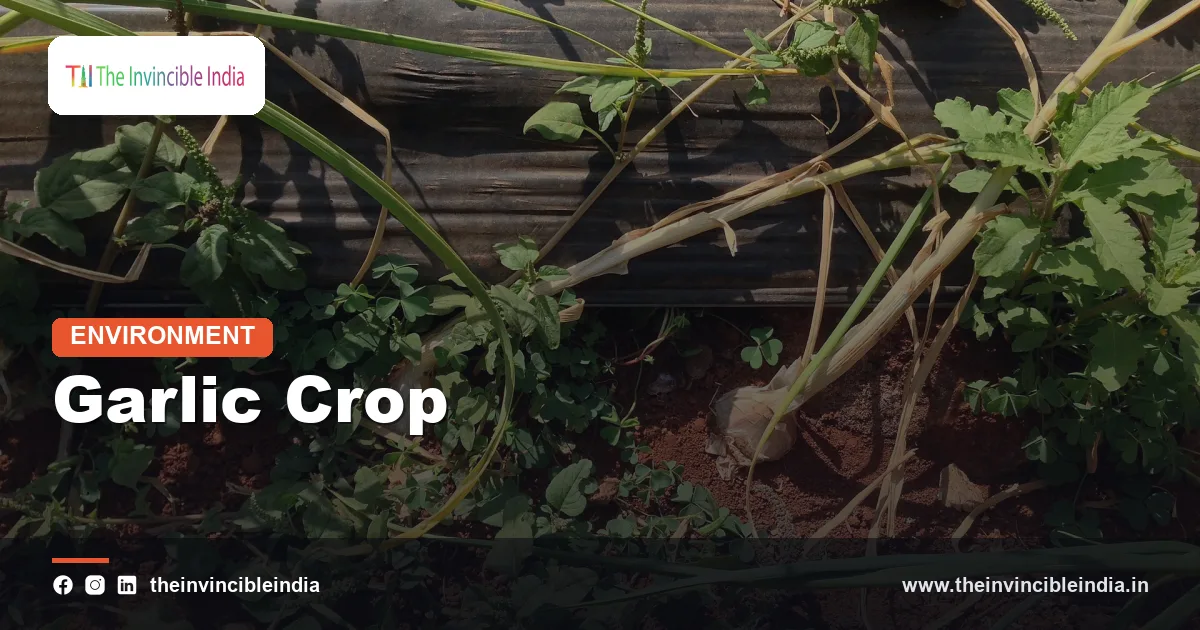
The garlic plant (Allium sativum) is a bulb crop of the onion family, grown across India for its pungent, aromatic cloves that season everyday cooking and feature in traditional medicine. A single garlic bulb is made up of several cloves wrapped in papery sheaths, and each clove can be planted to grow a new plant, which is how the crop is multiplied. India is among the largest garlic producers in the world, second only to China in volume, and Madhya Pradesh is the leading garlic-growing state.
Garlic is a winter-season (rabi) crop in most of the country, planted in the cooler months and lifted from the soil in late winter or early spring. This explainer covers what garlic is, where it came from, where and how it is grown in India, its main varieties, how it is stored, why it smells the way it does, and how it is used in kitchens, medicine and trade.
Garlic Quick Facts
| Scientific name | Allium sativum |
|---|---|
| Plant family | Amaryllidaceae (onion subfamily Allioideae), the same group as onion, leek and chives |
| Origin of the species | Central Asia, from where it spread across the ancient world |
| Where grown in India | Madhya Pradesh (largest), Gujarat, Rajasthan, Uttar Pradesh, Odisha, Haryana, Punjab, Karnataka and several other states |
| Growing season | Rabi (winter) crop: planted around October to November, harvested around February to April |
| Part used | Underground bulb made of cloves; green leaves and young shoots are also eaten |
| Propagation | By individual cloves, not by seed |
| Main uses | Cooking, pickles, chutneys, spice pastes, dehydrated flakes and powder, and traditional medicine |
| Notable fact | The sharp smell comes from sulphur compounds, chiefly allicin, which form only when a clove is cut or crushed |
Key Takeaways
- Garlic is a bulb crop of the onion family that is grown from cloves, not from seed, and each bulb holds several cloves under a papery skin.
- Madhya Pradesh is the leading garlic-producing state in India, with Gujarat, Rajasthan and Uttar Pradesh among the other major growers.
- Garlic is mainly a rabi crop in India, planted in the cool months of October and November and harvested between February and April.
- The pungent smell of garlic comes from sulphur compounds such as allicin, which form only when the cells of a clove are broken by cutting, crushing or chewing.
- Cured garlic bulbs can be stored for several months in a dry, well-ventilated place, which allows the crop to be sold long after harvest.
- Garlic prices in India can swing sharply from year to year because plantings, weather and storage stocks vary, making it one of the more volatile spice-vegetable markets.
What is garlic and how is it classified?
Garlic is a perennial-looking but annually grown herbaceous plant whose edible part is a compound underground bulb divided into cloves. Botanists place garlic in the genus Allium, the same genus as onion, shallot, leek and chives, which is why all of them share a family resemblance in smell and flavour. The Sanskrit name for garlic is lasuna, and the crop is called lehsun in Hindi, lasun in Marathi, lasan in Gujarati, roshun in Bengali, poondu in Tamil, vellulli in Telugu, bellulli in Kannada and velluli in Malayalam.
The plant has flat, narrow, upright leaves that grow in a fan from a short stem, reaching roughly half a metre in height. Beneath the soil, the bulb forms as the plant matures. The bulb is enclosed in white or pinkish papery skins, and inside lie anywhere from a handful to more than a dozen cloves, depending on the variety. Each clove is a swollen storage leaf packed with sugars and sulphur compounds, ready to sprout if planted.
Hardneck and softneck types
Garlic is often grouped into hardneck and softneck types. Hardneck garlic sends up a stiff central flower stalk, called a scape, and tends to have fewer, larger cloves. Softneck garlic does not form a stiff stalk, usually has more cloves per bulb and stores longer. Most garlic grown commercially in India behaves like the softneck type and is propagated entirely by cloves, because cultivated garlic produces little or no viable true seed.
Where did garlic come from and how did it reach India?
Garlic is believed to have originated in Central Asia, and it was carried by traders and farmers west to the Mediterranean and east to India and China thousands of years ago. The cultivated species Allium sativum is thought to descend from a wild relative that still grows in the mountains of Central Asia. Because garlic is spread by cloves, human beings have effectively been moving the same plant lineages around the world for millennia.
Garlic has been used in the Indian subcontinent since ancient times and appears in classical Ayurvedic texts, where it is known as lasuna or rasona. Traditional texts describe it as a warming food with many reputed uses. The name rasona is sometimes explained as meaning that the bulb carries all tastes except one, a piece of folk classification that survives in Ayurvedic teaching. Today garlic is so thoroughly woven into Indian cooking that it is easy to forget it was once regarded in some communities and traditions as a food to be avoided.
Where is garlic grown in India?
Garlic is grown in most Indian states, but production is concentrated in a belt running through central and western India, with Madhya Pradesh as the single largest producer. Within Madhya Pradesh, the Malwa region around Mandsaur, Neemuch, Ratlam and Indore is especially well known, and Mandsaur has long been recognised as one of the country’s principal garlic trading centres. Neighbouring south-eastern Rajasthan, around Kota and the Hadoti region, is another major growing area that shares similar soils and climate.
The table below summarises the broad regional picture. Exact rankings and tonnage shift from year to year, so the table describes the pattern rather than fixed figures.
| Region or state | Role in garlic production |
|---|---|
| Madhya Pradesh | Largest producer; Malwa districts and Mandsaur are major hubs |
| Rajasthan | Large producer, especially the Kota and Hadoti belt |
| Gujarat | Important grower, notably in the Saurashtra region and central Gujarat |
| Uttar Pradesh | Significant producer across the Gangetic plain |
| Odisha, Haryana, Punjab | Meaningful regional output for local and nearby markets |
| Karnataka, Maharashtra, Assam, Himachal Pradesh | Smaller but regular production, including hill and plateau garlic |
Garlic needs a cool growing period and a dry finish, which explains why the black cotton soils and cool winters of the Malwa plateau suit it so well. Hill regions grow a second type of crop, planted in spring and harvested in summer, because winters there are too cold for field work.
How is garlic cultivated in India?
Garlic is cultivated by planting individual cloves in well-prepared, well-drained soil during the cool season, and the crop matures in roughly four to five months. Farmers prefer fertile sandy loam or loam rich in organic matter, with a near-neutral soil reaction. Heavy waterlogged soil is avoided, because the bulbs rot easily when the ground stays wet.
Climate and planting
Garlic grows best where the leafy growth phase is cool and the bulb-filling phase is mild to warm and dry. Cloves are separated from the bulb shortly before planting, and only the larger, healthy outer cloves are chosen as planting material. They are pushed a few centimetres into the soil with the pointed end upward, in rows set roughly fifteen centimetres apart. A large quantity of cloves is needed for each hectare, which makes seed material one of the biggest costs of growing garlic.
Irrigation and nutrients
The crop is shallow-rooted and needs light, regular irrigation, especially during bulb formation, but watering is reduced as the tops begin to yellow so that bulbs can mature and dry. Garlic responds well to organic manure and also to sulphur, which is built into the crop’s own flavour compounds. Weeds compete strongly with the thin garlic leaves, so field weeding is an important routine task.
Pests and diseases
The common problems are thrips, which scrape the leaves, and fungal diseases such as purple blotch and basal rot. Careful selection of healthy cloves, crop rotation with non-Allium crops, and good drainage help keep these in check. Research institutions such as the ICAR Directorate of Onion and Garlic Research at Rajgurunagar near Pune work on improved varieties and management practices for the crop.
What are the main varieties of garlic grown in India?
India grows a mix of improved named varieties and many local landraces, and the best-known improved varieties come from agricultural research institutes. Varieties differ in the size of the bulb, the number of cloves, the colour of the skin, the strength of the flavour and how long they keep in storage. The list below gives some widely cited improved selections; availability and recommended areas vary by state.
- Yamuna Safed (G-1): a white-skinned variety with large, firm cloves, bred for the northern plains.
- Yamuna Safed 2 (G-50): a white variety with large bulbs and good storage quality.
- Agrifound White (G-41): a white-skinned selection with compact bulbs, popular for its keeping quality.
- Agrifound Parvati (G-313): a large-bulbed variety developed for higher yields.
- Godavari and Shweta: selections developed for Maharashtra and neighbouring regions.
- Local landraces: small-clove, strongly flavoured types grown in hill districts and by smallholders, often with a more intense pungency.
When is garlic harvested and how is it stored?
Garlic is harvested when the leaves turn yellow and begin to dry and fall over, usually four to five months after planting, and the bulbs are then cured before storage. Farmers loosen the soil, lift the bulbs by hand or with a light tool, and leave them in the field or in shade for several days so that the tops and outer skins dry.
Curing is the key step that determines how long garlic keeps. The bulbs are dried in shade, away from direct hot sun and rain, until the neck is tight and the skins are papery. The dried plants are then tied in bunches or trimmed and graded by size. Properly cured garlic can be kept for many months in a dry, airy store, often hung from beams or stacked in ventilated bins, though in humid conditions it may sprout or rot.
Because a large share of the crop arrives at the market within a few weeks, storage is closely tied to price. Growers and traders who hold stock can sell later at better rates, while a sudden glut after harvest can push prices down sharply.
Why does garlic smell and taste so strong?
Garlic smells and tastes strong because cutting or crushing a clove triggers a chemical reaction that makes sulphur-rich compounds, chiefly allicin. An intact clove contains a fairly odourless compound called alliin and a separate enzyme called alliinase, which are kept apart inside the cells. When the clove is chopped, pressed or chewed, the cells break, the enzyme meets alliin, and allicin is produced within seconds.
Allicin is unstable and quickly changes into other sulphur compounds, which give cooked and crushed garlic its characteristic pungent odour and sharp bite. This is why a whole clove tossed into a pot smells mild, while a finely minced or ground clove is far more aggressive. Heat reduces the sharpness, and slow cooking turns garlic sweet and nutty.
The same chemistry explains why garlic leaves a lingering smell on the breath and skin: some of the sulphur compounds are absorbed into the blood and released through the lungs and pores. Eating parsley, milk or apple alongside garlic is a common folk remedy for the smell, with modest and uneven effect.
How is garlic used in Indian food and traditional medicine?
Garlic is used in Indian kitchens as a base flavouring, a pickle ingredient and a stand-alone chutney, and it also has a long role in traditional medicine. Many curries, dals, and stir-fries begin with garlic fried in oil or ghee along with onion, ginger and spices. Ginger-garlic paste is a standard kitchen staple, sold ready-made in jars and prepared fresh in most households.
In the kitchen
- Tempering (tadka): sliced or whole garlic is fried in hot ghee or oil and poured over dal, sambar or curd rice.
- Chutneys: dry red garlic chutney, popular in Maharashtra and Rajasthan, is made by grinding garlic with red chillies and sometimes peanut or coconut.
- Pickles: whole or sliced garlic is preserved in oil with spices in many regional pickling traditions.
- Dried forms: garlic flakes, granules and powder are made in factories for the food industry and for export.
- Green garlic: young green leaves and immature bulbs are cooked as a winter vegetable in parts of north and central India.
In traditional medicine
Ayurveda and other folk systems have long used garlic in preparations for digestion, joint complaints, and coughs, and it appears in many household remedies. Modern laboratory research has studied its sulphur compounds for effects on blood pressure and cholesterol, but the evidence is mixed and garlic should not be treated as a replacement for medical care. People on blood-thinning drugs or preparing for surgery are usually advised to talk to a doctor before taking concentrated garlic supplements.
What is the economic and cultural importance of garlic in India?
Garlic matters in India as a cash crop for lakhs of small farmers, as an export commodity and as a food with strong religious and dietary associations. Because it is lighter in weight than many vegetables and stores well, garlic is traded across states through large wholesale markets, known as mandis, and is exported in smaller but steady volumes to neighbouring countries and parts of Southeast Asia and the Middle East.
Garlic prices are notorious for their sharp rises and falls. A season of good rains and high prices encourages many farmers to plant garlic the next year, which increases supply and often leads to a price crash, after which planting falls and the cycle repeats. Weather events at harvest, such as unseasonal rain, can also damage bulbs and tighten supply.
Culturally, garlic is treated differently across communities. Many Jain households and some Vaishnav and other devotional traditions avoid garlic and onion, regarding them as stimulating foods unsuited to a sattvic lifestyle, and temple kitchens and religious fasts generally leave them out. Other communities cook with garlic daily, and some regional cuisines, such as those of Kashmir, Maharashtra, Gujarat and the coastal states, rely heavily on it.
Bottom Line
Garlic is a clove-propagated bulb crop that India grows mainly in the cool season, with Madhya Pradesh leading production and a belt of central and western states close behind. Its sharp flavour comes from allicin, a compound formed only when the clove is damaged, and well-cured bulbs keep for months. The crop is central to Indian cooking, trade and folk medicine, while remaining subject to sharp price swings.
Frequently Asked Questions
What is garlic and which family does it belong to?
Garlic (Allium sativum) is a bulb crop that belongs to the onion family, the same genus as onion, leek and chives. Its bulb is made of several cloves wrapped in papery skin. Each clove can be planted to grow a new plant, which is how the crop is multiplied.
Which Indian state grows the most garlic?
Madhya Pradesh is the largest garlic-producing state in India. The Malwa region, including Mandsaur, Neemuch and Ratlam, is especially important. Rajasthan, Gujarat and Uttar Pradesh are other major producers, though exact rankings change slightly from year to year.
When is garlic planted and harvested in India?
Garlic is mostly planted in October and November and harvested between February and April. It is a rabi (winter) crop that needs a cool growing period and a dry finish for bulbs to mature. Hill regions follow a different calendar, planting in spring and harvesting in summer.
Why does garlic smell so strong when it is crushed?
Garlic smells strong when crushed because cutting the clove lets an enzyme called alliinase react with a compound called alliin to form allicin. Allicin quickly changes into other sulphur compounds that give garlic its sharp odour and taste. An uncut clove is much milder because these chemicals are stored separately.
How long can garlic be stored after harvest?
Well-cured garlic can be stored for several months in a dry, well-ventilated place. Curing means drying the bulbs in shade until the skins turn papery and the neck is tight. In humid conditions, garlic may sprout or rot sooner.
Why do some Indian communities avoid garlic?
Some communities avoid garlic because they consider it a stimulating food that does not suit a sattvic or ascetic way of life. Jain households and certain Vaishnav and devotional traditions leave out garlic and onion, as do many temple kitchens and fasting meals. The practice is cultural and religious, and it varies by community and region.
{“@context”:”https://schema.org”,”@graph”:[{“@type”:”FAQPage”,”mainEntity”:[{“@type”:”Question”,”name”:”What is garlic and which family does it belong to?”,”acceptedAnswer”:{“@type”:”Answer”,”text”:”Garlic (Allium sativum) is a bulb crop that belongs to the onion family, the same genus as onion, leek and chives. Its bulb is made of several cloves wrapped in papery skin. Each clove can be planted to grow a new plant, which is how the crop is multiplied.”}},{“@type”:”Question”,”name”:”Which Indian state grows the most garlic?”,”acceptedAnswer”:{“@type”:”Answer”,”text”:”Madhya Pradesh is the largest garlic-producing state in India. The Malwa region, including Mandsaur, Neemuch and Ratlam, is especially important. Rajasthan, Gujarat and Uttar Pradesh are other major producers, though exact rankings change slightly from year to year.”}},{“@type”:”Question”,”name”:”When is garlic planted and harvested in India?”,”acceptedAnswer”:{“@type”:”Answer”,”text”:”Garlic is mostly planted in October and November and harvested between February and April. It is a rabi (winter) crop that needs a cool growing period and a dry finish for bulbs to mature. Hill regions follow a different calendar, planting in spring and harvesting in summer.”}},{“@type”:”Question”,”name”:”Why does garlic smell so strong when it is crushed?”,”acceptedAnswer”:{“@type”:”Answer”,”text”:”Garlic smells strong when crushed because cutting the clove lets an enzyme called alliinase react with a compound called alliin to form allicin. Allicin quickly changes into other sulphur compounds that give garlic its sharp odour and taste. An uncut clove is much milder because these chemicals are stored separately.”}},{“@type”:”Question”,”name”:”How long can garlic be stored after harvest?”,”acceptedAnswer”:{“@type”:”Answer”,”text”:”Well-cured garlic can be stored for several months in a dry, well-ventilated place. Curing means drying the bulbs in shade until the skins turn papery and the neck is tight. In humid conditions, garlic may sprout or rot sooner.”}},{“@type”:”Question”,”name”:”Why do some Indian communities avoid garlic?”,”acceptedAnswer”:{“@type”:”Answer”,”text”:”Some communities avoid garlic because they consider it a stimulating food that does not suit a sattvic or ascetic way of life. Jain households and certain Vaishnav and devotional traditions leave out garlic and onion, as do many temple kitchens and fasting meals. The practice is cultural and religious, and it varies by community and region.”}}]}]}


