

A ginger plant (Zingiber officinale) is a tropical perennial herb, usually grown as an annual crop, whose underground stem, or rhizome, is the pungent, aromatic spice known in India as adrak when fresh and sonth or saunth when dried. India is one of the world’s largest producers of ginger, and the crop is grown mainly in the warm, humid, rain-fed regions of Kerala, the north-east, Karnataka and Odisha.
Although ginger is commonly called a root, the part used is a swollen, branching rhizome that grows horizontally just below the soil. The plant above ground is a slender, reed-like clump of green leaves. This explainer describes how the ginger plant grows, where it is cultivated in India, how the crop is planted, harvested and processed, and how ginger is used.
| Common names | Ginger, adrak (fresh, Hindi), sonth or saunth (dried), inji (Tamil and Malayalam), allam (Telugu) |
|---|---|
| Scientific name | Zingiber officinale |
| Plant family | Zingiberaceae (the ginger family, which also includes turmeric and cardamom) |
| Where grown in India | Kerala, Karnataka, Assam, Meghalaya, Arunachal Pradesh, Mizoram, Sikkim, Odisha, West Bengal, Madhya Pradesh and Himachal Pradesh |
| Growing season | Planted April to June with the onset of the monsoon; harvested from about six to nine months later |
| Part used | The rhizome (underground stem) |
| Products and uses | Fresh ginger, dry ginger, paste, powder, oil, oleoresin, candy, tea, pickles, traditional medicine |
| Propagation | Vegetatively, from pieces of rhizome called seed rhizomes |
| Notable fact | India is among the world’s largest producers of ginger |
Key Takeaways
- The ginger plant (Zingiber officinale) is a tropical perennial herb of the Zingiberaceae family that is grown for its aromatic underground rhizome, the spice ginger.
- Ginger is propagated from small pieces of rhizome, not from seed, because cultivated ginger rarely produces viable seed.
- Ginger is planted in India at the start of the monsoon, around April to June, and it needs warm, humid weather with plentiful rain and good drainage.
- Fresh ginger is harvested at roughly six months, while ginger meant for drying (sonth) is generally left to mature for eight to nine months.
- Soft rot and bacterial wilt are the most serious diseases of the ginger crop, and they spread quickly in waterlogged soil.
- Ginger is related to turmeric and cardamom, and its pungency comes mainly from compounds called gingerols.
What is the ginger plant and which part do we use?
The ginger plant is a leafy tropical herb of the Zingiberaceae family, and the part used as a spice is its thick, branching underground rhizome. The leaves, which rise to about 60 to 90 centimetres, are not the commercial product; the value lies below the surface.
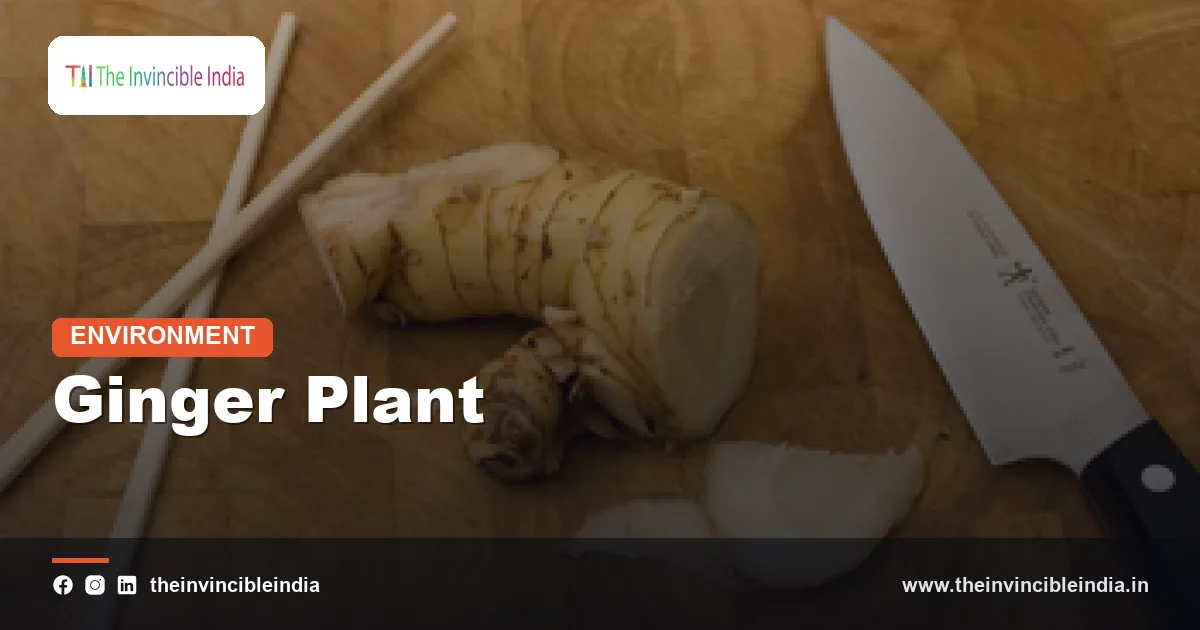
The rhizome is a modified stem that stores food for the plant. It has knobbly, finger-like branches covered in a thin buff skin, with pale yellow flesh inside. Each branch carries growth buds, called eyes, from which new shoots arise. When crushed or cut, the rhizome releases a sharp, warm, lemony fragrance and a pungent taste.
Ginger is believed to have originated in tropical South or South-East Asia and has been cultivated for thousands of years. It was one of the earliest Asian spices to travel along trade routes to the Mediterranean world. Its Sanskrit name, shringavera, which means “horn-shaped,” is thought to be the source of the botanical genus name Zingiber.
What does the ginger plant look like?
The ginger plant looks like a clump of upright, bamboo-like stems carrying narrow, pointed, glossy green leaves arranged in two neat rows. Plants usually stand roughly 60 to 90 centimetres tall in cultivation.
Above-ground growth
The stems that appear to emerge from the soil are actually pseudostems, formed by tightly rolled leaf bases. The lance-shaped leaves are borne alternately on these stems and have a strong fragrance when crushed. In cultivated fields the foliage looks lush and green during the rains and begins to turn yellow and dry as the crop matures.
Flowers
Ginger can produce cone-shaped flower spikes with yellowish-green bracts and small pale flowers, but flowering is rare in cultivated crops. Commercial ginger seldom sets viable seed. This is the main reason growers use rhizome pieces for planting.
The rhizome
Below ground, the rhizome multiplies by branching each season. The mother rhizome that was planted is gradually exhausted as new rhizomes form. The outer surface carries scale-like leaves and nodes, and the interior is fibrous, aromatic and juicy when fresh.
Where is the ginger plant grown in India?
The ginger plant is grown across the humid and sub-humid hill and coastal belts of India, with Kerala, Karnataka, Assam, Meghalaya, Arunachal Pradesh, Mizoram, Sikkim, Odisha and West Bengal among the important producing states. Madhya Pradesh and Himachal Pradesh also grow significant quantities, mostly for the fresh market.
Kerala has the oldest tradition. Its Malabar coast was a centre of the ancient spice trade, and areas such as Wayanad and Idukki remain associated with ginger. The north-eastern states have emerged as major producers, helped by suitable climate and hill terrain, and they supply large quantities of fresh ginger to markets across the country. Karnataka and Odisha are also important, and the exact ranking among states changes from year to year.
| Region | Notable features |
|---|---|
| Kerala | Oldest ginger-growing tradition; Malabar spice coast; much produce is dried |
| North-east India | Large share of area and output; suited to hills and heavy rain |
| Karnataka | Significant fresh ginger production, especially in the Western Ghats belt |
| Odisha | Hilly districts with traditional ginger cultivation |
| Madhya Pradesh and Himachal Pradesh | Fresh ginger for domestic markets |
What climate and soil does the ginger plant need?
The ginger plant needs a warm, humid climate with well-distributed rainfall of roughly 1,500 millimetres or more, temperatures around 25 to 30 degrees Celsius, and well-drained, fertile, loamy soil rich in organic matter. It thrives in the monsoon and does poorly in cold, dry or waterlogged conditions.
The crop grows from sea level to altitudes of around 1,500 metres. Light shade, such as that offered by tall companion crops or trees, is helpful, especially in the early weeks. Good drainage is critical, because standing water leads to rot of the rhizomes. Farmers therefore plant ginger on raised beds or ridges so that excess water drains away.
Why ginger exhausts the soil
Ginger is a heavy feeder, and repeated cropping on the same land builds up disease organisms in the soil. Farmers therefore rotate ginger with other crops and avoid planting it on the same plot for several years. Ginger is often grown as a mixed or intercrop with vegetables, maize or under the canopy of plantations.
How is ginger planted and grown?
Ginger is planted by placing small pieces of healthy rhizome, called seed rhizomes, in prepared beds at the start of the monsoon, around April to June, and keeping the crop mulched, weeded and well-drained through the rainy season. Each piece must carry at least one or two healthy buds.
Selecting and treating seed rhizomes
Farmers select plump, disease-free rhizomes from the previous crop and cut them into pieces weighing roughly 20 to 25 grams, each with a couple of buds. The pieces are often treated with fungicide or protective solutions to reduce rot, then left to dry briefly before planting. Seed material is a major cost, because large quantities are needed per hectare.
Planting and mulching
The pieces are planted a few centimetres deep on raised beds or ridges, at close spacing. A thick layer of green leaves or other mulch is spread over the beds immediately after planting. Mulch conserves moisture, prevents heavy rain from washing the soil away, suppresses weeds and adds organic matter as it decays. Further layers of mulch are often added during the season.
Care during growth
- Weeding: done by hand a few times, usually combined with mulching.
- Earthing up: soil is drawn up around the clumps so that developing rhizomes stay covered.
- Manuring: farmyard manure or compost is applied at planting, with supplementary nutrients in split doses.
- Drainage: channels are kept clear so that water does not stand around the plants.
When and how is ginger harvested?
Ginger is harvested when the leaves begin to yellow and dry, which is around six months after planting for fresh vegetable ginger and about eight to nine months for ginger meant for drying. The digging is done by hand or with a fork or spade, taking care not to damage the rhizomes.
Harvest timing depends on the end use. Early digging at around six months gives tender, less fibrous rhizomes with milder pungency, which are sold fresh. Fully mature rhizomes harvested at eight to nine months are more pungent and fibrous, and they are preferred for drying and for extraction of oil and oleoresin. After digging, the clumps are cleaned of soil and roots and the rhizomes are washed.
Yields vary with variety, management and weather. Under good care, a hectare can yield many tonnes of fresh rhizome, but figures differ widely between regions and years. Some growers store part of the crop in pits or leave a portion underground for planting in the next season.
What diseases and pests affect the ginger crop?
The most serious diseases of the ginger crop are soft rot of the rhizome, bacterial wilt and leaf spot, while pests such as the shoot borer also cause damage. These problems are heavily influenced by wet weather and poor drainage.
- Soft rot: caused by Pythium fungi, it turns the rhizome soft and watery and kills the plant. It is the most damaging disease and spreads rapidly in waterlogged soil.
- Bacterial wilt: a bacterial disease that causes sudden yellowing and wilting of the plants and a milky ooze from cut stems.
- Leaf spot: fungal spots on leaves that reduce the plant’s food production.
- Shoot borer: a moth caterpillar that tunnels into the pseudostems and makes them dry up.
Because infected seed rhizomes are the main carriers, the best protection starts with clean planting material, treatment of seed pieces, rotation, raised beds and good drainage. The Indian Institute of Spices Research (IISR) at Kozhikode in Kerala is a leading centre for research on ginger and has released several improved varieties.
How is ginger processed and what products does it give?
Ginger is processed into dry ginger (sonth), ginger powder, ginger paste, candy, essential oil and oleoresin, as well as being sold fresh. Each product serves a different market, from household kitchens to food and pharmaceutical industries.
| Product | How it is made | Common use |
|---|---|---|
| Fresh ginger (adrak) | Harvested, washed and sold in the moist form | Cooking, tea, chutney, pickles |
| Dry ginger (sonth) | Rhizomes are peeled, washed and sun-dried to hard pieces | Spice, traditional remedies, sweets |
| Ginger powder | Dry ginger ground fine | Spice mixes, baking, tea blends |
| Ginger paste | Fresh ginger ground, often with garlic | Base for curries and marinades |
| Essential oil and oleoresin | Steam distillation or solvent extraction | Flavouring, fragrance and pharmaceutical use |
| Candy and preserves | Rhizomes cooked in sugar syrup | Confectionery and snacks |
Making dry ginger
To make sonth, mature rhizomes are soaked, scraped or peeled to remove the outer skin, and dried in the sun for several days until they are hard and light. Some producers also bleach or limewash the dried pieces, though this practice is discouraged in favour of clean, natural drying. The finished product is stored dry to prevent mould.
How is ginger used in Indian food and daily life?
Ginger is used in India as a cooking spice, as a flavouring for tea and as a traditional household remedy, and it features in food, drinks and festive sweets across regions. Fresh ginger is one of the basic aromatics of Indian cooking.
- Ginger-garlic paste: a base for many curries, gravies and marinades.
- Adrak chai: tea boiled with crushed ginger, a favourite in winter and during the rains.
- Pickles and chutneys: including ginger pickle and sweet-sour ginger chutney.
- Dry ginger: used in sweets, soups, health drinks, and winter preparations such as sonth laddoos.
- Salads and garnishes: thin strips of fresh ginger with lemon and salt.
Ginger has a long place in Ayurveda and folk practice, where it is associated with digestion and relief from colds and nausea. Modern research has examined some of its compounds, but traditional claims should not replace medical advice, and people on medication or with health conditions should consult a doctor before using ginger in large amounts.
How is ginger related to turmeric and cardamom?
Ginger is related to turmeric and cardamom because all three belong to the Zingiberaceae family, but they differ in the part used and in their flavours. Together they form the best-known group of rhizome and capsule spices from tropical Asia.
| Plant | Scientific name | Part used | Character |
|---|---|---|---|
| Ginger | Zingiber officinale | Rhizome | Pungent, warm and lemony |
| Turmeric (haldi) | Curcuma longa | Rhizome | Earthy, yellow-orange colour |
| Cardamom (elaichi) | Elettaria cardamomum | Seed capsule | Sweet, floral, intensely aromatic |
Ginger and turmeric are often grown in similar conditions and planted at similar times, and both are propagated from rhizome pieces. Cardamom, in contrast, is a shade-loving perennial of the Western Ghats grown for its capsules rather than its roots.
Why does the ginger plant matter to farmers and the economy?
The ginger plant matters because it is a high-value cash crop for small farmers in rainy and hilly regions, and it supports a large trade in fresh and dry ginger. In many north-eastern and hill districts, ginger is one of the main sources of cash income.
The crop can earn considerably more per hectare than many food grains, but it carries high costs for seed rhizomes and a risk of disease. Prices can swing sharply, because supply responds to weather and area planted, and a glut is often followed by a shortage. Because of these swings, many farmers hedge by selling part of the crop fresh and drying the rest.
India exports ginger in fresh, dried and processed forms, and the Spices Board of India supports quality improvement and marketing. Research institutions work on disease-resistant varieties and better seed production, which remain priorities for the sector.
Bottom Line
The ginger plant is a leafy tropical herb whose hidden rhizome gives India one of its most familiar spices. Grown mainly in Kerala, the north-east and the southern and eastern hills, it rewards careful drainage, mulching and clean seed material. From fresh adrak to dried sonth, ginger links Indian farms, kitchens and medicine cabinets in a single plant.
Frequently Asked Questions
Is ginger a root or a stem?
Ginger is a stem, not a true root. The part we eat is a thick underground stem called a rhizome, which grows horizontally below the soil and stores food for the plant. It is commonly called a root in everyday speech.
How is the ginger plant grown?
The ginger plant is grown from pieces of rhizome, not from seed. Healthy pieces, each with one or two buds, are planted on raised beds at the start of the monsoon, around April to June, and covered with mulch. The crop needs warm, humid weather and well-drained soil.
Which states grow the most ginger in India?
Ginger is grown mainly in Kerala, Karnataka, Assam, Meghalaya, Arunachal Pradesh, Mizoram, Sikkim, Odisha and West Bengal, with Madhya Pradesh and Himachal Pradesh also contributing. The north-east accounts for a large share of the area. Rankings change from year to year with weather and prices.
How long does ginger take to grow?
Ginger takes about six months to reach the fresh-harvest stage and eight to nine months to mature fully for drying. Farmers dig the rhizomes when the leaves turn yellow and begin to dry. Earlier harvest gives tender, milder ginger, while later harvest gives more pungent and fibrous rhizomes.
What is the difference between adrak and sonth?
Adrak is fresh ginger, while sonth, also spelt saunth, is dried ginger. Sonth is made by peeling and sun-drying mature rhizomes until they are hard and light. Dry ginger is more concentrated in flavour and is used in sweets, spice mixes and traditional preparations.
What diseases affect the ginger plant?
The most serious diseases of the ginger plant are soft rot, caused by Pythium fungi, and bacterial wilt. Both thrive in wet, waterlogged soil and are often carried in infected seed rhizomes. Clean planting material, raised beds, good drainage and crop rotation are the main defences.
{“@context”:”https://schema.org”,”@graph”:[{“@type”:”FAQPage”,”mainEntity”:[{“@type”:”Question”,”name”:”Is ginger a root or a stem?”,”acceptedAnswer”:{“@type”:”Answer”,”text”:”Ginger is a stem, not a true root. The part we eat is a thick underground stem called a rhizome, which grows horizontally below the soil and stores food for the plant. It is commonly called a root in everyday speech.”}},{“@type”:”Question”,”name”:”How is the ginger plant grown?”,”acceptedAnswer”:{“@type”:”Answer”,”text”:”The ginger plant is grown from pieces of rhizome, not from seed. Healthy pieces, each with one or two buds, are planted on raised beds at the start of the monsoon, around April to June, and covered with mulch. The crop needs warm, humid weather and well-drained soil.”}},{“@type”:”Question”,”name”:”Which states grow the most ginger in India?”,”acceptedAnswer”:{“@type”:”Answer”,”text”:”Ginger is grown mainly in Kerala, Karnataka, Assam, Meghalaya, Arunachal Pradesh, Mizoram, Sikkim, Odisha and West Bengal, with Madhya Pradesh and Himachal Pradesh also contributing. The north-east accounts for a large share of the area. Rankings change from year to year with weather and prices.”}},{“@type”:”Question”,”name”:”How long does ginger take to grow?”,”acceptedAnswer”:{“@type”:”Answer”,”text”:”Ginger takes about six months to reach the fresh-harvest stage and eight to nine months to mature fully for drying. Farmers dig the rhizomes when the leaves turn yellow and begin to dry. Earlier harvest gives tender, milder ginger, while later harvest gives more pungent and fibrous rhizomes.”}},{“@type”:”Question”,”name”:”What is the difference between adrak and sonth?”,”acceptedAnswer”:{“@type”:”Answer”,”text”:”Adrak is fresh ginger, while sonth, also spelt saunth, is dried ginger. Sonth is made by peeling and sun-drying mature rhizomes until they are hard and light. Dry ginger is more concentrated in flavour and is used in sweets, spice mixes and traditional preparations.”}},{“@type”:”Question”,”name”:”What diseases affect the ginger plant?”,”acceptedAnswer”:{“@type”:”Answer”,”text”:”The most serious diseases of the ginger plant are soft rot, caused by Pythium fungi, and bacterial wilt. Both thrive in wet, waterlogged soil and are often carried in infected seed rhizomes. Clean planting material, raised beds, good drainage and crop rotation are the main defences.”}}]}]}


