

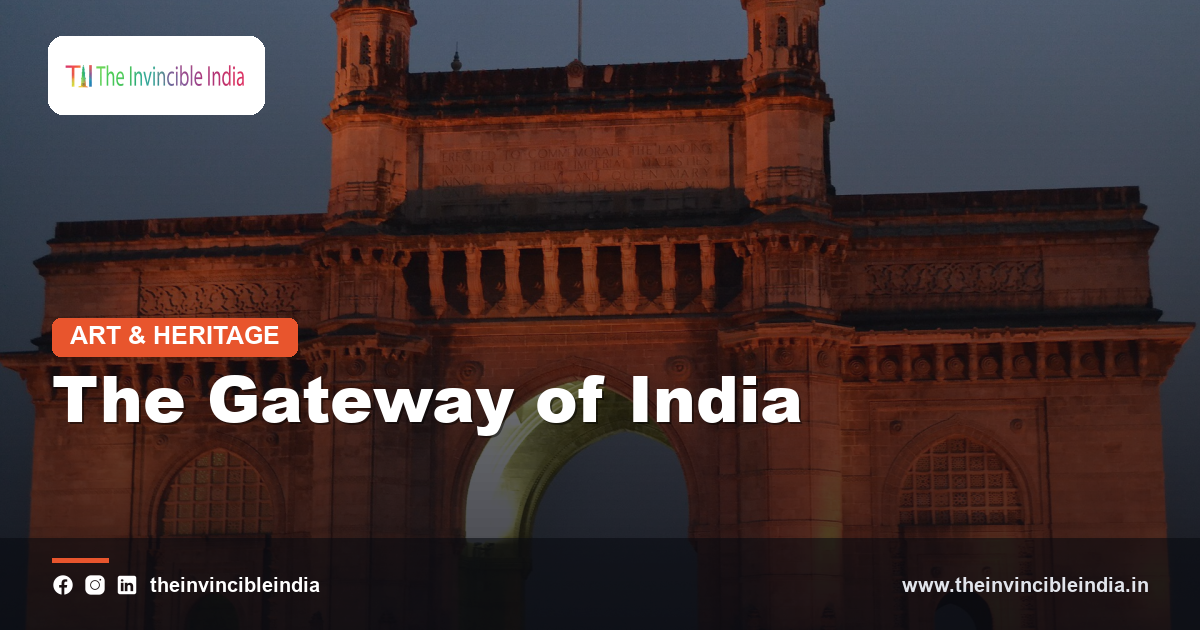
The Gateway of India stands at the water’s edge in South Mumbai, a monumental basalt archway built during the early twentieth century to commemorate a landmark royal visit and to serve as a ceremonial entry point for those arriving by sea. Designed in the Indo-Saracenic style that blended European and Indian architectural elements, the monument reflects the broader traditions of colonial architecture in India developed during British rule. Overlooking the Arabian Sea from the historic Apollo Bunder waterfront, the Gateway has since become one of Mumbai’s most recognizable symbols, its arch witnessing both the pageantry of empire and the eventual departure of colonial rule from Indian shores.
Quick Facts
| Detail | Information |
|---|---|
| Location | Apollo Bunder, Mumbai |
| Built to commemorate | Visit of King George V and Queen Mary, 1911 |
| Completed | 1924 |
| Architect | George Wittet |
| Architectural style | Indo-Saracenic |
| Material | Yellow basalt |
A Landmark on the Mumbai Waterfront
The Gateway of India occupies a prominent position on the Mumbai waterfront, its tall basalt arch framing views of the Arabian Sea and forming one of the city’s most iconic silhouettes. Positioned at Apollo Bunder, historically a significant harbor point, the monument has long served as a visual marker for the city’s maritime edge.
Its scale and central location have made it a natural gathering point for residents and visitors alike, functioning as both a historic monument and an everyday civic space. Few structures in Mumbai carry as much symbolic association with the city’s identity as the Gateway of India.
The Royal Visit of 1911
The Gateway of India was conceived to commemorate the visit of King George V and Queen Mary to Bombay in 1911, a significant event during the British colonial period marking the monarch’s arrival on Indian soil. The visit was considered an occasion of major ceremonial importance, warranting a permanent architectural memorial.
At the time of the actual royal visit, only a temporary structure existed at the site to mark the occasion, with the permanent monument constructed and completed some years later. This gap between the commemorated event and the finished monument is not unusual for large-scale ceremonial architecture of the period.
Commissioning the Monument
Following the royal visit, colonial authorities in Bombay commissioned a permanent monument to mark the occasion and to serve as a formal ceremonial gateway for future arrivals by sea. The project reflected the broader colonial practice of using monumental architecture to commemorate significant imperial events and visits.
Construction proceeded over an extended period during the early twentieth century, with the finished monument intended to stand as a lasting symbol of the city’s status as a major port and gateway to British India, welcoming dignitaries and travelers arriving by ship.
The Architect George Wittet
The Gateway of India was designed by the Scottish architect George Wittet, who was responsible for several notable buildings in Bombay during the colonial period. Wittet was known for his work within the Indo-Saracenic style, which sought to combine European architectural forms with Indian decorative and structural elements.
His design for the Gateway drew on this hybrid approach, creating a monument that would feel both suitably grand for its ceremonial function and visually connected to Indian architectural traditions. Wittet’s broader body of work in the city reflects this consistent stylistic approach across several major public buildings.
Indo-Saracenic Architectural Style
The Gateway of India is a prominent example of the Indo-Saracenic style, an architectural movement that developed under British colonial rule by combining European classical and Gothic elements with motifs drawn from Mughal, Hindu, and other Indian architectural traditions. This style was often employed for major public buildings intended to project both authority and local cultural resonance.
Elements such as decorative jali screens, domes, and arched openings found throughout the Gateway reflect this deliberate blending of architectural vocabularies, distinguishing the monument from more purely European colonial buildings constructed elsewhere in the city during the same period.
Basalt Construction
The monument is constructed primarily from yellow basalt, a durable volcanic stone well suited to withstanding Mumbai’s coastal climate and salt-laden sea air. This material choice reflects practical considerations of durability alongside the desired visual effect of a solid, monumental presence at the water’s edge.
The use of basalt also connects the Gateway to broader regional building traditions in western India, where volcanic stone has long been employed in construction due to its local availability and structural qualities, offering a material link between the colonial monument and the wider Deccan building tradition.
The Arch and Its Design
The Gateway’s central feature is its towering arch, flanked by decorative side halls and topped with a shallow dome, creating a triumphal gateway form reminiscent of ceremonial arches found in various architectural traditions worldwide. The structure’s scale allows it to be viewed clearly from a considerable distance across the harbor.
Decorative elements incorporated into the arch and surrounding structure draw on Indian architectural motifs, integrating carved details that soften the monument’s overall classical massing with locally resonant ornamentation, consistent with its Indo-Saracenic design intent.
Apollo Bunder and the Waterfront Setting
The Gateway stands at Apollo Bunder, a stretch of Mumbai’s waterfront that has long served as a significant point of arrival and departure for maritime traffic connecting the city to destinations across the Arabian Sea and beyond. This location gave the monument direct relevance to its function as a ceremonial point of entry.
The waterfront setting also contributes significantly to the monument’s visual impact, with the arch framed against the open sea on one side and the historic buildings of South Mumbai on the other, creating one of the city’s most recognizable urban vistas.
A Ceremonial Entry Point
In its original conception, the Gateway of India was intended to function as a formal ceremonial entry point for dignitaries and travelers arriving in Bombay by sea, welcoming visitors with a monumental structure befitting the city’s status as a major colonial port. Official visitors would traditionally pass through or near the arch upon arrival.
This ceremonial function reflected the broader colonial practice of using architecture to shape the experience of arrival for important visitors, ensuring that a traveler’s first impression of the city was framed by a deliberately grand and symbolically loaded structure.
The Departure of British Troops
The Gateway of India holds particular historical significance as the site associated with the final departure of British troops from India following independence, an event that lent the monument a symbolic role beyond its original ceremonial purpose. This association transformed the Gateway from a symbol of arrival into one connected with the end of colonial rule.
This historical episode has become closely intertwined with popular understanding of the monument’s significance, adding a layer of meaning tied to the transition of India from colonial rule to independence, alongside its original commemorative function.
The Gateway in Mumbai's Urban Identity
Over the decades since its completion, the Gateway of India has become deeply embedded in Mumbai’s civic identity, frequently appearing as a visual shorthand for the city in photographs, films, and popular culture. Its recognizable silhouette has made it one of the most widely reproduced images associated with Mumbai.
This symbolic prominence has reinforced the Gateway’s status as more than a historical relic, positioning it instead as an active part of the city’s contemporary identity and a familiar backdrop for both everyday life and significant civic occasions.
Nearby Landmarks
The Gateway of India stands near several other notable landmarks of South Mumbai, including the historic Taj Mahal Palace Hotel, whose domed silhouette forms a well-known visual pairing with the Gateway itself along the waterfront. This cluster of colonial-era buildings forms one of the city’s most historically significant districts.
The proximity of these landmarks has reinforced the area’s role as a focal point for both tourism and civic life in Mumbai, with the combination of monument, hotel, and harbor creating one of the most photographed urban settings in the country.
Cultural and Civic Gatherings
The open plaza surrounding the Gateway of India has long served as a popular gathering place for residents and visitors, hosting everyday leisure activities alongside occasional larger civic and cultural events. Its accessible waterfront location makes it a natural setting for public assembly.
This ongoing civic function demonstrates how the monument has been absorbed into the daily rhythms of city life, extending well beyond its original ceremonial purpose to become a shared public space enjoyed by generations of Mumbai residents and visitors alike.
Conservation and Restoration
As a coastal monument exposed to sea air, monsoon rains, and heavy visitor traffic, the Gateway of India requires ongoing conservation attention to address weathering and structural wear affecting its basalt surfaces. Periodic restoration efforts have sought to clean, repair, and stabilize the monument’s stonework.
Balancing the demands of continuous public access with the need for careful preservation remains an ongoing challenge for authorities responsible for maintaining the monument, particularly given its status as one of Mumbai’s most heavily visited public landmarks.
Visiting the Gateway of India
Visitors to the Gateway of India typically take in the monument from the surrounding plaza, often combining a visit with boat excursions departing from the adjacent harbor toward destinations such as Elephanta Island. The waterfront setting provides scenic views regardless of the time of day.
The area around the Gateway remains lively with vendors, photographers, and tourists, reflecting its enduring popularity as both a historic monument and an active public space at the heart of Mumbai’s coastal district.
The Statue of Chhatrapati Shivaji Maharaj Nearby
Near the Gateway of India stands a statue commemorating Chhatrapati Shivaji Maharaj, the seventeenth-century Maratha ruler celebrated as a significant figure in the history of western India. The statue’s placement near this major colonial-era monument reflects the layered historical associations found throughout the surrounding waterfront area.
The juxtaposition of a monument honoring a pre-colonial Indian ruler alongside a structure built to commemorate British royalty illustrates the complex historical layering found in many of Mumbai’s public spaces. Visitors to the Gateway often encounter both monuments together as part of the same waterfront promenade.
The Gateway During National Celebrations
The plaza surrounding the Gateway of India has periodically served as a venue for civic gatherings and commemorative events tied to significant national occasions, reflecting its symbolic prominence within the city. Its accessible location and historic character make it a natural focal point for such observances.
These occasional civic uses reinforce the monument’s dual identity as both a historic landmark and an active public space woven into the civic life of contemporary Mumbai. This ongoing relevance has helped sustain the Gateway’s prominence well beyond its original colonial-era purpose.
The Gateway of India Today
Today the Gateway of India remains one of Mumbai’s most iconic monuments, its basalt arch continuing to stand as a symbol of the city’s colonial-era history and its long-standing role as a maritime gateway to India. Its historical layers, from royal commemoration to the departure of colonial rule, continue to shape its meaning for visitors.
As both a heritage landmark and an active civic space, the Gateway of India endures as one of the defining images of Mumbai, linking the city’s colonial past with its vibrant contemporary identity along the Arabian Sea.
Sources & Further Reading
- Archaeological Survey of India (asi.nic.in).
- Maharashtra Tourism Development Corporation.
Frequently Asked Questions
Where is the Gateway of India located?
The Gateway of India stands at Apollo Bunder on the waterfront of South Mumbai, overlooking the Arabian Sea.
Why was the Gateway of India built?
It was built to commemorate the 1911 visit of King George V and Queen Mary to Bombay and to serve as a ceremonial entry point for sea arrivals.
Who designed the Gateway of India?
It was designed by the Scottish architect George Wittet in the Indo-Saracenic architectural style.
What material is the Gateway of India made from?
It is built primarily from yellow basalt, a durable volcanic stone suited to Mumbai’s coastal climate.
What historical event is the Gateway associated with besides its construction?
It is closely associated with the departure of the last British troops from India following independence.


