

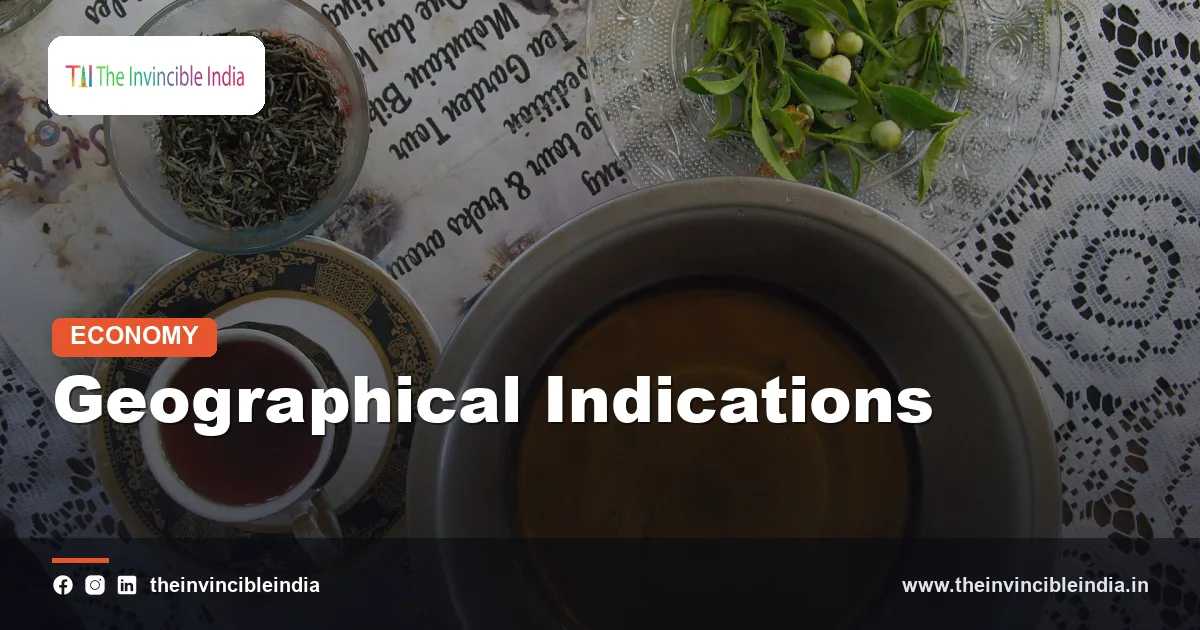
Geographical Indications (GI) are signs used on goods that have a specific geographical origin and possess a quality, reputation or characteristic essentially attributable to that origin, and in India they are registered and protected under the Geographical Indications of Goods (Registration and Protection) Act, 1999. A GI tag lets the producers of a place, such as the growers of Darjeeling tea or the weavers of Banarasi sarees, stop outsiders from using the name on goods that do not come from that place or meet its standards.
India’s GI system is administered by the Geographical Indications Registry in Chennai, which functions under the Controller General of Patents, Designs and Trade Marks. The system covers agricultural produce, handicrafts, textiles, manufactured goods and foodstuffs, and it has become one of the main legal tools for protecting India’s traditional products at home and abroad. This explainer was last reviewed on 15 October 2026.
Quick Facts
| Attribute | Details |
|---|---|
| Governing law | Geographical Indications of Goods (Registration and Protection) Act, 1999 |
| Date in force | 15 September 2003 |
| Administering department | Department for Promotion of Industry and Internal Trade (DPIIT), Ministry of Commerce and Industry |
| Registry | Geographical Indications Registry, Chennai (under the Controller General of Patents, Designs and Trade Marks) |
| First Indian GI | Darjeeling tea, registered in the first years after the Act came into force |
| Validity of registration | 10 years, renewable indefinitely for further periods of 10 years |
| Goods covered | Agricultural, natural, manufactured and handicraft goods and foodstuffs |
| International basis | Articles 22 to 24 of the WTO TRIPS Agreement |
Key Takeaways
- A Geographical Indication is a sign on goods indicating a specific place of origin, where a quality, reputation or characteristic of the goods is essentially due to that origin.
- India protects GIs through the Geographical Indications of Goods (Registration and Protection) Act, 1999, which came into force on 15 September 2003.
- The Geographical Indications Registry in Chennai receives, examines and registers GI applications in India.
- A GI registration lasts 10 years and can be renewed repeatedly, and the right belongs collectively to the producers of the region and cannot be sold or licensed to outsiders.
- Darjeeling tea was India’s first registered GI, and well-known registered GIs include Basmati rice, Banarasi brocades and sarees, Kashmir Pashmina and Madhubani paintings.
- A GI differs from a trademark because a trademark identifies a single business while a GI identifies the goods of a place and a community of producers.
What Is a Geographical Indication?
A Geographical Indication is a name or sign used on goods that come from a particular territory, where the goods owe a given quality, reputation or other characteristic essentially to that territory. The Indian definition, found in Section 2(1)(e) of the 1999 Act, refers to agricultural goods, natural goods, manufactured goods and goods of handicraft or industry, including foodstuffs.
The connection to place may arise from natural factors such as soil, climate, altitude and water, from human factors such as inherited skills and techniques, or from both. Darjeeling tea reflects hill climate and tea-making practice, while Pashmina reflects the fine undercoat of Changthangi goats and the traditional spinning and weaving skills of Kashmir.
GI protection applies to goods only. Services are not covered under the Indian Act. The name need not be a place name, because a traditional name that is linked to a region can also qualify, provided it identifies the goods as originating from there.
What Law Governs Geographical Indications in India?
The Geographical Indications of Goods (Registration and Protection) Act, 1999 governs GIs in India, and the Geographical Indications of Goods (Registration and Protection) Rules, 2002 set out procedure. The Act was passed to meet India’s obligations under the Agreement on Trade-Related Aspects of Intellectual Property Rights (TRIPS) of the World Trade Organization, which requires member countries to provide legal means to prevent misleading use of geographical indications.
The Act came into force on 15 September 2003. Its main features include:
- registration of geographical indications and of their authorised users;
- protection against use that misleads the public about the origin of goods;
- civil remedies and criminal penalties for infringement;
- a Registrar of Geographical Indications to examine applications;
- appeal to the Intellectual Property Appellate Board, whose functions were later transferred to the High Courts under the Tribunals Reforms Act, 2021.
At the international level, protection of GIs is linked to Articles 22 to 24 of the TRIPS Agreement, to the Paris Convention and to bilateral trade agreements, in which Geographical Indications are now a regular topic.
Who Runs the Geographical Indications Registry in India?
The Geographical Indications Registry in Chennai runs the GI system in India, operating under the Controller General of Patents, Designs and Trade Marks, who is also the Registrar of Geographical Indications. The Registry sits within the administrative framework of the Department for Promotion of Industry and Internal Trade (DPIIT) in the Ministry of Commerce and Industry.
The Registry maintains the Register of Geographical Indications, which has two parts:
- Part A: records the registered geographical indications themselves, with their description, area and particulars.
- Part B: records the registered authorised users, who are producers permitted to use the indication.
Examination in the Registry includes a scrutiny of the application, and the file is typically referred to a consultative group of subject experts to verify the claims about origin and quality. This expert step is a distinctive feature of GI practice, because the real test is whether the product’s characteristics are in fact linked to the region.
How Is a Geographical Indication Registered in India?
A Geographical Indication is registered in India when an association of persons, producers, an organisation or an authority representing the interests of the producers files an application with the GI Registry and the claim survives examination and public opposition. Individual producers on their own cannot normally file; the application has to come from a body that represents the producers of the goods.
The process runs through these stages:
- Application: the applicant describes the goods, the geographical area, the link between quality and origin, the method of production and the inspection structure, and attaches a map of the territory.
- Examination: the Registry scrutinises the application and may raise objections, with the expert group reviewing the claims.
- Show cause and publication: if accepted, the application is advertised in the Geographical Indications Journal.
- Opposition: any person can file an opposition within the prescribed period, typically three months.
- Registration: if there is no successful opposition, the indication is registered and a certificate issued.
- Authorised users: producers then apply separately to be registered as authorised users.
The registration is valid for ten years from the date of application and can be renewed for further ten-year terms.
Who Can Use a GI Tag?
Only producers registered as authorised users, and the registered proprietor, can use a GI tag on their goods. Any producer of the goods in the specified area who follows the prescribed standards can apply to the Registry for registration as an authorised user and, once entered in Part B of the Register, may use the indication.
The right to a GI is collective and public in character. Under Section 24 of the Act, the right in a registered geographical indication is not transferable, assignable, licensable or capable of being pledged or mortgaged. This is a key point of difference from private intellectual property, because the GI belongs to the community of producers of the region and not to one person or company.
An authorised user also takes on obligations, such as keeping to the product specification and quality norms. Producers from outside the region, or inside the region but not making the goods to the standard, cannot use the name even if they make a similar item.
What Is the Difference Between a GI and a Trademark?
A Geographical Indication certifies that goods come from a particular place and share a place-linked quality, while a trademark identifies the commercial source of goods or services as one particular business. The two systems protect different kinds of interests and operate under different laws, with trademarks governed in India by the Trade Marks Act, 1999.
| Feature | Geographical Indication | Trademark |
|---|---|---|
| What it signals | Origin and place-linked quality | Commercial source of a business |
| Owner | Collective: producers of the region | An individual, company or entity |
| Transfer or licence | Not transferable or licensable | Can be assigned and licensed |
| Link to place | Essential | Not required |
| Governing Act in India | GI Act, 1999 | Trade Marks Act, 1999 |
| Validity | 10 years, renewable | 10 years, renewable |
| Applies to | Goods only | Goods and services |
A product can carry both. A cooperative of weavers may hold the GI for a regional silk while individual firms sell it under their own trademarks.
Which Are the Famous Geographical Indications of India?
India’s most famous Geographical Indications include Darjeeling tea, Basmati rice, Banarasi brocades and sarees, Kashmir Pashmina and Madhubani paintings, and the list runs to several hundred registered products and keeps growing. The registered GIs cover almost every category of goods.
| Geographical Indication | Region | Category |
|---|---|---|
| Darjeeling tea | Darjeeling hills, West Bengal | Agricultural; India’s first registered GI |
| Basmati rice | Specified districts of northern India, in several states | Agricultural |
| Banarasi brocades and sarees | Varanasi and neighbouring districts, Uttar Pradesh | Textile and handicraft |
| Kashmir Pashmina | Jammu and Kashmir | Textile and handicraft |
| Madhubani paintings | Mithila region, Bihar | Handicraft |
| Kancheepuram silk | Kancheepuram, Tamil Nadu | Textile |
| Mysore silk | Karnataka | Textile |
| Alphonso mango | Konkan region, Maharashtra | Agricultural |
| Nagpur orange | Nagpur region, Maharashtra | Agricultural |
| Kullu shawl | Kullu valley, Himachal Pradesh | Textile |
Basmati rice is a notable case. It received GI registration for a defined set of northern states in 2016, and the geographical extent of its protection has been a subject of discussion among states and in trade with other countries.
What Are the Benefits of a GI Tag for Producers?
A GI tag benefits producers by giving legal protection against imitation, helping them earn better prices for authentic goods and building a recognised regional brand. These benefits matter most for artisans and farmers who have traditional skill but little marketing power.
- Legal protection: the registered proprietor and authorised users can sue for infringement and passing off, and misuse of the name can lead to civil and criminal action.
- Price premium: buyers often pay more for authenticated goods with a clear origin.
- Export value: a GI gives goods a distinct identity in foreign markets and supports claims for protection abroad.
- Preservation of tradition: specifications and quality norms help to retain traditional methods and knowledge.
- Rural and regional development: a GI can bring tourism, local employment and investment in the producer community.
- Consumer confidence: buyers get assurance about origin and quality.
Under Section 39 of the Act, applying a false geographical indication is punishable with imprisonment and fine, and a court can order remedies such as injunction and damages. The practical strength of enforcement depends on producers organising themselves, monitoring the market and acting on violations.
How Do GIs Connect With ODOP, KVIC and Rural Development?
Geographical Indications connect with rural development because many GI products are village-based crafts and crops that are also the focus of programmes such as One District One Product (ODOP) and the Khadi and Village Industries Commission (KVIC) schemes. A GI gives the legal identity, and these programmes supply finance, skills and markets.
In the ODOP framework, a district’s signature product is frequently a GI product, so registration, branding and marketing efforts reinforce one another. Handloom and handicraft clusters supported by the Ministry of Textiles often seek GI status for their products, and agricultural boards and commodity bodies help to document produce for registration. State governments and agencies such as NABARD have also supported producer groups in preparing GI applications.
The experience also shows a common challenge. Getting a GI is only the first step. Producers must register as authorised users, maintain quality, create a market and guard against fakes, and without that follow-through a registered GI can remain under-used.
What Challenges Do Indian GIs Face?
The main challenges facing Indian GIs are low awareness among producers, under-registration of authorised users, weak enforcement against counterfeits and difficulty in building markets after registration. Many artisans do not know about the tag or the benefits of becoming authorised users, and the number of registered users for some GIs remains small compared with the number of producers.
- Counterfeits: machine-made or out-of-region goods sold under famous names, especially in textiles.
- Cost and procedure: the process can be slow and may need technical and legal help that small groups lack.
- Quality control: without inspection structures, the standard promised by the GI may slip.
- Disputes between regions: two states may claim the same product, as has happened with some sweets and rice varieties.
- Foreign protection: securing recognition abroad requires separate registration or treaty arrangements.
Better outcomes depend on stronger producer organisations, awareness drives, traceability measures and coordination with schemes that provide finance and marketing.
Bottom Line
A Geographical Indication ties the name of a product to the place and people who make it, and India has built a dedicated legal and administrative system for it through the 1999 Act and the GI Registry in Chennai. The tag protects heritage products and can raise producer incomes, but its real value depends on producers using it, maintaining quality and defending the name in the market.
Frequently Asked Questions
What is a GI tag in India?
A GI tag is a registration under the Geographical Indications of Goods Act, 1999 that recognises goods as originating from a particular place with a quality or reputation linked to it. It prevents unauthorised use of the name. Darjeeling tea and Banarasi sarees are well-known examples.
Where is the GI Registry of India located?
The Geographical Indications Registry is located in Chennai, Tamil Nadu. It works under the Controller General of Patents, Designs and Trade Marks, who also acts as the Registrar of Geographical Indications. The Registry examines applications and maintains the Register of Geographical Indications.
Which was the first GI-tagged product in India?
Darjeeling tea was the first product registered as a Geographical Indication in India. It was registered in the early years after the 1999 Act came into force in 2003. Since then, hundreds of products from agriculture, textiles, crafts and food have been added.
How long is a GI registration valid?
A GI registration is valid for ten years from the date of application. It can be renewed for further periods of ten years, so protection can continue indefinitely if renewal fees are paid. Authorised user registrations also need to be renewed.
Can anyone apply for a GI tag?
No, an application must come from an association of persons, producers, an organisation or an authority representing the producers of the goods. A single producer cannot normally file alone. After registration, individual producers apply separately to become authorised users.
Is a GI the same as a trademark?
No, a GI and a trademark are different forms of intellectual property. A trademark identifies one business and can be sold or licensed, while a GI identifies goods from a region, belongs collectively to the producers and cannot be transferred. The two are governed by separate Acts.
{“@context”:”https://schema.org”,”@graph”:[{“@type”:”FAQPage”,”mainEntity”:[{“@type”:”Question”,”name”:”What is a GI tag in India?”,”acceptedAnswer”:{“@type”:”Answer”,”text”:”A GI tag is a registration under the Geographical Indications of Goods Act, 1999 that recognises goods as originating from a particular place with a quality or reputation linked to it. It prevents unauthorised use of the name. Darjeeling tea and Banarasi sarees are well-known examples.”}},{“@type”:”Question”,”name”:”Where is the GI Registry of India located?”,”acceptedAnswer”:{“@type”:”Answer”,”text”:”The Geographical Indications Registry is located in Chennai, Tamil Nadu. It works under the Controller General of Patents, Designs and Trade Marks, who also acts as the Registrar of Geographical Indications. The Registry examines applications and maintains the Register of Geographical Indications.”}},{“@type”:”Question”,”name”:”Which was the first GI-tagged product in India?”,”acceptedAnswer”:{“@type”:”Answer”,”text”:”Darjeeling tea was the first product registered as a Geographical Indication in India. It was registered in the early years after the 1999 Act came into force in 2003. Since then, hundreds of products from agriculture, textiles, crafts and food have been added.”}},{“@type”:”Question”,”name”:”How long is a GI registration valid?”,”acceptedAnswer”:{“@type”:”Answer”,”text”:”A GI registration is valid for ten years from the date of application. It can be renewed for further periods of ten years, so protection can continue indefinitely if renewal fees are paid. Authorised user registrations also need to be renewed.”}},{“@type”:”Question”,”name”:”Can anyone apply for a GI tag?”,”acceptedAnswer”:{“@type”:”Answer”,”text”:”No, an application must come from an association of persons, producers, an organisation or an authority representing the producers of the goods. A single producer cannot normally file alone. After registration, individual producers apply separately to become authorised users.”}},{“@type”:”Question”,”name”:”Is a GI the same as a trademark?”,”acceptedAnswer”:{“@type”:”Answer”,”text”:”No, a GI and a trademark are different forms of intellectual property. A trademark identifies one business and can be sold or licensed, while a GI identifies goods from a region, belongs collectively to the producers and cannot be transferred. The two are governed by separate Acts.”}}]}]}


