

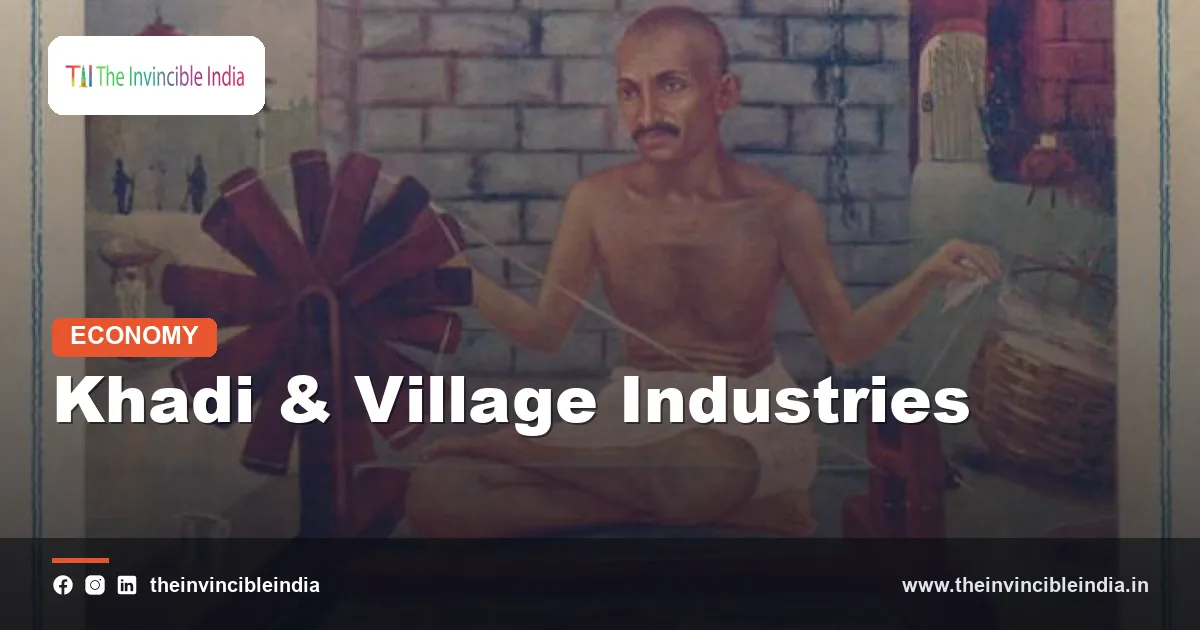
The Khadi and Village Industries Commission (KVIC) is a statutory body set up under the Khadi and Village Industries Commission Act, 1956 to plan, promote, organise and assist the development of khadi and other village industries in rural India. It functions under the Ministry of Micro, Small and Medium Enterprises (MSME) and is the apex organisation for the sector.
KVIC carries forward the Gandhian idea of swadeshi and self-reliant villages. It sells khadi through its own outlets, funds rural enterprises through schemes such as the Prime Minister’s Employment Generation Programme (PMEGP) and the Scheme of Fund for Regeneration of Traditional Industries (SFURTI), and supports a large base of spinners, weavers and village artisans. This explainer was last reviewed on 15 October 2026.
Quick Facts
| Attribute | Details |
|---|---|
| Full name | Khadi and Village Industries Commission (KVIC) |
| Established under | Khadi and Village Industries Commission Act, 1956 |
| Commission formed | April 1957, replacing the All India Khadi and Village Industries Board of 1953 |
| Parent ministry | Ministry of Micro, Small and Medium Enterprises (MSME) |
| Headquarters | Mumbai, with state and zonal offices across India |
| Legal status | Statutory body |
| Nodal agency for | Prime Minister’s Employment Generation Programme (PMEGP) at the national level |
| Other flagship scheme | Scheme of Fund for Regeneration of Traditional Industries (SFURTI), under the Ministry of MSME |
| Symbolic identity | The charkha (spinning wheel) and the Khadi Mark |
Key Takeaways
- The Khadi and Village Industries Commission is a statutory body created by the Khadi and Village Industries Commission Act, 1956, and it began functioning in April 1957.
- KVIC works under the Ministry of Micro, Small and Medium Enterprises and has its headquarters in Mumbai.
- Khadi is a hand-spun and hand-woven cloth whose revival was led by Mahatma Gandhi as part of the swadeshi movement.
- KVIC is the national nodal agency for the Prime Minister’s Employment Generation Programme (PMEGP), which gives a margin-money subsidy to new micro enterprises.
- The Scheme of Fund for Regeneration of Traditional Industries (SFURTI) supports clusters of traditional industries, with KVIC among its nodal agencies.
- In recent years KVIC has reported strong growth in khadi and village industry turnover, helped by modernised outlets, new designs and a younger customer base.
What Is the Khadi and Village Industries Commission?
The Khadi and Village Industries Commission is the central statutory organisation responsible for developing khadi and village industries across India. Its work covers training, finance, raw-material supply, technology, marketing and quality certification for rural producers.
The Commission’s mandate, as set out in its founding Act, includes:
- planning and organising the production and sale of khadi and the products of village industries;
- building up a reserve of raw materials and creating common service facilities for artisans;
- promoting research, design and technology suited to rural units;
- providing financial assistance to institutions and individuals engaged in these industries;
- encouraging the sale and marketing of khadi and village-industry products.
KVIC works through state Khadi and Village Industries Boards, registered institutions, cooperative societies and individual entrepreneurs. It operates mostly through a network of certified khadi institutions that employ spinners and weavers, rather than as a direct employer of artisans.
What Is Khadi?
Khadi is a hand-spun and hand-woven fabric, traditionally made from cotton but also produced in silk and wool, and it is a symbol of India’s freedom struggle and rural self-reliance. The yarn is spun on the charkha (spinning wheel) and woven on handlooms, and the process does not require electricity in its traditional form.
Khadi has several features that distinguish it:
- It is hand-made at both stages, spinning and weaving, which sets it apart from handloom cloth made with mill yarn.
- It has a characteristic texture and breathability that suits hot climates.
- It comes in types such as khadi cotton, khadi silk and khadi woollen.
- It carries the Khadi Mark, a certification for genuine khadi introduced to stop misuse of the name.
The legal definition in the KVIC Act describes khadi as cloth woven on handlooms in India from cotton, silk or woollen yarn handspun in India, or from a mixture of any two or all of such yarns. That definition is why the use of the term “khadi” is regulated.
What Are the Gandhian and Swadeshi Roots of Khadi?
The roots of khadi lie in the swadeshi movement, which began after the 1905 partition of Bengal, and in Mahatma Gandhi’s promotion of spinning as a means of economic independence and moral discipline. Gandhi saw the charkha as a way to give villagers a supplementary income, reduce dependence on imported British cloth and unite people across classes in a common act of labour.
Key moments in the story include:
- Gandhi’s book Hind Swaraj in 1909, which criticised industrial civilisation and argued for village self-reliance.
- The non-cooperation movement from 1920, when boycotting foreign cloth and wearing khadi became a political act.
- The formation of the All India Spinners’ Association in 1925 to organise khadi production and sales.
- The All India Village Industries Association, set up in 1934, which broadened the effort to other village crafts.
- The adoption of the khadi tricolour with the charkha, which was later replaced by the Ashoka Chakra in the national flag in 1947.
After independence, these ideas were institutionalised, first through a board and then through the Commission. The thinking of Gandhi and of Gandhian economists such as J. C. Kumarappa shaped the idea that village industries should provide decentralised employment.
When and How Was KVIC Established?
KVIC was established in April 1957 under the Khadi and Village Industries Commission Act, 1956, replacing the All India Khadi and Village Industries Board that had been set up in 1953. The Act was passed by Parliament to give the sector a stronger statutory footing and a professional body to coordinate its development.
The Act has been amended since then. The Commission has a Chairman and Members, and its work is carried out through zonal and state directorates. Over the decades, the organisation expanded from its early role of promoting khadi to a broader remit covering a wide range of village industries, including agro-based and food processing, mineral-based, forest-based, polymer and chemical-based, engineering and non-conventional energy, and service industries.
The administrative ministry has changed over time. Today KVIC reports to the Ministry of MSME, which positions khadi and village industries within India’s overall small-enterprise policy.
What Are Village Industries?
Village industries are industries located in a rural area that produce goods or render services with or without the use of power, and in which the fixed capital investment per head of an artisan or worker is within a limit set by the government. The KVIC Act uses this definition to decide which enterprises can receive Commission support.
KVIC groups them into broad categories:
| Category | Examples |
|---|---|
| Agro-based and food processing | Pickles, spices, fruit processing, cereal processing, bee-keeping and honey |
| Forest-based | Bamboo products, herbal and medicinal products, gum and resin |
| Mineral-based | Pottery, cement products, stone crafts |
| Polymer and chemical-based | Soaps, candles, leather-related and plastic goods |
| Rural engineering and non-conventional energy | Carpentry, blacksmithy, biogas |
| Textile | Khadi, hosiery, readymade garments |
| Handmade paper and fibre | Paper, coir and fibre products |
| Service | Repair, processing and similar rural services |
The Honey Mission, the potters’ empowerment programme Kumhar Sashaktikaran Yojana and support to leather artisans are examples of focused interventions under this broad umbrella.
How Has Khadi Been Rebranded and Revived?
Khadi has been rebranded in recent years from a politically associated, mostly austere cloth into a fashion-friendly, eco-conscious and quality-certified product, and KVIC has reported sharply higher sales as a result. The change involved design, retail and public messaging.
- Fashion and design: collaborations with designers and institutes brought new cuts, blends and colours.
- Retail modernisation: KVIC refurbished its showrooms, opened new ones in prime locations and expanded online sales.
- Public advocacy: national leaders encouraged citizens to buy khadi, including on 2 October, Gandhi’s birth anniversary.
- Sustainability appeal: hand-made, low-energy production aligned khadi with the global interest in sustainable textiles.
- Authenticity: the Khadi Mark and trademark rules were used to stop imitation and misleading labelling.
KVIC has reported that the combined turnover of the khadi and village industries sector crossed the one lakh crore rupee mark in the early 2020s, with khadi’s own sales rising several-fold compared with a decade earlier. These are figures reported by the Commission, and they include village industry products as well as cloth.
What Is the Prime Minister’s Employment Generation Programme?
The Prime Minister’s Employment Generation Programme (PMEGP) is a central credit-linked subsidy scheme to generate self-employment by helping set up micro enterprises in non-farm sectors. It was launched in 2008 by merging two earlier schemes, the Prime Minister’s Rozgar Yojana and the Rural Employment Generation Programme.
KVIC is the national nodal agency for implementation, working with state KVIC directorates, state Khadi and Village Industries Boards and District Industries Centres. Key features include:
- a margin-money subsidy on the project cost, with higher rates for rural applicants and for special categories such as women, Scheduled Castes, Scheduled Tribes, other backward classes, minorities, ex-servicemen and persons with disabilities;
- bank finance for the balance of the cost through participating banks;
- a required period of training for beneficiaries through entrepreneurship development programmes;
- eligibility for manufacturing and service units up to prescribed project-cost limits.
PMEGP is the largest rural employment-generation programme run by KVIC, and it links the Commission’s mission with the wider push for micro and small enterprises.
What Is SFURTI and How Does It Help Traditional Industries?
The Scheme of Fund for Regeneration of Traditional Industries (SFURTI) is a Ministry of MSME scheme, launched in 2005, that organises traditional industries and artisans into clusters and helps them become competitive and sustainable. It gives grants to nodal agencies such as KVIC to set up common facilities, upgrade technology and strengthen marketing.
The scheme operates on these lines:
- clusters of artisans are formed around a traditional product such as khadi, coir, bamboo, honey or handicraft;
- a nodal agency, which can be KVIC, the Coir Board or another body, guides the cluster through a technical agency;
- funds support common facility centres, raw-material banks, product development and training;
- clusters are classified by size, with the grant per cluster linked to the number of artisans involved.
SFURTI is closely related to the One District One Product approach, because many traditional clusters also represent a district’s signature product.
Who Are the Artisans Behind Khadi, and What Does KVIC Do for Rural Employment?
The artisans behind khadi are the spinners who produce yarn on the charkha, the weavers who convert it to cloth, and workers in dyeing, finishing and stitching, and KVIC supports them through institutions, training and income schemes. A large share of khadi workers are women, and many work from home or in small village centres.
KVIC’s measures for rural employment and artisan welfare include:
- modern, improved charkhas and looms that reduce drudgery and raise output;
- increased wages for spinners and weavers through reforms in the khadi sector;
- a group insurance and welfare scheme for khadi artisans;
- skill training and entrepreneurship development;
- market links through its showrooms, exhibitions and online platform.
The importance of khadi is also visible in the national symbol: under the Flag Code of India, the national flag was traditionally required to be made of hand-spun and hand-woven khadi, and this tradition is associated with the licensed flag-making unit at Hubballi, Karnataka. Rules on materials were relaxed in 2021 and 2022 to allow machine-made and polyester flags, but khadi remains the traditional fabric of the flag.
What Are the Links Between KVIC, ODOP and GI Products?
KVIC is linked to One District One Product (ODOP) and to Geographical Indications because many khadi and village-industry products are also district signature products or GI-registered crafts. Pottery, honey, handmade paper, bamboo goods and handwoven textiles are examples of village industries that appear in district product lists.
Under the ODOP approach, KVIC schemes such as PMEGP and SFURTI can finance new units and clusters for a district’s chosen product. For GI products made by village artisans, KVIC support in design, training and marketing complements the legal protection of the GI tag. Together, these arrangements aim to give rural producers both an identity and the means to earn from it.
Bottom Line
The Khadi and Village Industries Commission turns a Gandhian ideal into a working public institution, supporting khadi weavers and village entrepreneurs through finance, training, design and markets. Through PMEGP, SFURTI and a revitalised retail network, KVIC links rural livelihoods with a growing demand for hand-made, sustainable goods.
Frequently Asked Questions
What is the full form and role of KVIC?
KVIC stands for the Khadi and Village Industries Commission. It is a statutory body under the Ministry of MSME that promotes khadi and village industries in rural India. Its work includes finance, training, technology support, quality certification and marketing.
When was KVIC established?
KVIC was established in April 1957 under the Khadi and Village Industries Commission Act, 1956. It replaced the All India Khadi and Village Industries Board, which had been set up in 1953. Its headquarters are in Mumbai.
Which ministry controls KVIC?
KVIC functions under the Ministry of Micro, Small and Medium Enterprises (MSME), Government of India. The ministry provides policy direction and funds. The Commission itself is a statutory body with a Chairman and Members.
What is PMEGP and what is KVIC’s role in it?
PMEGP is the Prime Minister’s Employment Generation Programme, a credit-linked subsidy scheme for setting up micro enterprises. KVIC is the national nodal agency for the scheme. It works with state boards, District Industries Centres and banks to deliver subsidy and loans to beneficiaries.
What is the difference between khadi and handloom?
Khadi is both hand-spun and hand-woven, whereas handloom cloth is woven by hand but may use mill-spun yarn. This is why genuine khadi is regulated and carries the Khadi Mark. The KVIC Act defines khadi as cloth from handspun yarn woven on handlooms.
What is SFURTI?
SFURTI is the Scheme of Fund for Regeneration of Traditional Industries, run by the Ministry of MSME since 2005. It organises artisans into clusters and funds common facilities, technology and marketing. KVIC is one of the nodal agencies that implement it.
{“@context”:”https://schema.org”,”@graph”:[{“@type”:”FAQPage”,”mainEntity”:[{“@type”:”Question”,”name”:”What is the full form and role of KVIC?”,”acceptedAnswer”:{“@type”:”Answer”,”text”:”KVIC stands for the Khadi and Village Industries Commission. It is a statutory body under the Ministry of MSME that promotes khadi and village industries in rural India. Its work includes finance, training, technology support, quality certification and marketing.”}},{“@type”:”Question”,”name”:”When was KVIC established?”,”acceptedAnswer”:{“@type”:”Answer”,”text”:”KVIC was established in April 1957 under the Khadi and Village Industries Commission Act, 1956. It replaced the All India Khadi and Village Industries Board, which had been set up in 1953. Its headquarters are in Mumbai.”}},{“@type”:”Question”,”name”:”Which ministry controls KVIC?”,”acceptedAnswer”:{“@type”:”Answer”,”text”:”KVIC functions under the Ministry of Micro, Small and Medium Enterprises (MSME), Government of India. The ministry provides policy direction and funds. The Commission itself is a statutory body with a Chairman and Members.”}},{“@type”:”Question”,”name”:”What is PMEGP and what is KVIC’s role in it?”,”acceptedAnswer”:{“@type”:”Answer”,”text”:”PMEGP is the Prime Minister’s Employment Generation Programme, a credit-linked subsidy scheme for setting up micro enterprises. KVIC is the national nodal agency for the scheme. It works with state boards, District Industries Centres and banks to deliver subsidy and loans to beneficiaries.”}},{“@type”:”Question”,”name”:”What is the difference between khadi and handloom?”,”acceptedAnswer”:{“@type”:”Answer”,”text”:”Khadi is both hand-spun and hand-woven, whereas handloom cloth is woven by hand but may use mill-spun yarn. This is why genuine khadi is regulated and carries the Khadi Mark. The KVIC Act defines khadi as cloth from handspun yarn woven on handlooms.”}},{“@type”:”Question”,”name”:”What is SFURTI?”,”acceptedAnswer”:{“@type”:”Answer”,”text”:”SFURTI is the Scheme of Fund for Regeneration of Traditional Industries, run by the Ministry of MSME since 2005. It organises artisans into clusters and funds common facilities, technology and marketing. KVIC is one of the nodal agencies that implement it.”}}]}]}


