

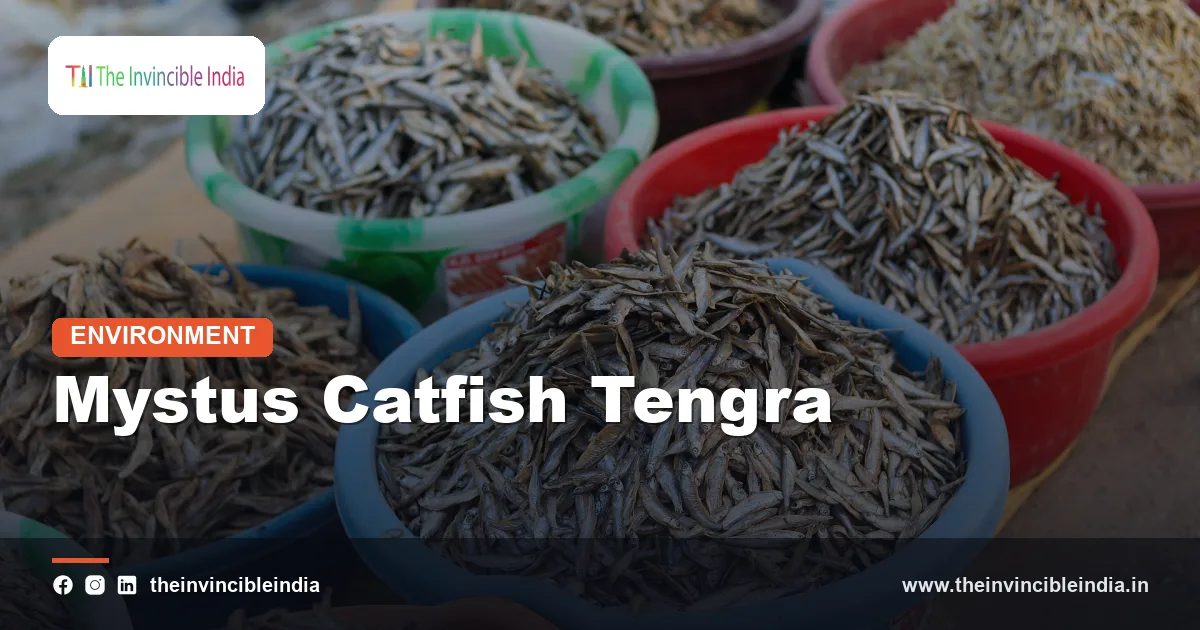
The mystus catfish, known across eastern and northern India as tengra, is a small to medium whiskered freshwater catfish of the genus Mystus that lives in rivers, canals, ponds and flooded fields and is widely eaten as a tasty, soft-fleshed fish. Several closely related species share the name, and all are recognised by their four pairs of barbels, a long adipose fin and sharp spines in the dorsal and pectoral fins.
The mystus catfish is a familiar sight in village markets of Bengal, Assam, Bihar and Odisha, where it is sold live or fresh in small heaps. This article explains what the fish is, how to tell the species apart, how it lives, what it eats, how it breeds, and why it matters to people and to river ecosystems in India.
| Feature | Detail |
|---|---|
| Common names | Tengra (Bengali and Hindi names), mystus catfish, dwarf catfish, whiskered catfish |
| Scientific names | Genus Mystus; common Indian species include Mystus vittatus, Mystus tengara, Mystus cavasius and Mystus gulio |
| Family | Bagridae (the bagrid or naked catfishes) |
| Size | Roughly 10 to 25 cm in most species; the Gangetic mystus can grow to about 40 cm |
| India range and habitat | Rivers, streams, canals, ponds, beels and floodplains across much of the country; Mystus gulio also enters brackish estuaries |
| Diet | Omnivorous: insects, small crustaceans, worms, small fish and plant matter |
| Breeding | Breeds mainly in the monsoon in shallow, flooded, vegetated waters |
| Economic importance | Popular food fish; small-scale fishery, aquaculture interest and aquarium trade |
| Conservation | Most common species are assessed as Least Concern, though local declines occur |
Key Takeaways
- The mystus catfish, called tengra in much of eastern India, belongs to the genus Mystus in the family Bagridae and is found in freshwater across the Indian subcontinent.
- A mystus catfish has four pairs of barbels, a scaleless skin, a long adipose fin and serrated spines on the dorsal and pectoral fins that can cause a painful puncture.
- Mystus catfish are omnivorous and mostly active at dusk and during the night, feeding on insects, crustaceans, worms and small fish.
- Mystus catfish breed in the monsoon, when rain floods shallow vegetated areas that shelter their eggs and young.
- Tengra is a prized food fish in Bengali, Assamese and Bihari cooking because the flesh is soft, flavourful and has few bones in the body.
- The name tengra is applied to several look-alike species, so the common name does not identify one species exactly.
What is the mystus catfish?
The mystus catfish is any of a group of small freshwater catfishes in the genus Mystus, and in India the name is most closely tied to the fish known locally as tengra. Scientists place the group in the family Bagridae, a large family of catfishes found across Africa and Asia.
The body of a mystus catfish is long and slightly compressed, with a smooth, scaleless skin. The head is flattened, and the mouth is surrounded by four pairs of barbels, which are fleshy whisker-like organs. The eyes are small and the colour is typically greyish or silvery with a pale belly.
The fish has a short dorsal fin with a stout spine in front, a long adipose fin behind it, and pectoral fins that also have a strong spine. These features place it among the “spiny” catfishes that need careful handling in fish markets.
What does tengra mean?
Tengra is the common regional name for the mystus catfish in Bengali, Hindi and other languages of eastern and northern India. The word is used loosely for several small bagrid catfishes, and in markets it may cover more than one species of Mystus sold together.
The names differ by region and language. In Bengal the fish is often called tengra or tangra, and in Hindi-speaking regions the same or a similar name is used. The variety of names reflects how widely it is eaten and how many closely related species exist.
For scientists this variety creates a difficulty. A fish sold as tengra may be Mystus vittatus, Mystus tengara, Mystus cavasius or another species, and a reliable identification needs a close look at body markings, fin spines and the number of fin rays.
Which species are called mystus catfish in India?
Several species of Mystus occur in India, and the best known are the striped dwarf catfish, the Gangetic mystus, the long-whiskered catfish and the Mystus tengara. Each has a distinct size and habitat, as the table below shows.
| Species | Common name | Notes |
|---|---|---|
| Mystus vittatus | Striped dwarf catfish | Small, with pale stripes along the sides and a dark spot behind the head; widespread in plains waters and sold in the aquarium trade |
| Mystus tengara | Tengara mystus | Small, with a few faint stripes; common in Gangetic plains, canals and floodplains |
| Mystus cavasius | Gangetic mystus | Larger, grows to about 40 cm; found in rivers and reservoirs of northern, eastern and central India |
| Mystus gulio | Long-whiskered catfish | Tolerates brackish water; found in estuaries and tidal creeks along the coast |
| Mystus bleekeri | Day’s mystus | Small, found in rivers and ponds of northern and eastern India |
The striped dwarf catfish, Mystus vittatus, is the species most often met by people in towns and villages. It reaches only about 20 cm in length, and the pale longitudinal bands on a greyish body make it relatively easy to recognise.
How can you identify a mystus catfish?
A mystus catfish is identified by its four pairs of barbels, its smooth scaleless skin, its long adipose fin and the sharp spine at the front of the dorsal and pectoral fins. These features separate it from other small catfishes of Indian waters.
The barbels are long, and in some species the maxillary pair reaches back past the base of the pectoral fin. The tail fin is forked and the two lobes may be rounded or pointed depending on the species.
- Four pairs of barbels: one nasal, one maxillary and two mandibular pairs.
- Long adipose fin, longer than the short-based dorsal fin.
- Serrated pectoral spines that are firm and sharp.
- Pale lateral stripes or a faint dark spot behind the head in several small species.
- A large mouth for the fish’s size, with small teeth in bands.
It differs from the walking catfish (magur) and the stinging catfish (singhi), both of which have an air-breathing organ, a very different body shape and a distinct flavour. The mystus catfish is a typical water-breathing fish and cannot survive long out of water.
Where does the mystus catfish live?
The mystus catfish lives in slow-flowing rivers, canals, ponds, lakes, beels and flooded fields, usually in shallow water with vegetation or a muddy bottom. It occurs across the Indian subcontinent, from the Indus and Ganga plains to the Brahmaputra valley, peninsular rivers and the coast.
During the day it hides among aquatic plants, under submerged logs and near the banks, and it becomes more active in the evening and at night. It is a bottom-oriented fish that stays near cover and usually avoids fast currents.
The species is tolerant of low oxygen and moderate pollution, which helps it persist in busy farmland waters. This is one reason that it is so common in irrigation canals and rice-growing regions of the plains.
Does the mystus catfish live in brackish water?
Some species do. Mystus gulio, the long-whiskered catfish, lives in estuaries, tidal creeks and mangrove channels and can move between fresh and brackish water. It is commonly sold in coastal markets of West Bengal, Odisha, Andhra Pradesh and the Sundarbans region.
What does the mystus catfish eat?
The mystus catfish is an omnivore that eats insects, insect larvae, small crustaceans, worms, small fish and some plant matter. It feeds mainly at night, using its barbels to find food in dark and muddy water.
The barbels carry taste and touch receptors, and they let the fish detect prey that it cannot see. Younger fish feed mostly on zooplankton and insect larvae, while larger ones take small fish and prawns.
Because it feeds on mosquito larvae and other aquatic insects, the mystus catfish contributes to natural pest control in ponds and paddy fields. At the same time, it is prey for larger fishes, water birds, snakes and otters, which makes it a link between small invertebrates and larger predators in the food chain.
How does the mystus catfish breed?
The mystus catfish breeds mainly during the monsoon, when rising water floods shallow areas and provides shelter and food for eggs and larvae. Females lay eggs in vegetation or in shallow depressions, and the eggs hatch in a day or two in warm water.
Spawning is triggered by the onset of rains and by the rise in water levels, which is a common pattern among Indian freshwater fishes. Fish move from rivers and deeper water into floodplains, paddy fields and shallow ponds to spawn.
The young grow quickly on the abundant plankton and insects of the flooded areas. Many species mature within about a year, and a female can lay several thousand eggs depending on her size.
Breeding in captivity has been attempted for the commercially favoured species. Hatchery methods similar to those of other catfishes, including hormone-induced spawning, have been tested for Mystus species to support farming and restocking.
Can a mystus catfish sting?
Yes, a mystus catfish can cause a painful wound with the sharp spines of its pectoral and dorsal fins. The pain results from the puncture and from mucus that may irritate the wound, and it usually lasts for several hours before fading.
The injury is not dangerous for most healthy people, but it can become infected if not cleaned. First aid is to wash the wound, remove any visible fragment, soak the area in warm water if it is very painful, and seek medical help if swelling or redness spreads.
Fish handlers in markets usually grip the fish firmly behind the head and keep the fingers away from the spines. Many sellers also trim or press down the spines before selling live fish.
Why is tengra so popular as food?
Tengra is popular because its flesh is tender, sweet and flavourful, and because the fish has few intermuscular bones compared with many carps. It is cooked as a light curry, a mustard preparation, a fry or a dry preparation in many parts of eastern India.
In Bengali cooking, tengra macher jhol is a classic everyday dish, often cooked with potato, brinjal or tomato. In Assam, the fish is prepared with simple spices and sometimes with local herbs, and in Bihar and Odisha it appears in mustard-based curries.
Small catfishes are traditionally regarded in many households as light, easily digested fish. This is a cultural belief rather than a proven medical claim, and the fish is best seen simply as an affordable, nutritious source of protein.
- It is usually sold live or very fresh, which is considered important for flavour.
- Small fish are cooked whole, with the head, after the spines are cleaned.
- It is a source of protein, fats and minerals such as calcium when eaten with the small bones.
What is the economic importance of the mystus catfish?
The mystus catfish supports small-scale capture fisheries, local markets and a modest aquaculture and ornamental fish trade. Its value comes from steady demand in states where it is a favoured dish and from its presence in nearly every floodplain wetland.
Fishers catch it with drag nets, cast nets, traps and hooks, and it is often part of the mixed catch that supports the livelihoods of rural families. Because it is not a major export fish, its importance is mostly local.
Aquarium dealers sell the striped dwarf catfish as a small, hardy ornamental fish. Researchers have also looked at several Mystus species as candidates for diversifying freshwater aquaculture, since they fetch good prices in local markets.
Is the mystus catfish threatened?
Most common mystus catfishes are assessed by the International Union for Conservation of Nature (IUCN) as Least Concern, but local populations decline where wetlands are drained or polluted. The species is adaptable, which keeps its overall risk low.
The pressures it faces are the same as those of many freshwater fishes of India. They include loss of floodplain wetlands, dams that interrupt migration, pollution, intensive pesticide use in paddy fields and overfishing of small fish with fine-mesh nets.
Protecting wetlands, allowing seasonal flooding, and avoiding fishing during the monsoon breeding season help keep tengra populations healthy. The species benefits from the same measures that support other native small fishes of India’s floodplains.
Bottom Line
The mystus catfish, or tengra, is a small spiny whiskered catfish that is common in Indian plains waters and valued on the plate. It is a hardy, adaptable species, and its main needs are clean, seasonally flooded wetlands to breed and feed.
Frequently Asked Questions
What is a mystus catfish?
A mystus catfish is a small freshwater catfish of the genus Mystus, family Bagridae, known in much of India as tengra. It has four pairs of barbels, a scaleless body, a long adipose fin and sharp fin spines. Several similar species are found in rivers, ponds and canals across the subcontinent.
What is tengra fish?
Tengra fish is the regional name for the mystus catfish, especially in Bengal, Assam, Bihar and Odisha. The name is used for several look-alike species, such as Mystus vittatus and Mystus tengara. It is a popular food fish cooked in light curries and mustard preparations.
Can a mystus catfish sting you?
Yes, a mystus catfish can inflict a painful puncture with the sharp spines on its dorsal and pectoral fins. The pain usually fades within hours, though the wound should be cleaned to prevent infection. Handling the fish firmly behind the head reduces the risk.
What does the mystus catfish eat?
The mystus catfish eats insects, insect larvae, small crustaceans, worms, small fish and some plant matter. It feeds mostly at night and uses its barbels to find food in murky water. Young fish prefer zooplankton and small insect larvae.
When does the mystus catfish breed?
The mystus catfish breeds mainly during the monsoon, when rising water floods shallow vegetated areas. Females lay eggs in plants or shallow depressions, and the eggs hatch within a day or two. The flooded habitats give the young plenty of food and cover.
Is the mystus catfish endangered?
No, most common mystus catfishes are not endangered and are classed as Least Concern by the IUCN. Local populations can decline because of wetland loss, pollution and overfishing. Keeping floodplain wetlands healthy helps the species survive.
{“@context”:”https://schema.org”,”@graph”:[{“@type”:”FAQPage”,”mainEntity”:[{“@type”:”Question”,”name”:”What is a mystus catfish?”,”acceptedAnswer”:{“@type”:”Answer”,”text”:”A mystus catfish is a small freshwater catfish of the genus Mystus, family Bagridae, known in much of India as tengra. It has four pairs of barbels, a scaleless body, a long adipose fin and sharp fin spines. Several similar species are found in rivers, ponds and canals across the subcontinent.”}},{“@type”:”Question”,”name”:”What is tengra fish?”,”acceptedAnswer”:{“@type”:”Answer”,”text”:”Tengra fish is the regional name for the mystus catfish, especially in Bengal, Assam, Bihar and Odisha. The name is used for several look-alike species, such as Mystus vittatus and Mystus tengara. It is a popular food fish cooked in light curries and mustard preparations.”}},{“@type”:”Question”,”name”:”Can a mystus catfish sting you?”,”acceptedAnswer”:{“@type”:”Answer”,”text”:”Yes, a mystus catfish can inflict a painful puncture with the sharp spines on its dorsal and pectoral fins. The pain usually fades within hours, though the wound should be cleaned to prevent infection. Handling the fish firmly behind the head reduces the risk.”}},{“@type”:”Question”,”name”:”What does the mystus catfish eat?”,”acceptedAnswer”:{“@type”:”Answer”,”text”:”The mystus catfish eats insects, insect larvae, small crustaceans, worms, small fish and some plant matter. It feeds mostly at night and uses its barbels to find food in murky water. Young fish prefer zooplankton and small insect larvae.”}},{“@type”:”Question”,”name”:”When does the mystus catfish breed?”,”acceptedAnswer”:{“@type”:”Answer”,”text”:”The mystus catfish breeds mainly during the monsoon, when rising water floods shallow vegetated areas. Females lay eggs in plants or shallow depressions, and the eggs hatch within a day or two. The flooded habitats give the young plenty of food and cover.”}},{“@type”:”Question”,”name”:”Is the mystus catfish endangered?”,”acceptedAnswer”:{“@type”:”Answer”,”text”:”No, most common mystus catfishes are not endangered and are classed as Least Concern by the IUCN. Local populations can decline because of wetland loss, pollution and overfishing. Keeping floodplain wetlands healthy helps the species survive.”}}]}]}


