

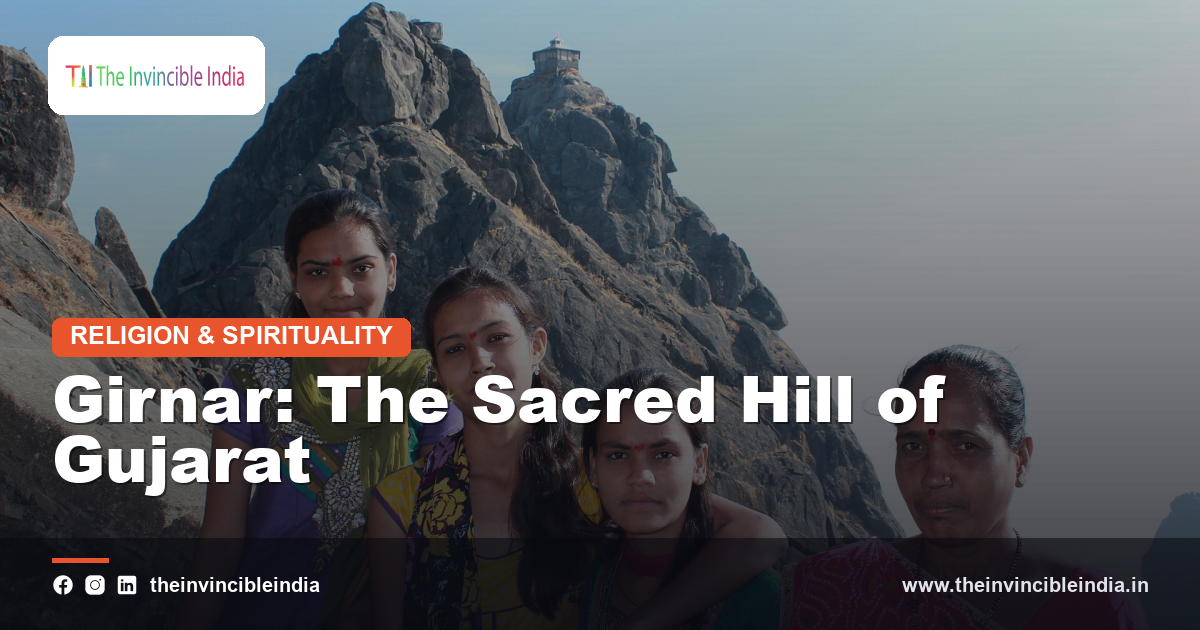
Girnar is a cluster of rocky peaks rising dramatically from the plains near Junagadh in Gujarat, and for centuries it has been regarded as a mountain of exceptional sanctity. Hindus, Jains, and ascetic traditions of many kinds have all found meaning here, and the hill’s long stone stairway leads past temples, shrines, and resting places that belong to several faiths. Its role as a meeting ground of devotion makes it a distinctive example of the practice described in this overview of pilgrimage in India. This guide introduces Girnar’s geography, its major shrines, its pilgrimage customs, and its place in the cultural life of Gujarat.
Quick Facts
| Detail | Information |
|---|---|
| Location | Near Junagadh, Gujarat |
| Landform | Group of sacred peaks |
| Traditions | Hindu, Jain, and ascetic |
| Jain Association | Neminatha, 22nd Tirthankara |
| Hindu Association | Dattatreya, Ambaji, Gorakhnath |
| Notable Event | Annual circumambulation in Kartik |
Girnar in the Landscape of Gujarat
Girnar rises abruptly from the flat country of the Saurashtra peninsula, a group of steep rocky hills clothed in dry forest and crowned with temples. The mountain lies close to the historic city of Junagadh, which grew up beneath it and has long been shaped by its presence. From a distance the peaks stand out against the sky with a sense of solemn height, and the contrast with the surrounding plains has encouraged people to regard the hill as a place set apart.
The hills form part of a landscape that is rich in history, with forts, ancient inscriptions, and sacred sites in close proximity. Girnar thus stands at the centre of a region where geography and faith have been interwoven for many centuries, and its natural grandeur is an essential part of its religious character.
A Mountain Sacred to Many Traditions
One of the most notable features of Girnar is that it is sacred to more than one tradition. Hindu devotees come to honour shrines associated with the sage Dattatreya, the goddess Ambaji, and the ascetic teacher Gorakhnath, while Jains revere the hill as a major pilgrimage place connected with the Tirthankara Neminatha. Ascetics from various orders have also lived and practised on the slopes for generations.
This sharing of a single sacred mountain among different communities reflects a long pattern in Indian religious life, in which pilgrimage places often draw devotion from several streams of belief. Each tradition approaches Girnar in its own way, with its own rituals and stories, yet all recognise the hill as holy. Girnar therefore illustrates how a single landscape can hold many forms of reverence at once.
The Stairway to the Summit
The principal route up Girnar is a long stone stairway of many thousands of steps, built over time to allow pilgrims to reach the temples near the summit. The climb begins at the foot of the hill and rises steadily through wooded slopes, passing small shrines, resting places, and viewpoints along the way. Many devotees start before dawn to avoid the heat of the day, and the ascent is regarded as an act of effort and devotion.
Along the stairway are stalls selling water and simple refreshments, and local bearers are available to carry those who cannot manage the climb unaided. The steps connect the different temple groups, so that the journey itself forms a continuous sequence of worship. The stairway of Girnar thus serves as both a practical path and a symbol of the spiritual ascent that pilgrims seek.
The Jain Temples and Neminatha
For the Jain community, Girnar is one of the most important pilgrimage hills, closely associated with Neminatha, who is revered as the twenty-second Tirthankara. Tradition holds that he attained liberation on this mountain, and the temples dedicated to him form the spiritual centre of the Jain presence here. The Jain temples are built of stone and marble, with carved pillars and ornamented halls that reflect the craftsmanship of western Indian temple architecture.
The complex also includes shrines dedicated to other Tirthankaras, and pilgrims move through them in a prescribed order, offering prayers and performing simple rites of reverence. The calm and ordered atmosphere in these temples reflects the Jain emphasis on discipline and non-violence. The Jain temples of Girnar thus link the hill to the foundational figures of the faith, as the neighbouring site described in the Palitana temples guide also does.
Hindu Shrines on the Hill
The upper reaches of Girnar include several important Hindu shrines, each situated on or near a distinct peak. Devotees honour Dattatreya, a figure associated in tradition with wisdom and ascetic life, as well as the goddess Ambaji, who is worshipped as a form of the Divine Mother. The peak connected with Gorakhnath, the revered teacher of the Nath ascetic tradition, is among the highest points of the range.
Pilgrims often climb through the temple groups in sequence, offering prayers at each, and the shrines on the summit ridges are reached only by additional effort beyond the main stairway. The variety of divine figures honoured here reflects the diversity within Hindu tradition itself, which accommodates many forms of worship. The Hindu shrines of Girnar therefore add a rich devotional dimension to a hill that is already sacred to several faiths.
Dattatreya and the Ascetic Tradition
Among the sacred peaks of Girnar, the shrine associated with Dattatreya holds a particularly cherished place. Dattatreya is a figure in Hindu tradition who is linked with spiritual knowledge and with the ideal of the wandering ascetic, and he is honoured by many devotees as a teacher who embodies detachment and wisdom. The shrine attracts those who seek guidance on the spiritual path.
The hill has also long been a home for sadhus and renunciants who retreat to the forests and caves of the slopes for meditation and austerity. Their presence gives Girnar an atmosphere of quiet seriousness that has been noted by pilgrims across generations. The ascetic tradition on Girnar demonstrates that the mountain is not only a destination for worship but also a place of sustained spiritual practice.
Gorakhnath and the Nath Tradition
The highest part of the Girnar range is associated by tradition with Gorakhnath, a renowned teacher of the Nath yogic lineage. The Nath tradition emphasises discipline of body and mind through yoga and meditation, and its teachers have been respected across India as masters of the inner path. A shrine on the peak marks the association, and devotees make a special effort to reach it.
Reaching this point requires a further steep climb beyond the principal temple groups, and those who accomplish it are often moved by the wide view over the surrounding country. The connection with Gorakhnath underlines the importance of Girnar for yogic and ascetic lineages, in addition to its role in temple-based worship. The peak thus serves as a reminder of the diverse spiritual currents that meet on this mountain.
The Girnar Parikrama
One of the best-known events connected with Girnar is the annual parikrama, a ritual circumambulation of the hill undertaken on foot by devotees. Held during the month of Kartik, in the weeks after the autumn festivals, it draws very large numbers of pilgrims who walk a long circuit through forest paths around the base of the mountain, stopping at shrines along the way.
The parikrama is an act of devotion that reflects a wider Indian practice of circling a sacred object or place as a gesture of respect. Local communities and charitable groups arrange food, water, and rest for the walkers, and the route takes on a festive yet devout character. The parikrama demonstrates how a sacred mountain can be honoured not only by climbing it but also by walking around it in reverent procession.
Mahashivratri and the Bhavnath Fair
At the foot of Girnar, the festival of Mahashivratri is marked by a large fair associated with the Bhavnath Mahadev temple, which draws devotees of Shiva from across the region. The fair is also known for the presence of ascetics who gather there and take part in processions and rites, giving the occasion a distinctive spiritual character. Pilgrims come to worship, to listen to religious discourse, and to enjoy the communal atmosphere.
The gathering combines devotion with the cultural life of the region, with music, folk performances, and stalls that serve the visitors. It shows how the sacred geography of Girnar supports a calendar of festivals that bring people together. The Bhavnath fair thus demonstrates the lively and communal side of Girnar’s religious life.
Junagadh and the Historic Setting
The city of Junagadh at the foot of Girnar is one of the historic towns of Gujarat, and its monuments reflect many periods of the region’s past. Among the notable features of the area are an ancient fort known as Uparkot, old stepwells, and rock-cut caves that testify to the long human presence here. The city has been a centre of power and culture for many centuries, and its development has been closely tied to the sacred mountain above it.
Near the base of the hill stands a famous rock bearing inscriptions of the emperor Ashoka, which marks the area as an important site in the early history of India’s written records. Junagadh and Girnar together present a layered historical landscape in which political, religious, and artistic history are intertwined.
Natural Environment and Forest
The slopes of Girnar are covered by dry deciduous forest that supports a range of plants and wildlife, and the area forms part of a protected landscape. The forest provides shade and a sense of seclusion along the stairway, and the hills are valued as a natural refuge in a region that is largely open and dry. The sound of birds and the movement of wildlife are part of the experience of the climb.
Care for this environment is a concern for both authorities and religious communities, since large numbers of visitors place a strain on a delicate landscape. Efforts to manage waste, protect the forest, and encourage responsible behaviour are therefore part of the modern life of the pilgrimage. The natural setting of Girnar is an integral part of its sanctity, and protecting it is a form of respect for the sacred hill itself.
Art, Architecture, and Inscriptions
The temples of Girnar display a variety of architectural styles that reflect the traditions of the communities that built them. The Jain temples are noted for their carved stone and marble work, while the Hindu shrines tend to be simpler in form, often set in natural surroundings among rocks and trees. The combination gives the hill a diverse architectural character, from grand temple complexes to small hilltop sanctuaries.
The region around Girnar is also notable for its inscriptions, which provide valuable evidence about the history of the area across many periods. These records, together with the temples, form a body of heritage that attracts the attention of historians and scholars as well as pilgrims. The art and architecture of Girnar thus serve as a record in stone of the devotion and creativity of those who have honoured the mountain.
The Pilgrim Experience
For many pilgrims, climbing Girnar is a deeply personal experience that combines physical effort, devotion, and a sense of community. Visitors rise early, carry little, and walk steadily up the long stairway in the company of others who are making the same journey. Conversation tends to be quiet, and chants and hymns can often be heard along the route as groups pause to offer prayers.
On reaching the temples near the summit, pilgrims experience a sense of accomplishment that is felt to be spiritual as well as physical. The wide views from the heights and the stillness of the hilltop encourage reflection. The experience of Girnar is thus remembered by pilgrims as an occasion of discipline, gratitude, and renewed faith that stays with them long after the descent.
Practical Guidance for Visitors
Visitors planning to climb Girnar should prepare carefully for a long and demanding ascent. It is advisable to start early in the morning, wear comfortable footwear suited to stone steps, carry sufficient drinking water, and allow plenty of time for rest. Modest clothing is appropriate, and the rules of each shrine and temple should be observed with courtesy.
Information about local transport, accommodation, and the timing of festivals is best confirmed in advance, since conditions vary through the year. Crowds can be very large during the Kartik parikrama and at Mahashivratri, so travellers seeking a quieter visit often prefer other times. Careful planning and respectful behaviour allow every visitor, whether a pilgrim or a curious traveller, to enjoy Girnar safely and to honour its sacred character.
Girnar Today
Today Girnar remains a living centre of faith, visited by devotees from many parts of India and by travellers drawn by its history and scenery. The temples continue to hold daily worship, the stairway is climbed by pilgrims every day, and the annual events at the foot of the hill retain their popularity. The hill stands as a rare example of shared devotion in which several traditions maintain their own practices side by side.
Modern facilities and management have improved access and comfort for pilgrims, while conservation efforts aim to protect the forest and the monuments. The continued reverence shown by Hindu and Jain communities alike ensures that the mountain remains vibrant. Girnar endures as a symbol of the long and varied spiritual heritage of Gujarat and of the enduring power of sacred landscapes in Indian life.
Sources & Further Reading
- Ministry of Culture, Government of India (indiaculture.gov.in).
- Archaeological Survey of India (asi.nic.in).
Frequently Asked Questions
Where is Girnar located?
Girnar is a group of sacred hills near the city of Junagadh in Gujarat. The peaks rise sharply from the plains of the Saurashtra peninsula and are visible from a long distance.
Why is Girnar sacred to both Hindus and Jains?
Hindus honour shrines on the hill associated with Dattatreya, Ambaji, and Gorakhnath, while Jains revere it as a major pilgrimage place linked with the Tirthankara Neminatha. The mountain is therefore a shared sacred landscape.
How long is the climb to the summit?
The main route is a stone stairway of many thousands of steps that takes several hours to climb for most visitors. Pilgrims often begin before dawn and take rests along the way.
What is the Girnar parikrama?
The parikrama is an annual circumambulation of the hill made on foot during the month of Kartik. Large numbers of pilgrims walk a long forest circuit around the base of the mountain, stopping at shrines along the way.
When is the best time to visit Girnar?
The cooler months of the year are generally the most comfortable for the climb. Visitors seeking quieter conditions may wish to avoid the peak festival periods of Kartik and Mahashivratri.


