

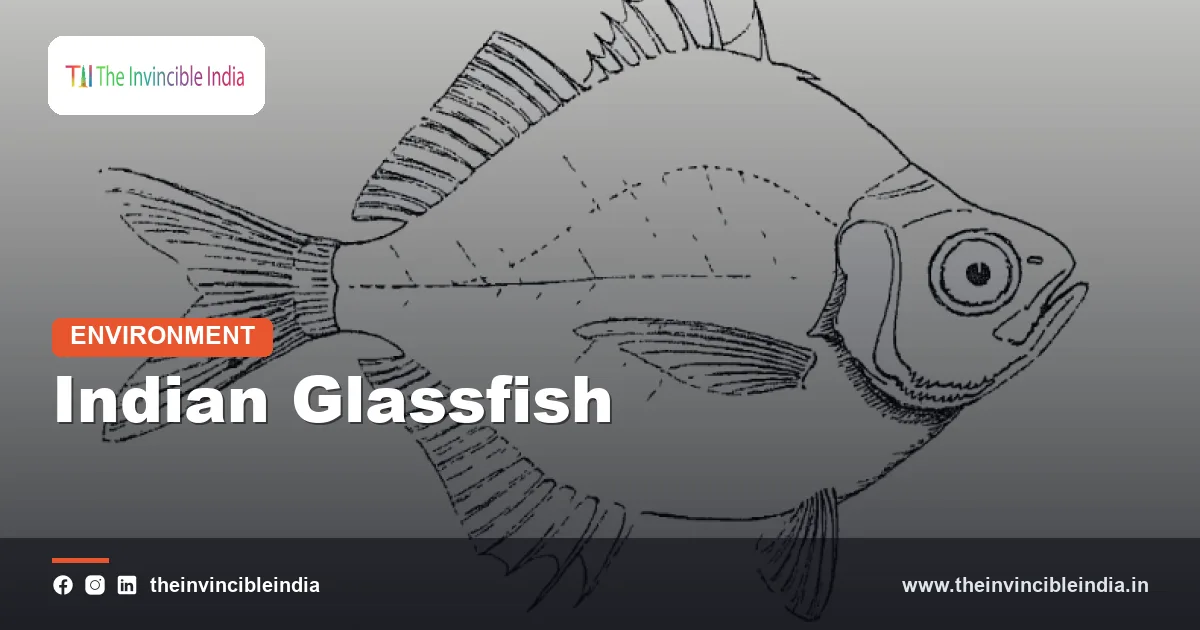
The Indian glassfish is a small, almost transparent freshwater fish, Parambassis ranga, whose backbone, swim bladder and internal organs can be seen through its glassy body. Found in ponds, ditches, canals, slow rivers and reservoirs across much of South Asia, the glassfish belongs to the family Ambassidae and is also known as the Indian glassy fish, Indian glassy perchlet or Indian glass perch.
A glassfish rarely grows longer than about eight centimetres, yet it is among the most widespread small native fish in the Indian plains. This article explains what a glassfish is, how its see-through body works, where it lives, what it eats, how it breeds and why this tiny fish matters to wetlands, local food habits and the aquarium trade.
| Attribute | Detail |
|---|---|
| Common names | Indian glassy fish, Indian glassy perchlet, glass perch, glassfish; “chanda” or “chanda mach” in Bengali and Assamese |
| Scientific name | Parambassis ranga (formerly Chanda ranga or Ambassis ranga) |
| Family and order | Ambassidae (Asiatic glassfishes), order Perciformes |
| Typical size | About 4 to 5 cm commonly; up to roughly 8 cm |
| Body | Laterally compressed, translucent, with visible backbone and swim bladder |
| Habitat | Ponds, ditches, canals, slow streams, floodplain wetlands and reservoirs with vegetation |
| Range | India, Pakistan, Nepal, Bangladesh, Myanmar and Thailand |
| Diet | Carnivore: zooplankton, insect larvae, small crustaceans |
| Conservation status | Least Concern on the IUCN Red List, with local declines where wetlands are lost |
Key Takeaways
- The Indian glassfish, Parambassis ranga, is a small freshwater fish of the family Ambassidae whose translucent body shows its backbone and internal organs.
- Glassfish live in shoals in still or slow-flowing waters across India, Pakistan, Nepal, Bangladesh, Myanmar and Thailand, usually near water plants.
- A glassfish is a carnivore that feeds on zooplankton, insect larvae and tiny crustaceans, including the larvae of mosquitoes.
- Male Indian glassfish show a bluish-yellow or orange tinge on their fins during the breeding season, while females remain plainer and more transparent.
- The glassfish is classed as Least Concern globally, although the loss of ponds and wetlands reduces local populations.
- Glassfish sold in aquarium shops with bright neon colours are often dyed artificially, because the natural colour of the Indian glassfish is almost clear.
What is a glassfish?
A glassfish is a small perch-like fish of the family Ambassidae, named for its transparent or translucent body that lets an observer see its skeleton and organs. The family is also called the Asiatic glassfishes or glass perchlets, and it includes species in fresh, brackish and coastal waters from Africa and South Asia to Australia and the Pacific.
In India, the glassfish most people meet is Parambassis ranga, the Indian glassy fish. Its body is deep from back to belly yet thin from side to side, so it looks like a small leaf of clear glass in the water. A narrow dark line often marks the position of the backbone, and a silvery patch around the swim bladder reflects light.
Scientists have moved the species between several genera over the years, so older books and aquarium labels may list it as Chanda ranga or Ambassis ranga. The name “perchlet” reflects its distant relationship to the true perches, since it has a spiny front dorsal fin like other perch-like fishes.
Which glassfish species occur in India?
Several glassfish species occur in India, including the Indian glassy fish (Parambassis ranga), the elongate glass perchlet (Chanda nama), the highfin glassy perchlet (Parambassis lala) and the Western Ghats species Parambassis thomassi. Each has a slightly different body shape, range and habitat.
| Species | Common name | Distinguishing features | Typical range in India |
|---|---|---|---|
| Parambassis ranga | Indian glassy fish | Deep, compressed, very transparent body; male fins edged with yellow or orange in season | Widespread across plains and peninsular drainages |
| Chanda nama | Elongate glass perchlet | More elongated, less deep body than Parambassis ranga, and also nearly transparent | Ganga and Brahmaputra plains, eastern and northern India |
| Parambassis lala | Highfin glassy perchlet | Males carry a higher dorsal fin with dark markings | Northeastern India and neighbouring regions |
| Parambassis thomassi | Western Ghats glassy perchlet | Small, endemic to streams of the Western Ghats | Streams and rivers of the Western Ghats |
Because glassfish are small and similar in appearance, species are often confused in markets and aquarium shops. Fish biologists separate them by the count of fin rays, the shape of the body and the pattern of small spots, and some species have been described only in the last few decades.
Why is the glassfish transparent?
The glassfish is transparent because its tissues contain very little pigment and its muscles and skin are thin and clear, so light passes through the body rather than being absorbed. This near-invisibility helps the fish avoid predators in open water.
Transparency in a glassfish works in several ways.
- Camouflage: A see-through fish is hard to spot against bright water, so herons, kingfishers and larger fish detect it less easily.
- Silver reflection: A reflective layer around the swim bladder and belly helps hide the dark internal organs from predators looking from below.
- Shoaling: Many near-invisible bodies moving together make it harder for a predator to single out one target.
- Thin tissues: The body wall is thin and almost colourless, which means the skeleton, the gill covers and the swim bladder remain visible when viewed against light.
Transparency does not make the glassfish colourless in every light. Under bright sun or in a lit aquarium tank, the fish shows a faint greenish, silvery or bluish sheen, and breeding males develop a more noticeable tint on the fins.
Where is the glassfish found in India?
The glassfish is found throughout most of India in freshwater habitats such as ponds, village tanks, irrigation canals, ditches, floodplain wetlands, slow streams and reservoirs. It is especially common in the Gangetic plains, the Brahmaputra valley, the Deccan, and the coastal lowlands.
The species prefers calm or gently moving water with aquatic plants, floating vegetation or submerged roots, where it can hide and hunt. It tolerates a range of conditions, and in some estuarine areas it can also be found in slightly brackish water. Outside India, it ranges across Pakistan, Nepal, Bangladesh, Myanmar and Thailand.
Seasonal flooding spreads glassfish into paddy fields and temporary wetlands during the monsoon. As the water recedes, the fish retreat to permanent ponds and channels. This habit means that glassfish populations rely on connected networks of small water bodies, not just on large rivers.
How can you recognise a glassfish in a pond?
You can recognise a glassfish in a pond by its small, flattened, see-through body, its habit of hovering in a loose shoal near plants, and the visible dark line of the backbone. The fish often appears only as a faint shimmer until it turns and catches the light.
- The body is deep and flattened from side to side, shaped somewhat like a small leaf.
- The first dorsal fin carries sharp spines, and the second dorsal fin and anal fin are soft-rayed.
- The mouth is upturned and slightly oblique, suited to picking food from the water column.
- The eyes are large relative to the head, which helps the fish hunt by sight.
- The fish swims in a stop-and-start fashion, hovering motionless and then darting forward.
These traits help separate the glassfish from similar small silvery fishes, such as young barbs and rasboras, which are opaque and have scales that reflect light more strongly.
What does a glassfish eat?
A glassfish is a small carnivore that feeds on zooplankton, insect larvae, tiny crustaceans such as water fleas and copepods, and occasionally very small worms. It hunts by sight in the daytime, picking prey from the water column rather than grubbing in mud.
Glassfish are useful in wetlands because they eat larvae of mosquitoes and other aquatic insects. They are not a complete solution to mosquito control, as other native fish and methods are also used, yet in ponds and ditches a healthy shoal of glassfish helps limit insect larvae. In turn, the glassfish is prey for larger fish, snakes, frogs, birds such as kingfishers and herons, and aquatic insects such as giant water bugs.
Because of its small size and its position in the middle of the food chain, the glassfish serves as an important link that transfers energy from plankton to larger animals. Where glassfish disappear, ecologists often find that the pond or wetland has been drained, polluted or heavily stocked with large predatory or exotic fish.
How does the glassfish breed?
The glassfish breeds by scattering small, sticky eggs among aquatic plants, and the eggs hatch within about a day. The breeding season generally coincides with the warm, rainy months, although fish in warm waters can spawn over a longer period.
The breeding cycle of the glassfish follows a simple pattern.
- Males develop a more intense tint on the dorsal, anal and tail fins, and they chase females around plants.
- Females release eggs in small batches, and males fertilise them externally.
- The eggs stick to leaves, roots and other submerged surfaces.
- The tiny larvae hatch quickly and feed first on microscopic organisms.
- Adults give no parental care and may eat their own eggs if the eggs are not hidden in vegetation.
The glassfish matures within a few months and has a short lifespan of around two years in the wild. Its rapid breeding allows populations to bounce back quickly when ponds refill after the dry season.
Is the glassfish eaten or kept in aquariums?
Yes, the glassfish is both eaten and kept in aquariums in India, although its main importance is as a small native fish in the ecosystem. In several eastern and northeastern regions, small fish like the glassfish are cooked fresh, fried or dried, and they are part of the tradition of “small indigenous fish species” that supply protein, calcium and micronutrients to rural households.
Small indigenous fish are eaten whole, including the bones and organs, which makes them a rich source of calcium and micronutrients. Researchers in South Asia have argued that conserving such small fish supports nutrition in poorer communities.
In the aquarium trade, the glassfish is valued for its transparent beauty and peaceful schooling behaviour. It does best in groups in a planted tank with soft light and clean water, and it can live with other small peaceful species. Hobbyists should avoid releasing aquarium fish into natural waters because mixing populations can spread disease.
What is the problem with dyed glassfish?
The problem with dyed glassfish is that they are injected with fluorescent dye to look neon pink, blue or green, a practice that causes stress and injury and often shortens the fish’s life. These artificially coloured fish are sometimes sold as “painted” or “colour” glassfish.
The dye is typically injected under the skin with a fine needle, and the fish may fade as the dye spreads or is absorbed. Animal-welfare groups and many responsible aquarium keepers oppose the practice, and some countries restrict the sale of dyed fish. Buyers can avoid the problem by choosing naturally transparent glassfish and by asking sellers about the origin of the animals.
Wild-caught glassfish also deserve care. Collecting large numbers from ponds can reduce local populations, so captive breeding is a better source. The glassfish breeds readily in aquariums, which makes breeding a practical route for the hobby.
Why does the glassfish matter for wetlands and people?
The glassfish matters because it is a widespread indicator of healthy small water bodies, a link in the food chain, a natural controller of insect larvae and a source of nutrition for rural households. Its presence suggests that a pond or ditch still has clean water, plants and food.
Ponds, tanks and ditches are often overlooked in conservation planning, yet they hold large numbers of small native fish such as the glassfish, barbs, danios and rasboras. Draining ponds for construction, filling wetlands, using heavy pesticides and stocking invasive fish can all damage these communities.
Simple measures help the glassfish and other small fish: protect village ponds and tanks, keep margins vegetated, avoid unnecessary pesticide use near water, and keep exotic predatory fish out of small natural water bodies. Community ponds that remain clean and connected to seasonal floods tend to hold a richer variety of fish.
Bottom Line
The Indian glassfish, Parambassis ranga, is a tiny transparent fish that quietly supports food webs, mosquito control and rural nutrition across South Asia. Protecting village ponds and choosing natural, undyed fish in the aquarium trade are the most practical ways to look after it.
Frequently Asked Questions
What is a glassfish?
A glassfish is a small, translucent freshwater fish of the family Ambassidae whose backbone and organs are visible through its body. The best-known Indian species is Parambassis ranga, the Indian glassy fish.
Why can you see through a glassfish?
You can see through a glassfish because its skin and muscles contain very little pigment and are thin and clear. This transparency helps the fish hide from predators.
How big does an Indian glassfish grow?
An Indian glassfish usually grows to about 4 to 5 cm and can reach roughly 8 cm. Females are generally slightly larger than males.
What do glassfish eat?
Glassfish eat zooplankton, insect larvae including mosquito larvae, and tiny crustaceans. They hunt by sight in open water near plants.
Are coloured glassfish natural?
No, brightly coloured neon glassfish are artificially dyed, because the natural body of the Indian glassfish is nearly clear. The dye is injected into the fish, which is stressful and harmful.
Is the glassfish endangered?
The Indian glassfish Parambassis ranga is listed as Least Concern globally, so it is not endangered as a species. Some local populations decline when ponds and wetlands are drained, polluted or filled.
{“@context”:”https://schema.org”,”@graph”:[{“@type”:”FAQPage”,”mainEntity”:[{“@type”:”Question”,”name”:”What is a glassfish?”,”acceptedAnswer”:{“@type”:”Answer”,”text”:”A glassfish is a small, translucent freshwater fish of the family Ambassidae whose backbone and organs are visible through its body. The best-known Indian species is Parambassis ranga, the Indian glassy fish.”}},{“@type”:”Question”,”name”:”Why can you see through a glassfish?”,”acceptedAnswer”:{“@type”:”Answer”,”text”:”You can see through a glassfish because its skin and muscles contain very little pigment and are thin and clear. This transparency helps the fish hide from predators.”}},{“@type”:”Question”,”name”:”How big does an Indian glassfish grow?”,”acceptedAnswer”:{“@type”:”Answer”,”text”:”An Indian glassfish usually grows to about 4 to 5 cm and can reach roughly 8 cm. Females are generally slightly larger than males.”}},{“@type”:”Question”,”name”:”What do glassfish eat?”,”acceptedAnswer”:{“@type”:”Answer”,”text”:”Glassfish eat zooplankton, insect larvae including mosquito larvae, and tiny crustaceans. They hunt by sight in open water near plants.”}},{“@type”:”Question”,”name”:”Are coloured glassfish natural?”,”acceptedAnswer”:{“@type”:”Answer”,”text”:”No, brightly coloured neon glassfish are artificially dyed, because the natural body of the Indian glassfish is nearly clear. The dye is injected into the fish, which is stressful and harmful.”}},{“@type”:”Question”,”name”:”Is the glassfish endangered?”,”acceptedAnswer”:{“@type”:”Answer”,”text”:”The Indian glassfish Parambassis ranga is listed as Least Concern globally, so it is not endangered as a species. Some local populations decline when ponds and wetlands are drained, polluted or filled.”}}]}]}


