

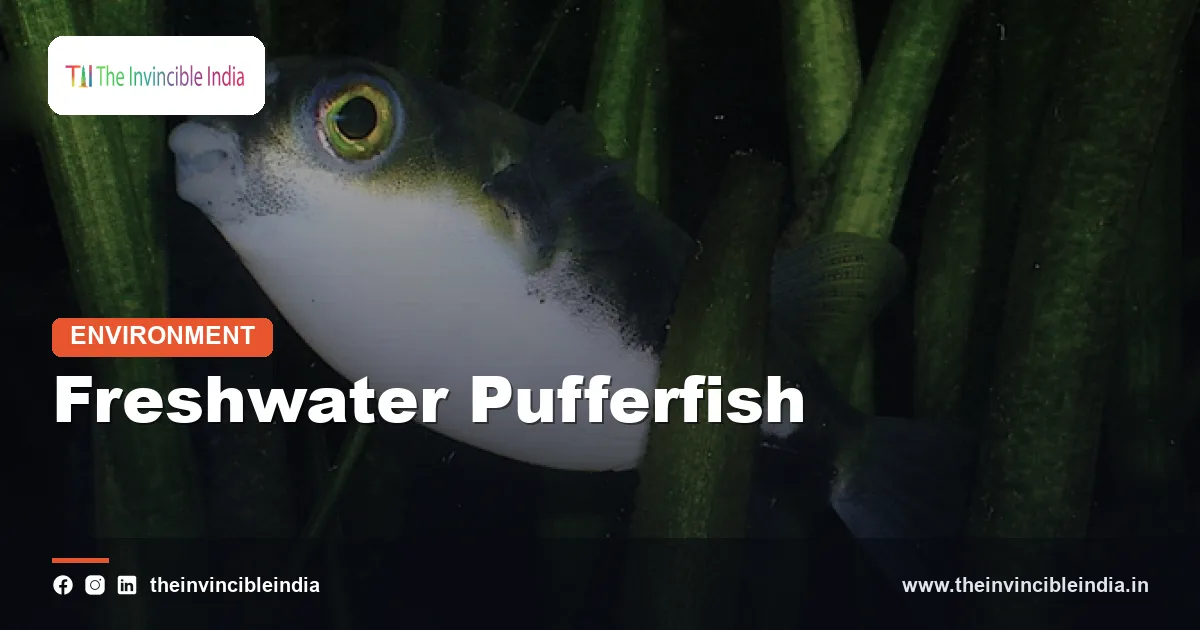
A freshwater pufferfish is a small, round-bodied fish of the family Tetraodontidae that can swell its body with water when threatened and whose tissues may contain a powerful nerve poison called tetrodotoxin. In India, the pufferfish most often seen in rivers, ponds, floodplains and estuaries are the ocellated or Indian dwarf pufferfish, Tetraodon cutcutia, and the green pufferfish, Dichotomyctere fluviatilis.
The pufferfish is a favourite of aquarium keepers and a subject of both curiosity and caution among fishing communities. This article explains what a pufferfish is, how it inflates, which species live in Indian waters, why its toxin is dangerous, and what this unusual fish tells us about rivers and estuaries.
| Attribute | Detail |
|---|---|
| Common names | Pufferfish, puffer, blowfish; Indian dwarf or ocellated pufferfish; “potka” or “tepa” in Bengali and Odia-speaking regions |
| Key Indian species | Tetraodon cutcutia (ocellated pufferfish) and Dichotomyctere fluviatilis (green pufferfish) |
| Family and order | Tetraodontidae, order Tetraodontiformes |
| Typical size | Roughly 10 to 17 cm depending on the species |
| Defence | Inflates its body by gulping water; some tissues contain toxin |
| Teeth | Four teeth fused into a beak-like plate that grows continuously |
| Habitat in India | Slow rivers, ponds, floodplains, canals, estuaries and mangrove creeks |
| Diet | Carnivore: snails, crustaceans, worms and insect larvae |
| Conservation status | Both main Indian freshwater species are assessed as Least Concern on the IUCN Red List |
Key Takeaways
- A pufferfish is a fish of the family Tetraodontidae that defends itself by gulping water or air to inflate its body into a ball, which makes it difficult for predators to swallow.
- The freshwater pufferfish species of India, including Tetraodon cutcutia and Dichotomyctere fluviatilis, live in slow rivers, ponds, floodplains and brackish estuaries of the eastern and southern regions.
- Many pufferfish carry tetrodotoxin, a nerve poison with no known antidote, and eating an improperly handled pufferfish can be fatal.
- The four teeth of a pufferfish are fused into a beak that never stops growing, so the fish must gnaw on snails and shells to keep it worn down.
- Marine pufferfish such as Lagocephalus species caught off the Indian coast have caused poisoning in people who ate them, so no unidentified pufferfish should be eaten.
- Freshwater pufferfish are kept in aquariums, but they are aggressive, may nip other fish and need careful feeding and water conditions.
What is a pufferfish?
A pufferfish is a bony fish of the family Tetraodontidae that has a rounded body, no scales in the usual sense, a beak of four fused teeth and the ability to inflate itself. The family name Tetraodontidae means “four teeth,” and it includes more than a hundred species found in tropical seas, brackish waters and some freshwater rivers.
The pufferfish lacks pelvic fins and ribs, which gives its body the flexibility needed for inflation. It swims slowly with its small pectoral, dorsal and anal fins, and it steers with its tail. Its large eyes move independently, and its skin is leathery or lightly spiny rather than covered with overlapping scales.
Pufferfish belong to the order Tetraodontiformes, together with triggerfish, boxfishes and ocean sunfish. Pufferfish are famous worldwide through the Japanese delicacy fugu, which is prepared only by licensed chefs because of the toxin in the fish’s organs.
Which pufferfish live in India?
The freshwater and estuarine pufferfish most commonly reported from India are the ocellated pufferfish (Tetraodon cutcutia) and the green pufferfish (Dichotomyctere fluviatilis, formerly Tetraodon fluviatilis), while several marine species also occur along the coast.
| Species | Common name | Habitat | Notable features |
|---|---|---|---|
| Tetraodon cutcutia | Ocellated pufferfish, Indian dwarf pufferfish | Freshwater ponds, ditches, slow rivers and floodplains of the Ganga-Brahmaputra basin and eastern India | Small; mottled olive-brown body with dark blotches and eye-like markings; adults around 10 to 15 cm |
| Dichotomyctere fluviatilis | Green pufferfish | Brackish estuaries, tidal creeks and lower rivers, sometimes in fresh water | Green back with dark spots and a pale belly; tolerates salinity changes |
| Lagocephalus species | Marine pufferfish | Coastal seas and estuaries | Larger; associated with poisoning in coastal India when eaten |
The ocellated pufferfish is an Indian-subcontinent species found in India, Bangladesh and Myanmar. The green pufferfish ranges more widely across South and Southeast Asia, including estuarine waters of India and Sri Lanka. Because the marine species look similar to freshwater ones to a non-expert, correct identification matters.
How does a pufferfish inflate?
A pufferfish inflates by rapidly gulping water into a highly elastic stomach, which expands so that the whole body becomes a taut ball. This reaction normally happens in seconds when the fish feels threatened.
The mechanism relies on several special features of the pufferfish body.
- Elastic stomach: The stomach has folds that stretch to hold a large volume of water, which can multiply the fish’s body size.
- No ribs and no pelvic fins: A flexible skeleton lets the body wall expand without breaking.
- Loose, stretchy skin: The skin has special layers of collagen fibres arranged to withstand the stretch.
- Strong muscles: Powerful muscles pump water in and then push it out again once the danger has passed.
- Spines in some species: In some pufferfish, small spines on the skin stand upright when the body inflates.
Inflation is a last resort, because it is stressful and leaves the fish unable to swim quickly. A pufferfish pumped with air rather than water, for example when lifted out of the water, can have trouble releasing it, so fishers and aquarium keepers should avoid provoking the fish to puff.
Why is the pufferfish poisonous?
The pufferfish is poisonous because many species carry tetrodotoxin (TTX), a potent neurotoxin that blocks sodium channels in nerve cells and can cause paralysis and death. The toxin is not destroyed by cooking, freezing or drying.
Tetrodotoxin usually concentrates in the liver, ovaries, intestines and skin, although the amounts vary by species, season and place. Scientists believe that the toxin is made largely by certain bacteria, and that pufferfish accumulate it through their diet. This explains why fish of the same species can be more toxic in one location than in another, and why captive-reared fish can be nearly free of toxin.
Toxicity in freshwater species is less well understood. Some freshwater pufferfish in Southeast Asia have been found to carry other toxins such as saxitoxin, and some species are far less dangerous than the marine ones. Since the toxic status of many Indian freshwater pufferfish is not well documented, the sensible approach is to treat every pufferfish as potentially poisonous.
What happens in pufferfish poisoning?
In pufferfish poisoning, the victim experiences numbness around the mouth, tingling, dizziness and vomiting, followed by muscle weakness and, in severe cases, paralysis of the breathing muscles. Symptoms can begin within minutes to a few hours after eating.
There is no specific antidote for tetrodotoxin. Treatment relies on emergency medical care, including keeping the airway open, assisted breathing if needed and supportive hospital treatment. Patients who survive the first day usually recover fully, which is why prompt care is essential.
Cases of poisoning from marine pufferfish have been reported along the Indian coast, often when fishers or consumers mistook the fish for another species or when it was mixed into catches of small fish. Public health authorities warn people not to eat pufferfish and to throw them back or discard them safely.
Where does the pufferfish live and what does it eat?
The pufferfish lives in slow-moving fresh water, brackish estuaries and coastal waters, where it hides among plants and mud and hunts small animals. It is a carnivore that eats snails, small crustaceans, insect larvae, worms and sometimes small fish or the fins of other fish.
The fused beak of the pufferfish is well suited to crushing shells. Because the beak keeps growing throughout life, the fish needs hard-bodied food such as snails to wear it down. If the beak overgrows, the fish may be unable to eat properly, which is a common problem for captive pufferfish fed only soft food.
In the wild, the pufferfish is an ambush hunter. It sits half-hidden in vegetation or sand and moves slowly toward prey, then darts forward. This behaviour makes it an effective controller of snail populations in ponds and floodplains.
How does the pufferfish reproduce?
The pufferfish reproduces by laying eggs, usually on a hard surface or in a sheltered spot, and the male of many freshwater species guards the eggs until they hatch. Spawning takes place in the warmer months, and the young are very small when they emerge.
Courtship involves the male chasing and nudging the female. The female lays a clutch of small eggs, which the male fertilises. After the larvae hatch, they feed on microscopic organisms before moving on to larger prey. Breeding details for the Indian species are less thoroughly studied than for some Southeast Asian freshwater puffers, so conservation planners rely on observations from the field and from aquariums.
Can you keep a pufferfish in an aquarium?
Yes, a freshwater pufferfish can be kept in an aquarium, but it needs a species-only or carefully chosen tank, plenty of hiding places and a varied diet. It is not a good choice for beginners or community tanks.
- Pufferfish are curious and intelligent, yet they are often aggressive and may nip the fins of tank mates.
- The ocellated pufferfish does well in clean, planted fresh water, while the green pufferfish usually needs brackish water as it matures.
- The diet should include live or frozen snails, shrimp and worms so that the beak wears down.
- Water quality must be kept high, since pufferfish are messy eaters and sensitive to ammonia.
- Buyers should confirm that the fish is captive-bred or legally sourced and should not release unwanted fish into natural waters.
Handling a pufferfish is best avoided. Keepers should wash their hands after servicing the tank and should never feed the fish to other animals or eat it.
Why does the pufferfish matter for rivers and estuaries?
The pufferfish matters because it is a predator of snails and small invertebrates, an indicator of the condition of slow-water habitats and a reminder of the value of brackish and estuarine ecosystems. Its presence suggests that mangroves, creeks and floodplains still support a varied food web.
Healthy estuaries and floodplains support large numbers of species that depend on seasonal changes in salinity and flooding. Threats to the pufferfish are similar to those faced by many wetland animals: drainage of marshes, pollution, damming that changes flow, and the capture of fish for the aquarium trade.
The pufferfish also teaches an important lesson about food safety in coastal communities. Awareness programmes that show fishers how to identify and discard pufferfish can prevent accidental poisoning and help protect both people and fish.
Is the pufferfish eaten in India?
The pufferfish is not a recognised food fish in India, and eating it is strongly discouraged because the risk of poisoning cannot be judged by looking at the fish. In some riverside and coastal communities small pufferfish are caught accidentally in nets and traps, and in a few places they are cooked, yet this practice carries real danger.
Japan, by contrast, treats fugu as a regulated delicacy. Chefs undergo long training and licensing, the toxic organs are removed under strict rules, and only certain species are allowed. India has no comparable culinary tradition or training system, so the safest rule for fishers, cooks and consumers is simple.
- Do not eat any pufferfish, whether caught in a river, a pond or the sea.
- Remove pufferfish from mixed catches of small fish before sale or cooking.
- Do not feed pufferfish to dogs, cats or poultry, because they can be poisoned too.
- Seek urgent medical help at once if numbness of the lips or tongue appears after a fish meal.
Fisheries departments and local health workers in coastal states have used posters and village meetings to teach fishers these points, and such awareness work remains one of the most effective ways of preventing accidental poisoning.
Bottom Line
The pufferfish is a small, round, beaked fish that inflates when threatened and may carry a deadly toxin. The freshwater and estuarine species of India are fascinating wetland predators, but they should be admired, studied and conserved rather than eaten.
Frequently Asked Questions
What is a freshwater pufferfish?
A freshwater pufferfish is a small, round-bodied fish of the family Tetraodontidae that lives in rivers, ponds and estuaries and can inflate itself with water. In India, examples include Tetraodon cutcutia and Dichotomyctere fluviatilis.
Why does a pufferfish puff up?
A pufferfish puffs up to make itself too big and awkward for a predator to swallow. It gulps water into an elastic stomach, and some species also have spines that stand out as the body swells.
Are Indian freshwater pufferfish poisonous?
Many pufferfish carry tetrodotoxin, and the toxicity of Indian freshwater species is not well documented, so all pufferfish should be treated as potentially poisonous. Eating a pufferfish is unsafe and can be fatal.
Is there an antidote for pufferfish poison?
No, there is no specific antidote for tetrodotoxin. Treatment consists of emergency hospital care, such as keeping the airway open and assisting breathing until the toxin wears off.
What do pufferfish eat?
Pufferfish eat snails, small crustaceans, worms and insect larvae. Their fused beak-like teeth crush shells, and hard food helps wear the beak down.
Can pufferfish be kept as pets in India?
Freshwater pufferfish can be kept in aquariums, but they are aggressive and need specialised care, so they suit experienced keepers. Captive-bred fish are the better choice, and aquarium fish should never be released into rivers or ponds.
{“@context”:”https://schema.org”,”@graph”:[{“@type”:”FAQPage”,”mainEntity”:[{“@type”:”Question”,”name”:”What is a freshwater pufferfish?”,”acceptedAnswer”:{“@type”:”Answer”,”text”:”A freshwater pufferfish is a small, round-bodied fish of the family Tetraodontidae that lives in rivers, ponds and estuaries and can inflate itself with water. In India, examples include Tetraodon cutcutia and Dichotomyctere fluviatilis.”}},{“@type”:”Question”,”name”:”Why does a pufferfish puff up?”,”acceptedAnswer”:{“@type”:”Answer”,”text”:”A pufferfish puffs up to make itself too big and awkward for a predator to swallow. It gulps water into an elastic stomach, and some species also have spines that stand out as the body swells.”}},{“@type”:”Question”,”name”:”Are Indian freshwater pufferfish poisonous?”,”acceptedAnswer”:{“@type”:”Answer”,”text”:”Many pufferfish carry tetrodotoxin, and the toxicity of Indian freshwater species is not well documented, so all pufferfish should be treated as potentially poisonous. Eating a pufferfish is unsafe and can be fatal.”}},{“@type”:”Question”,”name”:”Is there an antidote for pufferfish poison?”,”acceptedAnswer”:{“@type”:”Answer”,”text”:”No, there is no specific antidote for tetrodotoxin. Treatment consists of emergency hospital care, such as keeping the airway open and assisting breathing until the toxin wears off.”}},{“@type”:”Question”,”name”:”What do pufferfish eat?”,”acceptedAnswer”:{“@type”:”Answer”,”text”:”Pufferfish eat snails, small crustaceans, worms and insect larvae. Their fused beak-like teeth crush shells, and hard food helps wear the beak down.”}},{“@type”:”Question”,”name”:”Can pufferfish be kept as pets in India?”,”acceptedAnswer”:{“@type”:”Answer”,”text”:”Freshwater pufferfish can be kept in aquariums, but they are aggressive and need specialised care, so they suit experienced keepers. Captive-bred fish are the better choice, and aquarium fish should never be released into rivers or ponds.”}}]}]}


