

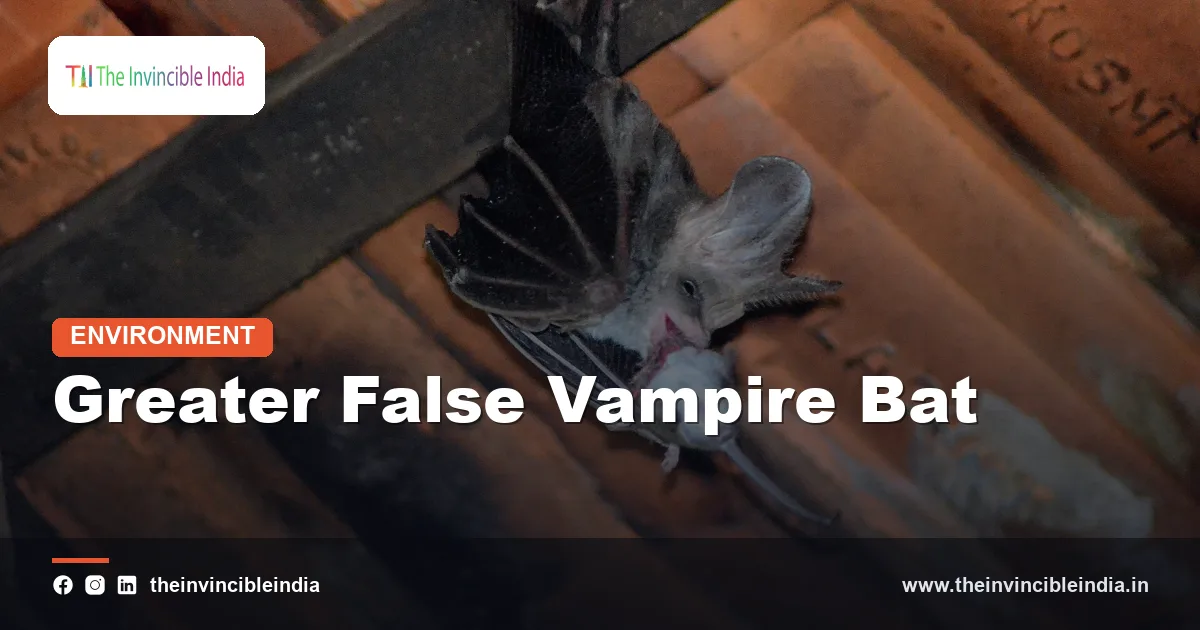
The greater false vampire bat (Megaderma lyra) is a large, tailless, carnivorous bat of South Asia that roosts in caves, ruins and old buildings across India and hunts insects, frogs, lizards, small birds, rodents and even other bats by night. Despite the word “vampire” in its name, the greater false vampire bat does not drink blood; the label comes from its fierce appearance and from its habit of eating other vertebrates.
This species is among the most unusual mammalian predators living close to people in India, often sharing temples, forts, wells and abandoned houses with human communities. It is also one of the few bats that listens for the faint movements of prey rather than relying only on echolocation, which makes it a fascinating subject for anyone interested in the natural history of the subcontinent.
| Attribute | Detail |
|---|---|
| Common name | Greater false vampire bat, also called the Indian false vampire bat |
| Scientific name | Megaderma lyra |
| Family | Megadermatidae (false vampire bats or “megadermatids”) |
| Diet | Carnivorous: large insects, frogs, lizards, small birds, rodents and smaller bats |
| Forearm length | Roughly 6.5 to 7.5 cm, with a total body weight of about 40 to 60 grams |
| Distinctive features | Very large ears joined at the base, tall upright nose-leaf, no visible tail |
| Roosts | Caves, old buildings, ruins, temples, tunnels, wells and hollow trees |
| Range | South Asia, including most of mainland India, Sri Lanka, Nepal, Bangladesh and Pakistan |
| Conservation status | Least Concern on the IUCN Red List, but dependent on undisturbed roosts |
Key Takeaways
- The greater false vampire bat (Megaderma lyra) is a carnivorous South Asian bat that eats frogs, lizards, insects, small birds, rodents and smaller bats, and it does not feed on blood.
- True vampire bats live only in the Americas, so no bat found in India is a real blood-feeder, and the “false vampire” name simply reflects how large and predatory this species looks.
- The greater false vampire bat hunts by gleaning, which means it locates prey by listening for rustles and calls and then picks it from the ground or foliage, rather than catching it in flight.
- Greater false vampire bats roost in small groups in caves, old buildings, temples and similar dark shelters, and they usually carry prey back to a feeding perch to eat it, leaving telltale remains below.
- The greater false vampire bat is listed as Least Concern on the IUCN Red List, but it depends on quiet, undisturbed roosts that are lost when ruins are demolished, caves are mined or colonies are smoked out.
- By controlling large insects, rodents and amphibian numbers near human settlements, the greater false vampire bat plays a useful role as a predator in India’s rural and semi-urban ecosystems.
What is the greater false vampire bat?
The greater false vampire bat is a medium-sized bat in the family Megadermatidae, which is a small group of Old World carnivorous bats, and its scientific name is Megaderma lyra. The word “lyra” refers to the lyre-like shape of its upright nose-leaf, a fleshy structure above the nostrils that helps direct its sound signals.
The species is sometimes called the Indian false vampire bat because the Indian subcontinent is its core homeland. A related species, the lesser false vampire bat (Megaderma spasma), is smaller and occurs in the forests of peninsular India, the Western Ghats, the north-east and South-East Asia. Together, these two bats are the only members of the genus Megaderma found in India.
Unlike the small insect-eating bats that most people see flitting around streetlights at dusk, the greater false vampire bat is a heavyweight in bat terms. It has a stocky body, broad wings and a fierce, wide-mouthed face, and it behaves more like a small owl or a small mammalian carnivore than like a typical pipistrelle.
What does the greater false vampire bat look like?
The greater false vampire bat looks like a grey to grey-brown bat with enormous, rounded ears that join across the forehead and a tall, erect, leaf-shaped growth on the nose. Its fur is soft and fairly short, usually paler on the underside than on the back, and its eyes are large and dark compared with those of many other bats.
The species has no visible tail, which is one reliable way to separate it from many other Indian bats whose tails extend beyond or sit within the membrane between the hind legs. Its wingspan is roughly 40 centimetres in typical adults, and the broad wings suit slow, manoeuvrable flight rather than fast open-air chasing.
How can you tell it apart from similar bats?
- The ears are very large and fused at the base, unlike the separate ears of most bats.
- The nose-leaf is tall and straight, and the ears often look disproportionately big when the bat is hanging at rest.
- The bat has no tail, whereas free-tailed bats and many other insect-eating bats show a tail that is clearly visible or projects from the membrane.
- A hanging bat usually sits in a more exposed spot than a crevice-dwelling bat, often visible in the open ceiling of a dark room.
Where does the greater false vampire bat live in India?
The greater false vampire bat lives across most of mainland India, from the dry plains and scrub of the north-west to the forested Deccan, the Western Ghats and the eastern states, usually below the higher mountain zones. Its wider range stretches from Pakistan and Nepal through India and Bangladesh to Sri Lanka.
The species is a flexible roost-user. In natural settings, it chooses caves, rock crevices, tunnels, wells and hollow trees. In human-modified landscapes, it moves into disused bungalows, forts, old temples, granaries, ruins, culverts and unused rooms, as long as the interior is dark, sheltered and quiet. Roosts are often small and may hold a few individuals to a few dozen, although larger groups are known in sizeable caves or ruins.
The bat’s habitat spans dry deciduous forest, scrub, grassland edges, farmland and village outskirts. It generally avoids dense high-altitude forests and tends to remain near water bodies, fields and clearings where prey is easy to find.
What does the greater false vampire bat eat?
The greater false vampire bat eats a mixed diet of large insects, frogs, lizards, small rodents, small birds and other bats, which makes it one of the largest and most predatory bats in India. Beetles, crickets, grasshoppers, moths and similar large arthropods make up a big share of its menu, but vertebrate prey is a defining feature.
Researchers studying feeding remains under roosts have recorded the legs and wings of insects, along with the bones of frogs, geckos, mice and smaller bats. Documented bat prey includes smaller insect-eating species roosting in the same region, which gives the false vampire its reputation as a bat that eats bats.
Which prey groups does the bat take?
- Large insects such as beetles, crickets, grasshoppers and moths, caught mostly from the ground or vegetation.
- Amphibians such as frogs, especially around ponds, paddy fields and the monsoon breeding season.
- Small reptiles such as geckos and other lizards.
- Small mammals such as mice and, in some cases, smaller bats.
- Small birds, occasionally taken at roosts or in vegetation.
The diet changes with the season and with what is abundant nearby. After the first monsoon rains, insects and frogs become easier to find, and the bat shifts its hunting accordingly.
How does the greater false vampire bat hunt?
The greater false vampire bat hunts mainly by gleaning, which means it flies low, listens for the sounds made by prey, and then swoops to seize the animal from the ground, a leaf or a branch. The method is closer to how an owl hunts than how most bats hunt.
The bat’s large ears are a key tool. They allow it to detect the faint rustle of an insect walking on dry leaves or the croak of a frog. Because it can pinpoint prey by passive listening, the bat can stay quiet and avoid warning the animals it is about to catch.
Its echolocation is also unusual. Many bats use loud calls, but the greater false vampire bat produces very soft, low-intensity echolocation signals. These are often described as “whispering” echolocation. A faint call lets the bat navigate and judge obstacles without alerting prey that can hear loud bat sounds, such as certain moths. Some prey animals have evolved ears tuned to detect bat calls, so a quiet hunter gains an advantage.
After a catch, the bat often carries the prey to a regular feeding perch, such as a rafter or a quiet corner of a cave, and eats it there. Over time, a pile of discarded insect wings, legs and bones accumulates on the floor below, and these remains are what biologists examine to learn what the colony eats.
Is the greater false vampire bat really a vampire?
No, the greater false vampire bat is not a vampire, because it does not drink blood and has no adaptations for blood-feeding. The true vampire bats are three species found only in Central and South America, and they are not related closely to the false vampire bats of the Old World.
Early naturalists gave the group its name because they suspected such a large, toothy bat must prey on large animals. The suspicion proved only partly wrong: the bat does kill and eat vertebrates, but those are small animals taken whole, not blood taken from livestock or people. There is no credible evidence that the greater false vampire bat attacks cattle, goats or people.
The myth is still repeated in village folklore, where bats are often feared as omens or bloodsuckers. Clearing up the myth matters because fear often leads to roost destruction, which hurts a species that mostly helps local farmers by eating pests.
How does the greater false vampire bat breed and live?
The greater false vampire bat breeds once a year in most populations and females usually give birth to a single pup, which is typical for a bat of this size. Pups are born helpless and are nursed on milk, and mothers are known to carry pups during the early period of life.
Breeding is seasonal and timing varies with region and climate, but births generally coincide with the period when food becomes more plentiful, so that the nursing female has enough prey to eat. The species lives in loose colonies, and females form maternity groups during the pup-rearing period. Groups are generally small, and individuals may roost singly or in clusters within the same dark chamber.
Because female bats raise only one pup per year, the species recovers slowly from losses. This is one reason why even a “Least Concern” bat remains sensitive to disturbance at breeding roosts.
What threatens the greater false vampire bat?
The main threats to the greater false vampire bat are the loss and disturbance of roosts, the use of pesticides that reduce prey and poison predators, and direct persecution driven by myths. The species is widespread and listed as Least Concern, but local colonies can disappear when a single roost is destroyed.
- Demolition and renovation: Old forts, temples and houses are repaired, sealed or torn down, which removes roosts that may have been used for generations.
- Mining and quarrying: Limestone and stone quarrying can destroy or disturb the caves where colonies live.
- Smoking and killing: Roosts are sometimes smoked out or burned because bats are feared or considered dirty.
- Pesticides: Heavy insecticide use reduces prey and may poison bats that eat contaminated insects and frogs.
- Tourism and noise: Frequent visitors in caves and monuments can cause colonies to abandon roosts.
In India, bats receive different levels of legal protection under the Wildlife (Protection) Act, 1972, depending on the species, and the law bars hunting of listed wildlife. Practical conservation, however, depends on awareness among property owners and local communities.
Why does the greater false vampire bat matter?
The greater false vampire bat matters because it is a top nocturnal predator that regulates populations of large insects, rodents and amphibians near villages, farmland and monuments. Predators like this bat help keep food webs balanced and reduce pests that damage crops and stored grain.
It also matters scientifically. The bat’s passive listening, quiet echolocation and unusual diet have made it a model species for studies of sensory ecology, sound processing and predator-prey arms races. Many findings on how bats detect hidden prey on the ground come from research on false vampire bats.
The species is a reminder that India’s urban and semi-urban buildings can act as artificial caves. Protecting old structures with dark interiors often protects wildlife too, so conservationists encourage landowners to leave known roosts undisturbed or to carry out repairs outside the breeding season.
How does the greater false vampire bat compare with other Indian bats?
The greater false vampire bat is larger and more carnivorous than most Indian bats, and it differs sharply from fruit bats and tiny insect-eating bats in diet, hunting style and body build. The table below compares it with other well-known groups seen in India.
| Bat | Typical diet | Hunting or feeding style | Notable feature |
|---|---|---|---|
| Greater false vampire bat | Insects, frogs, lizards, rodents, small birds, bats | Gleaning, guided by listening | Huge fused ears, no tail |
| Lesser false vampire bat | Large insects and small vertebrates | Gleaning in forest | Smaller, mainly in forests |
| Indian flying fox | Fruit and nectar | Flies long distances to fruiting trees | Very large, fox-like face |
| Common pipistrelle-type bats | Small flying insects | Aerial hawking with loud echolocation | Tiny and fast |
| Free-tailed bats | Flying insects | Fast open-air flight | Tail extends past the membrane |
What should you do if a false vampire bat roosts in your building?
If a greater false vampire bat roosts in your building, the best response is to leave the colony alone, keep people and pets away from it, and avoid sealing or smoking the roost. The bats are not aggressive and rarely enter living areas, and a quiet colony poses little risk when left undisturbed.
- Do not use smoke, chemicals or loud noise to drive the bats out.
- Do not handle bats with bare hands, since any wild animal may bite if cornered.
- If you must repair the building, ask a local wildlife office or a bat conservation group for advice and avoid working during the pup-rearing season.
- Keep droppings and prey remains cleaned from floors with gloves and a damp cloth.
- Consider leaving one unused room or loft as a permanent bat space.
If a bat is found injured on the ground, wearing thick gloves and placing it in a cloth-lined box while calling a wildlife rescuer is the safest approach. Anyone who is bitten should wash the wound with soap and running water and seek medical advice.
Bottom Line
The greater false vampire bat is a harmless-to-people but fearsome-to-prey predator that deserves protection rather than fear. Its quiet listening hunt, its cave and ruin roosts, and its role in controlling pests make it one of the most interesting bats in India, and keeping old roosts undisturbed is the simplest way to help it.
Frequently Asked Questions
Does the greater false vampire bat drink blood?
No, the greater false vampire bat does not drink blood. It is a carnivore that kills and eats small animals such as insects, frogs, lizards, rodents, birds and smaller bats, and the only true blood-feeding bats live in the Americas.
Is the greater false vampire bat dangerous to humans?
No, the greater false vampire bat is not dangerous to humans when left alone. Like any wild animal it may bite if handled or cornered, so people should avoid touching it and should seek medical care if bitten.
Where is the greater false vampire bat found in India?
The greater false vampire bat is found across most of mainland India, roosting in caves, old buildings, temples, ruins and tunnels. Its range also covers Pakistan, Nepal, Bangladesh and Sri Lanka.
What is the difference between the greater and lesser false vampire bat?
The greater false vampire bat (Megaderma lyra) is larger and occurs in a wide range of open and semi-urban habitats, while the lesser false vampire bat (Megaderma spasma) is smaller and mostly lives in forested areas. Both are carnivorous gleaning bats with large fused ears and a tall nose-leaf.
How does the greater false vampire bat find its prey?
The greater false vampire bat finds prey mainly by listening for the faint sounds that insects, frogs and rodents make, and it also uses very soft echolocation calls. It then glides down and seizes the prey from the ground or vegetation.
Is the greater false vampire bat endangered?
No, the greater false vampire bat is not endangered and is listed as Least Concern on the IUCN Red List. However, individual colonies are vulnerable when roosts are demolished, mined or disturbed.
{“@context”:”https://schema.org”,”@graph”:[{“@type”:”FAQPage”,”mainEntity”:[{“@type”:”Question”,”name”:”Does the greater false vampire bat drink blood?”,”acceptedAnswer”:{“@type”:”Answer”,”text”:”No, the greater false vampire bat does not drink blood. It is a carnivore that kills and eats small animals such as insects, frogs, lizards, rodents, birds and smaller bats, and the only true blood-feeding bats live in the Americas.”}},{“@type”:”Question”,”name”:”Is the greater false vampire bat dangerous to humans?”,”acceptedAnswer”:{“@type”:”Answer”,”text”:”No, the greater false vampire bat is not dangerous to humans when left alone. Like any wild animal it may bite if handled or cornered, so people should avoid touching it and should seek medical care if bitten.”}},{“@type”:”Question”,”name”:”Where is the greater false vampire bat found in India?”,”acceptedAnswer”:{“@type”:”Answer”,”text”:”The greater false vampire bat is found across most of mainland India, roosting in caves, old buildings, temples, ruins and tunnels. Its range also covers Pakistan, Nepal, Bangladesh and Sri Lanka.”}},{“@type”:”Question”,”name”:”What is the difference between the greater and lesser false vampire bat?”,”acceptedAnswer”:{“@type”:”Answer”,”text”:”The greater false vampire bat (Megaderma lyra) is larger and occurs in a wide range of open and semi-urban habitats, while the lesser false vampire bat (Megaderma spasma) is smaller and mostly lives in forested areas. Both are carnivorous gleaning bats with large fused ears and a tall nose-leaf.”}},{“@type”:”Question”,”name”:”How does the greater false vampire bat find its prey?”,”acceptedAnswer”:{“@type”:”Answer”,”text”:”The greater false vampire bat finds prey mainly by listening for the faint sounds that insects, frogs and rodents make, and it also uses very soft echolocation calls. It then glides down and seizes the prey from the ground or vegetation.”}},{“@type”:”Question”,”name”:”Is the greater false vampire bat endangered?”,”acceptedAnswer”:{“@type”:”Answer”,”text”:”No, the greater false vampire bat is not endangered and is listed as Least Concern on the IUCN Red List. However, individual colonies are vulnerable when roosts are demolished, mined or disturbed.”}}]}]}


