

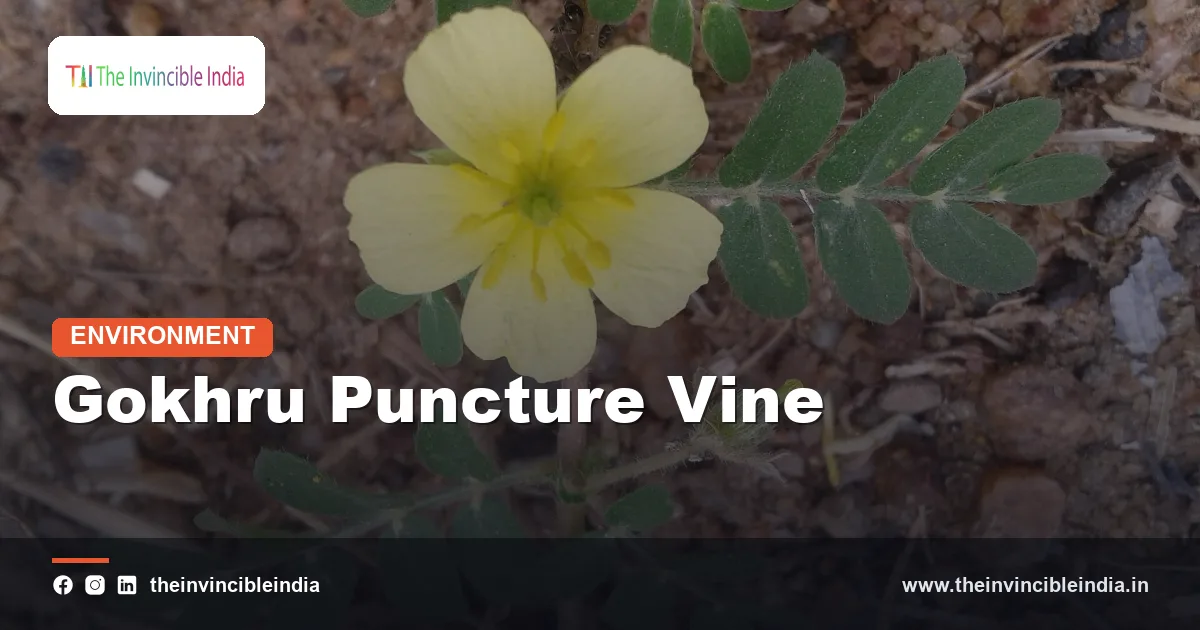
The plant gokhru, also called puncture vine or caltrop and scientifically Tribulus terrestris, is a low, mat-forming herb of dry and sandy ground whose small yellow flowers give way to hard, star-shaped fruits armed with sharp spines. Found across India and much of the warm world, gokhru is a common roadside weed and, as gokshura, a well-known herb in the Ayurvedic tradition.
Anyone who has walked barefoot across dry waste ground or ridden a bicycle through a vacant plot may have met gokhru’s spiny fruits the hard way. This article explains the botany, names, distribution and traditional use of the plant, and it treats all medicinal claims as traditional rather than proven. 30 October 2026
| Attribute | Detail |
|---|---|
| Common names | Gokhru, gokshura, puncture vine, caltrop, small caltrops, goathead |
| Scientific name | Tribulus terrestris |
| Family | Zygophyllaceae (the caltrop family) |
| Where found in India | Dry plains, sandy soils, roadsides, wastelands and fields across the country |
| Plant type | Prostrate annual herb, sometimes short-lived perennial, with trailing stems |
| Parts used | Spiny fruit, root and whole plant |
| Main uses | Traditional Ayurvedic and folk medicine; also a widespread weed |
| Notable facts | Spiny fruits can puncture bicycle tyres and bare feet; the Sanskrit name means “cow’s hoof” |
Key Takeaways
- Gokhru (Tribulus terrestris) is a prostrate herb of the Zygophyllaceae family that grows on dry, sandy and disturbed ground across India.
- The plant is known as puncture vine in English because its hard, spiny fruits can puncture bicycle tyres and hurt bare feet.
- The Sanskrit name gokshura means “cow’s hoof”, a reference to the shape and sharpness of the spiny fruit.
- Ayurveda traditionally uses gokshura for the urinary system and as a tonic for vigour, but these uses are traditional and not proven by strong clinical evidence.
- Gokhru is often confused with bada gokhru, which is a different plant, Pedalium murex, that belongs to another family.
- Anyone thinking of using gokhru as medicine or as a supplement should consult a qualified practitioner or doctor first.
What is gokhru?
Gokhru is a creeping annual plant, Tribulus terrestris, found throughout the warmer regions of the Old World and widely naturalised elsewhere. In India it is one of the most familiar plants of dry waste ground, growing in the thin soil of roadsides, railway embankments and unfarmed plots.
The plant has trailing stems that spread out in a flat circle from a central root, forming a dense mat that can be half a metre or more across. The species belongs to the Zygophyllaceae, a family of mostly desert and dry-zone plants that also includes the creosote bush and lignum vitae.
The scientific name Tribulus comes from a Latin word associated with a three-pointed spiked weapon, while terrestris means “of the earth”, describing a plant that hugs the ground. The English word “caltrop” itself refers to an old military device with spikes pointing upwards.
Why is gokhru called puncture vine?
Gokhru is called puncture vine because its hard, sharp-spined fruits are strong enough to puncture bicycle tyres, thorn shoes and bare feet. The fruit breaks into several woody segments, each carrying two stout spines, and at least one spine always points upwards no matter how the segment lies.
This design helps the plant spread, since the spines catch in animal hooves, fur, tyres and clothing, which carry the seeds to new places. In some countries gokhru is regarded as a troublesome invasive weed, and cyclists, farmers and children treat it with caution.
In Hindi and Sanskrit tradition, the same feature gave the plant its name. Gokshura is made of go, meaning “cow”, and kshura, meaning “hoof” or “razor”, and it describes the shape of the spiny fruit compared with a cow’s hoof.
What does the gokhru plant look like?
The gokhru plant looks like a flat, hairy, spreading herb with pinnate leaves, small yellow flowers and star-shaped spiny fruits. Its trailing stems radiate outward from a central root and can root occasionally at the joints.
Leaves
The leaves are opposite and divided into several pairs of small oval leaflets, giving a feathery, fern-like look. Both the leaves and the stems are covered with fine silky hairs, which gives the plant a greyish-green appearance.
Flowers
The flowers are small, about one centimetre across, with five yellow petals, and they appear singly at the leaf joints. They open in the morning and close by afternoon. Small bees, flies and other insects visit them for pollen.
Fruits and seeds
The fruit is a woody, star-shaped capsule that splits into five segments, each with two large and two small spines. Each segment contains a few seeds. The fruit turns from green to hard brown as it dries, and seeds can remain viable in the soil for several years.
Where does gokhru grow in India?
Gokhru grows throughout India, especially in dry and semi-arid regions such as Rajasthan, Gujarat, Haryana, Punjab, Madhya Pradesh, Maharashtra, Karnataka and Tamil Nadu. It favours sandy or gravelly soils with full sun and little shade.
The plant germinates with the monsoon rains and grows quickly in the wet months, flowering and fruiting before the soil dries out. It can tolerate drought, poor soil and trampling, and it quickly colonises bare ground. Outside India, it is native to a belt stretching from southern Europe through Africa and Asia to Australia, and it has been introduced to the Americas, where it is considered an invasive weed.
What are the names of gokhru in Indian languages?
Gokhru is known as gokshura in Sanskrit and by regional variants of that name in many Indian languages. The word is also used in Ayurvedic texts to refer to the plant that is sometimes called chota gokhru, or small gokhru.
| Language | Name |
|---|---|
| Sanskrit | Gokshura, Trikantaka |
| Hindi | Gokhru, Chhota gokhru |
| Bengali | Gokshura, Gokhri |
| Marathi | Sarate, Gokhru |
| Gujarati | Betho gokhru, Nano gokhru |
| Tamil | Nerunji, Nerinjil |
| Telugu | Palleru, Pallerukayalu |
| Kannada | Neggilu mullu |
What is gokhru used for in Ayurveda?
In Ayurveda, gokhru, under the name gokshura, is traditionally used for urinary complaints and as a tonic for strength and vigour. These uses are described in classical texts, but they are traditional claims, and modern clinical evidence is limited and mixed.
Gokshura is placed in a group of five herbs called the Laghu Panchamula, or “five lesser roots”, which is combined with five “greater roots” to form the well-known Dashamula group used in many formulations. The fruit and root are the parts most often prepared, and the plant appears in classical combinations such as Gokshuradi guggulu.
Traditional uses at a glance
- As a diuretic and tonic for the urinary tract, including traditional use for urinary stones and burning urination.
- As a vajikarana herb, meaning a tonic believed to support vigour and reproductive health.
- As a general strengthening herb in classical Ayurvedic formulations.
- In folk practice, as a remedy for joint pain and cough.
Because these claims come from tradition, they should not replace medical diagnosis or treatment. A qualified Ayurvedic practitioner or doctor should be consulted before gokhru is used for any health purpose.
How is gokhru traditionally prepared?
Gokhru is traditionally prepared as a dried powder, a decoction or a ready-made Ayurvedic formulation, and the dried spiny fruit is the part most often used. Practitioners describe the preparation and dose according to the person, which is why home experimentation is discouraged.
- Churna: the dried fruits are ground to a fine powder, which is traditionally taken with water, milk or honey as advised by a practitioner.
- Kwatha: a decoction made by boiling the crushed fruit or root in water and reducing it.
- Compound formulations: tablets, medicated ghee and guggulu preparations that combine gokshura with other herbs.
The spiny fruits must be collected, dried and cleaned carefully, as the spines can injure the hands. Commercial products are made by licensed manufacturers, and buyers should look for a clear botanical name, a batch number and a reputable source. Traditional preparation does not guarantee that a product is safe or effective for every person.
What does modern research say about gokhru?
Modern research on gokhru is mixed, and no strong human evidence has established that the plant treats any specific disease. The plant contains saponins, including a compound called protodioscin, along with flavonoids and alkaloids, and these have been studied in laboratories and in animals.
Gokhru extracts are sold worldwide as supplements marketed for athletic performance and sexual health. Controlled studies in humans have generally not shown strong, consistent effects on hormone levels or performance, and the quality and content of commercial products vary widely. Scientists continue to investigate the plant, but results so far are inconclusive.
Safety is also an important issue. Supplements are not always standardised, and people with kidney, heart or hormone-related conditions, as well as those who are pregnant or breastfeeding, should avoid self-medicating. In some countries, grazing animals that eat large quantities of the plant have developed illness, which is another reason for caution.
How is gokhru different from bada gokhru?
Gokhru, or chota gokhru, is Tribulus terrestris, while bada gokhru is a different plant called Pedalium murex, which belongs to the sesame family. The two plants have similar spiny fruits and similar-sounding names, so they are often mistaken for one another in the herbal trade.
| Feature | Gokhru (chota gokhru) | Bada gokhru |
|---|---|---|
| Scientific name | Tribulus terrestris | Pedalium murex |
| Family | Zygophyllaceae | Pedaliaceae |
| Growth habit | Flat, trailing mat | Upright to spreading, stouter herb |
| Fruit | Star-shaped, splits into five spiny segments | Four-angled, with four stout spines |
| Flower colour | Small yellow | Yellow, larger and funnel-shaped |
| Typical habitat | Dry plains, roadsides, wasteland | Sandy coasts and dry plains |
In Ayurvedic practice the two are not interchangeable, and the identity of the plant should be confirmed from a reliable source. Product labels that give the scientific name help avoid confusion.
Is gokhru a weed or a useful plant?
Gokhru is both a weed and a useful plant, depending on the place and the purpose. Farmers often treat it as a weed of dry fields and roadsides, while traditional medicine values it as an herb.
Where it has been introduced, such as parts of North America and Australia, gokhru is classed as a noxious or invasive weed, and small seed-feeding weevils have been used to help control its spread. In its native dry regions of India, it is part of the natural vegetation. Its flowers provide pollen for small insects, and its seeds are eaten by some birds and ants.
Livestock generally avoid the plant when other forage is available, though in dry periods grazing animals can eat it and may be affected. This is why farmers in some countries pull it out before it sets seed.
How do you control or handle gokhru safely?
You can control gokhru by removing the plants before they set seed, by hand or with a hoe, and by wearing thick-soled shoes when walking through infested ground. Because the seeds persist in the soil, repeated clearing over several seasons is usually needed.
- Pull plants early in the monsoon, before the first fruits harden.
- Bag and discard plants that have fruits, so the seeds are not spread.
- Wear gloves and sturdy footwear when handling the plant.
- Keep bicycle paths and play areas free of the plant, and sweep up fallen fruits.
- Do not collect and use the plant medicinally without expert guidance.
Bottom Line
Gokhru is a flat, spiny-fruited weed of dry ground that doubles as one of the best-known herbs of Ayurveda under the name gokshura. Its traditional uses are old and widespread, but they are not proven medical treatments, and a professional should be consulted before using it as medicine.
Frequently Asked Questions
What is gokhru?
Gokhru is a creeping herb, Tribulus terrestris, with small yellow flowers and spiny star-shaped fruits. It grows on dry, sandy ground across India and is also called puncture vine or caltrop. In Ayurveda it is known as gokshura.
Why is gokhru called puncture vine?
Gokhru is called puncture vine because its hard, sharp-spined fruits can puncture bicycle tyres and hurt bare feet. Each fruit splits into woody segments with stout spines. The spines also catch in animal hooves and fur, which helps the seeds spread.
What is gokhru used for in Ayurveda?
In Ayurveda, gokhru is traditionally used for urinary complaints and as a tonic for strength and vigour. These uses come from classical texts and are not proven by strong clinical trials. Consult a qualified practitioner before using it as medicine.
Is gokhru the same as bada gokhru?
No, gokhru and bada gokhru are different plants. Gokhru is Tribulus terrestris, a flat trailing herb of the caltrop family, while bada gokhru is Pedalium murex, a stouter plant of the sesame family. Their fruits look similar, which causes confusion.
Where does gokhru grow in India?
Gokhru grows across India on dry plains, sandy soil, roadsides and wasteland. It is especially common in semi-arid regions such as Rajasthan and Gujarat. The plant germinates in the monsoon and tolerates drought and poor soil.
Is gokhru safe to take as a supplement?
The safety of gokhru supplements is not well established, and product quality varies. People with kidney, heart or hormone-related conditions, and those who are pregnant or breastfeeding, should avoid self-medicating. Always ask a doctor or a qualified Ayurvedic practitioner first.
{“@context”:”https://schema.org”,”@graph”:[{“@type”:”FAQPage”,”mainEntity”:[{“@type”:”Question”,”name”:”What is gokhru?”,”acceptedAnswer”:{“@type”:”Answer”,”text”:”Gokhru is a creeping herb, Tribulus terrestris, with small yellow flowers and spiny star-shaped fruits. It grows on dry, sandy ground across India and is also called puncture vine or caltrop. In Ayurveda it is known as gokshura.”}},{“@type”:”Question”,”name”:”Why is gokhru called puncture vine?”,”acceptedAnswer”:{“@type”:”Answer”,”text”:”Gokhru is called puncture vine because its hard, sharp-spined fruits can puncture bicycle tyres and hurt bare feet. Each fruit splits into woody segments with stout spines. The spines also catch in animal hooves and fur, which helps the seeds spread.”}},{“@type”:”Question”,”name”:”What is gokhru used for in Ayurveda?”,”acceptedAnswer”:{“@type”:”Answer”,”text”:”In Ayurveda, gokhru is traditionally used for urinary complaints and as a tonic for strength and vigour. These uses come from classical texts and are not proven by strong clinical trials. Consult a qualified practitioner before using it as medicine.”}},{“@type”:”Question”,”name”:”Is gokhru the same as bada gokhru?”,”acceptedAnswer”:{“@type”:”Answer”,”text”:”No, gokhru and bada gokhru are different plants. Gokhru is Tribulus terrestris, a flat trailing herb of the caltrop family, while bada gokhru is Pedalium murex, a stouter plant of the sesame family. Their fruits look similar, which causes confusion.”}},{“@type”:”Question”,”name”:”Where does gokhru grow in India?”,”acceptedAnswer”:{“@type”:”Answer”,”text”:”Gokhru grows across India on dry plains, sandy soil, roadsides and wasteland. It is especially common in semi-arid regions such as Rajasthan and Gujarat. The plant germinates in the monsoon and tolerates drought and poor soil.”}},{“@type”:”Question”,”name”:”Is gokhru safe to take as a supplement?”,”acceptedAnswer”:{“@type”:”Answer”,”text”:”The safety of gokhru supplements is not well established, and product quality varies. People with kidney, heart or hormone-related conditions, and those who are pregnant or breastfeeding, should avoid self-medicating. Always ask a doctor or a qualified Ayurvedic practitioner first.”}}]}]}


