

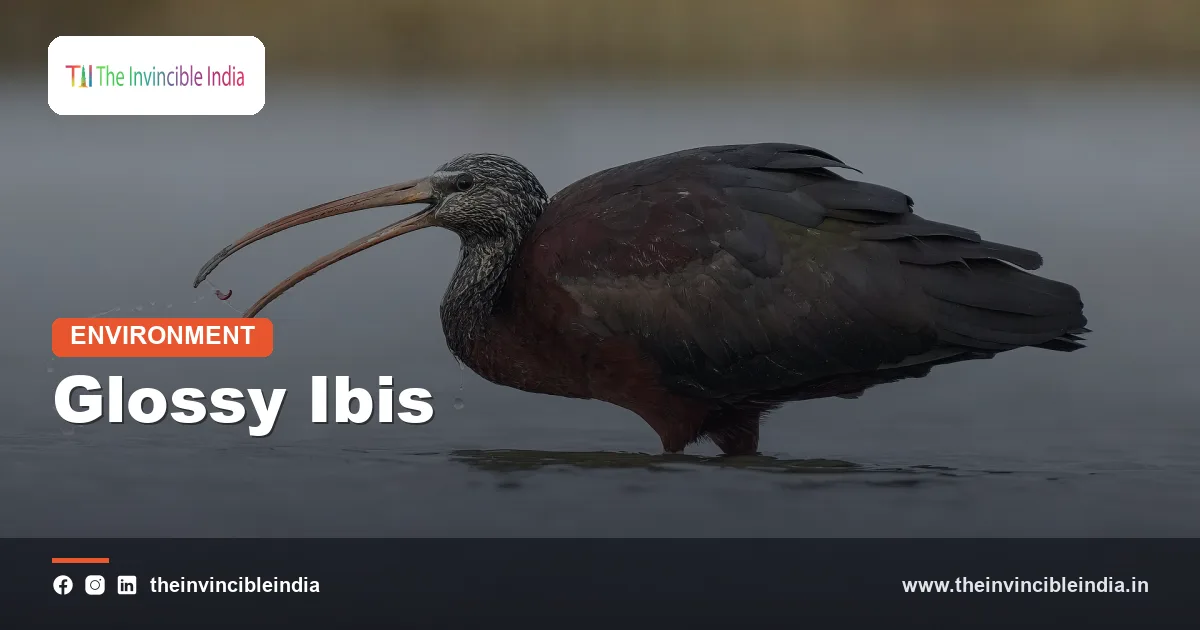
The glossy ibis (Plegadis falcinellus) is a dark, long-legged wading bird with a long downward-curved bill that probes the mud of marshes, flooded fields and lake shores across India. From a distance it looks plain black or brown, but in good light its plumage shimmers with bronze, green and purple, which gives the bird its name.
The glossy ibis is one of the most widely distributed wading birds in the world, found on several continents, and in India it occurs as both a resident and a winter visitor. It feeds in flocks, breeds in mixed colonies with herons and egrets, and is a good indicator of the health of freshwater wetlands.
Quick Facts
| Common name | Glossy ibis |
|---|---|
| Scientific name | Plegadis falcinellus |
| Family | Threskiornithidae (ibises and spoonbills) |
| Indian names | Hindi “kala buza” (a name also applied loosely to other dark ibises); local names vary by region |
| Size | About 55 to 65 cm in length, with a wingspan of roughly 90 to 105 cm |
| Habitat and range | Freshwater marshes, flooded fields, lake margins and slow rivers; resident and winter visitor in India; occurs on several continents |
| Diet | Insects, worms, leeches, crustaceans, molluscs, small fish and frogs |
| Breeding season | Mainly the monsoon months in India, in colonies on trees, bushes or reeds |
| Conservation status | Least Concern (IUCN); protected in India under the Wildlife (Protection) Act, 1972 |
Key Takeaways
- The glossy ibis is a dark wading bird whose bronze-chestnut plumage shows green and purple iridescence in sunlight.
- The glossy ibis has a long, downward-curved bill that it sweeps through mud and shallow water to find food by touch.
- The scientific name Plegadis falcinellus refers to the sickle shape of the glossy ibis’s bill.
- Glossy ibises feed on insects, worms, leeches, crustaceans, small fish and frogs, and they usually forage in flocks.
- Glossy ibises nest in mixed colonies with herons, egrets and cormorants, laying about three or four deep blue-green eggs.
- The glossy ibis is listed as Least Concern by the IUCN, but it relies on freshwater wetlands that are drained or polluted in many places.
What is the glossy ibis?
The glossy ibis is a medium-sized wading bird of the ibis and spoonbill family, Threskiornithidae, recognised by its dark iridescent plumage and long curved bill. It belongs to the genus Plegadis, a name taken from a Greek word meaning “sickle”, while the species name falcinellus comes from a Latin word for a small sickle. Both names describe the same thing, the arched shape of the bill.
Ibises are related to spoonbills, and the family is separate from the herons and storks, although all of these birds wade in shallow water. A simple field test separates them in flight. Ibises, like storks and spoonbills, fly with the neck stretched forward, while herons and egrets tuck the neck back into an S-shape.
The glossy ibis is not a rare or localised bird. It is among the most widespread of all wading birds, occurring across parts of Europe, Africa, Asia, Australia and the Americas. In India it is found over much of the country wherever shallow, fertile wetlands exist.
What does a glossy ibis look like?
A glossy ibis looks like a slim, dark wader with long legs, a long neck and a long, slightly drooping bill, and in good light its plumage shows a bronze, green and purple sheen. In poor light or at distance the bird can look uniformly black, which is why it is often mistaken for other dark waders.
Breeding plumage
In breeding plumage the head, neck and body turn a rich dark chestnut, while the wings and back glint with metallic green and purple. A narrow pale line of bare skin often borders the face at the base of the bill. The legs and bill are dark, and the bare facial skin may take on a slightly bluish or greenish tone.
Non-breeding and juvenile plumage
Outside the breeding season the head and neck of the glossy ibis are duller and finely streaked with white, and the chestnut tones fade to darker brown. Young birds are even duller, with less gloss and a paler, more streaked head. The sexes look alike at all times of the year.
The bill is the most useful feature. It is long, gently curved, and as thick as a pencil at the base, tapering to a narrow tip. The bird holds it slightly open when probing, and the end is sensitive to touch.
How can you tell the glossy ibis from other Indian ibises?
The glossy ibis can be told from other Indian ibises by its smaller size, uniformly dark and glossy plumage and lack of any bare red or black head patch. Three ibises are commonly seen across the Indian plains, and a related spoonbill often shares their wetlands, so each is worth knowing apart.
| Species | Colour | Head and bill | Typical habitat |
|---|---|---|---|
| Glossy ibis | Dark chestnut to bronze with green and purple gloss | Feathered head; slender curved dark bill | Freshwater marshes, wet fields and lake edges |
| Black-headed ibis | White body with a black naked head and neck | Bare black head; thick curved bill | Marshes, tanks and coastal lagoons |
| Red-naped ibis | Dark brown-black with white shoulder patch | Bare black head with a red patch on the nape | Dry fields, river banks and open country |
| Eurasian spoonbill (related) | All white | Flat spoon-shaped bill | Shallow lakes and wetlands |
The glossy ibis is the smallest of the three ibises and the only one with a fully feathered head. Beginners also confuse it with curlews, which have a similar curved bill but streaky brown plumage, but the combination of slim body, dark colour and long curved bill points to the glossy ibis.
Where does the glossy ibis live in India?
The glossy ibis lives in freshwater wetlands across much of India, including marshes, village tanks, reservoir edges, river floodplains and flooded paddy fields. The bird is often absent from dry areas and from steep hill country, and it prefers places with shallow, muddy water and short vegetation.
The Indian population includes resident birds and winter visitors. Some individuals breed locally, while others arrive from breeding grounds farther north or west in Asia as the cold season begins. Numbers at any one site can therefore change greatly from month to month, and flocks may appear suddenly at a wetland after rain or disappear when water levels fall.
Typical Indian habitats include:
- Large freshwater lakes and jheels with muddy margins.
- Seasonal marshes and floodplains along rivers such as the Ganga and Brahmaputra systems.
- Rice fields during the rains and after harvest.
- Reservoir backwaters and irrigation tanks.
- Coastal wetlands and lagoons with freshwater inflow.
The species avoids deep water and is not often seen on open sea coasts. Its need for shallow, productive wetlands ties it closely to the availability of seasonal water.
What does the glossy ibis eat?
The glossy ibis eats aquatic and wet-ground invertebrates, mainly insects, worms, leeches, crustaceans and molluscs, along with small fish, tadpoles and frogs. It finds most of this food by touch, not sight, in muddy water where visibility is poor.
The insect diet covers beetles, dragonfly nymphs, grasshoppers and the larvae of many flies and moths. In wet fields the bird also takes earthworms and snails. When fish are trapped in shrinking pools, the glossy ibis will include them in its meal, although it is less of a fish specialist than a heron.
Because it eats so many insects and invertebrates, the glossy ibis can be useful in agricultural wetlands, where it removes pests and larvae from irrigated fields. The effect is difficult to measure, but ornithologists regard ibises as helpful members of farmland food webs.
How does the glossy ibis feed?
The glossy ibis feeds by wading in shallow water and probing or sweeping its long bill through the mud, grasping prey that it detects by touch. Sensitive nerve endings near the tip of the bill let the bird feel buried or hidden animals without seeing them.
The feeding style has several common patterns:
- Probing: the bird pushes the bill deep into soft mud and opens it slightly to seize worms or larvae.
- Sweeping: the bird swings its head from side to side in shallow water to catch swimming insects and small animals.
- Surface picking: the bird picks insects and snails from vegetation or the water surface.
Glossy ibises are social foragers. They feed in tight flocks, walking forward together, and each bird benefits from the prey disturbed by the others. The group also gives protection, since many eyes are alert for danger. At dusk the birds fly to communal roosts, often in trees, where they gather in the company of herons and egrets.
How does the glossy ibis breed?
The glossy ibis breeds in colonies, building a platform nest of sticks and reeds in trees, bushes or dense aquatic vegetation, usually during the monsoon months in India. The timing matches the abundance of insects and amphibians that follow the rains.
Pairs usually share a breeding site with other water birds such as egrets, night herons, cormorants and spoonbills. The nest is lined with finer material, and the female lays about three or four deep blue-green eggs. Both parents incubate the clutch for roughly three weeks and both feed the young by regurgitation.
The chicks stay in the nest for several weeks before they climb out onto branches and later learn to fly. Colony sites may be reused for many years if the trees and the surrounding wetland stay intact. Disturbance at the colony, such as tree felling, noise or egg collection, can lead to desertion.
Is the glossy ibis endangered?
The glossy ibis is not endangered and is classified as Least Concern by the IUCN, since its range is vast and its global population is large. The species nevertheless faces local risks because it depends on shallow freshwater wetlands.
The main threats to the glossy ibis and its habitat include:
- Drainage and conversion of marshes for agriculture, housing and industry.
- Pollution from pesticides, fertilisers and industrial waste, which harms prey and can accumulate in birds.
- Loss of nesting trees and reeds at colony sites.
- Disturbance, hunting and egg collection in places where protection is weak.
- Changes in rainfall and water management that dry out seasonal wetlands.
In India, wild birds are protected under the Wildlife (Protection) Act, 1972. Conservation of the glossy ibis in practice means protecting wetlands as a whole, including those that fall outside national parks and sanctuaries. Wetlands recognised under the Ramsar Convention, an international treaty for wetland conservation, give important refuge to this and many other waterbirds.
Why is the glossy ibis important to wetlands?
The glossy ibis is important to wetlands because it is a reliable indicator of the quality of shallow freshwater habitats and a link in the wetland food chain. A wetland that supports flocks of glossy ibises typically has a healthy supply of invertebrates, clean mud and varied vegetation.
The bird also moves nutrients as it feeds in the water and roosts and nests in trees. Its droppings enrich the soil beneath breeding colonies. Its ability to travel long distances in search of suitable water ties together wetlands that may be hundreds of kilometres apart, so protection of one marsh helps birds that use many.
For birdwatchers, the glossy ibis is rewarding to watch. A flock lifting from a marsh at sunrise, with each bird’s plumage catching the light, is a notable sight, and the species is a common target on winter bird counts.
Bottom Line
The glossy ibis is a widely distributed, dark and iridescent wader whose curved bill and social habits make it easy to recognise once seen well. It is secure as a species but depends on shallow freshwater wetlands. Protecting those wetlands is the key to keeping it a regular visitor and resident across India.
Frequently Asked Questions
What is a glossy ibis?
A glossy ibis is a medium-sized wading bird with dark, iridescent plumage and a long, downward-curved bill. It is found in marshes and wet fields across India and in many other parts of the world. It belongs to the ibis and spoonbill family, Threskiornithidae.
Why is it called the glossy ibis?
The glossy ibis is called glossy because its dark feathers reflect sunlight with a metallic sheen of bronze, green and purple. In poor light the bird can look entirely black or dark brown, but in bright sun the iridescence is clear.
What does the glossy ibis eat?
The glossy ibis eats insects, worms, leeches, crustaceans, snails, small fish and frogs. It finds this food mostly by touch, sweeping and probing its long bill through mud and shallow water.
Is the glossy ibis a migratory bird in India?
Partly. The glossy ibis is both a resident and a winter visitor in India, so some birds stay and breed locally while others arrive from farther north or west as the cold season begins. Numbers at a given wetland can change greatly through the year.
How do you tell the glossy ibis from the red-naped ibis?
The glossy ibis has a fully feathered head and glossy bronze-brown plumage, while the red-naped ibis has a bare black head with a red patch on the nape and a white shoulder patch. The red-naped ibis is also larger and more often seen in dry fields and river banks.
Is the glossy ibis endangered?
No, the glossy ibis is not endangered and is classified as Least Concern by the IUCN because of its very large range and population. It is protected in India under the Wildlife (Protection) Act, 1972, and its main risk is the loss of shallow freshwater wetlands.
{“@context”:”https://schema.org”,”@graph”:[{“@type”:”FAQPage”,”mainEntity”:[{“@type”:”Question”,”name”:”What is a glossy ibis?”,”acceptedAnswer”:{“@type”:”Answer”,”text”:”A glossy ibis is a medium-sized wading bird with dark, iridescent plumage and a long, downward-curved bill. It is found in marshes and wet fields across India and in many other parts of the world. It belongs to the ibis and spoonbill family, Threskiornithidae.”}},{“@type”:”Question”,”name”:”Why is it called the glossy ibis?”,”acceptedAnswer”:{“@type”:”Answer”,”text”:”The glossy ibis is called glossy because its dark feathers reflect sunlight with a metallic sheen of bronze, green and purple. In poor light the bird can look entirely black or dark brown, but in bright sun the iridescence is clear.”}},{“@type”:”Question”,”name”:”What does the glossy ibis eat?”,”acceptedAnswer”:{“@type”:”Answer”,”text”:”The glossy ibis eats insects, worms, leeches, crustaceans, snails, small fish and frogs. It finds this food mostly by touch, sweeping and probing its long bill through mud and shallow water.”}},{“@type”:”Question”,”name”:”Is the glossy ibis a migratory bird in India?”,”acceptedAnswer”:{“@type”:”Answer”,”text”:”Partly. The glossy ibis is both a resident and a winter visitor in India, so some birds stay and breed locally while others arrive from farther north or west as the cold season begins. Numbers at a given wetland can change greatly through the year.”}},{“@type”:”Question”,”name”:”How do you tell the glossy ibis from the red-naped ibis?”,”acceptedAnswer”:{“@type”:”Answer”,”text”:”The glossy ibis has a fully feathered head and glossy bronze-brown plumage, while the red-naped ibis has a bare black head with a red patch on the nape and a white shoulder patch. The red-naped ibis is also larger and more often seen in dry fields and river banks.”}},{“@type”:”Question”,”name”:”Is the glossy ibis endangered?”,”acceptedAnswer”:{“@type”:”Answer”,”text”:”No, the glossy ibis is not endangered and is classified as Least Concern by the IUCN because of its very large range and population. It is protected in India under the Wildlife (Protection) Act, 1972, and its main risk is the loss of shallow freshwater wetlands.”}}]}]}


