

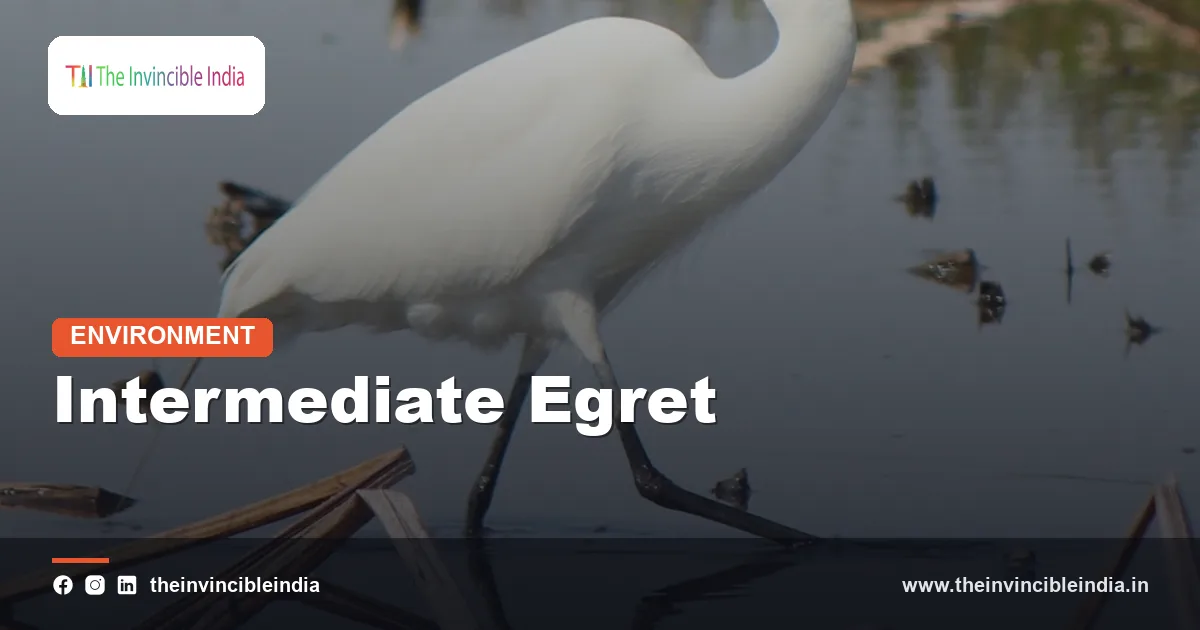
The intermediate egret (Ardea intermedia) is a medium-sized, all-white wading bird of the heron family that lives in marshes, ponds, flooded fields and river margins across India, sitting in size between the little egret and the great egret. It is one of the most common white waders of the subcontinent, yet it is often overlooked because many observers lump it together with the other white egrets that share the same wetlands.
Also called the median egret or the yellow-billed egret, the intermediate egret hunts fish, frogs and insects in shallow water, nests in noisy mixed colonies during the monsoon, and grows delicate breeding plumes that once made it a target of the feather trade. This article explains how to identify the bird, where it lives, what it eats and how it breeds.
Quick Facts
| Common name | Intermediate egret (also median egret, yellow-billed egret) |
|---|---|
| Scientific name | Ardea intermedia (formerly placed in Mesophoyx or Egretta) |
| Family | Ardeidae (herons, egrets and bitterns) |
| Indian names | Commonly grouped with the white “bagla” or “bagula” egrets in Hindi; local names vary by region |
| Size | Roughly 56 to 70 cm in length, with a wingspan a little over a metre |
| Habitat and range | Freshwater marshes, flooded fields, ponds and rivers; resident across much of India, also in Africa, Southeast Asia and Australasia |
| Diet | Fish, frogs, aquatic insects, crustaceans and small reptiles |
| Breeding season | Mainly the monsoon months, in colonies on trees or reeds |
| Conservation status | Least Concern (IUCN); protected under India’s Wildlife (Protection) Act, 1972 |
Key Takeaways
- The intermediate egret is a medium-sized white heron whose size falls between the smaller little egret and the larger great egret.
- The intermediate egret has a relatively short, thick yellow bill and a mouth line that ends below the eye, which separates it from the great egret.
- Intermediate egrets feed on fish, frogs and aquatic insects, hunting by standing still or walking slowly through shallow water.
- Intermediate egrets nest in mixed colonies, called heronries, usually during the monsoon when food is plentiful.
- During the breeding season the intermediate egret grows long, lacy plumes on its back and breast, and its bill and facial skin change colour.
- The intermediate egret is classified as Least Concern by the IUCN, but it depends on healthy wetlands, which are shrinking in many parts of India.
What is the intermediate egret?
The intermediate egret is a medium-sized white heron that belongs to the family Ardeidae and wades in shallow freshwater to catch fish, frogs and insects. Its scientific name, Ardea intermedia, has been revised more than once by taxonomists, and older field guides may list it as Mesophoyx intermedia or Egretta intermedia. All of these names refer to the same bird.
The word “intermediate” is quite literal. The species is larger and heavier than the little egret and clearly smaller than the great egret, with a body that looks compact and a neck that is shorter than that of the great egret. Adults stand about knee-high to a human and carry a pure white plumage all year. Males and females look alike, and the sexes can only be told apart by behaviour during courtship.
Like other herons, the intermediate egret flies with its neck folded back in an S-shape, unlike storks, ibises and spoonbills, which fly with the neck stretched forward. This folded-neck flight is a handy field mark for the whole heron family.
How can you tell the intermediate egret from other white egrets?
The intermediate egret can be told apart from other white egrets by its medium size, short thick yellow bill, a mouth line that stops below the eye and a neck that is shorter and less snaky than that of the great egret. Identification is the main difficulty for beginners, because four white herons often stand side by side on the same pond.
| Feature | Little egret | Intermediate egret | Great egret | Cattle egret |
|---|---|---|---|---|
| Relative size | Small and slim | Medium | Large and tall | Small and stocky |
| Bill | Black and thin | Yellow and fairly short; black in breeding season | Long and yellow; black in breeding season | Short, thick and yellow |
| Legs | Black with yellow feet | Black, with reddish upper legs in breeding season | Black | Yellowish to dark, reddish in breeding season |
| Mouth line | Short | Ends below the eye | Extends behind the eye | Short |
| Usual habitat | Wetlands and coasts | Marshes and flooded fields | Large wetlands and rivers | Grazing land with cattle |
The mouth-line test is the most reliable single feature. In the great egret, the line of the gape runs back past the eye, giving the face a long, grinning look. In the intermediate egret, the line stops under the eye. The posture also differs: the intermediate egret often holds its neck in a kinked, hunched way and looks rounder in the body, while the great egret appears elegant and upright.
The bill length is another clue. In the intermediate egret the bill is about the same length as the head, whereas in the great egret it is clearly longer than the head. Observers who learn these two features can usually name the species within seconds, even at a distance.
Where does the intermediate egret live in India?
The intermediate egret lives throughout peninsular India, the Gangetic plains and the north-east wherever there is shallow fresh water, including rice fields, village tanks, marshes, canals and reservoirs. It is largely a resident bird in India, although many individuals make local movements in response to monsoon rains, drying wetlands and the availability of food.
Outside India the species has a wide Old World range. It occurs across tropical and subtropical Asia, parts of Africa and into Australasia, which makes it one of the more widespread medium herons. Within India it is most common in lowland and plain regions and becomes scarce at higher altitudes in the Himalaya.
The bird prefers open, shallow water with some vegetation, because it needs a place to wade and hunt. Common settings include:
- Paddy fields flooded during the rains and drained after harvest.
- Village ponds, temple tanks and irrigation channels.
- Reed-fringed marshes and the edges of large lakes.
- Seasonal floodplains along rivers.
- Coastal lagoons and the margins of estuaries, mostly in freshwater or lightly brackish patches.
Because the species adapts to man-made wetlands, it is a frequent sight in agricultural landscapes. A rice-growing region with good water management can support large numbers of intermediate egrets alongside other waders.
What does the intermediate egret eat?
The intermediate egret eats mainly small fish, frogs, tadpoles, aquatic insects and crustaceans, and it will also take lizards, small snakes and even small rodents when it gets the chance. Its diet shifts with the season and with whatever prey is concentrated in shrinking pools.
Fish form a large share of the food, especially small species that gather in shallow water. Frogs and tadpoles are important during and after the monsoon, when breeding amphibians fill every puddle. Dragonfly nymphs, water beetles, bugs and grasshoppers add variety, and in drying wetlands the bird takes advantage of fish trapped in dwindling pools.
Because it eats pests such as grasshoppers and insect larvae in fields, as well as the aquatic life that can serve as prey, the intermediate egret plays a quiet role in controlling populations of small animals. Farmers in rice country often welcome egrets, although the benefit is hard to measure in precise terms.
How does the intermediate egret hunt?
The intermediate egret hunts mostly by standing motionless in shallow water and striking at passing prey with a quick stab of the bill, or by walking slowly with deliberate steps. The method relies on patience and sharp eyesight rather than speed, and it is common to see the bird frozen for long periods with its neck drawn back.
Common hunting styles include:
- Stand and wait: the bird stays still at the water’s edge, then lunges when a fish or frog comes within reach.
- Slow walking: the bird wades with careful, high steps, sometimes disturbing prey with a foot before striking.
- Field foraging: the bird walks across wet grass or ploughed ground and picks off insects, frogs and other small animals.
Unlike the cattle egret, which follows grazing animals closely, the intermediate egret is less strongly tied to livestock, although it may feed near them at times. It often forages alone or in loose groups, and it may join mixed feeding flocks where food is abundant. Within a flock, individuals keep a polite distance and may chase off a neighbour that comes too close to a good fishing spot.
How does the intermediate egret breed?
The intermediate egret breeds in colonies called heronries, usually from the onset of the monsoon, building a loose platform of sticks in trees, bushes or reed beds, often over or near water. The timing follows the rains because food is plentiful and nestlings grow quickly when frogs and fish are abundant.
Courtship begins with changes in the bird’s appearance. The bill turns black, the skin between the eye and bill (the lores) shifts to a greenish tone, and the upper legs may flush reddish. Long, lacy plumes sprout from the back and breast. The male displays by stretching, bowing and raising these plumes, then offers sticks to the female, who helps build the nest.
A typical clutch has three to five pale bluish-green eggs. Both parents share incubation, which lasts about three weeks, and both feed the chicks by regurgitating food. Young birds leave the nest after several weeks, first clambering about the branches before they can fly.
Intermediate egrets seldom nest alone. They commonly share trees with little egrets, great egrets, cattle egrets, night herons, cormorants, spoonbills and other water birds. These mixed heronries are noisy, crowded and smelly, and the same sites may be used year after year if they remain undisturbed.
What are the breeding plumes and why did they matter?
The breeding plumes of the intermediate egret are long, fine, hair-like feathers called aigrettes that grow on the back and breast, and they were once so fashionable in hats and ornaments that egrets were hunted heavily for them. The trade peaked in the late nineteenth and early twentieth centuries, when plumes of egrets and other herons were exported in large volumes.
The hunting took place at breeding colonies, because the plumes are at their finest when the birds are nesting. Shooting the adults left eggs and chicks to die, so colonies collapsed quickly. Public outcry in Europe and North America helped bring about the early bird protection laws and conservation societies of that era.
Today, in India, the species is protected under the Wildlife (Protection) Act, 1972, which restricts hunting and trade in wild birds. The plume trade is no longer the main threat. The history nevertheless explains why egrets are often viewed as symbols of early bird conservation.
Is the intermediate egret threatened?
The intermediate egret is not globally threatened and is listed as Least Concern by the International Union for Conservation of Nature (IUCN), because it has a very large range and a large population. Even so, local populations depend on the health of wetlands, and these habitats have been drained, polluted or built over in many regions.
The main pressures on intermediate egrets and their wetlands include:
- Drainage and reclamation of marshes for farming and construction.
- Pollution from pesticides, fertiliser run-off and industrial effluent, which affects prey and can build up in the food chain.
- Felling or disturbance of trees used for heronries.
- Hunting and egg collection in some areas, despite legal protection.
- Changes in water management that dry out wetlands in the breeding season.
Protecting heronries, keeping nesting trees standing and maintaining shallow, fish-rich water are the most effective conservation steps. Community conservation has worked well in several places, where villagers guard nesting colonies because the birds also enrich the soil beneath the trees with droppings.
Where can you watch intermediate egrets in India?
Intermediate egrets can be watched at almost any wetland in India, but sites that protect large waterbird colonies give the best views, such as Keoladeo National Park in Rajasthan, Vedanthangal Bird Sanctuary in Tamil Nadu, Ranganathittu Bird Sanctuary in Karnataka and the wetlands of Chilika Lake in Odisha. These places combine shallow water, nesting trees and a rich supply of prey.
Tips for watching the bird:
- Visit during or just after the monsoon to see breeding plumage and nesting activity.
- Go early in the morning, when egrets are active and light is soft.
- Look first for the mouth line and bill length to separate this species from the great egret and little egret.
- Keep a respectful distance from nesting colonies and avoid sudden noise.
Even without travel, a farm pond or village tank in the rainy season can show all of the white egrets side by side, which is the best classroom for learning to tell them apart.
Why do wading birds like the intermediate egret matter?
Wading birds such as the intermediate egret matter because they act as indicators of wetland health, since a pond or marsh that supports many egrets almost always has healthy populations of fish, amphibians and insects beneath the surface. A decline in egrets can therefore be an early warning that a wetland is being degraded.
Egrets also move nutrients between water and land. Their droppings fertilise nesting trees, and their feeding changes the balance of small aquatic animals. In farmland, they are part of the food web that keeps insect numbers in check.
Culturally, white egrets are a familiar sight in Indian poetry, folklore and village life. Flocks of egrets rising over green paddy are a recurring image of the monsoon, and for many people they are the first birds they learn to notice.
Bottom Line
The intermediate egret is a medium-sized white heron that is easy to overlook but easy to identify once the mouth line, bill and size are understood. It remains common in India, and its fortunes track the health of the country’s wetlands. Looking after ponds, marshes and heronries is the best way to keep it a regular part of the landscape.
Frequently Asked Questions
What is an intermediate egret?
An intermediate egret is a medium-sized white heron that wades in shallow water across India and much of Asia, Africa and Australasia. It is larger than the little egret and smaller than the great egret. It eats fish, frogs and insects.
How do you tell an intermediate egret from a great egret?
The easiest way is to look at the mouth line and the bill. In the intermediate egret, the line of the mouth ends below the eye and the bill is about as long as the head, while in the great egret the mouth line runs behind the eye and the bill is longer than the head. The great egret is also noticeably taller with a longer, more snaky neck.
What does the intermediate egret eat?
The intermediate egret eats small fish, frogs, tadpoles, aquatic insects and crustaceans, and it may also take lizards and small snakes. It hunts by standing still or walking slowly in shallow water and striking quickly with its bill.
When does the intermediate egret breed in India?
The intermediate egret breeds mainly during the monsoon months, when food is abundant. It nests in mixed colonies called heronries, building stick platforms in trees or reeds and laying about three to five pale bluish-green eggs.
Is the intermediate egret endangered?
No, the intermediate egret is not endangered and is classified as Least Concern by the IUCN because of its wide range and large population. It is protected in India under the Wildlife (Protection) Act, 1972, but it still depends on healthy wetlands that are under pressure in many regions.
Why does the intermediate egret grow long plumes?
The intermediate egret grows long, lacy plumes on its back and breast during the breeding season as part of courtship display. These plumes, called aigrettes, helped make egrets targets of the feather trade in the nineteenth and early twentieth centuries.
{“@context”:”https://schema.org”,”@graph”:[{“@type”:”FAQPage”,”mainEntity”:[{“@type”:”Question”,”name”:”What is an intermediate egret?”,”acceptedAnswer”:{“@type”:”Answer”,”text”:”An intermediate egret is a medium-sized white heron that wades in shallow water across India and much of Asia, Africa and Australasia. It is larger than the little egret and smaller than the great egret. It eats fish, frogs and insects.”}},{“@type”:”Question”,”name”:”How do you tell an intermediate egret from a great egret?”,”acceptedAnswer”:{“@type”:”Answer”,”text”:”The easiest way is to look at the mouth line and the bill. In the intermediate egret, the line of the mouth ends below the eye and the bill is about as long as the head, while in the great egret the mouth line runs behind the eye and the bill is longer than the head. The great egret is also noticeably taller with a longer, more snaky neck.”}},{“@type”:”Question”,”name”:”What does the intermediate egret eat?”,”acceptedAnswer”:{“@type”:”Answer”,”text”:”The intermediate egret eats small fish, frogs, tadpoles, aquatic insects and crustaceans, and it may also take lizards and small snakes. It hunts by standing still or walking slowly in shallow water and striking quickly with its bill.”}},{“@type”:”Question”,”name”:”When does the intermediate egret breed in India?”,”acceptedAnswer”:{“@type”:”Answer”,”text”:”The intermediate egret breeds mainly during the monsoon months, when food is abundant. It nests in mixed colonies called heronries, building stick platforms in trees or reeds and laying about three to five pale bluish-green eggs.”}},{“@type”:”Question”,”name”:”Is the intermediate egret endangered?”,”acceptedAnswer”:{“@type”:”Answer”,”text”:”No, the intermediate egret is not endangered and is classified as Least Concern by the IUCN because of its wide range and large population. It is protected in India under the Wildlife (Protection) Act, 1972, but it still depends on healthy wetlands that are under pressure in many regions.”}},{“@type”:”Question”,”name”:”Why does the intermediate egret grow long plumes?”,”acceptedAnswer”:{“@type”:”Answer”,”text”:”The intermediate egret grows long, lacy plumes on its back and breast during the breeding season as part of courtship display. These plumes, called aigrettes, helped make egrets targets of the feather trade in the nineteenth and early twentieth centuries.”}}]}]}


