

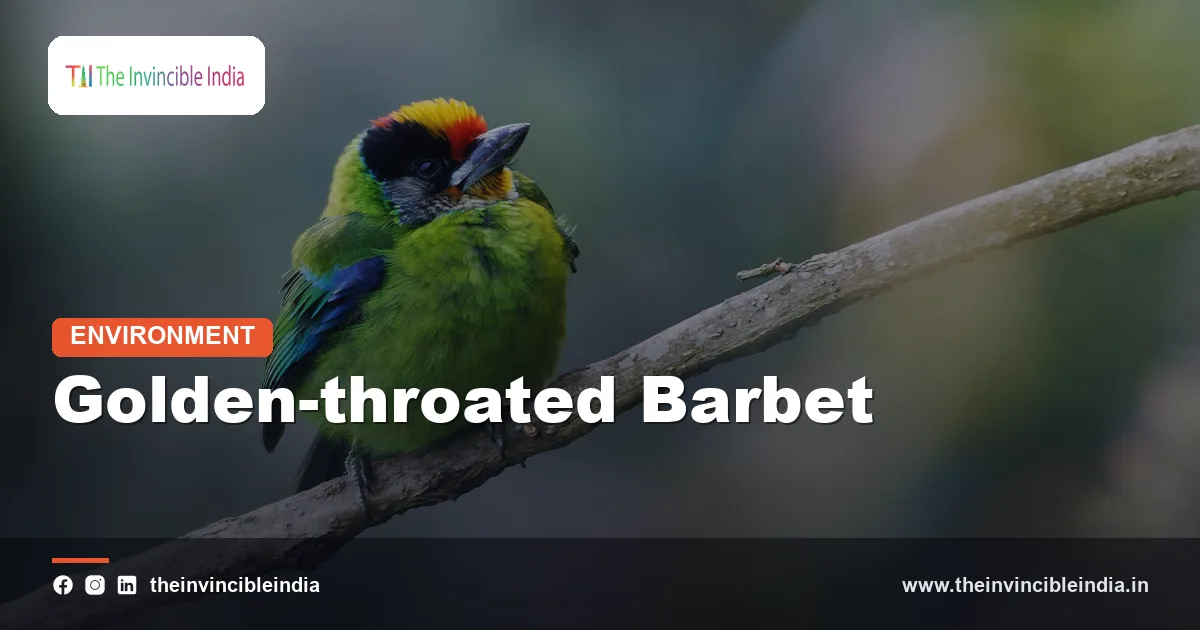
The golden-throated barbet (Psilopogon franklinii) is a colourful, mostly green, fruit-eating bird of the eastern Himalaya and the hill forests of north-east India, recognised by its golden-yellow throat, red and blue markings on the head and loud, repeated piping call. Although it is bright, the golden-throated barbet is hard to see because its green body blends with the leaves of the tall trees in which it feeds, so most people first notice it by sound.
The golden-throated barbet belongs to the Asian barbets, a group of stout-billed, tree-dwelling birds that dig their own nest holes in dead wood and disperse the seeds of many forest trees. This guide explains how to identify the species, where it lives in India, what it eats, how it breeds, why it matters to forests and how it is faring.
| Quick Fact | Detail |
|---|---|
| Common name | Golden-throated barbet (named for its golden-yellow throat) |
| Scientific name | Psilopogon franklinii (formerly placed in the genus Megalaima) |
| Family | Megalaimidae (Asian barbets) |
| Size | About 22 to 23 cm long, stout-billed and plump |
| Range | Eastern Himalaya from Nepal eastwards, including Sikkim, north Bengal, Arunachal Pradesh and the hills of north-east India, and onwards into south-east Asia |
| Diet | Mainly fruits such as figs and berries, with some insects and occasionally nectar and flowers |
| Breeding | Digs a nest hole in a dead tree trunk or branch; lays a few white eggs, generally in spring and early summer |
| Conservation status | Least Concern on the IUCN Red List |
Key Takeaways
- The golden-throated barbet is a green, fruit-eating bird about 22 to 23 cm long with a golden-yellow throat, found in the eastern Himalaya and the north-eastern hills of India.
- The golden-throated barbet is usually heard before it is seen, because its loud, monotonous piping call carries far through hill forest.
- The golden-throated barbet feeds mostly on figs and other wild fruits, and it helps spread the seeds of forest trees.
- The golden-throated barbet digs its own nest hole in dead wood, so standing dead trees are important to its breeding.
- The golden-throated barbet lives in broadleaved hill forest at middle altitudes and is classified as Least Concern by the IUCN.
- The golden-throated barbet is protected in India under the Wild Life (Protection) Act, 1972, like other wild birds.
What is the golden-throated barbet?
The golden-throated barbet is a medium-sized, stocky bird in the family of Asian barbets, named for the golden-yellow patch on its throat. Barbets are among the best-known tree birds of Asian forests, and the golden-throated barbet is one of the more handsome species found in India’s eastern hills.
The species was described to science in the 1840s from specimens collected in the Himalaya, and its scientific name franklinii honours a 19th-century British naturalist who studied the birds of India. Taxonomists previously placed it in the genus Megalaima, but modern classification treats the Asian barbets as the genus Psilopogon within the family Megalaimidae, which is why older books and newer ones may use different Latin names for the same bird.
The common word barbet comes from the French word for beard. It refers to the stiff bristles around the base of the heavy bill, which give the face a whiskered look. All barbets share this feature, along with a short neck, a large head and a strong bill suited to fruit and wood.
How can you identify a golden-throated barbet?
You can identify the golden-throated barbet by its leaf-green body, the golden-yellow throat bordered by a darker band, and the red, black and blue markings on the head. The head is the most colourful part of the bird, and these colours stand out in good light, particularly when the bird perches in the open at the top of a tree.
- Throat: the golden-yellow throat gives the species its name and is a key field mark.
- Head: a mix of red on the crown, a black band through the eye, and blue on the sides of the head and neck.
- Body: bright green above and paler green below, with a heavy, pale bill.
- Size and shape: plump and short-tailed, with a large head, about 22 to 23 cm from bill to tail.
- Sexes: males and females look much alike, and young birds are duller with less distinct head colours.
The green back is the reason the bird is so difficult to spot. Where the golden-throated barbet sits motionless among broad leaves, even an experienced observer may fail to see it until it moves. Looking for the yellow throat, scanning fruiting trees and following the sound are the best methods.
What does the golden-throated barbet sound like?
The golden-throated barbet gives a loud, repeated, piping call that rings through hill forest, often delivered in long series from a high perch in the early morning. Like its relatives, it can call for many minutes with only short pauses, and this is how most observers locate the bird.
The call is rhythmic and rather monotonous, with a mellow, musical quality that differs from the harsher notes of some other barbets. Several birds may answer one another across a valley, particularly in the breeding season. The calls serve to claim a territory, attract a mate and keep in contact with other birds when visibility is poor.
Anyone visiting an eastern Himalayan forest, such as those in Sikkim or Arunachal Pradesh, is likely to hear barbet calls long before seeing any bird. Learning the call is therefore the single most useful skill for finding the species.
Where does the golden-throated barbet live in India?
The golden-throated barbet lives in the eastern Himalaya and the hills of north-east India, including Sikkim, the hills of north Bengal, Arunachal Pradesh and neighbouring north-eastern states, and its range continues east and south into Myanmar and other parts of south-east Asia. In Nepal it is found at the western edge of its range.
It lives mainly in humid, broadleaved evergreen and mixed forest at middle altitudes, generally in the temperate and subtropical hill zone rather than in the plains. In winter many birds move to somewhat lower elevations, following ripening fruit. It is often found in the tall canopy, along forest edges, in clearings with fruiting trees and sometimes in well-wooded gardens or old plantations close to forest.
Other barbets share the same region. The table below compares three barbets that birdwatchers commonly meet in the eastern Himalayan foothills.
| Barbet | Main colour feature | Typical habitat in India |
|---|---|---|
| Golden-throated barbet | Golden-yellow throat; red, black and blue on head | Hill forest of the eastern Himalaya and north-east |
| Great barbet | Large size; dark blue-brown head and yellow bill | Himalayan forests across a wide altitude range |
| Blue-throated barbet | Blue throat and face; red patch at the crown | Foothill forests and gardens in the Himalaya and north-east |
What does the golden-throated barbet eat?
The golden-throated barbet eats mostly fruit, especially wild figs and berries, and supplements this with insects and sometimes flower nectar or petals. Fruit is the bulk of the diet for the greater part of the year, and the bird often gathers in large fruiting trees along with other fruit-eaters such as bulbuls, mynas, hornbills, pigeons and other barbets.
Fig trees are especially important. A single large fig tree can bear fruit over a long period, and it draws a crowd of birds, monkeys and squirrels. Barbets use their strong bills to pluck the fruit, sometimes swallowing it whole. In the breeding season, the adults add insects to the diet and give them to nestlings to supply protein.
This diet makes the golden-throated barbet a seed disperser. Seeds pass through the gut or are dropped away from the parent tree, which helps forests regenerate and spreads fig trees and other plants over a wider area. Ecologists describe fruit-eating birds like barbets as keystone mutualists in tropical and subtropical forests because both the birds and the trees depend on one another.
How does the golden-throated barbet breed?
The golden-throated barbet breeds by excavating a nest cavity in a dead or rotting tree trunk or branch, usually in spring and early summer. Both partners take part in digging, using their strong bills to chip out a chamber, and the hole may be at a considerable height above the ground.
The female lays a small clutch of white eggs, generally a few in number, and both parents incubate them and feed the chicks. The nestlings are fed fruit and insects. Once the young have fledged, they may stay near the parents for some time before dispersing. The same species often uses a fresh hole each year, but old cavities may be reused.
The nest holes of barbets are valuable for other wildlife. After barbets abandon a hole, other birds, such as small owls, tits and starlings, as well as squirrels and bats, may move in. Barbets are therefore sometimes described as primary cavity nesters whose work creates homes for other species. This is a reason why foresters and conservationists try to leave standing dead trees in forests where this is safe.
Why is the golden-throated barbet important to forests?
The golden-throated barbet is important to forests because it disperses seeds, helps control insects and creates nest cavities that other animals can use. These three roles make it a useful indicator of a healthy, fruit-bearing hill forest.
- Seed dispersal: fruit eaten in one place is deposited elsewhere, helping trees such as figs colonise new ground.
- Insect control: feeding insects to chicks and eating them in season reduces numbers of some forest insects.
- Cavity creation: abandoned holes are used by many secondary cavity nesters.
- Indicator value: the presence of barbets usually signals older trees, fruiting trees and dead standing wood.
Because the species depends on mature trees, it is more common in intact and old forest than in heavily cleared land. Patches of fruiting trees left in farmland or along village boundaries in the hills can also host barbets, which shows how traditional land use that retains big trees supports wildlife.
What is the conservation status of the golden-throated barbet?
The golden-throated barbet is classified as Least Concern on the IUCN Red List, which means it is not considered threatened with extinction at present. The reasons are its extensive range across the eastern Himalaya and south-east Asia and the absence of evidence for a rapid, overall population decline.
Nevertheless, hill forests face pressure from shifting cultivation, logging, road building, hydropower projects, and expansion of settlements and plantations. Removing old and dead trees reduces both food and nest sites for the species. Climate change may also shift the altitudes at which fruit ripens and could change where the bird can live over the long term.
In India, the golden-throated barbet is covered by the Wild Life (Protection) Act, 1972, which prohibits hunting and capture of wild birds. Much of its habitat lies within protected areas, community-conserved forests and reserved forests in states such as Sikkim, West Bengal and Arunachal Pradesh. Maintaining continuous forest cover and retaining old trees are the most useful ways to protect it.
Where is the best place to see a golden-throated barbet?
The best places to see a golden-throated barbet in India are mid-altitude hill forests in the eastern Himalaya and north-east, especially in Sikkim, north Bengal and Arunachal Pradesh, visited in the early morning when the birds call and feed. Birdwatchers commonly look along forest roads, in wooded valleys and around fruiting fig trees.
- Visit in the early morning, when barbets call from exposed perches.
- Listen first, then scan the top of tall trees for a bird sitting still.
- Look for a fruiting tree, since many birds will gather there at once.
- Carry binoculars, as the bird is often high above the observer.
- Hire a local guide who knows the calls and the best forest trails.
Spring and early summer are good seasons because males call more and birds are more active. Patience matters, because a green bird against green foliage can sit for long periods without moving.
Bottom Line
The golden-throated barbet is a bright but elusive resident of the eastern Himalayan and north-eastern hill forests, known for its golden throat and carrying call. It eats fruit, spreads seeds and digs nest holes that other animals reuse, so its health reflects the health of old, fruit-rich forest.
Frequently Asked Questions
What is a golden-throated barbet?
A golden-throated barbet is a stout, mostly green, fruit-eating bird with a golden-yellow throat and red and blue markings on its head. It lives in the eastern Himalaya, the hills of north-east India and parts of south-east Asia. It belongs to the family of Asian barbets.
Where is the golden-throated barbet found in India?
The golden-throated barbet is found in the eastern Himalaya and north-eastern hills of India, including Sikkim, north Bengal and Arunachal Pradesh. It prefers humid broadleaved forest at middle altitudes. In winter it may move lower down the hills in search of fruit.
What does the golden-throated barbet eat?
The golden-throated barbet eats mainly fruit, especially figs and berries, along with some insects and occasionally nectar. Fruit makes up most of its diet. By carrying seeds in its gut, the bird helps trees spread through the forest.
How does a golden-throated barbet make its nest?
A golden-throated barbet makes its nest by chiselling a hole into a dead or rotting tree trunk or branch with its strong bill. Both parents help to dig the chamber. The female lays a few white eggs inside, and old holes are later used by other birds and small animals.
How can you tell the golden-throated barbet from other barbets?
The golden-yellow throat is the clearest sign of a golden-throated barbet. Its head also carries red, black and blue markings, and the body is green. The great barbet is larger with a dark head and a yellow bill, while the blue-throated barbet has a blue throat and face.
Is the golden-throated barbet endangered?
No, the golden-throated barbet is not endangered and is listed as Least Concern by the IUCN. It has a large range and no evidence of a rapid overall decline. Loss of old forest and dead trees could still affect local populations in the future.
{“@context”:”https://schema.org”,”@graph”:[{“@type”:”FAQPage”,”mainEntity”:[{“@type”:”Question”,”name”:”What is a golden-throated barbet?”,”acceptedAnswer”:{“@type”:”Answer”,”text”:”A golden-throated barbet is a stout, mostly green, fruit-eating bird with a golden-yellow throat and red and blue markings on its head. It lives in the eastern Himalaya, the hills of north-east India and parts of south-east Asia. It belongs to the family of Asian barbets.”}},{“@type”:”Question”,”name”:”Where is the golden-throated barbet found in India?”,”acceptedAnswer”:{“@type”:”Answer”,”text”:”The golden-throated barbet is found in the eastern Himalaya and north-eastern hills of India, including Sikkim, north Bengal and Arunachal Pradesh. It prefers humid broadleaved forest at middle altitudes. In winter it may move lower down the hills in search of fruit.”}},{“@type”:”Question”,”name”:”What does the golden-throated barbet eat?”,”acceptedAnswer”:{“@type”:”Answer”,”text”:”The golden-throated barbet eats mainly fruit, especially figs and berries, along with some insects and occasionally nectar. Fruit makes up most of its diet. By carrying seeds in its gut, the bird helps trees spread through the forest.”}},{“@type”:”Question”,”name”:”How does a golden-throated barbet make its nest?”,”acceptedAnswer”:{“@type”:”Answer”,”text”:”A golden-throated barbet makes its nest by chiselling a hole into a dead or rotting tree trunk or branch with its strong bill. Both parents help to dig the chamber. The female lays a few white eggs inside, and old holes are later used by other birds and small animals.”}},{“@type”:”Question”,”name”:”How can you tell the golden-throated barbet from other barbets?”,”acceptedAnswer”:{“@type”:”Answer”,”text”:”The golden-yellow throat is the clearest sign of a golden-throated barbet. Its head also carries red, black and blue markings, and the body is green. The great barbet is larger with a dark head and a yellow bill, while the blue-throated barbet has a blue throat and face.”}},{“@type”:”Question”,”name”:”Is the golden-throated barbet endangered?”,”acceptedAnswer”:{“@type”:”Answer”,”text”:”No, the golden-throated barbet is not endangered and is listed as Least Concern by the IUCN. It has a large range and no evidence of a rapid overall decline. Loss of old forest and dead trees could still affect local populations in the future.”}}]}]}


