

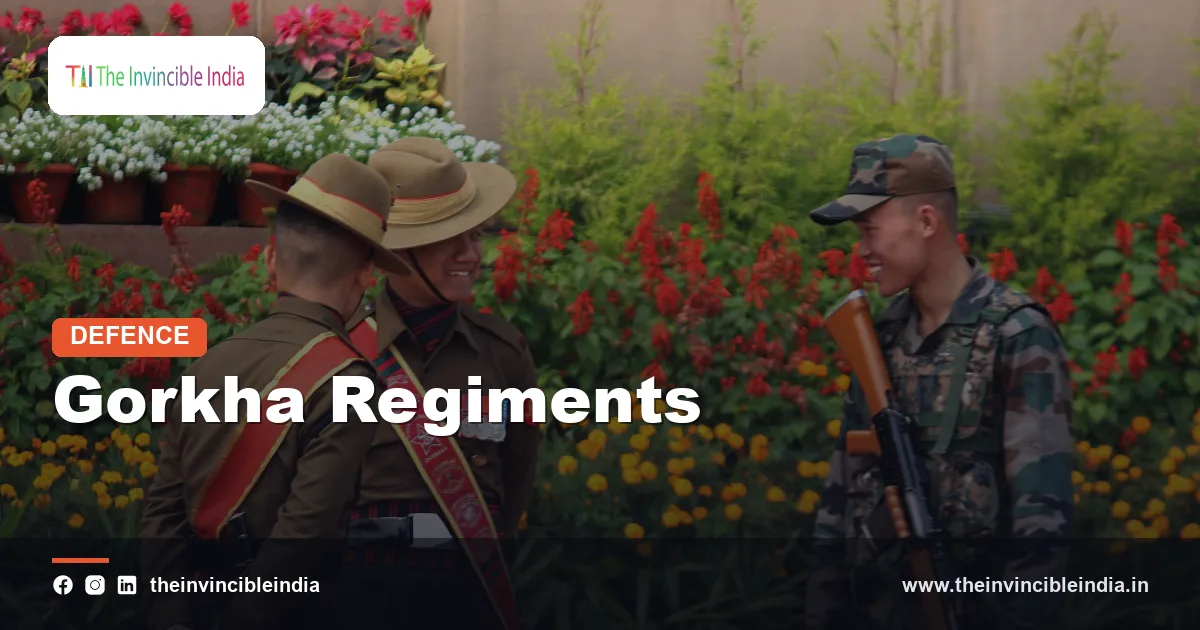
The Gorkha regiments of the Indian Army are seven infantry regiments of Gorkha Rifles, the 1st, 3rd, 4th, 5th, 8th, 9th and 11th, which together recruit soldiers from the Gorkha communities of Nepal and India and are known for their discipline, courage and the traditional khukri. Six of them descend from the Gurkha regiments of the British Indian Army that were allotted to India under a tripartite agreement of 1947, and the seventh was raised after independence.
The Gorkha regiments have earned an unusually strong reputation in military history, with battle honours in both world wars and in India’s wars since 1947. Their ethos is summed up in the Nepali saying “Kaphar hunnu bhanda marnu ramro”, which means that it is better to die than to live as a coward.
| Attribute | Detail |
|---|---|
| Type | Infantry regiments (rifle regiments) of the Indian Army |
| Number of regiments | Seven: 1st, 3rd, 4th, 5th, 8th, 9th and 11th Gorkha Rifles |
| Origins | Nineteenth-century Gurkha units raised after the Anglo-Nepalese War of 1814-16 |
| Allotment to India | Tripartite Agreement among India, Nepal and the United Kingdom, signed in November 1947 |
| Recruited from | Gorkha communities of Nepal and India, including Gurung, Magar, Rai, Limbu and Thakuri groups |
| Ethos | “Kaphar hunnu bhanda marnu ramro” (better to die than live as a coward) |
| Battle cry | “Jai Mahakali, Ayo Gorkhali” |
| Symbol | The khukri, the curved Nepali knife, shown crossed on regimental insignia |
Key Takeaways
- The Gorkha regiments of the Indian Army comprise seven infantry regiments of Gorkha Rifles, numbered 1, 3, 4, 5, 8, 9 and 11.
- The Tripartite Agreement of November 1947 among India, Nepal and the United Kingdom divided the old Gurkha regiments, with six going to the Indian Army and four to the British Army.
- The Gorkha regiments recruit both Indian Gorkhas and Nepali Gorkhas, and the recruitment of Nepali citizens rests on the 1947 agreement.
- The regimental motto “Kaphar hunnu bhanda marnu ramro” means that death is better than cowardice, and the khukri is the emblem of the Gorkha soldier.
- Gorkha officers and soldiers have won India’s highest gallantry honour, the Param Vir Chakra, including Major Dhan Singh Thapa in 1962 and Lieutenant Manoj Kumar Pandey in 1999.
- Field Marshal Sam Manekshaw, India’s first Field Marshal, is closely associated with the 8th Gorkha Rifles.
What are the Gorkha regiments of the Indian Army?
The Gorkha regiments of the Indian Army are the seven rifle regiments formed around soldiers of Gorkha origin, which are among the best-known infantry units in the Army. Each regiment has several battalions, a regimental centre where recruits are trained, and its own history, colours and customs.
The regiments are called Gorkha Rifles, because they began as light infantry that were trained for skirmishing and for movement in hills. The term “Gorkha” comes from the town and former kingdom of Gorkha in Nepal, from which the Shah dynasty expanded to unify much of present-day Nepal in the eighteenth century.
The Gorkha regiments are fully integrated in the Indian Army. They serve under the same command structure, take part in operations across the country, from the Himalayan borders to counter-insurgency areas, and contribute contingents to United Nations peacekeeping missions.
How did the Gorkha regiments originate?
The Gorkha regiments originated in the Anglo-Nepalese War of 1814-16, in which the army of the East India Company fought the forces of the Gorkha kingdom, and the British, impressed by their opponents’ fighting qualities, began to recruit Gorkhas into their own service. The war ended with the Treaty of Sugauli in 1816, which fixed the boundaries between Nepal and British India.
Gorkha irregulars were taken into British service even before the treaty, and the early units, including the Nasiri Battalion and the Sirmoor Battalion, formed in 1815. The Nasiri Battalion is the ancestor of the 1st Gorkha Rifles, and the Kumaon Battalion, raised in the same period, is linked to the 3rd.
During the nineteenth century, Gorkha battalions served in the Indian subcontinent and took part in campaigns, including those of 1857, along the north-west frontier and in Burma. More regiments were added over time, and by the early twentieth century there were ten Gurkha regiments in the British Indian Army.
In the First and Second World Wars, Gorkha units served in very large numbers in theatres that included France, Gallipoli, the Middle East, North Africa, Italy and Burma. Their record in those wars was an important part of the reputation that later Indian regiments inherited.
What was the 1947 Tripartite Agreement?
The 1947 Tripartite Agreement was an arrangement among India, Nepal and the United Kingdom, signed in November 1947, which divided the Gurkha regiments of the former British Indian Army between the Indian and British armies and set the terms for the recruitment of Nepali citizens by both. When British rule ended in 1947, the ten Gurkha regiments had to be allotted to one of the successor states.
Under the agreement, six regiments became part of the Indian Army, and four went to the British Army. The regiments that remained in India were the 1st, 3rd, 4th, 5th, 8th and 9th Gorkha Rifles, and the 11th Gorkha Rifles was later added as a seventh regiment.
The agreement also recognised that Nepali Gorkhas who joined the Indian or British armies should be treated on terms comparable to those of other soldiers in their respective armies, including pay, allowances and pensions. It remains the basis on which Nepali citizens have been recruited into the Gorkha regiments of the Indian Army.
Because it is a treaty-based arrangement, changes to recruitment practice, such as those that follow reforms in the Indian Army’s recruitment policy, involve consultation with the Government of Nepal.
Which are the seven Gorkha Rifles regiments?
The seven Gorkha Rifles regiments of the Indian Army are the 1st, 3rd, 4th, 5th (Frontier Force), 8th, 9th and 11th Gorkha Rifles, each with its own lineage. All are commonly abbreviated as GR, for example 1 GR or 5 GR (FF).
| Regiment | Notes on lineage and identity |
|---|---|
| 1st Gorkha Rifles (The Malaun Regiment) | Traces its origin to the Nasiri Battalion of 1815, among the earliest Gorkha units; Captain Gurbachan Singh Salaria of its 3rd Battalion received the Param Vir Chakra in the Congo in 1961 |
| 3rd Gorkha Rifles | Descends from the Kumaon Battalion of the early nineteenth century; Gorkha soldiers of this lineage won the Victoria Cross in the Second World War |
| 4th Gorkha Rifles | A nineteenth-century regiment with a long record of service on the frontier and in the world wars |
| 5th Gorkha Rifles (Frontier Force) | Linked to the Frontier Force tradition of the north-west; Gorkha soldiers of this lineage earned Victoria Crosses in the Second World War |
| 8th Gorkha Rifles | Associated with Field Marshal Sam Manekshaw, and with Major Dhan Singh Thapa, who won the Param Vir Chakra in 1962 |
| 9th Gorkha Rifles | A long-standing nineteenth-century regiment with service in both world wars and in post-independence conflicts |
| 11th Gorkha Rifles | Re-raised after independence as the seventh regiment; Lieutenant Manoj Kumar Pandey of its 1st Battalion won the Param Vir Chakra in 1999 |
The regiments have regimental centres located in places such as the Himalayan foothills of Himachal Pradesh, in Uttar Pradesh and in Meghalaya, where recruits receive basic training and where the regimental traditions are preserved.
Who are the Gorkhas, and who is recruited?
The Gorkhas are people of the Himalayan hill regions who are historically associated with the Gorkha kingdom, and the Indian Army’s Gorkha regiments recruit from both Nepal and the Gorkha communities that live in India. The soldiers include members of communities such as the Gurung, Magar, Rai, Limbu, Tamang, Sunuwar, Thakuri and Chhetri.
Within India, Gorkha families live in a belt that runs from Uttarakhand and Himachal Pradesh through Sikkim and Darjeeling to Assam and the north-eastern states. Many of these families have a tradition of service in the Army across several generations.
Nepali Gorkhas are recruited at recruitment rallies in Nepal, while Indian Gorkhas are recruited through the Army’s regular recruitment system. Historically, recruitment depots at places such as Gorakhpur and Darjeeling have been important, and trained soldiers regularly go home on leave to Nepal, so the regiments have close ties with the hill communities.
After retirement, Nepali ex-servicemen return to Nepal, and the pensions and welfare they receive form a significant source of income in the hill regions. This link is one reason that the regiments are discussed in the context of India-Nepal relations.
What does “Kaphar hunnu bhanda marnu ramro” mean?
“Kaphar hunnu bhanda marnu ramro” is a Nepali saying which means “it is better to die than to live as a coward”, and it is widely quoted as the guiding spirit of the Gorkha soldier. It expresses the importance given to honour, courage and loyalty to comrades and to the unit.
The saying is a cultural expression of the martial ethic rather than an official regimental order, and it is often associated with the Gorkha Rifles and with Gurkha units elsewhere. It is used in regimental ceremonies, in literature about the regiments and in the way soldiers describe their duty.
Alongside this ethos, the regiments have a battle cry, “Jai Mahakali, Ayo Gorkhali”, which means “Victory to Goddess Mahakali, the Gorkhas are upon you”. The cry is used in charges and parades and is a symbol of unit pride.
What is the khukri and why is it important?
The khukri is a curved knife of Nepali origin that is the traditional blade of the Gorkhas, and it is the best-known emblem of the Gorkha soldier. The blade bends inward, with the sharpest edge on the inside of the curve, and is used both as a working tool and as a close-combat weapon.
In civilian life in the hills, the khukri is used for chopping wood, cutting crops and household tasks, so it is a familiar object that carries a sense of identity. In the Army, crossed khukris appear on regimental badges, and the knife is carried or displayed in ceremonial dress.
Popular tradition says that a khukri, once drawn, should not return to its sheath without being used, but this is folklore rather than a rule. In practice, the khukri today is mainly a symbol and a ceremonial and utility item, while Gorkha soldiers are trained and equipped with modern infantry weapons.
What are the famous battle honours and acts of bravery?
The Gorkha regiments hold battle honours from both world wars and from the conflicts of independent India, including 1947-48, 1962, 1965, 1971 and 1999, and their members have won some of the highest gallantry awards. The honours are carried on the regimental colours and are part of the unit’s identity.
- Second World War: Gorkha soldiers earned the Victoria Cross, the highest British award at the time, in campaigns that included North Africa and Burma.
- Jammu and Kashmir, 1947-48: Gorkha battalions took part in operations to defend the territory soon after independence.
- Ladakh, 1962: Major Dhan Singh Thapa of the 1st Battalion, 8th Gorkha Rifles, received the Param Vir Chakra for holding a forward post near Pangong Tso against heavy odds.
- Congo, 1961: Captain Gurbachan Singh Salaria of the 1st Gorkha Rifles received the Param Vir Chakra posthumously while serving with a United Nations force.
- 1965 and 1971: Gorkha battalions fought in the wars with Pakistan, including operations during the liberation of Bangladesh.
- Kargil, 1999: Lieutenant Manoj Kumar Pandey of the 1st Battalion, 11th Gorkha Rifles received the Param Vir Chakra posthumously for his leadership in the Khalubar area.
Field Marshal Sam Manekshaw, who led the Army during the 1971 war and became India’s first Field Marshal in 1973, is closely associated with the 8th Gorkha Rifles, of which he was the Colonel of the Regiment. His relationship with the Gorkhas is often cited as a mark of the respect that the regiments enjoy.
What is the identity and tradition of the Gorkha regiments?
The identity of the Gorkha regiments is built on a mix of Himalayan hill culture, rifle regiment tradition and military customs, which together give each unit a strong sense of belonging. Recruits come from close-knit communities, and units often have many soldiers from the same villages and families.
Several features are widely recognised. The slouch hat, the khukri insignia and the quick marching pace of the rifle regiments are familiar elements of parades. Festivals of the hill communities, especially Dashain, are celebrated in units with traditional rituals, music and food.
Officers of the Gorkha regiments typically learn Nepali, which is widely used in the unit’s social life, and this contributes to the trust between officers and soldiers. Many Gorkha officers are drawn from India, and the Indian Army’s officers include Gorkha-community members who have risen to senior ranks.
The regiments have a reputation for good humour and calm under pressure, but they are also a modern professional force, with soldiers trained in mountain warfare, counter-insurgency, jungle operations and peacekeeping.
How are Gorkhas recruited and trained today?
Gorkhas today are recruited through rallies and examinations, trained at the regimental centres and then posted to battalions, and recruitment of Nepali citizens is governed by the 1947 agreement and by dialogue between India and Nepal. Candidates are selected on physical standards, medical fitness and a written test, like other soldiers.
After selection, recruits undergo basic military training at their regimental centre, which includes drill, weapon handling, fitness, field craft and regimental history. They are then posted to battalions across the country and take advanced courses in specialised skills.
In recent years, changes in the Army’s recruitment policy, including the short-term Agnipath scheme introduced in 2022, raised questions about how the arrangement applies to Nepali recruits, and the matter has been the subject of discussion between the two governments. Details of this process change over time, so the latest position should be checked from official statements.
Why do the Gorkha regiments matter?
The Gorkha regiments matter because they are one of the most decorated and recognised parts of the Indian Army, and because they are a living link between India and Nepal that dates back more than two centuries. Their record of service gives them a special place in India’s military tradition.
They also show how a military institution can combine local culture with national service. Gorkha soldiers keep their language, festivals and customs, while serving fully in the Indian Army under the same laws, ranks and oaths as every other regiment.
For families in the hill regions of India and Nepal, service in a Gorkha regiment is a source of livelihood and pride, and the regimental ties often continue after retirement through welfare and veterans’ organisations.
Bottom Line
The Gorkha regiments of the Indian Army are seven rifle regiments, rooted in the nineteenth-century Gurkha units and shaped by the 1947 Tripartite Agreement, and they are known for their ethos of courage, the khukri emblem and a record of battle honours. They remain a distinctive and respected part of India’s armed forces and a visible link between India and Nepal.
Frequently Asked Questions
How many Gorkha regiments are there in the Indian Army?
There are seven Gorkha regiments in the Indian Army: the 1st, 3rd, 4th, 5th (Frontier Force), 8th, 9th and 11th Gorkha Rifles. Six were inherited from the British Indian Army in 1947, and the 11th Gorkha Rifles was added after independence. Each regiment has several battalions.
What does “Kaphar hunnu bhanda marnu ramro” mean?
“Kaphar hunnu bhanda marnu ramro” is a Nepali phrase that means it is better to die than to live as a coward. It is widely associated with the Gorkha soldier’s code of honour and courage. It is a cultural expression of the ethos rather than a formal regimental order.
What was the 1947 Tripartite Agreement for Gorkhas?
The 1947 Tripartite Agreement was signed by India, Nepal and the United Kingdom in November 1947 to divide the Gurkha regiments of the British Indian Army. Six regiments went to the Indian Army and four to the British Army. It also set the basis for recruiting Nepali Gorkhas into both armies.
Are Gorkha soldiers in the Indian Army all from Nepal?
No, the Indian Army’s Gorkha regiments recruit both Nepali citizens and Indian Gorkhas, who live in areas such as Uttarakhand, Himachal Pradesh, Darjeeling, Sikkim and Assam. The share between them has varied over time. All serve under the same Army rules and oath.
What is the khukri?
The khukri is a curved knife from Nepal that is the traditional blade and best-known emblem of the Gorkhas. It is used as an everyday tool in the hills and as a ceremonial symbol in the Army. Crossed khukris appear on the badges of Gorkha units.
Which Gorkha soldiers have won the Param Vir Chakra?
Major Dhan Singh Thapa of the 8th Gorkha Rifles received the Param Vir Chakra for the 1962 action in Ladakh, Captain Gurbachan Singh Salaria of the 1st Gorkha Rifles received it posthumously for service in the Congo in 1961, and Lieutenant Manoj Kumar Pandey of the 11th Gorkha Rifles received it posthumously for Kargil in 1999.
{“@context”:”https://schema.org”,”@graph”:[{“@type”:”FAQPage”,”mainEntity”:[{“@type”:”Question”,”name”:”How many Gorkha regiments are there in the Indian Army?”,”acceptedAnswer”:{“@type”:”Answer”,”text”:”There are seven Gorkha regiments in the Indian Army: the 1st, 3rd, 4th, 5th (Frontier Force), 8th, 9th and 11th Gorkha Rifles. Six were inherited from the British Indian Army in 1947, and the 11th Gorkha Rifles was added after independence. Each regiment has several battalions.”}},{“@type”:”Question”,”name”:”What does “Kaphar hunnu bhanda marnu ramro” mean?”,”acceptedAnswer”:{“@type”:”Answer”,”text”:””Kaphar hunnu bhanda marnu ramro” is a Nepali phrase that means it is better to die than to live as a coward. It is widely associated with the Gorkha soldier’s code of honour and courage. It is a cultural expression of the ethos rather than a formal regimental order.”}},{“@type”:”Question”,”name”:”What was the 1947 Tripartite Agreement for Gorkhas?”,”acceptedAnswer”:{“@type”:”Answer”,”text”:”The 1947 Tripartite Agreement was signed by India, Nepal and the United Kingdom in November 1947 to divide the Gurkha regiments of the British Indian Army. Six regiments went to the Indian Army and four to the British Army. It also set the basis for recruiting Nepali Gorkhas into both armies.”}},{“@type”:”Question”,”name”:”Are Gorkha soldiers in the Indian Army all from Nepal?”,”acceptedAnswer”:{“@type”:”Answer”,”text”:”No, the Indian Army’s Gorkha regiments recruit both Nepali citizens and Indian Gorkhas, who live in areas such as Uttarakhand, Himachal Pradesh, Darjeeling, Sikkim and Assam. The share between them has varied over time. All serve under the same Army rules and oath.”}},{“@type”:”Question”,”name”:”What is the khukri?”,”acceptedAnswer”:{“@type”:”Answer”,”text”:”The khukri is a curved knife from Nepal that is the traditional blade and best-known emblem of the Gorkhas. It is used as an everyday tool in the hills and as a ceremonial symbol in the Army. Crossed khukris appear on the badges of Gorkha units.”}},{“@type”:”Question”,”name”:”Which Gorkha soldiers have won the Param Vir Chakra?”,”acceptedAnswer”:{“@type”:”Answer”,”text”:”Major Dhan Singh Thapa of the 8th Gorkha Rifles received the Param Vir Chakra for the 1962 action in Ladakh, Captain Gurbachan Singh Salaria of the 1st Gorkha Rifles received it posthumously for service in the Congo in 1961, and Lieutenant Manoj Kumar Pandey of the 11th Gorkha Rifles received it posthumously for Kargil in 1999.”}}]}]}


