

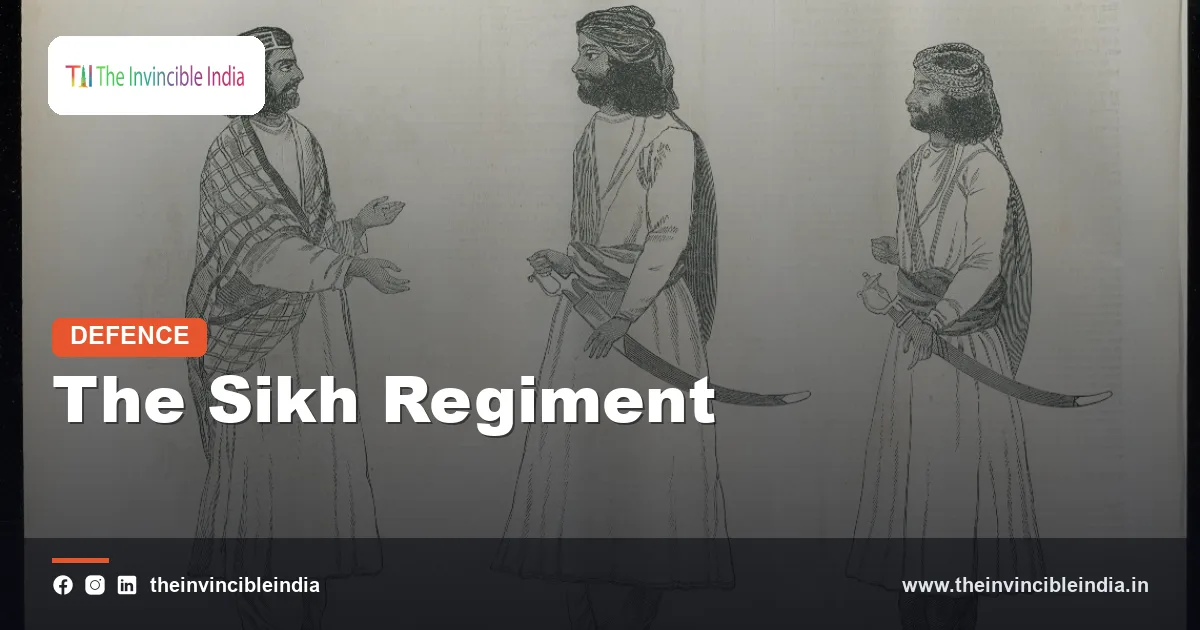
The Sikh Regiment is one of the most decorated infantry regiments of the Indian Army, raised in 1846 and remembered above all for the 1897 Battle of Saragarhi, in which 21 of its soldiers fought to the last against overwhelming odds. Its soldiers are drawn from the Sikh community and go into battle to the war cry “Jo Bole So Nihal, Sat Sri Akal”.
From the North-West Frontier of the nineteenth century to the First and Second World Wars and the wars fought since 1947, the Sikh Regiment has built a record of gallantry that is studied in military academies and honoured in gurdwaras and memorials across Punjab. This explainer covers the history, battle honours, traditions and recruitment of the Sikh Regiment, using only well-documented public facts.
Quick Facts
| Item | Sikh Regiment of the Indian Army |
|---|---|
| Origin | First battalion raised on 1 August 1846 by the East India Company as the Ferozepore Regiment of Sikhs |
| Name history | Merged with other Sikh battalions in 1922 as the 11th Sikh Regiment; the numeral was dropped after Independence |
| Type | Infantry regiment of the Indian Army (single-class regiment) |
| War cry | “Jo Bole So Nihal, Sat Sri Akal” |
| Motto | “Nische Kar Apni Jeet Karon” (with determination, I shall be victorious) |
| Regimental Centre | Ramgarh Cantonment, Jharkhand (earlier located at Meerut) |
| Most famous action | Battle of Saragarhi, 12 September 1897 (36th Sikhs, 21 soldiers) |
| Param Vir Chakra recipients | Lance Naik Karam Singh (1948) and Subedar Joginder Singh (1962) |
Key Takeaways
- The Sikh Regiment of the Indian Army traces its origin to 1 August 1846, when the first battalion was raised as the Ferozepore Regiment of Sikhs.
- The Battle of Saragarhi, fought on 12 September 1897 on the North-West Frontier, saw 21 soldiers of the 36th Sikhs, now the 4th Battalion of the Sikh Regiment, hold a signalling post to the death.
- The Sikh Regiment’s war cry is “Jo Bole So Nihal, Sat Sri Akal”, a Sikh call of victory and faith, and its motto is “Nische Kar Apni Jeet Karon”.
- Two soldiers of the Sikh Regiment, Lance Naik Karam Singh and Subedar Joginder Singh, have been awarded India’s highest gallantry honour, the Param Vir Chakra.
- The 1st Battalion of the Sikh Regiment was the first unit airlifted to Srinagar on 27 October 1947 to defend Jammu and Kashmir.
- The Sikh Regiment Centre is at Ramgarh Cantonment in Jharkhand, where recruits are trained and the regimental traditions are preserved.
What is the Sikh Regiment?
The Sikh Regiment is an infantry regiment of the Indian Army that recruits Sikhs and is known for combining the martial traditions of the Khalsa with modern military professionalism. It is a “single-class” regiment, meaning that its fighting battalions are traditionally manned by soldiers of one community, while its officers are commissioned from across the Army.
The regiment is made up of a number of regular battalions, supported by the Regimental Centre, which handles recruit training, records and welfare. Its battalions have served in plains, deserts, mountains and jungles, and in counter-insurgency, conventional war and international peacekeeping.
The Sikh Regiment should not be confused with the Sikh Light Infantry. The Sikh Light Infantry is a separate regiment, raised in 1941 from Mazhabi and Ramdasia Sikhs, with its own centre at Fatehgarh in Uttar Pradesh and its own traditions. Both regiments serve the Indian Army, but they have different lineages and different histories.
When and how was the Sikh Regiment raised?
The Sikh Regiment was raised on 1 August 1846, when the East India Company formed the Ferozepore Regiment of Sikhs, soon after the First Anglo-Sikh War. The new unit recruited Sikh soldiers from Punjab, many of whom had earlier fought in the army of the Sikh Empire, and it became the 14th Ferozepore Sikhs in the Bengal Army.
Over the next decades, further Sikh battalions were added. The Ludhiana Sikhs were raised in 1846 and Rattray’s Sikhs in 1856. Sikh battalions served in the campaigns of 1857 and in the frontier expeditions that followed, and the soldiers earned a reputation for discipline and steadiness under fire.
After the First World War, the British Indian Army was reorganised into larger regiments. In 1922 the Sikh battalions were grouped into the 11th Sikh Regiment. After Independence in 1947 the numeral was dropped, and the regiment became simply the Sikh Regiment of the Indian Army.
Lineage at a glance
- 1846: Ferozepore Regiment of Sikhs raised, later numbered the 14th Sikhs.
- 1846 and 1856: Ludhiana Sikhs and Rattray’s Sikhs raised.
- 1887: The 36th Sikhs raised, the battalion that fought at Saragarhi.
- 1922: Consolidated as the 11th Sikh Regiment.
- 1947 onwards: The Sikh Regiment of the Indian Army.
What happened at the Battle of Saragarhi?
The Battle of Saragarhi was fought on 12 September 1897, when 21 soldiers of the 36th Sikhs held a small signalling post on the Samana Ridge against a massive assault by Afridi and Orakzai tribesmen. The post at Saragarhi connected two forts, Fort Lockhart and Fort Gulistan, by heliograph, and its loss would have cut communication between the two garrisons.
The detachment was commanded by Havildar Ishar Singh. Estimates of the attacking force run from several thousand to around ten thousand tribesmen, who surrounded the post and attacked it in waves. The garrison refused to abandon its position, and the signaller, Gurmukh Singh, continued to send messages to Fort Lockhart by heliograph until the end of the fight.
All 21 defenders were killed, but the delay they imposed on the attackers gave the garrisons of the two forts time to prepare. Fort Gulistan was relieved within days. Each of the 21 soldiers was posthumously awarded the Indian Order of Merit, which was then the highest gallantry award available to Indian soldiers of the British Indian Army.
Why Saragarhi still matters
- It is a textbook example of a last stand in which a small unit fulfilled its mission of keeping communications open.
- It is commemorated on 12 September every year as Saragarhi Day, and the Sikh Regiment treats it as its principal battle honour day.
- Memorial gurdwaras dedicated to the Saragarhi soldiers stand at Ferozepur and Amritsar in Punjab.
- The battle is regularly cited in military history courses and has inspired books, documentaries and films in India and abroad.
What is the war cry of the Sikh Regiment and what does it mean?
The war cry of the Sikh Regiment is “Jo Bole So Nihal, Sat Sri Akal”, which can be translated as “Whoever utters this shall be fulfilled; truth is the timeless one”. The call is a traditional Sikh affirmation, with the first half raised by a leader and the second half answered by the whole body of soldiers.
The war cry draws on the language of the Khalsa, the community of initiated Sikhs created by Guru Gobind Singh in 1699. It is used on parade, in the field and at regimental ceremonies, and it expresses the faith that gives the regiment its identity.
The motto of the regiment, “Nische Kar Apni Jeet Karon”, is usually translated as “With determination, I shall win”. The regimental insignia features a lion encircled by a chakra, the quoit-shaped steel weapon associated with Sikh warriors, and the lion reflects the “Singh” name carried by Sikh men.
What are the major battle honours of the Sikh Regiment?
The Sikh Regiment carries a large number of battle honours earned in the nineteenth-century frontier campaigns, in both World Wars and in every major conflict since Independence. The regiment is routinely described as among the most decorated in the Indian Army, although exact tallies of awards vary between sources and are best treated as approximate.
In the First World War, Sikh battalions fought on the Western Front, including at Neuve Chapelle and Ypres, and in Gallipoli, Mesopotamia and Egypt and Palestine. In the Second World War, battalions of the 11th Sikh Regiment served in the East African campaign, North Africa, Italy, Malaya and Burma. Naik Nand Singh of the 11th Sikh Regiment won the Victoria Cross in Burma in 1944 for storming enemy positions in the face of heavy fire.
After 1947, the regiment fought in the 1947-48 war in Jammu and Kashmir, the 1962 war with China, the 1965 and 1971 wars with Pakistan, and later operations including the Kargil conflict of 1999. The regiment has also contributed battalions to United Nations peacekeeping missions.
Selected milestones
| Year | Event | Significance for the Sikh Regiment |
|---|---|---|
| 1846 | Ferozepore Regiment of Sikhs raised | Origin of the regiment |
| 1897 | Battle of Saragarhi | 21 soldiers of the 36th Sikhs fight to the last |
| 1914-1918 | First World War | Service on the Western Front, Gallipoli, Mesopotamia and Palestine |
| 1922 | Reorganisation | Battalions merged into the 11th Sikh Regiment |
| 1939-1945 | Second World War | Service in Africa, Italy and Burma; Victoria Cross to Naik Nand Singh |
| 1947 | Defence of Srinagar | 1st Battalion airlifted to Srinagar on 27 October |
| 1948 | Tithwal sector | Lance Naik Karam Singh wins the Param Vir Chakra |
| 1962 | Bum La, Tawang sector | Subedar Joginder Singh wins the Param Vir Chakra |
Who are the Param Vir Chakra winners of the Sikh Regiment?
Two soldiers of the Sikh Regiment have won the Param Vir Chakra, India’s highest wartime gallantry award: Lance Naik Karam Singh in 1948 and Subedar Joginder Singh in 1962. Both served in the 1st Battalion of the Sikh Regiment.
Lance Naik Karam Singh was decorated for his actions in the Tithwal sector of Jammu and Kashmir in October 1948, where he held a vital post under repeated enemy counter-attacks and personally led counter-attacks even though wounded. He is remembered as one of the first group of recipients of the Param Vir Chakra and survived the war, later retiring as an honorary captain.
Subedar Joginder Singh was decorated for his conduct at Bum La in the Tawang sector of Arunachal Pradesh on 23 October 1962, during the war with China. His platoon, heavily outnumbered, resisted successive waves of attacks, and he was awarded the Param Vir Chakra posthumously after being captured and dying in custody.
In addition, the regiment has earned numerous Maha Vir Chakras, Vir Chakras, Ashoka Chakras and Sena Medals. Lieutenant Colonel Dewan Ranjit Rai, who commanded the 1st Battalion on its airlift to Srinagar in 1947, was awarded the Maha Vir Chakra posthumously.
What role did the Sikh Regiment play in 1947 in Jammu and Kashmir?
The 1st Battalion of the Sikh Regiment became the first unit airlifted into the Kashmir Valley, landing at Srinagar airfield on 27 October 1947 after the state acceded to India. Its arrival, by air and at short notice, helped secure the airfield and the capital while tribal raiders and irregulars were advancing towards the city.
The battalion’s commanding officer, Lieutenant Colonel Dewan Ranjit Rai, was killed in action near Baramulla in the early fighting and was awarded the Maha Vir Chakra posthumously. The Sikh Regiment’s battalions continued to serve in Jammu and Kashmir through 1948, including at Tithwal, where Karam Singh earned his Param Vir Chakra.
The airlift is regarded as a turning point in the early days of the war because it allowed Indian forces to hold Srinagar and push back the advance. The Sikh Regiment remembers this operation as one of its foundational post-Independence achievements.
How does the Sikh Regiment recruit and train its soldiers?
The Sikh Regiment traditionally recruits its soldiers from the Sikh community, mainly from Punjab and neighbouring states, and trains them at the Sikh Regimental Centre in Ramgarh Cantonment, Jharkhand. Recruits go through basic military training, weapons handling, physical conditioning and instruction in regimental history and customs.
Recruitment policy for the Indian Army has been updated from time to time, so the exact rules in force today should be checked against official notifications. What does not change is the connection between the regiment and Sikh tradition, visible in the war cry, the observance of Saragarhi Day and the regimental gurdwara at the Centre.
The Regimental Centre also maintains the museum, the records and the welfare network for serving soldiers, veterans and families. Like other regiments, the Sikh Regiment depends on the strong bond between serving units, the Centre and the villages from where recruits come.
What traditions and symbols define the Sikh Regiment?
The traditions of the Sikh Regiment centre on Sikh faith, the memory of Saragarhi and a strong sense of regimental family. The regiment observes 1 August as its Raising Day, and 12 September as Saragarhi Day, when memorial parades and prayers are held.
- War cry: “Jo Bole So Nihal, Sat Sri Akal”, shouted on parade and in battle.
- Insignia: a lion within a chakra, the traditional circular steel quoit of the Sikh warrior.
- Motto: “Nische Kar Apni Jeet Karon”, meaning to win with determination.
- Regimental gurdwara: a place of worship and ceremony at the Centre and in unit lines.
- Saragarhi memorials: gurdwaras at Ferozepur and Amritsar and monuments inside regimental premises.
- Turban: the distinctive Sikh turban is part of the uniform and dress of the regiment’s soldiers.
The regiment’s pipe and brass bands, its drill and its museum collections all keep the memory of past campaigns alive for new recruits and visitors.
How is the Sikh Regiment different from other Sikh units?
The Sikh Regiment differs from other Sikh units mainly in its lineage and composition: it descends from the 11th Sikh Regiment and recruits Sikhs for its infantry battalions, while the Sikh Light Infantry was raised separately in 1941 and the Punjab Regiment is a different multi-class regiment. Sikh soldiers also serve in many other arms and services of the Army, including armoured, artillery and engineer units.
Because the names are similar, people often confuse the Sikh Regiment, the Sikh Light Infantry and the Punjab Regiment. Each has its own Regimental Centre, battle honours, war cry and history.
| Regiment | Raised | Centre | Notes |
|---|---|---|---|
| Sikh Regiment | 1846 | Ramgarh, Jharkhand | Descends from the 11th Sikh Regiment; Saragarhi lineage |
| Sikh Light Infantry | 1941 | Fatehgarh, Uttar Pradesh | Recruits Mazhabi and Ramdasia Sikhs |
| Punjab Regiment | Eighteenth-century origins | Ramgarh, Jharkhand | Multi-class regiment with Sikhs, Dogras and Punjabi Muslims historically |
Why does the Sikh Regiment matter in Indian military history?
The Sikh Regiment matters because it combines one of the longest unbroken records of service with some of the best-known acts of courage in Indian military history, from Saragarhi in 1897 to the defence of Srinagar in 1947 and Bum La in 1962. Its story is often used to explain the ethos of the Indian infantry: loyalty to the unit, personal courage and a willingness to hold a position at any cost.
The regiment also shows how historic recruitment traditions have shaped the modern Army. Its battle honours, war cry and customs are a living record of how soldiers of Punjab have served on India’s frontiers over more than 175 years.
Bottom Line
The Sikh Regiment is one of the Indian Army’s most decorated infantry regiments, shaped by the 1897 stand at Saragarhi, service in two World Wars and a distinguished record in every war since 1947. Its war cry, “Jo Bole So Nihal, Sat Sri Akal”, and its two Param Vir Chakra winners keep that heritage alive. Last reviewed: 15 October 2026.
Frequently Asked Questions
What is the Sikh Regiment of the Indian Army?
The Sikh Regiment is an infantry regiment of the Indian Army that recruits Sikhs and traces its origin to 1 August 1846. It descends from the 11th Sikh Regiment of the British Indian Army and has its Regimental Centre at Ramgarh Cantonment in Jharkhand. It is among the most decorated regiments in the Army.
What is the war cry of the Sikh Regiment?
The war cry of the Sikh Regiment is “Jo Bole So Nihal, Sat Sri Akal”. It is a traditional Sikh affirmation of faith and victory, answered by soldiers in unison. The regiment’s motto is “Nische Kar Apni Jeet Karon”, meaning to win with determination.
What was the Battle of Saragarhi?
The Battle of Saragarhi was a battle fought on 12 September 1897 in which 21 soldiers of the 36th Sikhs held a signalling post on the Samana Ridge against a very large force of Afridi and Orakzai tribesmen. All 21 defenders were killed, and each was posthumously awarded the Indian Order of Merit. The sacrifice gave nearby forts time to prepare, and the battle is commemorated every year as Saragarhi Day.
How many Param Vir Chakras has the Sikh Regiment won?
The Sikh Regiment has won two Param Vir Chakras. Lance Naik Karam Singh received the award for the Tithwal sector in 1948, and Subedar Joginder Singh received it for Bum La in 1962. Both soldiers belonged to the 1st Battalion.
Is the Sikh Regiment the same as the Sikh Light Infantry?
No, the Sikh Regiment and the Sikh Light Infantry are two separate regiments of the Indian Army. The Sikh Regiment was raised in 1846 and trains at Ramgarh, while the Sikh Light Infantry was raised in 1941 from Mazhabi and Ramdasia Sikhs and has its centre at Fatehgarh. Each has its own battle honours and traditions.
Where is the Sikh Regiment Centre located?
The Sikh Regimental Centre is located at Ramgarh Cantonment in Jharkhand. It was earlier at Meerut in Uttar Pradesh. The Centre trains recruits, keeps regimental records and maintains the museum and traditions of the regiment.
{“@context”:”https://schema.org”,”@graph”:[{“@type”:”FAQPage”,”mainEntity”:[{“@type”:”Question”,”name”:”What is the Sikh Regiment of the Indian Army?”,”acceptedAnswer”:{“@type”:”Answer”,”text”:”The Sikh Regiment is an infantry regiment of the Indian Army that recruits Sikhs and traces its origin to 1 August 1846. It descends from the 11th Sikh Regiment of the British Indian Army and has its Regimental Centre at Ramgarh Cantonment in Jharkhand. It is among the most decorated regiments in the Army.”}},{“@type”:”Question”,”name”:”What is the war cry of the Sikh Regiment?”,”acceptedAnswer”:{“@type”:”Answer”,”text”:”The war cry of the Sikh Regiment is “Jo Bole So Nihal, Sat Sri Akal”. It is a traditional Sikh affirmation of faith and victory, answered by soldiers in unison. The regiment’s motto is “Nische Kar Apni Jeet Karon”, meaning to win with determination.”}},{“@type”:”Question”,”name”:”What was the Battle of Saragarhi?”,”acceptedAnswer”:{“@type”:”Answer”,”text”:”The Battle of Saragarhi was a battle fought on 12 September 1897 in which 21 soldiers of the 36th Sikhs held a signalling post on the Samana Ridge against a very large force of Afridi and Orakzai tribesmen. All 21 defenders were killed, and each was posthumously awarded the Indian Order of Merit. The sacrifice gave nearby forts time to prepare, and the battle is commemorated every year as Saragarhi Day.”}},{“@type”:”Question”,”name”:”How many Param Vir Chakras has the Sikh Regiment won?”,”acceptedAnswer”:{“@type”:”Answer”,”text”:”The Sikh Regiment has won two Param Vir Chakras. Lance Naik Karam Singh received the award for the Tithwal sector in 1948, and Subedar Joginder Singh received it for Bum La in 1962. Both soldiers belonged to the 1st Battalion.”}},{“@type”:”Question”,”name”:”Is the Sikh Regiment the same as the Sikh Light Infantry?”,”acceptedAnswer”:{“@type”:”Answer”,”text”:”No, the Sikh Regiment and the Sikh Light Infantry are two separate regiments of the Indian Army. The Sikh Regiment was raised in 1846 and trains at Ramgarh, while the Sikh Light Infantry was raised in 1941 from Mazhabi and Ramdasia Sikhs and has its centre at Fatehgarh. Each has its own battle honours and traditions.”}},{“@type”:”Question”,”name”:”Where is the Sikh Regiment Centre located?”,”acceptedAnswer”:{“@type”:”Answer”,”text”:”The Sikh Regimental Centre is located at Ramgarh Cantonment in Jharkhand. It was earlier at Meerut in Uttar Pradesh. The Centre trains recruits, keeps regimental records and maintains the museum and traditions of the regiment.”}}]}]}


