

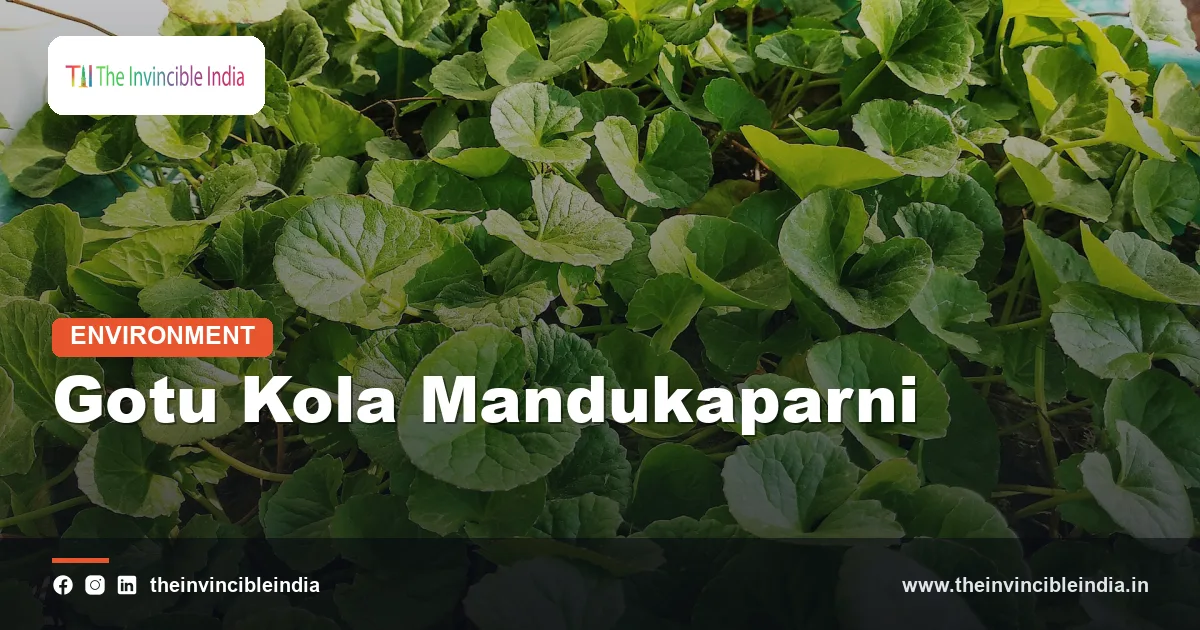
Gotu kola, known in Sanskrit and Hindi as mandukaparni, is a small, creeping herb of damp ground (Centella asiatica) that grows wild across India and has long been used in Ayurveda as a traditional tonic for the mind and the skin. It is a low, carpet-forming plant of the carrot family, easy to overlook beside a drain, a paddy bund or a shaded garden wall, yet it features in classical Ayurvedic texts, in village kitchens and in modern herbal products alike.
This explainer covers what gotu kola looks like, where it grows, why it is so often confused with brahmi, how it is traditionally used in food and home remedies, what its main plant compounds are, and what a careful reader should keep in mind. The medicinal uses described here are traditional and are not proven medical claims.
| Attribute | Details |
|---|---|
| Common names | Gotu kola, mandukaparni, Indian pennywort, Asiatic pennywort |
| Botanical name | Centella asiatica (L.) Urban |
| Family | Apiaceae (the carrot or umbellifer family) |
| Plant type | Perennial, creeping herb that spreads by runners (stolons) |
| Part used | Whole plant, especially the fresh or dried leaves and stems |
| Where found in India | Moist and shaded places, paddy fields, stream banks and wet lawns, from the plains to the lower hills |
| Key plant compounds | Triterpenoid saponins such as asiaticoside and madecassoside, plus asiatic acid and madecassic acid |
| Traditional Ayurvedic role | Medhya (a plant traditionally linked with mental clarity) and a skin and wound herb |
| Notable fact | Often confused with brahmi (Bacopa monnieri), a different plant |
Key Takeaways
- Gotu kola (Centella asiatica) is a creeping herb of the carrot family, called mandukaparni in Sanskrit, and it is a different plant from Bacopa monnieri, which is also sold as brahmi.
- Gotu kola grows wild across India in moist, shaded ground, and it spreads by runners that root at the nodes.
- The leaves of gotu kola are round to kidney-shaped with scalloped edges, and the Sanskrit name mandukaparni means “frog leaf”.
- Ayurveda classes gotu kola among the medhya rasayana plants, which are traditionally used to support memory, learning and the nervous system.
- The characteristic compounds of gotu kola are triterpenoid saponins, including asiaticoside and madecassoside, which are the main focus of laboratory research on the plant.
- Gotu kola is a traditional herb and not a proven medicine, so anyone who is pregnant, breastfeeding, taking regular medication or living with a liver condition should consult a qualified practitioner before using it.
What is gotu kola?
Gotu kola is a perennial herb of the genus Centella, whose most widespread species is Centella asiatica, and it belongs to the family Apiaceae. The family is better known for coriander, cumin, fennel, carrot and celery, which explains why the tiny flowers of gotu kola sit in small umbel-like clusters, a family trait.
The plant has a long history in Indian and Sri Lankan traditions. In India it is called mandukaparni in Sanskrit, and in Hindi it is commonly sold under the names brahmi or mandukparni, which is the root of much confusion. The name gotu kola itself comes from Sinhala and became the standard English trade name because the herb is so widely eaten in Sri Lanka.
In English the plant is also called Indian pennywort or Asiatic pennywort, a reference to the round, coin-like leaves. The term pennywort is shared by several unrelated small-leaved plants, so the botanical name Centella asiatica is the safest way to identify the species.
What does the gotu kola plant look like?
The gotu kola plant is a small, trailing herb with long, slender stems that creep along the ground and send up leaves on upright stalks. Each leaf is typically round to kidney-shaped, with a notch where the stalk joins, and the margin is scalloped or lightly toothed. The surface is smooth, bright to deep green and marked with radiating veins.
The creeping stems are called stolons or runners. At each node, the point where a leaf stalk emerges, the runner can put down fine roots, and this is how a single plant forms a dense mat. Cut a runner and each rooted piece can grow into a new plant, which is why gotu kola is easy to propagate and can spread quickly in a damp garden.
The flowers are small, rounded or slightly oval, and range from white to pink to a dark reddish-purple. They are borne in tiny clusters close to the ground, often half hidden by the leaves. The fruit is a small, ridged, flattened structure that splits into two parts, and it is not a feature most casual observers ever notice.
Features that help identify it
- Creeping stems that root at the nodes and form a low carpet
- Round or kidney-shaped leaves with a notch at the base and scalloped edges
- Leaves held singly or in small groups on long, slender stalks
- Small flower clusters sitting very close to the ground
- A fresh, slightly bitter, grassy smell when the leaves are crushed
Where does gotu kola grow in India?
Gotu kola grows wild across India wherever the ground stays damp, including the plains, river valleys, coastal regions and the lower slopes of hills. It prefers partial shade, rich moist soil and a humid climate, and it is a regular sight along irrigation channels, ponds, paddy field margins, shaded lawns and the base of garden walls.
Beyond India, the plant is found across tropical and subtropical Asia, parts of Africa, Australia and the Pacific, and it has been carried around the world as a food, medicine and ground cover. Its tolerance for moisture and shade makes it a weed in some places and a valued kitchen herb in others.
The herb does best in the monsoon, when new growth is lush and the leaves are large and tender. In dry weather the plant shrinks back, and in colder regions the leaves may die back in winter, with the plant regrowing from the runners when warm, wet weather returns. Because the plant is wild-harvested widely, quality can vary with where it was collected, which is an important point for anyone buying dried or powdered material.
Is gotu kola the same as brahmi?
No, gotu kola is not the same plant as brahmi in the strict botanical sense, although the two names are used for each other in many parts of India. Gotu kola is Centella asiatica, while the plant most Ayurvedic authorities call true brahmi is Bacopa monnieri, a different species from a different plant family.
The confusion has historical roots. In classical Sanskrit literature the names brahmi and mandukaparni were used for plants with overlapping reputations, and over centuries regional traditions applied the name brahmi to whichever plant was local and similar in use. In North India, the name brahmi is often applied to Centella asiatica, while in many southern and eastern traditions it refers to Bacopa monnieri.
| Feature | Gotu kola (mandukaparni) | Bacopa (brahmi) |
|---|---|---|
| Botanical name | Centella asiatica | Bacopa monnieri |
| Family | Apiaceae | Plantaginaceae |
| Leaf shape | Round to kidney-shaped, long-stalked, scalloped | Small, oblong to spoon-shaped, fleshy, stalkless, arranged in pairs |
| Growth habit | Creeping on the ground, with roots at the nodes | Creeping and succulent, often near water |
| Main compounds | Asiaticoside, madecassoside, asiatic acid | Bacosides |
| Typical sellers’ label | Mandukaparni, brahmi (regional), gotu kola | Brahmi |
Because the two plants contain entirely different active compounds, a product that says only “brahmi” on the label may contain either one. Checking for the botanical name on the packaging is the simplest way to know which plant is inside.
What does mandukaparni mean in Ayurveda?
Mandukaparni is the Sanskrit name for gotu kola, and it literally means “frog leaf”, from manduka (frog) and parni (leaf), a reference to the rounded leaf that resembles a frog’s webbed foot and to the damp places where frogs live. The name appears in classical Ayurvedic literature and is still used in the Ayurvedic pharmacopoeia of India.
In classical Ayurvedic thinking, mandukaparni is placed among the medhya rasayana, a group of plants traditionally associated with the intellect, memory and the nervous system. The classical texts describe the fresh juice of the plant as one such preparation. Within the Ayurvedic framework, the herb is described as bitter in taste and cooling in nature, and it is considered to balance the pitta dosha in particular.
These are descriptions from a traditional system of medicine with its own concepts, not conclusions from modern clinical trials. They are useful for understanding why the plant has the reputation it does, but they should not be read as proof that the herb treats any disease.
How is gotu kola traditionally used?
Gotu kola is traditionally used in India as a leafy food, a fresh juice, a dried powder and a skin application. The same plant plays different roles in different regions, from a cooked green on the dinner table to a home remedy for small cuts.
As food
In Bengal, the leaves are known as thankuni and are eaten as thankuni pata, often ground into a paste with green chilli and mustard oil and served with rice, or cooked with lentils. In Sri Lanka, finely chopped leaves are mixed with coconut and lime in a salad called gotu kola sambol. In several southern states, the leaves are used in chutneys and light stir-fries, and the plant is valued as an everyday bitter green.
As a juice or infusion
The fresh leaves are pressed for juice, steeped as a tea or blended into drinks. In village households, a small quantity of the fresh juice has traditionally been given to children and students, in line with the plant’s medhya reputation. These are folk practices and the quantities used are modest.
As powder and herbal preparations
Dried and powdered mandukaparni is sold as a single-herb powder and is included in multi-herb Ayurvedic formulations, tablets and medicated ghee preparations. The traditional use of ghee as a carrier is linked to the idea that fat-soluble preparations reach the nervous system more effectively, which is a concept of the Ayurvedic system rather than a laboratory-established fact.
On the skin
Fresh leaf paste has traditionally been applied to minor cuts, scrapes, burns and skin blemishes. In modern cosmetics, extracts of Centella asiatica appear in creams and serums, often labelled “cica” or “centella”, because the plant’s saponins have been studied for their effect on skin.
What are the active compounds in gotu kola?
The main active compounds in gotu kola are triterpenoid saponins and related acids, chiefly asiaticoside, madecassoside, asiatic acid and madecassic acid, which together are often called centelloids. These compounds are concentrated in the leaves and are what most laboratory studies on Centella asiatica examine.
Besides the centelloids, the plant contains flavonoids, tannins, phytosterols, volatile oils, amino acids and several vitamins and minerals typical of leafy greens. The exact balance of compounds changes with the plant’s origin, the season of harvest and the way it is dried and processed, which is one reason why different commercial products can differ widely in strength.
Laboratory and small clinical studies have explored the plant in areas such as wound healing, skin health, circulation in the veins of the legs and cognitive function. Results so far are mixed and the quality of the studies varies, so researchers generally describe the evidence as promising but incomplete. A traditional herb that has a promising laboratory profile is still not the same as an approved treatment.
What are the traditional benefits attributed to gotu kola?
Traditional Ayurvedic and folk sources attribute a range of benefits to gotu kola, mainly for the mind, the skin and the digestive and urinary systems. The list below summarises what is commonly claimed, and it should be read as traditional belief, not as medical fact.
| Area | Traditional claim | Status of the claim |
|---|---|---|
| Memory and learning | Supports memory, concentration and calm in students | Traditional; limited modern research |
| Skin and wounds | Used on minor cuts, burns and scars | Traditional; some laboratory interest in the saponins |
| Stress and sleep | Used as a calming nervine herb | Traditional; evidence limited |
| Veins and circulation | Used for heavy, tired legs | Studied in small trials; inconclusive overall |
| Digestion | Used as a bitter to stimulate appetite | Traditional |
| Fever and urinary complaints | Used in folk remedies | Traditional |
A reader looking for reliable health guidance should treat these as starting points for a conversation with a qualified Ayurvedic physician or doctor, not as a prescription.
Is gotu kola safe to use?
Gotu kola is generally eaten without problems in the amounts used as a leafy food, but concentrated extracts and long-term supplement use call for caution. The herb is traditional and is not a proven medicine, so it is sensible to consult a qualified Ayurvedic practitioner or doctor before using it in medicinal amounts.
Points commonly raised by herbal safety references include the following.
- Pregnancy and breastfeeding: avoid medicinal use unless a qualified practitioner advises otherwise, as there is not enough reliable safety information.
- Liver conditions: rare reports of liver problems have been linked to products containing the herb, so people with liver disease or those taking liver-affecting medicines should be especially careful.
- Sedation: the plant is traditionally calming, and it may add to the effect of sedatives or sleep medicines.
- Skin reactions: some people develop redness or itching from topical use, so a small patch test is wise.
- Surgery: because the herb may interact with anaesthesia and sedatives, it is usually advised to stop use before planned surgery.
- Source quality: wild plants growing in polluted drains or waterlogged ground can take up contaminants, so only clean, known sources should be eaten.
As with any herbal product, a consult-a-professional approach is the responsible one. This article is general information and is not a substitute for medical advice.
How can gotu kola be grown at home?
Gotu kola can be grown at home easily in a pot, tray or shaded garden bed, using a runner cut from an existing plant. It needs moist, fertile soil, partial shade and regular watering, and it thrives in the humid conditions of the monsoon.
- Choose a wide, shallow container or a shaded corner of the garden, since the plant spreads sideways rather than growing tall.
- Use loose, rich soil mixed with compost, and keep it damp but not stagnant.
- Plant a rooted runner or a piece of stem with at least one node, and press it lightly onto the soil.
- Provide morning sun or bright shade, since strong afternoon sun in summer scorches the leaves.
- Harvest by cutting outer leaves and stems regularly, which encourages denser growth.
- Keep it contained, as the runners can spread into neighbouring beds.
Home-grown gotu kola has one clear advantage: the grower knows exactly where the water and soil came from. Leaves from a clean pot are a safer choice than leaves picked from a roadside ditch.
Why does gotu kola matter?
Gotu kola matters because it shows how a single, humble wild plant can connect a country’s food, folk medicine, classical texts and modern cosmetic industry. It is an everyday ground herb, yet it features in recipes in Bengal, in Ayurvedic formulations in Kerala and in skincare labels sold worldwide.
It also illustrates a recurring theme in India’s plant traditions: names are shared, local and sometimes contradictory. Understanding that mandukaparni, brahmi and gotu kola do not always mean the same thing helps consumers read labels more carefully and helps students of botany identify the right species.
Finally, gotu kola is a reminder that wild habitats such as wetland edges, shaded streams and unpaved ground support plants with real cultural value. When those habitats are drained or paved, local plant knowledge can disappear along with the plants.
Bottom Line
Gotu kola, or mandukaparni, is a creeping, kidney-leaved herb of damp ground that Indian tradition values as a mental and skin tonic and as an edible bitter green. It is not the same as Bacopa-based brahmi, its benefits are traditional rather than proven, and anyone planning to use it in medicinal amounts should speak to a qualified professional first.
Frequently Asked Questions
What is gotu kola used for in India?
Gotu kola is used in India as an edible leafy green, a fresh juice and a traditional Ayurvedic herb for the mind and skin. In Bengal the leaves are eaten as thankuni, while Ayurveda lists the plant as mandukaparni among its medhya rasayana herbs. These uses are traditional, not proven medical treatments.
Is gotu kola the same as brahmi?
No, gotu kola is Centella asiatica, whereas the plant usually called true brahmi is Bacopa monnieri. The two are unrelated species with different active compounds, but regional traditions in India often use the name brahmi for either one. Reading the botanical name on a product label avoids the confusion.
What does mandukaparni mean?
Mandukaparni is the Sanskrit name for gotu kola and means “frog leaf”. It comes from the words manduka, meaning frog, and parni, meaning leaf, a reference to the round leaf shape and the damp habitat of the plant. The name appears in classical Ayurvedic literature.
Where does gotu kola grow in India?
Gotu kola grows across India in moist, shaded places such as paddy field margins, stream banks, pond edges and damp lawns. It is found from the plains to the lower hills and grows best during the monsoon. The plant spreads by creeping runners that root at the nodes.
Is gotu kola safe to take every day?
Eating gotu kola leaves in small food amounts is common, but daily use of concentrated extracts should be discussed with a qualified professional first. Pregnant or breastfeeding women, people with liver conditions and those taking sedatives or regular medicines should be especially careful. Rare reports of liver problems and skin reactions have been linked to some products.
Can gotu kola be grown at home?
Yes, gotu kola grows easily at home in a shallow pot or shaded bed filled with moist, fertile soil. A rooted runner or a stem piece with a node is enough to start a new plant. It needs regular watering and partial shade, and it should be kept contained because it spreads quickly.
{“@context”:”https://schema.org”,”@graph”:[{“@type”:”FAQPage”,”mainEntity”:[{“@type”:”Question”,”name”:”What is gotu kola used for in India?”,”acceptedAnswer”:{“@type”:”Answer”,”text”:”Gotu kola is used in India as an edible leafy green, a fresh juice and a traditional Ayurvedic herb for the mind and skin. In Bengal the leaves are eaten as thankuni, while Ayurveda lists the plant as mandukaparni among its medhya rasayana herbs. These uses are traditional, not proven medical treatments.”}},{“@type”:”Question”,”name”:”Is gotu kola the same as brahmi?”,”acceptedAnswer”:{“@type”:”Answer”,”text”:”No, gotu kola is Centella asiatica, whereas the plant usually called true brahmi is Bacopa monnieri. The two are unrelated species with different active compounds, but regional traditions in India often use the name brahmi for either one. Reading the botanical name on a product label avoids the confusion.”}},{“@type”:”Question”,”name”:”What does mandukaparni mean?”,”acceptedAnswer”:{“@type”:”Answer”,”text”:”Mandukaparni is the Sanskrit name for gotu kola and means “frog leaf”. It comes from the words manduka, meaning frog, and parni, meaning leaf, a reference to the round leaf shape and the damp habitat of the plant. The name appears in classical Ayurvedic literature.”}},{“@type”:”Question”,”name”:”Where does gotu kola grow in India?”,”acceptedAnswer”:{“@type”:”Answer”,”text”:”Gotu kola grows across India in moist, shaded places such as paddy field margins, stream banks, pond edges and damp lawns. It is found from the plains to the lower hills and grows best during the monsoon. The plant spreads by creeping runners that root at the nodes.”}},{“@type”:”Question”,”name”:”Is gotu kola safe to take every day?”,”acceptedAnswer”:{“@type”:”Answer”,”text”:”Eating gotu kola leaves in small food amounts is common, but daily use of concentrated extracts should be discussed with a qualified professional first. Pregnant or breastfeeding women, people with liver conditions and those taking sedatives or regular medicines should be especially careful. Rare reports of liver problems and skin reactions have been linked to some products.”}},{“@type”:”Question”,”name”:”Can gotu kola be grown at home?”,”acceptedAnswer”:{“@type”:”Answer”,”text”:”Yes, gotu kola grows easily at home in a shallow pot or shaded bed filled with moist, fertile soil. A rooted runner or a stem piece with a node is enough to start a new plant. It needs regular watering and partial shade, and it should be kept contained because it spreads quickly.”}}]}]}


