

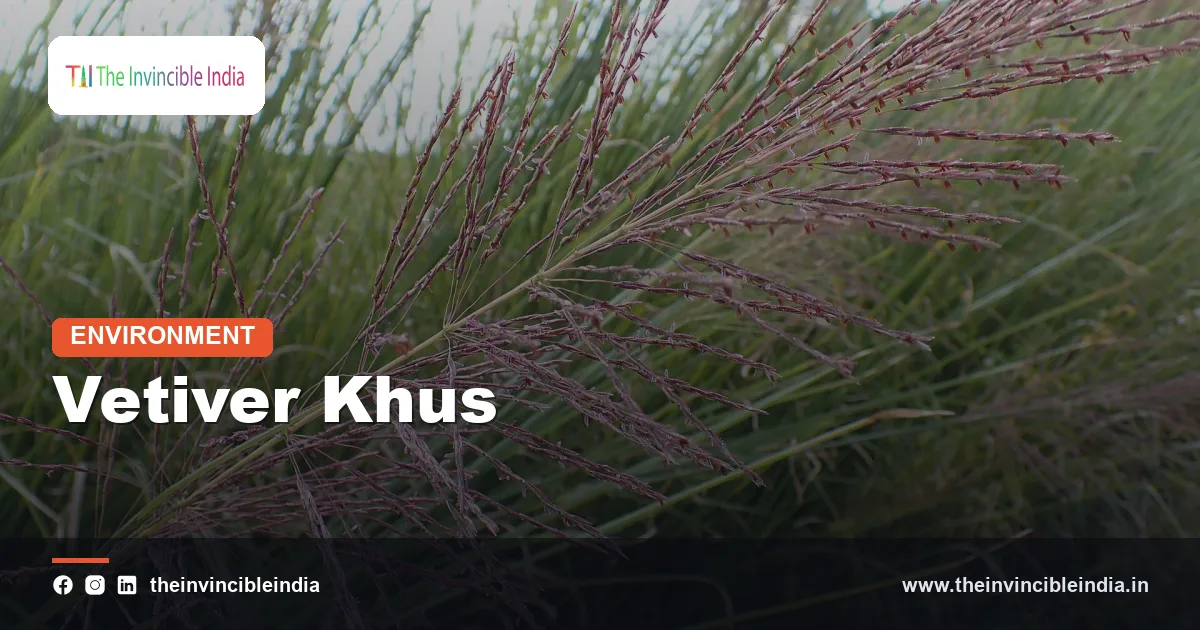
Vetiver is a tall, clump-forming perennial grass, Chrysopogon zizanioides, whose dense, fibrous, sweet-smelling roots are known in India as khus and are used for cooling screens, perfumery, essential oil, sherbets and soil conservation. The plant has deep, vertically growing roots that can reach two to four metres or more into the soil, which makes it unusually effective at holding soil in place. The aromatic oil distilled from the roots is called khus oil, ruh khus or oil of vetiver.
In Indian life, vetiver is best known through the khus tatti, a screen of woven roots that was hung in doorways and sprinkled with water to cool summer air, and through khus syrup, a traditional summer drink. This article explains what vetiver is, how it grows, how it is used and why it is valued in both perfumery and environmental protection.
| Attribute | Detail |
|---|---|
| Scientific name | Chrysopogon zizanioides (formerly Vetiveria zizanioides) |
| Common names | Vetiver, khus, khas, usheer (Arabic and Urdu), ramacham (Tamil and Malayalam), vattiveru (Telugu), usira (Sanskrit) |
| Family | Poaceae (the grass family) |
| Where grown in India | Uttar Pradesh, Rajasthan, Madhya Pradesh, Haryana, Karnataka, Tamil Nadu, Kerala and Andhra Pradesh, with the Kannauj region long known for perfumes |
| Season | Planted at the start of the rains; roots are harvested after about 12 to 18 months |
| Part used | Roots (for oil, screens, sherbet and crafts); leaves for thatch, mulch and handicrafts |
| Uses | Essential oil and attar, cooling screens, summer drinks, soil and water conservation, handicrafts, traditional medicine |
| Notable facts | Sterile, non-invasive clump grass; roots grow downward rather than spreading sideways; oil gets richer with age and is used as a fixative in perfumery |
Key Takeaways
- Vetiver (Chrysopogon zizanioides) is a perennial tropical grass whose aromatic roots are called khus in Hindi and Urdu.
- Vetiver oil, also called khus oil, is obtained by steam distillation of the roots and is used as a fixative and base note in perfumery.
- Vetiver roots grow deep and downward, so the grass is widely planted in hedgerows to prevent soil erosion on slopes and river banks.
- Khus tatti, the root screen soaked in water, cools indoor air in dry summer heat through evaporation.
- Cultivated South Indian vetiver is a sterile, non-seeding type that spreads only by clumps and does not become a weed, unlike some wild, seed-setting forms.
- Khus syrup (sherbet) is a traditional cooling summer drink made with an extract of khus roots, particularly popular in north India.
What is vetiver?
Vetiver is a perennial bunchgrass that grows in dense upright clumps with narrow, stiff leaves and a massive, fibrous root system, and its roots produce a rich, earthy, woody and slightly sweet fragrance. The leaves grow to about one to two metres in height, and the clumps are tightly packed so that a row of plants forms a thick living barrier.
The roots are the most valuable part. They are thin, pale yellow to light brown when fresh, darken with age, and grow almost straight down into the soil rather than spreading sideways. The grass is closely related to sorghum and to the lemongrasses, and it has long been placed in the same grass family, Poaceae, as cereals such as rice and wheat.
What does khus mean and what are its other names?
Khus is the Hindi and Urdu name for the roots of the vetiver grass, and the word is also used for the fragrance, the oil and the cooling screens made from them. The word vetiver itself comes from the Tamil word vettiver, meaning a root that is dug up. In Sanskrit literature the plant appears as usira, and in the Arabic and Persian trade the oil is known as ruh khus.
The many names reflect the plant’s long history of use. In classical Indian texts on medicine and perfumery, usira is mentioned among cooling and aromatic substances, and the plant has been part of South Asian life for a very long time.
Where does vetiver grow in India?
Vetiver grows in India in a wide range of tropical and sub-tropical regions, and the main growing and distilling areas include Uttar Pradesh, Rajasthan, Madhya Pradesh, Haryana, Karnataka, Tamil Nadu and Kerala. Wild and semi-wild stands occur along streams, canal banks and moist ground, especially on the Indo-Gangetic plain.
The plant tolerates a remarkable range of conditions, including waterlogging, drought, poor soils and a wide range of soil acidity or salinity. The Kannauj district in Uttar Pradesh is a long-established centre of the traditional perfume (ittar) industry, where khus attar is produced by the traditional deg-bhapka method of distillation into sandalwood oil. Vetiver oil from India has historically been regarded as one of the major varieties in the world market, though Haiti, Indonesia and Réunion are also important producers.
How is vetiver grown?
Vetiver is grown by planting slips, which are small pieces of the clump with some root and shoot, at the beginning of the rainy season, and the roots are dug up for oil after one to one and a half years. Since the cultivated South Indian types are largely sterile and do not set viable seed, farmers rely on slips, which also prevents the plant from becoming a weed.
- Soil and climate: Deep, loose sandy loam or alluvial soil gives the best roots, but the plant also tolerates heavy and poor soil.
- Planting: Slips are placed in rows with moderate spacing, and the plant establishes quickly with the first rains.
- Care: The grass needs little fertiliser or water once established, and leaves are cut back occasionally.
- Harvest: The whole clump is dug up, the roots are washed and cut from the shoots, and part of the clump can be replanted for the next crop.
Digging the roots is labour-intensive, particularly in compact soil, so the crop suits regions with a ready labour supply. Fresh roots are generally distilled soon after washing, though dried roots are also used for screens and crafts.
How is vetiver oil made and what is it used for?
Vetiver oil is made by steam distillation of cleaned, chopped roots, a process that takes many hours, and it produces a thick, amber to dark brown oil with a deep, smoky, earthy and woody scent. The oil is viscous and improves with age, as the aroma becomes smoother and sweeter after storage.
The oil consists of a complex mixture of many sesquiterpene compounds, rather than one main aroma chemical, and this is why synthetic copies rarely match the real thing. The oil is valued most as a fixative, meaning it slows the evaporation of lighter fragrance notes and helps a perfume last longer.
- Perfumery: A base note in many men’s and women’s fragrances, in attars and in incense.
- Soaps and cosmetics: Used in soaps, hair oils and body products.
- Aromatherapy: Used in diffusers and massage oils for its grounding smell.
- Flavour and drinks: Used as an extract in traditional sherbets, though the quantity is small.
What is a khus tatti and how does it cool a room?
A khus tatti is a mat or screen made of woven khus roots that is hung over a window or doorway and kept wet, and it cools the air passing through because the evaporation of water absorbs heat. The same effect is used in desert coolers and in simple evaporative cooling systems.
When hot, dry wind blows through the wet screen, the water evaporates and lowers the air temperature, while the roots release their typical earthy scent. This system worked best in the dry heat of north India, such as in Rajasthan and Uttar Pradesh, where humidity is low in summer, and it was a common summer feature of homes, offices and government buildings before electric coolers became widespread. In humid coastal regions, the cooling effect is weaker. Khus tatti is still sold in markets, and some people use khus pads in modern desert coolers for the fragrance.
How is khus syrup used and what does it taste like?
Khus syrup is a sweet, pale green or yellowish concentrate flavoured with an extract of khus roots, and it is diluted with chilled water or milk to make a cooling summer drink often called khus sherbet. Its taste is earthy, floral and faintly woody, and many people connect it with childhood summers in north India.
The drink is made by steeping or boiling clean roots in water, mixing the extract with sugar syrup and sometimes adding a little food colour. It is often served with ice, lemon and basil seeds, or added to milkshakes, falooda and ice cream. Because vetiver contains no caffeine and is used in small quantities in food, it is considered a mild beverage flavour, but people should buy it from a trusted brand and avoid using the essential oil as a flavouring.
Why is vetiver important for soil and water conservation?
Vetiver is important for soil and water conservation because its deep, dense root system anchors soil, slows runoff and prevents erosion, and planted in rows along the contour it forms a living barrier that traps silt. The method is known as the vetiver system, and it is promoted worldwide as a low-cost, low-maintenance technology.
The grass has features that make it suitable for this role.
- Roots penetrate deep into the soil and bind it like reinforcement bars.
- Stiff, dense stems slow flowing water and trap sediment.
- The plant tolerates drought, flooding, fire, frost and a range of soil conditions.
- Non-seeding types do not spread and become weeds.
In India, vetiver hedgerows are used on farmland slopes, embankments, canal banks, roadsides and degraded land. The grass is also used in the treatment of polluted water in constructed wetlands, since the roots can take up nutrients and some pollutants. Research on these uses is carried out by agricultural universities and institutions such as the Central Soil and Water Conservation Research and Training Institute (CSWCRTI) in Dehradun.
What other uses does vetiver have?
Vetiver also has uses beyond oil and conservation, including thatch, mulch, handicrafts and traditional medicine. The leaves are used for roofing thatch and as mulch, and the roots and leaves are woven into mats, fans, baskets, bags and decorative items by artisans in several states.
| Part | Use |
|---|---|
| Roots | Essential oil, attar, screens, sherbet, crafts, sachets |
| Leaves | Thatch, mulch, fodder when young, handicrafts |
| Whole clump | Soil and water conservation hedges |
| Spent roots after distillation | Fuel, compost, incense bases |
In Ayurveda and folk medicine, the root has traditionally been regarded as a cooling substance used in drinks and preparations for heat and thirst. These are traditional uses and not proven medical treatments, and anyone with a health problem should consult a doctor. Dried roots are also placed among clothes as sachets for fragrance.
What is the difference between wild and cultivated vetiver?
The main difference between wild and cultivated vetiver is that wild North Indian vetiver sets viable seed and can spread by it, whereas the cultivated South Indian type is sterile and spreads only by its clumps. This difference decides how safe the grass is to introduce for soil protection, because a seeding type can become a weed in fields and waterways.
North Indian wild forms usually have shallower, more branched and fibrous roots, and they are mostly gathered from natural stands along streams. The South Indian cultivated type tends to have deeper and thicker roots, and it is the one recommended for hedgerows and for oil production. For this reason, soil conservation programmes choose planting material of the non-seeding type with care.
How should khus products be bought and stored?
Khus products should be bought from trusted sellers who can show that the root or oil is genuine, and stored in a cool, dry and dark place so the fragrance lasts. Real khus roots smell sweet, earthy and slightly smoky when wetted, while artificial products often smell sharp or sweet in a flat way.
- Khus tatti and mats: Keep them dry and rolled when not in use, since they can develop mould if stored damp.
- Khus syrup: Store it in a cool place, close the bottle tightly and refrigerate after opening, following the label.
- Vetiver oil: Keep it in a tightly closed dark glass bottle away from heat, and dilute it before using on the skin because pure essential oils can irritate.
- Dried roots: Store them in a cloth bag or sealed box among clothes or cupboards, and replace them when the scent fades.
Pure essential oils are intended for external use in diluted form only, and they should be kept out of reach of children. Persons with sensitive skin should test a small patch first.
Bottom Line
Vetiver, or khus, is a remarkable grass whose roots serve at once as a perfume ingredient, a cooling material and a natural soil binder. It connects India’s traditional summer comforts, its centuries-old perfume trade and modern efforts to protect soil and water.
Frequently Asked Questions
Is khus the same as vetiver?
Yes, khus is the Hindi and Urdu name for vetiver, and it normally refers to the aromatic roots of Chrysopogon zizanioides. The word is also used for the oil, the syrup and the cooling screens made from the roots. In English, the plant is called vetiver, and in some other languages it is called usheer or ramacham.
What is khus used for?
Khus is used for perfumery oil, cooling screens, summer sherbets, incense, handicrafts and soil conservation. The roots are distilled for oil or woven into mats. The living plant is planted in rows to stop soil erosion.
How does a khus tatti cool a room?
A khus tatti cools a room by evaporative cooling, in which water on the wet roots evaporates into passing dry air and absorbs heat. The air that comes through feels cooler and has a pleasant earthy scent. The effect works best in hot, dry climates and is much weaker in humid places.
Why is vetiver used to prevent soil erosion?
Vetiver is used to prevent soil erosion because its roots grow deep and straight down, binding the soil, while its dense stems slow running water and trap silt. Rows of vetiver planted across a slope form a living barrier. The cultivated non-seeding types do not spread, so they do not become weeds.
How long does vetiver take to grow before the roots are harvested?
Vetiver roots are usually harvested after about 12 to 18 months of growth. The longer the plant grows, the better the roots are developed and the richer the oil. The clump is dug up, and the roots are washed and distilled or dried.
Is vetiver oil the same as khus attar?
No, vetiver oil is the essential oil obtained by steam distillation of the roots, while khus attar is a traditional perfume made by distilling the roots into a base such as sandalwood oil. The two have a similar smell. Attar is produced by traditional methods in centres such as Kannauj.
{“@context”:”https://schema.org”,”@graph”:[{“@type”:”FAQPage”,”mainEntity”:[{“@type”:”Question”,”name”:”Is khus the same as vetiver?”,”acceptedAnswer”:{“@type”:”Answer”,”text”:”Yes, khus is the Hindi and Urdu name for vetiver, and it normally refers to the aromatic roots of Chrysopogon zizanioides. The word is also used for the oil, the syrup and the cooling screens made from the roots. In English, the plant is called vetiver, and in some other languages it is called usheer or ramacham.”}},{“@type”:”Question”,”name”:”What is khus used for?”,”acceptedAnswer”:{“@type”:”Answer”,”text”:”Khus is used for perfumery oil, cooling screens, summer sherbets, incense, handicrafts and soil conservation. The roots are distilled for oil or woven into mats. The living plant is planted in rows to stop soil erosion.”}},{“@type”:”Question”,”name”:”How does a khus tatti cool a room?”,”acceptedAnswer”:{“@type”:”Answer”,”text”:”A khus tatti cools a room by evaporative cooling, in which water on the wet roots evaporates into passing dry air and absorbs heat. The air that comes through feels cooler and has a pleasant earthy scent. The effect works best in hot, dry climates and is much weaker in humid places.”}},{“@type”:”Question”,”name”:”Why is vetiver used to prevent soil erosion?”,”acceptedAnswer”:{“@type”:”Answer”,”text”:”Vetiver is used to prevent soil erosion because its roots grow deep and straight down, binding the soil, while its dense stems slow running water and trap silt. Rows of vetiver planted across a slope form a living barrier. The cultivated non-seeding types do not spread, so they do not become weeds.”}},{“@type”:”Question”,”name”:”How long does vetiver take to grow before the roots are harvested?”,”acceptedAnswer”:{“@type”:”Answer”,”text”:”Vetiver roots are usually harvested after about 12 to 18 months of growth. The longer the plant grows, the better the roots are developed and the richer the oil. The clump is dug up, and the roots are washed and distilled or dried.”}},{“@type”:”Question”,”name”:”Is vetiver oil the same as khus attar?”,”acceptedAnswer”:{“@type”:”Answer”,”text”:”No, vetiver oil is the essential oil obtained by steam distillation of the roots, while khus attar is a traditional perfume made by distilling the roots into a base such as sandalwood oil. The two have a similar smell. Attar is produced by traditional methods in centres such as Kannauj.”}}]}]}


